

As we look toward the 2026 season, the landscape of professional tennis and Tennis Tactics 2026 is shifting beneath our feet. The era of the “Big Three” has officially transitioned into a new age of hyper-athleticism, led by the likes of Carlos Alcaraz, Jannik Sinner, and Iga Świątek. But it’s not just the names that are changing—it’s the geometry of the game itself.
For coaches, players, and serious analysts, understanding tennis tactics 2026 requires looking beyond the scoreboard. We are witnessing the death of the “defensive grinder” and the rise of “first-strike efficiency.” Based on current data trends and the physical evolution of the tour, here are the three tactical pillars that will define winning tennis in 2026.
1. The “Serve + 1” Becomes a Mathematical Necessity
In the past, the serve was a weapon, and the rally was a negotiation. In Tennis Tactics 2026, the rally is a liability.
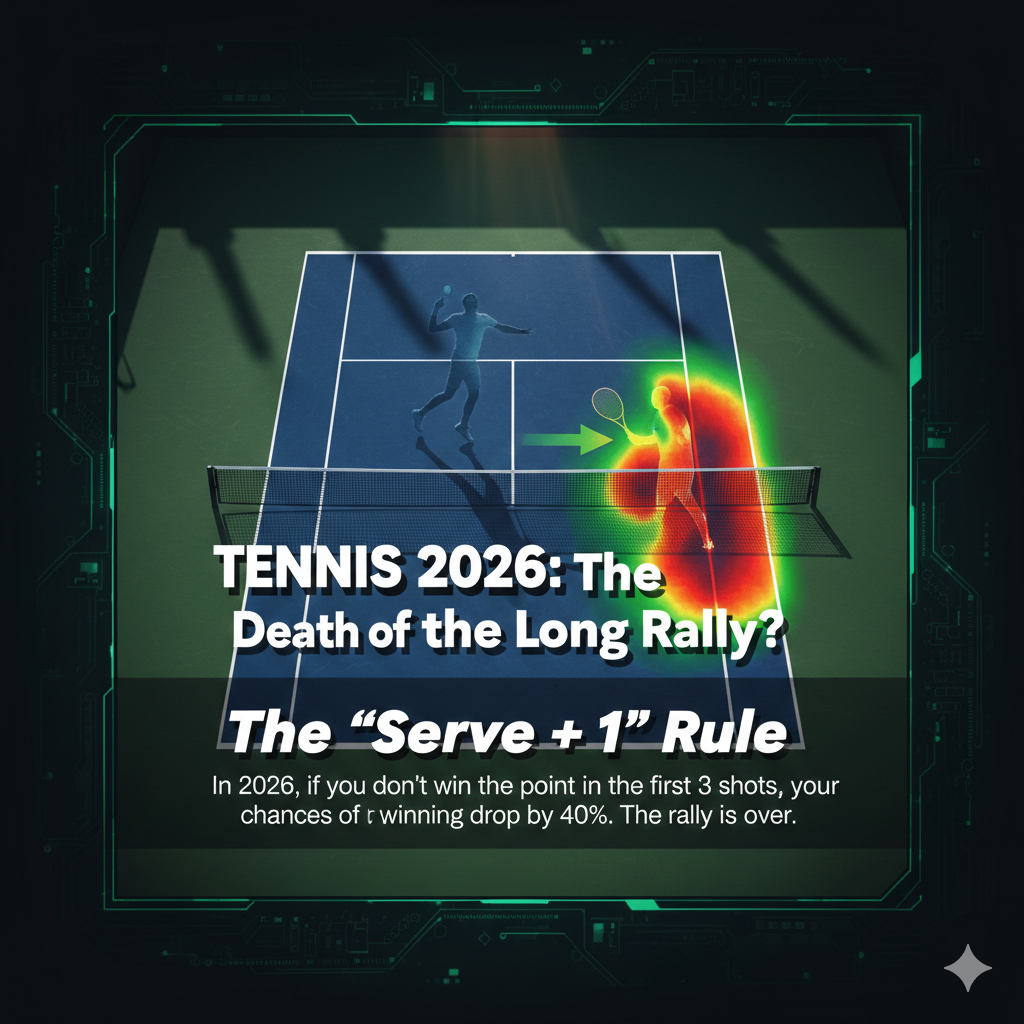
Data analytics from the last two seasons show a sharp decline in the win percentage of rallies extending beyond nine shots. The modern court is too fast, and the players are too explosive. The tennis tactics 2026 is the absolute optimization of the “Serve + 1” (the serve followed immediately by a forehand winner).
We are seeing players sacrifice serve speed for serve placement specifically to open up the forehand corner. The goal is no longer just an ace; it is to force a weak return to the middle of the court. Expect to see players in 2026 standing even wider on the deuce court to create extreme angles, turning the first two shots of a point into a scripted set piece rather than a reactive exchange.
2. The Death of the “Pure” Baselyner: The Vertical Game
For a decade, baseline grinding was the meta. You could win by simply outlasting your opponent from the back of the court. That strategy is becoming obsolete.
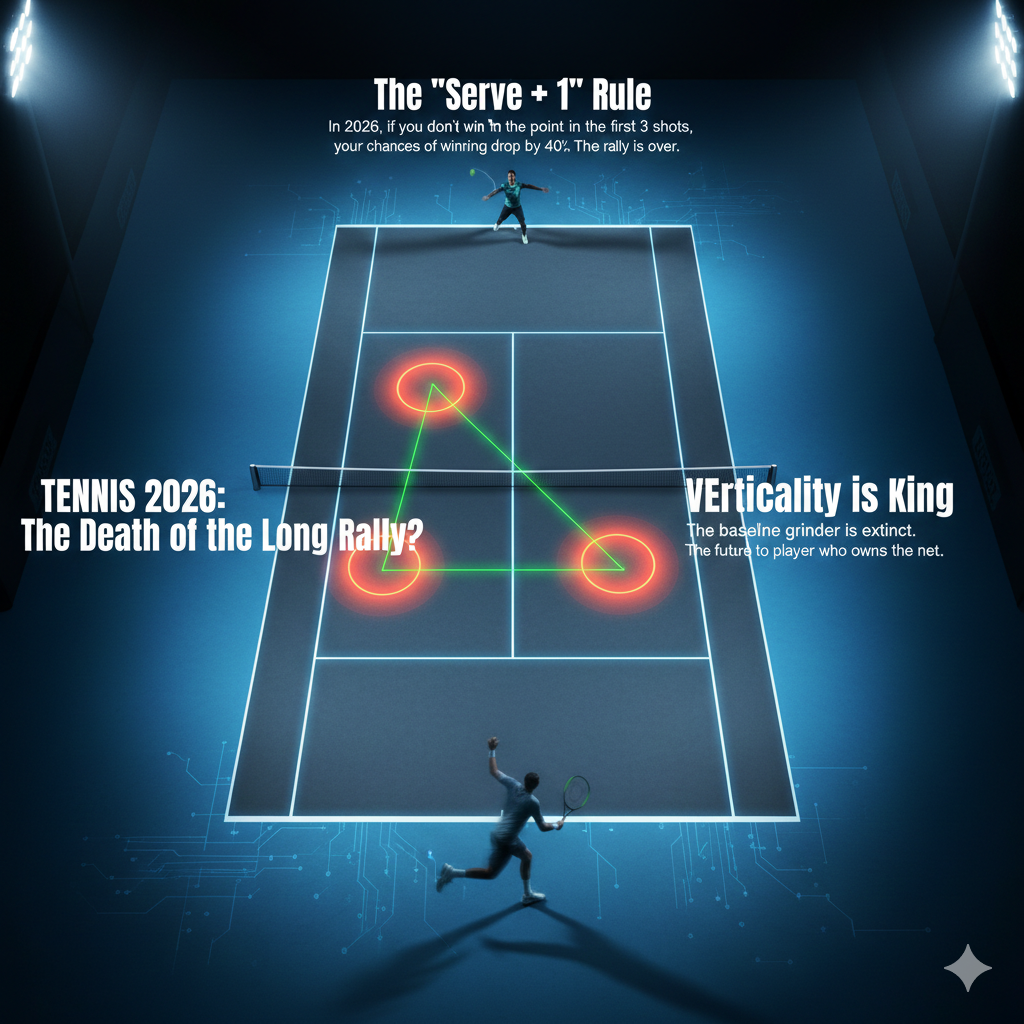
The 2026 tactic is “Verticality.” This doesn’t mean a return to 1990s serve-and-volley, but rather the ability to transition forward instantly. Players like Alcaraz have normalized the drop-shot not as a gimmick, but as a standard tactical tool to drag opponents off the baseline.
In 2026, we predict that “net approaches” will increase by 15-20% across the ATP and WTA tours. However, these aren’t chip-and-charge approaches; they are “power approaches.” Players are hitting heavy topspin deep into a corner and sprinting in behind it. If a player cannot finish points at the net in 2026, they will effectively be walled out by opponents who can cut off the angles.
3. The “Sabr” Return Goes Mainstream
Perhaps the most aggressive shift we will see is on the return of serve. Inspired by Roger Federer’s “Sneak Attack by Roger” (SABR) and evolved by the aggressive positioning of modern hard-court specialists, the 2026 return position is right on top of the baseline—or even inside it.
With serving speeds plateauing (human physiology has limits), the advantage shifts to the returner who can rob the server of time. We are moving away from the deep positions of Daniil Medvedev and toward a “block and punch” style. By taking the ball early, returners reduce the server’s recovery time, effectively turning the server’s speed against them.
The Role of AI in Real-Time Tactics
Finally, 2026 will be the year of Real-Time Data. Coaching from the box is now legal in most formats, and that coaching is becoming data-driven.
Tablets in the player box aren’t just for checking emails; they are generating heat maps in real-time. In Tennis Tactics 2026, a player will know by the third game of the first set that their opponent is serving 70% wide on break points. The mental “feeling” of the game is being replaced by cold, hard probability. The player who can interpret and trust this data mid-match will have a distinct edge over the “feel” player.
Conclusion of Tennis Tactics 2026
The tennis of 2026 will be faster, more vertical, and mathematically ruthless. The romantic era of long, grueling rallies is fading, replaced by a high-octane battle for positioning and first-strike dominance. For the aspiring pro or the dedicated fan, watching the feet—not the ball—will tell you everything you need to know about who is winning the tactical war.
Follow for more Tennis Updates: https://kharasportsdaily.com/category/tennis/
More About Tennis: https://www.tennis.com/
Share your thought in comments about the Tennis Tactics 2026
[…] Tennis Tactics 2026: 3 Tactical Shifts Defining the Future of the Game […]