
Football Tactics
Explained.
Decoding the Modern Game – Beyond the Formation.
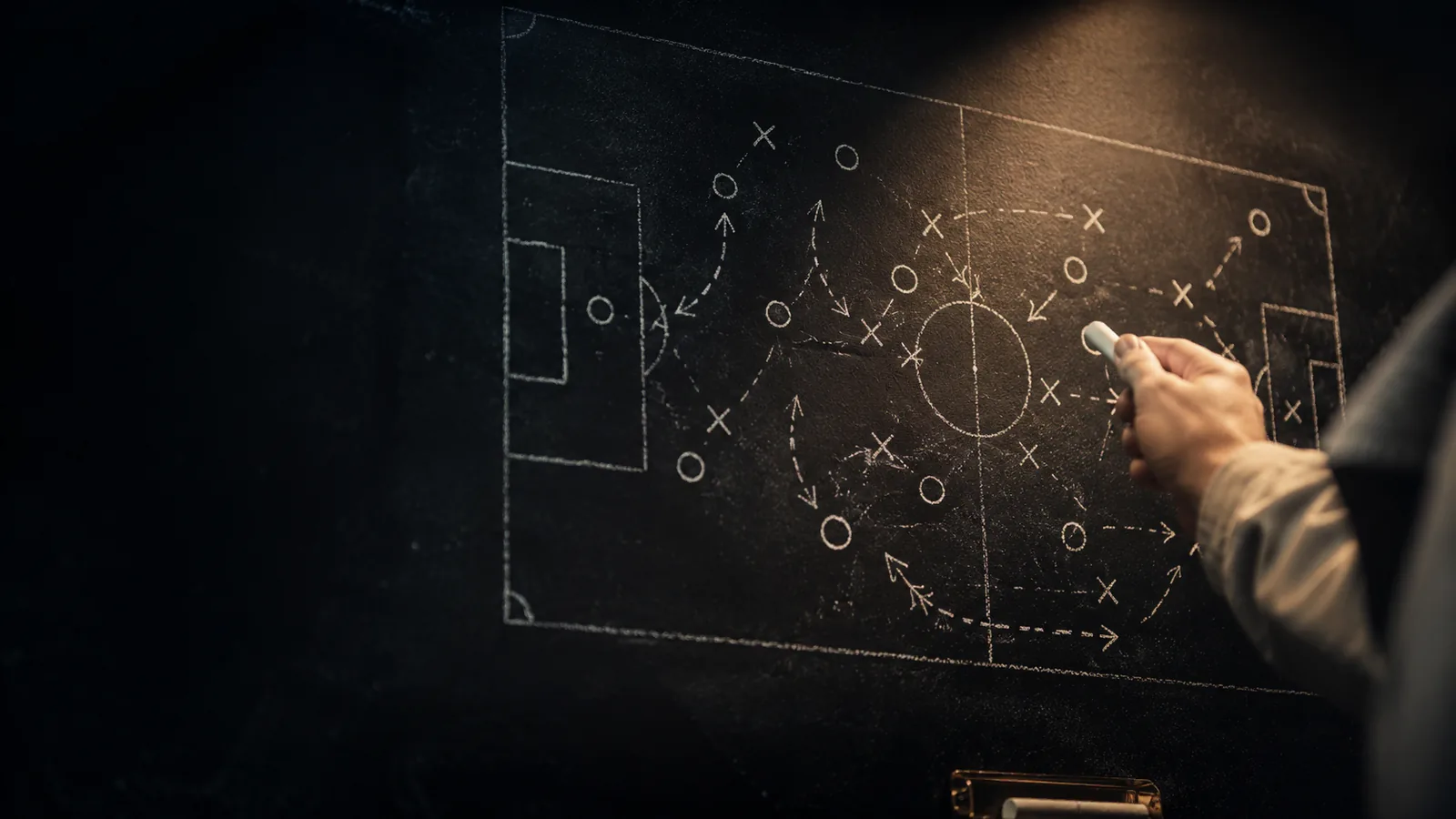
Football is no longer defined by rigid starting positions. It is defined by moments of transition and control. This framework breaks down the mechanics of how elite teams manipulate space, tempo, and probability – from the high press to the hybrid centre-back.
Defensive Control: The Art of Aggressive Patience
Why the Best Defense is Actually the First Phase of Attack.
In modern football, defending isn’t just about protecting your goal – it is about dictating where the opponent is allowed to play. Elite teams use Defensive Engagement Lines to set the terms of battle. Whether it’s a high-risk, high-reward press designed to force turnovers in the final third, or a disciplined Mid-Block that chokes the central channels, the objective is the same: to shepherd the opposition into dead zones. Here we analyse the pressing triggers and structural traps managers use to disrupt rhythm and win the ball back in dangerous areas.
Articles in this pillar
Build-Up & Progression: Engineering the Exit
How to Bait the Press and Break Lines with Precision.
The journey from the goalkeeper to the final third is a game of numbers and nerve. Effective build-up play is about inviting pressure to create space elsewhere. We examine how teams utilize structures like the 3-2-2-3 to create numerical superiority against a press. It’s not just about passing accuracy – it’s about positional play: understanding how Overloads on one flank can isolate a winger on the other, and how Line-Breaking Passes dismantle defensive shapes. Learn how the best teams turn their own penalty area into a launchpad for attacks.
Articles in this pillar
Modern Roles: The Death of Fixed Positions
Understanding the Hybrids – From Inverted Fullbacks to False Nines.
The days of a player staying in their lane are over. Contemporary tactics demand functional fluidity. We are seeing the rise of the Inverted Fullback, who abandons the touchline to become a central playmaker, and the Sweeper-Keeper, who acts as the eleventh outfield player in possession. This section explores how these hybrid roles disrupt marking schemes and create dilemmas for defenders – and how individual player profiles now dictate the system, not the other way around.
Articles in this pillar
Tactical Case Studies: The Blueprint in Action
Dissecting the Philosophies of the World’s Best Managers.
Theory is useless without execution. This is where we take the concepts and apply them to the chaotic reality of match day. By analysing specific systems – from Xabi Alonso’s fluid rotations at Leverkusen to the decade of control Pep Guardiola built at Manchester City – we provide proof of concept. These deep dives go beyond the highlights, using freeze-frame analysis to show how top managers solve problems in real time. Whether it’s breaking a low block or nullifying a counter-attack, these case studies bridge the gap between the tactics board and the pitch.
Articles in this pillar
Metrics, Models & Language: The Analyst’s Toolkit
Contextualising the Data Behind the Eye Test.
Data doesn’t replace the eye test – it sharpens it. We demystify the key metrics that front offices use to evaluate performance, from xG (Expected Goals) to PPDA (Passes Allowed Per Defensive Action). But we go further than definitions – we explain why they matter. Learn what Field Tilt tells you about dominance and what Post-Shot xG reveals about a goalkeeper’s true value. This section equips you with the vocabulary and the scepticism needed to interpret football data correctly.
Articles in this pillar
How Modern Football Tactics Actually Work
Modern football tactics are not a formation on a teamsheet; they are a set of rules for what a team does in each phase of the game. The five pillars above map the whole system, but they share one idea: every side is always trying to control space, time, and probability. Learn how those three levers move and the rest of the tactical language starts to click.
Coaches now think in phases rather than fixed slots. A team has a plan for when it has the ball – its build-up play and positional structure – and a different plan for the moment it loses possession, whether that is an instant counter-press or a retreat into a compact mid-block. The best teams rehearse every phase until it looks automatic.
This is also why player roles have splintered. A full-back who steps inside to become a midfielder (the inverted full-back) or a goalkeeper who acts as a spare defender (the sweeper-keeper) only makes sense once you see the team as a moving structure rather than eleven fixed jobs. Klopp’s Liverpool 2.0 rebuild is the clearest case study of an entire system being redesigned around one of those roles. Read the pillars above as five lenses on the same machine, not five separate topics.
The Four Phases of Play
Every tactical decision belongs to one of four moments. This is the simplest framework for reading any match:
- In possession – building from the back and progressing the ball, from line-breaking passes to overloads that isolate a defender.
- Out of possession – the defensive shape, whether that is a high press, a compact mid-block, or a deep low block.
- Attacking transition – the seconds after winning the ball, when space is at its most exploitable.
- Defending transition – the moment after losing it, when counter-pressing or a rest-defense structure decides whether you concede.
From the Eye Test to the Data
Numbers have not replaced watching football; they give us a shared vocabulary for what we already see. Metrics like expected goals (xG) measure chance quality, PPDA gauges pressing intensity, and field tilt captures territorial dominance. Used well, they sharpen the eye test instead of overruling it.
For definitions in plain English, start with the tactical glossary; to go deeper, the reading list collects the books behind this framework. For wider context, see how a formation is only ever a starting shape, and how expected goals became football’s most-cited metric.
The Evolution of Football Tactics: From Catenaccio to Relationism
Every “new” idea in football tactics is an answer to the idea before it. Catenaccio’s man-marking and sweeper gave way to Total Football’s positional fluidity; the pressing revolution of Sacchi and later the gegenpressing school turned defending into the first act of attack; Guardiola’s positional play made the pitch a grid of zones to be occupied. The current frontier is the debate between that structured approach and relationism – systems built on player relationships rather than fixed zones – alongside revivals of old ideas in new clothes, like Bielsa’s man-marking or the slow extinction of the classic number 10. Understanding the lineage is what stops tactical analysis from becoming buzzword bingo: nothing on this page is new, only newly recombined.
Football Tactics: Frequently Asked Questions
What are the basic tactics in football?
Football tactics break down into four phases: what a team does in possession, out of possession, and in the two transition moments when the ball changes hands. Within those phases sit the familiar ideas of pressing, building from the back, defensive blocks, and attacking patterns. Everything else is detail layered on top of that frame.
What is the best formation in football?
There is no single best formation, because a formation is only a starting shape that morphs the moment the ball moves. A 4-3-3 can defend as a 4-4-2 and attack as a 3-2-5, so the principles a team plays by matter far more than the numbers on paper. Judge a system by how it controls space and manufactures high-quality chances.
How are modern football tactics different from the past?
The biggest shift is from fixed positions to fluid roles, where players such as the inverted full-back or sweeper-keeper change job depending on the phase. Modern sides also defend more proactively, using the press to win the ball high rather than only sitting deep. Data has added a shared language for measuring all of it.
What are the four phases of play?
The four phases are in possession, out of possession, attacking transition, and defending transition. Each phase has its own objectives and rehearsed patterns, and elite teams move between them seamlessly. Spotting which phase a match is in at any moment is the fastest way to read the tactics on show.
Learn how to read a football match
The framework behind everything on this site, in one 40-page pack: the four phases, a 15-minute method for diagnosing both teams, a printable match-watching worksheet, and all 51 glossary terms connected.
Get the pack$9, instant downloadCan you read a match?
Six real in-game situations, one tactical read each. See how sharp your eye is, and get the full breakdown after every answer.
Take the test