
Introduction
If you have been watching the evolution of the Premier League over the last five years, you have likely noticed a shift in the geometry of the pitch. Gone are the days when a flat 4-4-2 or a rigid 4-3-3 was the pinnacle of tactical setups. Today, the elite teams—the ones lifting the heavy silverware—are winning games by dominating the center of the park with a shape that looks peculiar on paper but is devastating on grass. I am talking, of course, about the box midfield tactics.
As someone who has spent decades on the touchline, I have seen trends come and go. I remember the rise of the Makélélé role and the dominance of the Spanish tiki-taka. But the box midfield tactics we see today, deployed by masterminds like Pep Guardiola and Mikel Arteta, represent a specific evolution in Build-Up & Progression. It is not just about keeping the ball; it is about creating a “box” of four players in the center to suffocate the opponent’s three-man midfield.
In this deep dive, we are going to strip away the complex jargon and look at the engine under the hood. We will explore how the 3-2-2-3 shape creates numerical superiority, which players you need to pull it off, and why this might just be the most difficult system to defend against in modern football history.
Key Takeaways
- Numerical Superiority: Box midfield tactics create a 4v3 overload in the central areas, forcing opponents to make impossible choices.
- The “Inverter”: The system relies on a defender (fullback or center-back) stepping up to become a second pivot.
- Vertical Passing: The “box” offers diagonal passing lanes that are harder to intercept than straight vertical passes.
- Rest Defense: The 3-2 base structure provides immediate security against counter-attacks.
- Evolution: This is the modern successor to the W-M formation of the 1930s.
Enjoying the analysis?
Don’t Just Watch Football. Understand It.
Join KharaSportsDaily and receive occasional deep tactical insights most fans miss.
Occasional analysis. No match reports. No noise.
Table of Contents
What is the Box Midfield (3-2-2-3)?
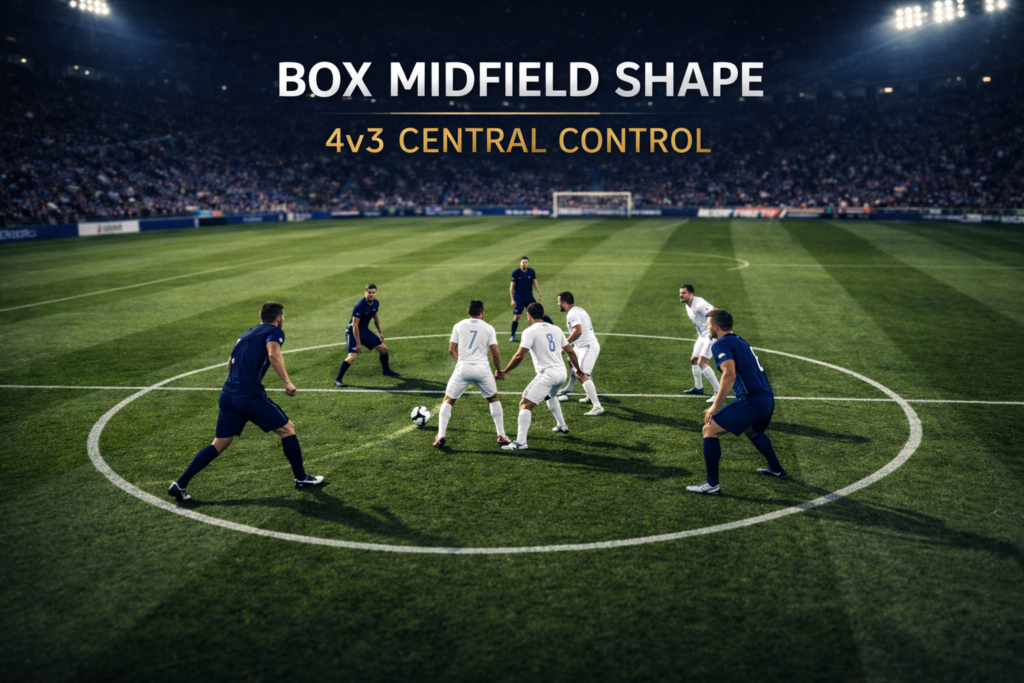
To understand box midfield tactics, you have to stop looking at formations as static telephone numbers (4-4-2, 4-3-3) and start viewing them as fluid shapes in possession.
The “Box” refers to the shape formed in the center of the pitch during the build-up phase. Traditionally, a team might play with a single pivot (a lone defensive midfielder) and two #8s ahead of him (a triangle). In the 3-2-2-3, the team restructures to have two defensive midfielders sitting deep and two attacking midfielders (#10s) floating high in the half-spaces.
The Structure
- The Base (3): Three defenders spread across the backline to circulate the ball.
- The Bottom of the Box (2): Two pivots acting as the link. Usually, one is a natural midfielder (like Rodri) and one is a converted defender.
- The Top of the Box (2): Two advanced playmakers (like De Bruyne and Foden) positioning themselves behind the opponent’s midfield line.
- The Front (3): High wingers stretching the pitch wide and a striker pinning the center-backs.
When you connect the two pivots with the two attacking midfielders, you get a square—or a “box.” This structure is the heart of modern box midfield tactics.
Pro Coach Tip: The goal isn’t just to make a shape. The goal is to occupy the “half-spaces”—those vertical corridors between the wing and the center. The top two corners of your box should live in those pockets.
The Geometry of Control: Why It Works

Why go through the trouble of moving a defender into midfield? Why not just start with four midfielders? The answer lies in the concept of Overloads & Isolations.
Most teams defend in a 4-4-2 or a 4-3-3/4-1-4-1. In these setups, the defending team usually has three players patrolling the central zone.
The 4 vs. 3 Overload
By utilizing box midfield tactics, the attacking team places four bodies in that central zone.
- If the opponent’s midfielders press the “bottom” of your box (your pivots), the “top” of the box (your #10s) becomes free to receive the ball behind them.
- If the opponent’s midfielders drop deep to mark your #10s, your pivots are free to drive the ball forward unopposed.
- The Result: The defending team is permanently outnumbered in the most dangerous area of the pitch.
Diagonal Supremacy
In my thirty years of watching tape, I have learned one thing: diagonal passes are the hardest to defend. Straight vertical passes are easily blocked by a defender standing in the way. Lateral passes don’t gain ground.
The box midfield tactics naturally create diagonal passing lanes.
- Center Back to Pivot: Diagonal forward.
- Pivot to Attacking Midfielder: Diagonal forward.
- Attacking Midfielder to Winger/Striker: Diagonal through-ball.
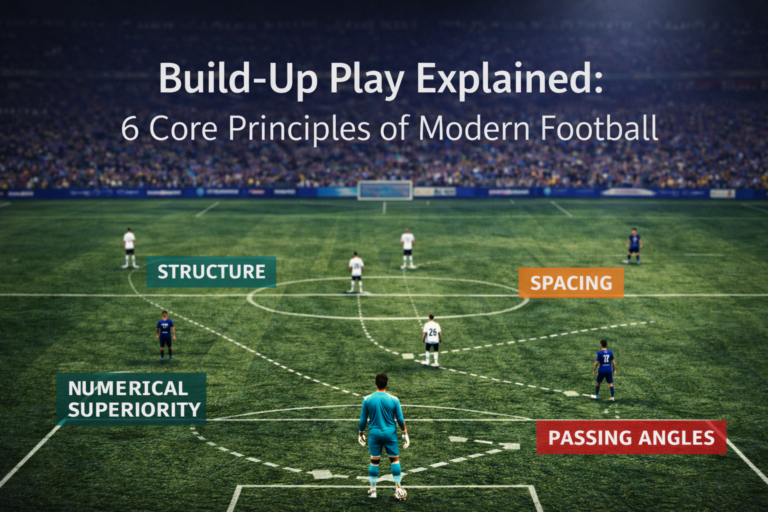
This constant triangulation means the ball moves faster than the defenders can shift their hips. This geometric advantage is a core component of Build-Up Play Explained in our tactical blueprint.
The Pivot Player: Inverted Fullbacks vs. Stepping Center-Backs
You cannot execute box midfield tactics without the right personnel. Specifically, you need a player in the defensive line who is comfortable stepping into the chaos of midfield. This is where we see the two main variations of the system.

Variation A: The Inverted Fullback
This was the primary method used by Arsenal (with Zinchenko) and early-phase Guardiola (with Delph or Cancelo). When the team has the ball, the Left Back or Right Back leaves the sideline and tucks inside next to the defensive midfielder.
- Pros: Allows you to keep natural center-backs in defense who are strong in the air.
- Cons: Requires a fullback with elite technical passing ability.
- Learn more about this specific role in our guide to Inverted Fullbacks Explained.
Variation B: The Stepping Center-Back (The Stones Role)
This is the evolution we saw in Manchester City’s treble-winning season. Instead of a fullback, a central defender (John Stones) steps up into midfield alongside the pivot (Rodri).
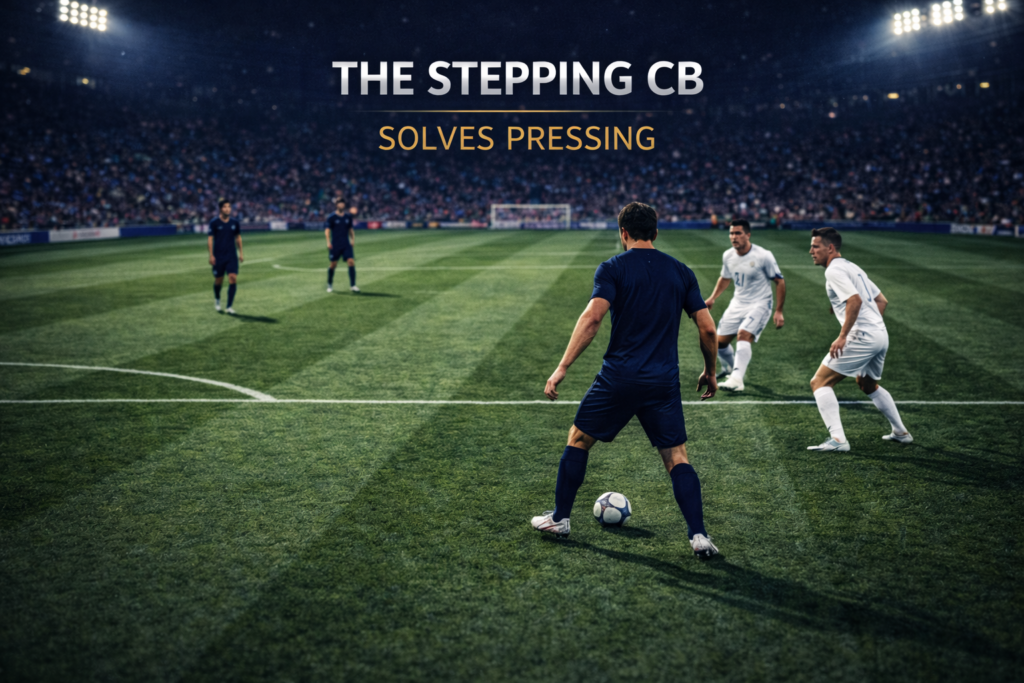
- Pros: Much more solid defensively against counters. When the ball is lost, the player simply drops back into the defensive line.
- Cons: Requires a “unicorn” player—a center-back with the hips and vision of a #10.
Implementing box midfield tactics requires you to identify which of your defenders has the composure to play 360-degree football. If they panic under pressure, the box collapses.
Real-World Case Study: Man City & Arsenal
To truly grasp box midfield tactics, we must look at the masters. Both Guardiola and Arteta have utilized this, but with subtle differences that highlight the flexibility of the 3-2-2-3.
Manchester City (The 3-2-2-3 Juggernaut)
Pep Guardiola used this to dismantle Europe.
- The Personnel: A back three of Ake, Dias, and Akanji. John Stones (CB) steps up next to Rodri.
- The Effect: With Stones and Rodri controlling the base, De Bruyne and Gundogan (or Alvarez) occupied the “pockets” at the top of the box.
- The Outcome: This forced opponents to tuck inside to stop the overload. The moment they tucked in, the ball was pinged wide to Grealish or Silva, who were isolated 1v1. This is a classic example of Pep Guardiola’s Final Third Mechanics.
Arsenal (The Zinchenko Influence)
Arsenal’s resurgence was built on box midfield tactics initiated from the flank.
- The Personnel: Ben White tucks in to form a back three, while Zinchenko (LB) inverts to join Partey/Rice.
- The Effect: Zinchenko’s ability to receive the ball under pressure allowed Arsenal to dominate possession stats against almost everyone.
- External Insight: For a visual breakdown of how Arsenal rotates into this shape, reputable sources like The Athletic or Tifo Football provide excellent heatmaps showing Zinchenko’s central positioning compared to a traditional fullback.
Both teams prove that box midfield tactics are not just defensive possession strategies; they are offensive weapons designed to unbalance low blocks.
Comparison: Standard 4-3-3 vs. Box Midfield (3-2-2-3)
Let’s look at the data. Why switch? Here is a comparison of how the box midfield tactics stack up against the traditional 4-3-3.
| Feature | Standard 4-3-3 | Box Midfield (3-2-2-3) |
| Midfield Shape | Triangle (1 Pivot, 2 Eights) | Square/Box (2 Pivots, 2 Tens) |
| Central Players | 3 Players | 4 Players |
| Width | Provided by Fullbacks & Wingers | Provided strictly by Wingers |
| Rest Defense | 2 Center Backs + 1 Pivot (2+1) | 3 Center Backs + 2 Pivots (3+2) |
| Passing Angles | Vertical and Lateral | Heavy Diagonal Bias |
| Risk | Counter-attacks in wide areas behind fullbacks | Counter-attacks if the pivot loses the ball |
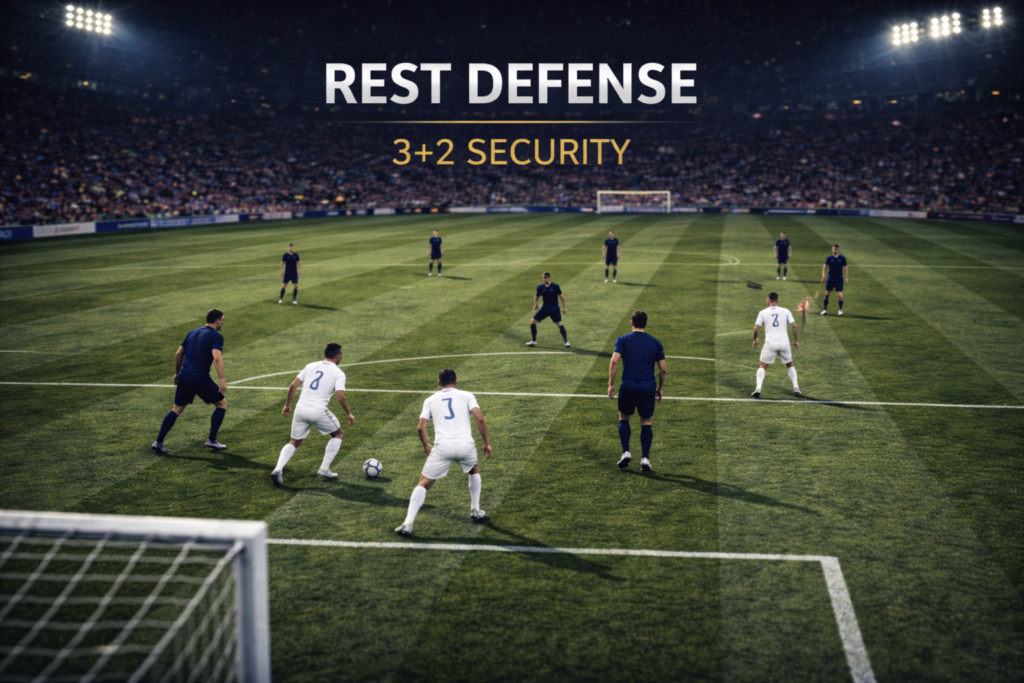
As you can see, the box midfield tactics offer a robust 3+2 structure in “Rest Defense” (defense while attacking). This allows the team to press immediately upon losing the ball, a concept we cover in Counter-Pressing Explained.
How to Coach the Box Midfield
Implementing box midfield tactics at the grassroots or semi-pro level is challenging but rewarding. You cannot just tell players to “form a box.” You have to coach the triggers.
Drill 1: The Rondo Box (4v2 + 2)
Set up a literal box grid. Place two pivots on the bottom line, two #10s on the top line. Place two defenders inside the box.
- Objective: The pivots must find a pass to the #10s. The #10s must drop into “pockets” to receive.
- Coaching Point: Focus on body shape. The pivots must receive on the “back foot” to open up the field.
Drill 2: The Shadow Play
Walk through the transition from defense to attack without opposition.
- Trigger: Goalkeeper rolls the ball to the center-back.
- Action: As the CB touches the ball, the “Inverter” (Fullback or CB) must sprint into the pivot zone. The wingers must hug the touchline immediately to create space for the box.
- Keyword Repetition: Reinforce box midfield tactics terminology. Call out “Form the Box!” or “Find the Pocket!”
This system requires high technical fidelity. If your “Inverter” cannot turn with the ball, you are better off sticking to a standard back four. But if you have the players, box midfield tactics will elevate your game.
Final Thoughts
The box midfield tactics (3-2-2-3) are not a fad. They are the logical conclusion of a game that is becoming increasingly obsessed with space and control. By turning the midfield battle from a 3v3 into a 4v3, teams like City and Arsenal have “solved” the problem of the low block.
For coaches and tactical enthusiasts, the lesson is clear: Football is no longer played in straight lines. It is played in angles, pockets, and boxes. If you can master the geometry of the box midfield tactics, you control the engine room. And as the old saying goes—if you control the midfield, you control the game.
Ready to see how to break down a defense once you have established this control? Your next step is to understand how to manipulate the opposition’s defensive line. Read our upcoming guide on Overloads & Isolations Explained.
Enjoyed this breakdown?
Don’t Just Watch Football. Understand It.
Join KharaSportsDaily and receive occasional deep tactical insights most fans miss.
Occasional analysis. No match reports. No noise.
Frequently Asked Questions (FAQ)
Q: Are box midfield tactics only for elite teams?
A: While difficult, amateur teams can use simplified versions. If you have one very smart defender and intelligent midfielders, you can implement the basic 3-2 build-up shape to help escape pressing.
Q: What is the weakness of the 3-2-2-3?
A: The wide areas during transition. Since the fullbacks are often tucked in or part of the back three, a rapid switch of play to the opponent’s winger can expose the space on the flanks.
Q: How does this relate to xG?
A: By dominating the center, teams using box midfield tactics often generate higher quality chances rather than high volume, low-quality shots. This improves their What Is xG? Metrics & Models efficiency.
Q: Can you play this with a Target Man?
A: Yes. Erling Haaland is a classic target man. The box midfield supplies the through balls; the target man finishes them. See our article on False 9 vs Target Man for more on striker roles.
About the Author
Football Tactician & Analyst. breaking down elite systems for coaches and fans.