
Introduction: The End of the Consensus
For the last fifteen years, elite football spoke one language: Juego de Posición.
Half-spaces, Zone 14, the five lanes. If you coached at a high level and didn’t speak Positionism, you were already behind. Pep Guardiola built the template, and everyone else spent a decade trying to copy it.
But football always finds a way to break its own rules. Just as we thought the “Meta” was solved, a counter-culture emerged – or rather, re-emerged – from the streets of South America and the pragmatic dugouts of Italy.
This is Relationism vs. Positionism. It is not just a debate about formations; it is a philosophical war regarding how the game should be played. On one side, you have the geometry of space (Positionism). On the other, you have the intuition of time and connection (Relationism).
To understand where football is going next, you must first understand this divide. You need to know why Fernando Diniz allows six players on one wing, and why Mikel Arteta threatens to bench a winger for drifting two yards out of his zone.
Key Takeaways
- The Core Conflict: Positionism treats the pitch as a grid where space is king; Relationism treats the pitch as a canvas where player connection is king.
- The “Wait” vs. The “Gather”: Positional players wait in zones for the ball; Relationist players travel to the ball to create overloads.
- Structure vs. Emergence: Guardiola’s City relies on pre-determined geometry, while Diniz’s Fluminense relied on spontaneous, emergent play.
- Defensive Implications: Positionism creates a natural “Rest Defense” structure; Relationism risks massive transitions if the immediate counter-press fails.
Enjoying the analysis?
Don’t Just Watch Football. Understand It.
Join KharaSportsDaily and receive occasional deep tactical insights most fans miss.
Occasional analysis. No match reports. No noise.
Table of Contents
The Rigid Grid: Understanding Positionism
Positionism, or Positional Play, is likely what you are most familiar with. It is the dominant ideology of European football. Think of Manchester City, Arsenal, or Arne Slot’s Liverpool.
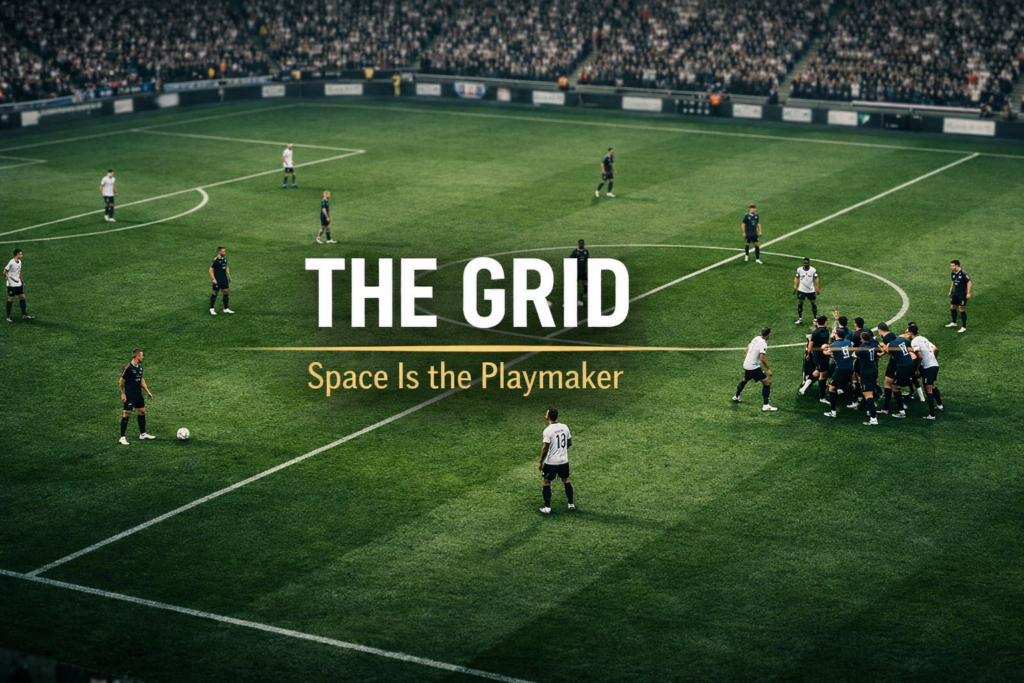
At its heart, Positionism is about rational space occupation. The pitch is divided into zones, and players are assigned specific tasks within those zones to stretch the opponent. The objective is to make the pitch as big as possible when attacking.
The Golden Rule: “Don’t Move to the Ball”
In a strict positional system, players are discouraged from moving toward the ball carrier unless it is to receive a pass in a superior position.
- If the ball is on the left wing, the right winger stays wide on the touchline.
- Why? To pin the opposition fullback and keep the defensive shape stretched.
If that right winger drifts inside to “help,” he actually hurts the team. He brings his defender with him, clogging the space and destroying the team’s structure. In Positionism, you trust the system. You wait. You trust that if you hold your width, the ball will eventually switch to you, and you will have a 1v1 isolation.
The Structure is the Playmaker
We often talk about Kevin De Bruyne or Martin Ødegaard as playmakers, but in Positionism, the structure itself is the primary playmaker. The players are simply interchangeable parts (albeit high-quality ones) that execute the function of the grid. This is why City can swap players so seamlessly; the role remains constant even if the personnel changes.
The Chaos of Connection: Defining Relationism

If Positionism is classical music – scripted, precise, and conducted – Relationism is jazz. It is improvised, chaotic to the untrained eye, and relies entirely on the chemistry between the performers.
Relationism (often called “Functional Play” or Apoio in Brazil) rejects the idea that players should be spread evenly across the pitch. Instead, it argues that players should be where the ball is.
The “Escadinha” (The Ladder)
In a Relationist system, you will see something that would give a positional coach a heart attack: four, five, or even six players clustered in a 20-yard radius on one side of the pitch.
This is not a mistake. It is a strategy. They are forming an escadinha – a diagonal ladder of passing options. They play short, rapid passes (toco y me voy – touch and go) to draw the entire opposition defense toward them.
Tilting the Pitch
While Positionism tries to stretch the opponent, Relationism tries to tilt them. By overloading one side so heavily, they force the defense to over-commit. If the defense doesn’t shift, the Relationist team passes through them with superior numbers. If the defense does shift, they might switch play, but usually, they prefer to break through the density using sheer technical skill and proximity.
Think of Carlo Ancelotti’s Real Madrid. They often lack a rigid structure. You see Vinícius Jr., Rodrygo, and Bellingham all drifting to the left wing, combining, dribbling, and playing off each other’s intuition. That is Relationism in elite European practice.
How They Actually Differ
To truly grasp the difference, we must look at the mechanics side-by-side. This is not about which is “better”—it is about what you sacrifice to gain control.
| Feature | Positionism (Guardiola/Arteta) | Relationism (Diniz/Ancelotti) |
| Primary Reference | Space (The Zones) | The Ball & Teammates |
| Player Positioning | Rational, equidistant spacing. | Approximating, clustering around the ball. |
| Width | Permanent maximal width (touchline). | Variable width (often narrow). |
| Tempo | Controlled, rhythmic circulation. | Explosive, erratic, rapid combinations. |
| Defensive Transition | Structured Rest Defense (2-3 or 3-2). | Immediate, chaotic counter-pressing pack. |
| The “Playmaker” | The System / The Structure. | The Connection between players. |
| Key Phrase | “Pass to the next zone.” | “Pass and move (Toco y me voy).” |
Case Study: The Fluminense Experiment vs. The City Machine
The 2023 Club World Cup Final gave us the perfect laboratory: Fernando Diniz’s Fluminense vs. Pep Guardiola’s Manchester City. It was the ultimate clash of ideologies.
Fluminense’s Extreme Relationism
Diniz took Relationism to its absolute limit. In the build-up, you would see Marcelo (the left back) playing as a right midfielder. You saw Ganso dropping between the center-backs. At times, Fluminense had seven players in a 15-meter box, playing one-touch passes against City’s press.
When it worked, it was mesmerizing. They broke City’s first line of pressure not by switching play, but by passing through the pressure cooker. It required immense bravery and technical arrogance.
City’s Ruthless Positionism
However, the match also exposed the fatal flaw of Relationism: Rest Defense.
Because Fluminense committed so many bodies to the ball side, the far side was completely abandoned. When City won the ball, a simple switch of play or a drive into open space was lethal. Positionism provides safety; the grid ensures that if you lose the ball, players are already spread out to cover the counter-attack. Relationism requires you to win the ball back immediately upon losing it, or you are wide open.
City won 4-0. The structural superiority of Positionism, combined with elite talent, dismantled the romantic chaos of Relationism. But the scoreline hid the fact that for 20 minutes, Diniz’s side made the best team in the world uncomfortable by refusing to follow the “rules” of space.
The Hybrid Future: Can They Coexist?
We are now entering a phase I call “The Hybrid Era.” The strict dogmas are fading. Elite coaches are realizing that pure Positionism is becoming predictable, while pure Relationism is too risky.
The Arsenal Evolution
Look at Mikel Arteta’s Arsenal. They are fundamentally Positional. However, observe Ødegaard, Saka, and Ben White on the right side. They frequently rotate, overlap, and underlap in tight proximity – a “Relationist” cluster within a “Positional” framework. They create a mini-overload on the right to disrupt the defensive block, while the rest of the team maintains the grid.
Bayer Leverkusen under Xabi Alonso
Alonso is another hybrid. His 3-4-2-1 looks rigid on paper, but watch Wirtz and Hofmann. They are “dual 10s” who play very close to each other. They approximate to combine, acting like street footballers in the final third, but they press and defend with Positional discipline.
The future of tactics is not choosing one side. It is about knowing when to use the Grid and when to unleash the Jazz. The best teams of the next decade will use Positionism to get the ball to the final third, and Relationism to break down the low block once they arrive.
Final Thoughts
The battle between Relationism and Positionism is healthy for the game. We spent too long believing there was only one way to play football. The resurgence of Relationism forces defenders to think differently – they can no longer just guard a zone; they have to track runners who refuse to stay still.
For you as a coach or analyst, the lesson is not to pick a tribe. It is to recognize the tools. If your team is struggling to break down a low block, maybe your wingers are holding their width too well. Maybe they need to come inside, approximate, and play a little jazz.
The best coaches aren’t picking a side anymore. They’re deciding which tool fits the moment – and that’s a harder problem than it sounds.
Enjoyed this breakdown?
Don’t Just Watch Football. Understand It.
Join KharaSportsDaily and receive occasional deep tactical insights most fans miss.
Occasional analysis. No match reports. No noise.
Frequently Asked Questions (FAQs)
Is Relationism just “schoolboy football” chasing the ball?
No. While it looks chaotic, it requires incredibly high technical skill and non-verbal communication. “Schoolboy” football is chasing the ball without purpose. Relationism is moving to the ball to create numerical superiority (4v3, 3v2) to bypass defenders. It is organized chaos.
Can you play Relationism with average players?
It is very difficult. Positionism protects average players because the system tells them exactly where to stand and pass. Relationism exposes players; if they cannot handle the ball under pressure in tight spaces, the system collapses. It demands high technical proficiency.
Why is Positionism more popular in Europe?
It is easier to coach and scale. You can teach a player a “role” in a grid much faster than you can teach them to build intuitive chemistry with ten other teammates. Positionism minimizes risk and variance, which is what big clubs with big budgets prefer.
About the Author
Football Tactician & Analyst. breaking down elite systems for coaches and fans.