
Introduction
Set-piece tactics are one of the most controlled phases in football. Unlike open play, dead-ball situations remove randomness and allow teams to pre-plan movements, spacing, and decision-making. Corners, free kicks, and throw-ins may appear secondary compared to pressing or build-up play, but at elite levels they often decide tight matches.
Modern football increasingly treats set-pieces as a distinct tactical phase, not a bonus opportunity. Teams design repeatable routines, rehearse movements, and assign specialist roles. The objective is not improvisation, but reliable advantage creation.
At a structural level, set-piece tactics connect directly to broader tactical ideas such as positional play, blocking, overloads, and second-ball control. Understanding these patterns explains why certain teams consistently score or defend better from dead balls, regardless of personnel changes.
Many coaches treat set-pieces as a separate game, but the best teams view them as part of their overall dominance. Whether it is a corner kick or a throw-in, the principles of creating space remain the same. For a breakdown of how set-piece tactics fit into the wider tactical picture, refer to our comprehensive Ultimate Guide to Football Tactics
Table of Contents
Set-Pieces as a Tactical Phase
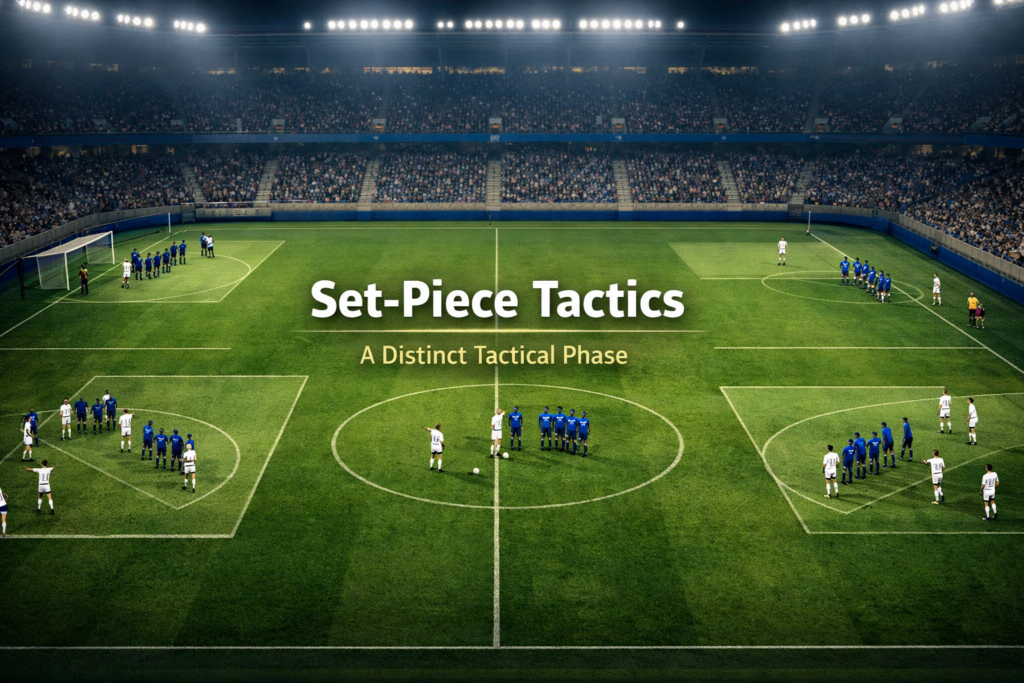
Set-pieces are unique because they freeze the game state. Both teams know where the ball will be delivered from, the defensive line is set, and off-ball movement becomes the primary advantage mechanism.
Key characteristics of set-piece phases:
- Fixed starting positions
- Predictable defensive reference points
- High value of timing and coordination
- Emphasis on blocking, screening, and spacing
Rather than reacting to opponents, attacking teams dictate sequences. Defending teams respond by choosing between zonal coverage, man-marking, or hybrid systems.
Crucially, set-piece success is rarely about creativity. It is about precision, repetition, and clarity of roles.
Corner Kick Tactics Explained
Corner kicks remain the most productive set-piece in football due to proximity to goal and repeatability. Attacking teams aim to disrupt defensive organization through movement, blocking, and targeted delivery zones.
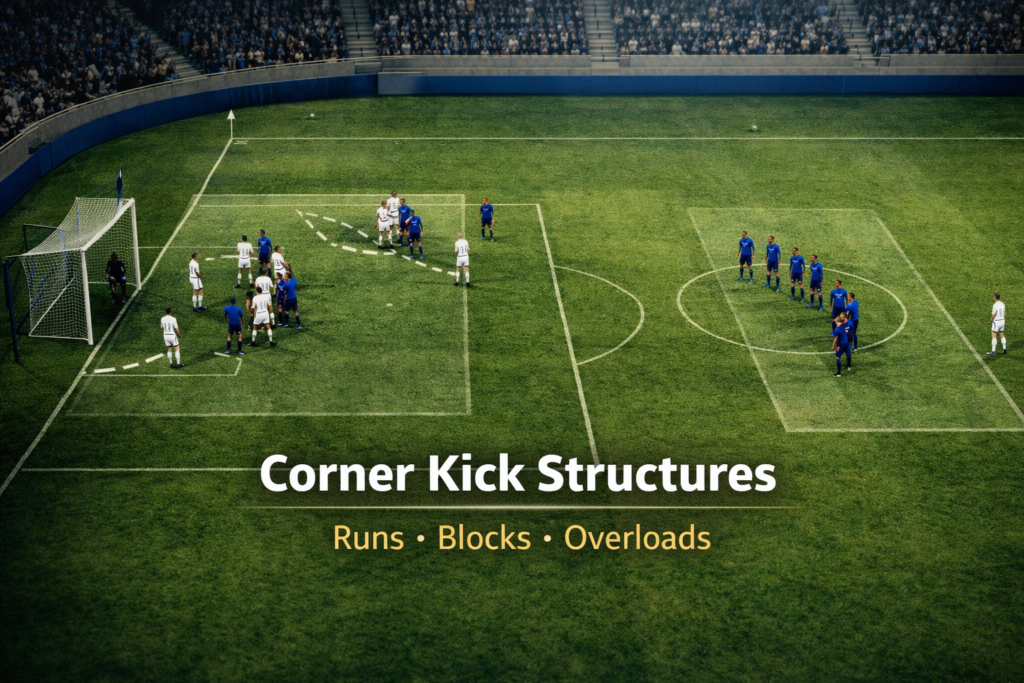
Attacking Corner Structures
Most corner routines fall into three structural categories:
| Corner Type | Tactical Objective | Key Movement |
|---|---|---|
| Near-post routines | Redirect ball before defensive reaction | Aggressive first run |
| Far-post overloads | Isolate weaker defender | Late-arriving runners |
| Central blocks | Free primary header | Screens and decoys |
Blocking is legal when performed as positional occupation rather than overt obstruction. Well-coached teams use passive blocks to delay defenders just enough to create separation.
Second balls are equally important. Many goals originate not from the initial header, but from loose clearances attacked by edge-of-box players.
Enjoying the analysis?
Don’t Just Watch Football. Understand It.
Join KharaSportsDaily and receive occasional deep tactical insights most fans miss.
Occasional analysis. No match reports. No noise.
Defensive Corner Organization
Defending corners is primarily about space control rather than individual duels.
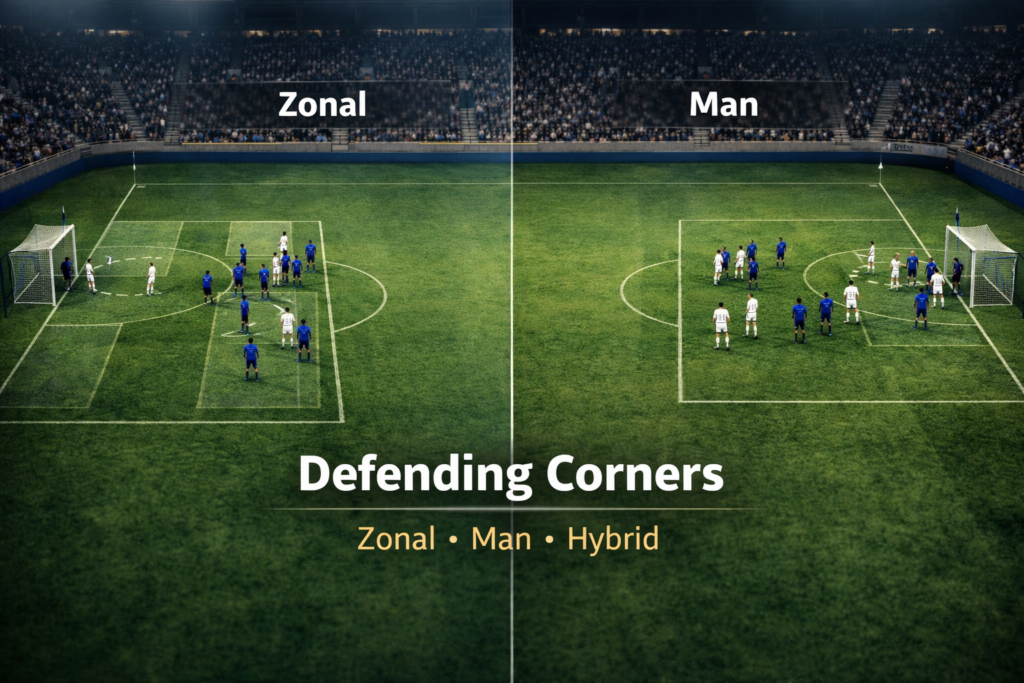
Zonal vs Man-Marking
| Defensive System | Strength | Weakness |
|---|---|---|
| Zonal marking | Protects key zones | Vulnerable to late runs |
| Man-marking | Tracks movement | Susceptible to blocks |
| Hybrid | Balance of both | Requires coordination |
Most teams now use hybrid systems, placing zonal defenders in central zones while assigning man-markers to primary aerial threats.
Defensive structure must also account for:
- Near-post protection
- Goalkeeper access to crossing lanes
- Second-ball positioning outside the box
Defending a corner kick requires the same discipline as defending in open play. The principles of compactness and space protection used here are identical to those found in a structured Low Block Defense Explained, where the priority is protecting the central channel at all costs.
Free Kick Set-Plays
Free kicks differ from corners because delivery angles and distances vary significantly. Teams divide them into direct and indirect scenarios.
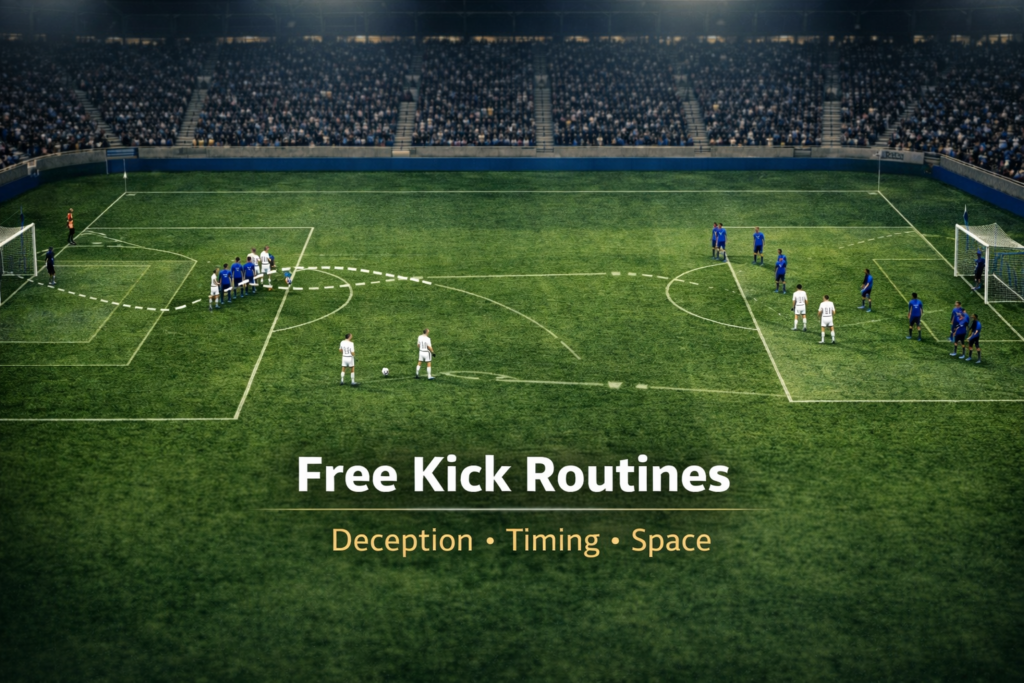
Indirect Free Kick Patterns
Indirect free kicks prioritize deception over power. Common patterns include:
- Decoy runners pulling defenders away
- Delayed passes to reset defensive shape
- Cut-back deliveries instead of aerial balls
Wall manipulation is a major focus. Teams design movements to block goalkeeper sightlines or force defenders to step out early, opening passing lanes.
Defending Free Kicks
Defensive free-kick organization emphasizes compactness and communication. Unlike corners, defenders must manage both the wall and open-play runners simultaneously.
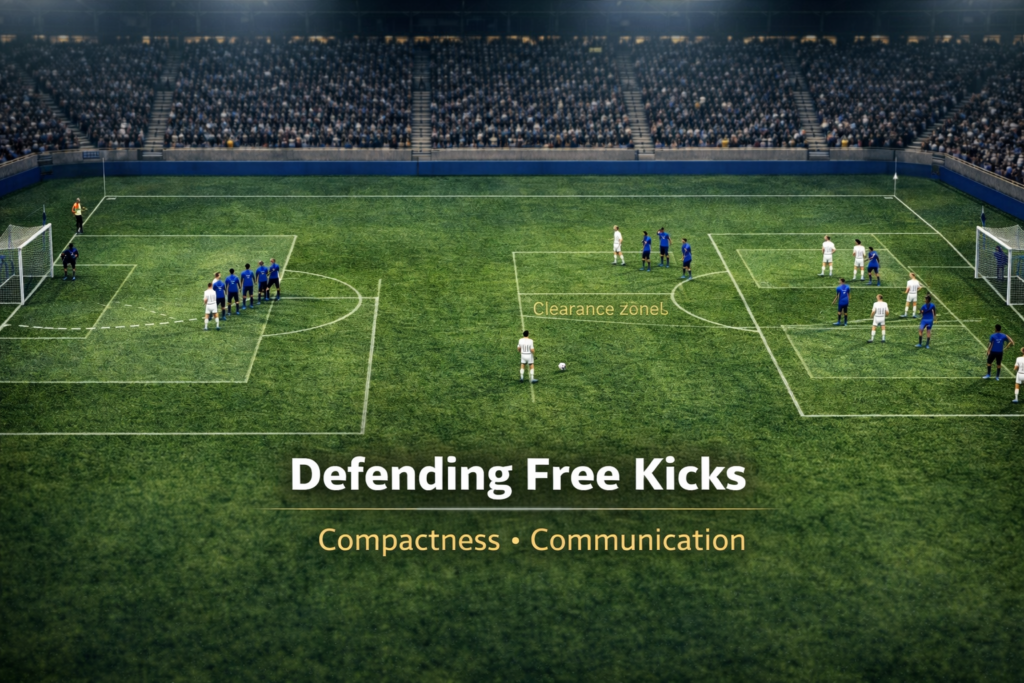
Key defensive principles:
- Clear wall responsibilities
- Defined offside line behind the wall
- Aggressive first contact after clearance
Teams also assign exit routes after defending free kicks to prevent immediate counter-pressing pressure.
Throw-Ins as Tactical Triggers
Throw-ins are often overlooked, yet they provide consistent opportunities to initiate attacks, particularly in the final third.
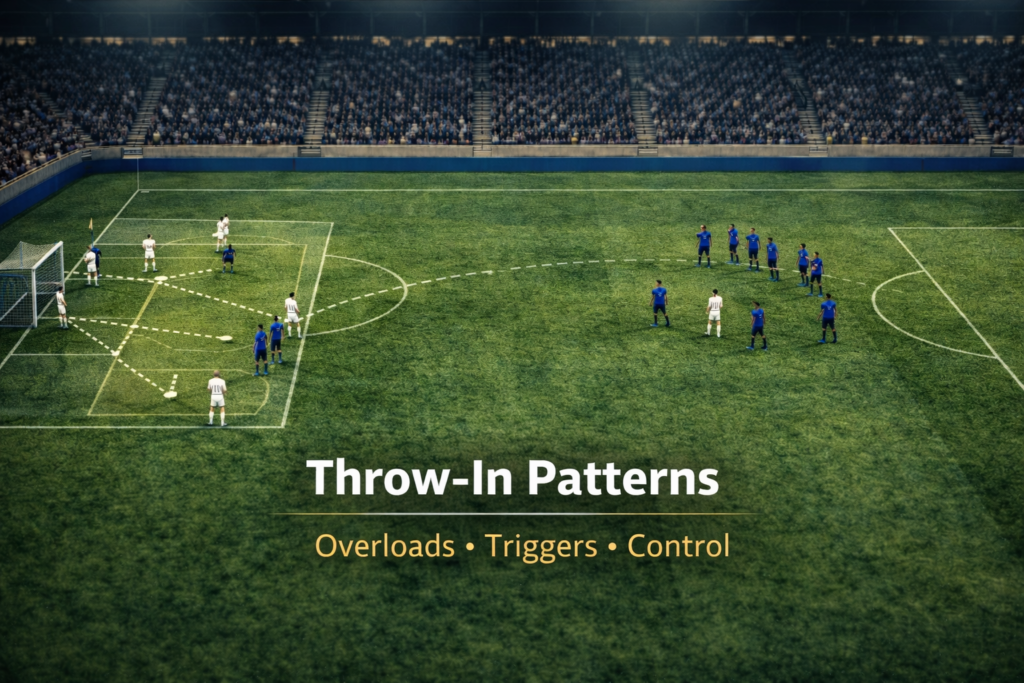
Modern throw-in tactics treat the sideline as a constraint that can be exploited through:
- Overloads near the ball
- Third-man combinations
- Long-throw structures resembling corners
Short throw-ins are commonly used to re-enter positional play structures, while long throws function as direct chance-creation tools.
Defensive Throw-In Structure
Defending throw-ins requires compact spacing and anticipation rather than aerial dominance.
Effective defensive principles:
- Deny immediate forward passes
- Force backward throws
- Maintain central compactness
Teams that fail to treat throw-ins seriously often concede territory rather than goals — but sustained territorial loss accumulates pressure.
Coaching Set-Pieces: Repeatability Over Creativity
Set-piece success depends less on novelty and more on execution consistency. Elite teams rehearse a limited number of routines extensively rather than rotating constantly.
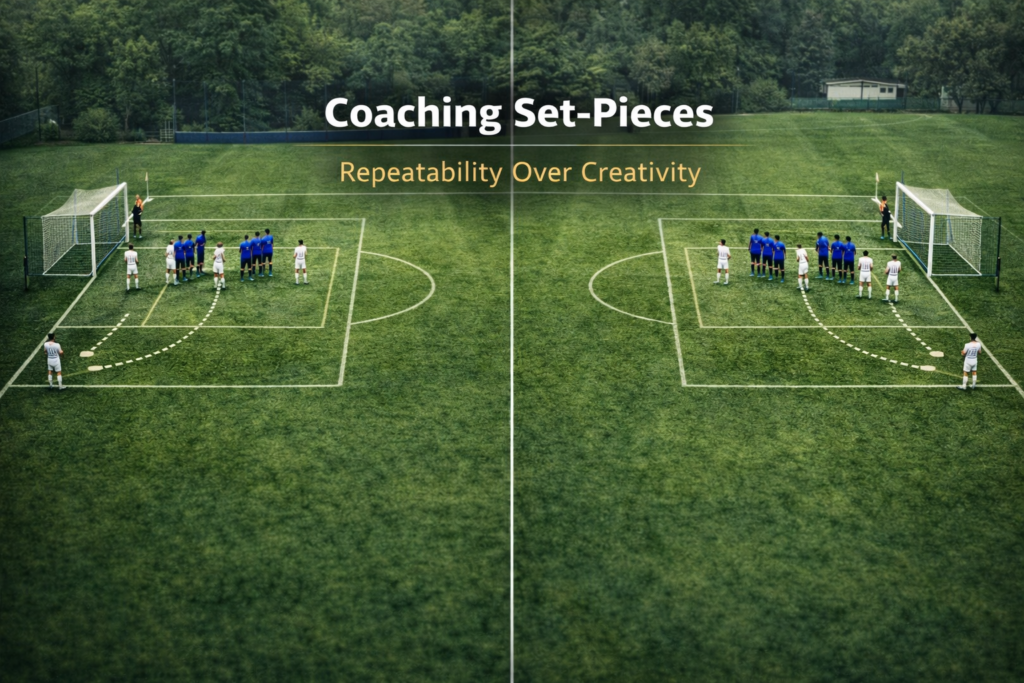
Key coaching priorities:
- Clear role assignments
- Timing synchronization
- Adaptability against opponent schemes
Set-piece routines are often adjusted weekly based on opposition tendencies, but the underlying structure remains stable. Very critical part of training and as per Laws of the Game.
Set-Pieces and Marginal Gains
In low-margin matches, set-pieces offer controllable advantage. A single well-executed routine can offset disparities in open-play quality.
This is why teams with limited possession often invest heavily in dead-ball scenarios. Set-pieces democratize scoring opportunities by reducing reliance on sustained build-up.
They also scale well across competition levels, making them a foundational tactical layer rather than a situational tool.
How Set-Pieces Connect to Other Tactical Phases
Set-piece tactics do not exist in isolation. They intersect directly with pressing, build-up, and defensive block structures.
- Counter-pressing begins immediately after attacking set-pieces
- Defensive block height affects clearance zones
- Build-up principles influence short set-piece execution
Final Thoughts
Set-piece tactics represent football at its most deliberate. They strip the game down to structure, timing, and execution. Teams that treat dead-ball situations seriously gain a quiet but consistent edge, often invisible until results accumulate.
Understanding set-pieces is not about memorizing routines, but recognizing patterns: space creation, blocking, and second-ball control. These principles mirror broader tactical ideas across football, reinforcing why set-pieces deserve equal analytical attention.
In modern football, matches are rarely won by chance. They are decided by preparation — and set-pieces are preparation made visible.
Enjoyed this breakdown?
Don’t Just Watch Football. Understand It.
Join KharaSportsDaily and receive occasional deep tactical insights most fans miss.
Occasional analysis. No match reports. No noise.
Frequently Asked Questions (FAQs)
What are set-piece tactics in football?
Set-piece tactics refer to planned routines used during dead-ball situations such as corners, free kicks, and throw-ins to create scoring or defensive advantages.
Why are set-pieces important in modern football?
They provide structured, repeatable opportunities that reduce randomness and allow teams to exploit preparation and coordination.
Do set-piece tactics favor attacking or defensive teams?
They benefit both. Attacking teams gain chance creation, while defensive teams can control space and reduce chaos.
Are set-pieces more important for certain teams?
Teams with limited possession or lower open-play creativity often rely more heavily on set-pieces as a scoring pathway.
How often do teams change set-piece routines?
Core routines remain stable, with minor weekly adjustments based on opponent tendencies.
Part of the Football Tactics Framework
This article is part of KharaSportsDaily’s Football Tactics Framework, where we break down how teams structure play, defend space, and create advantages across all phases of the game.
About The Author
Football Tactician & Analyst. breaking down elite systems for coaches and fans.