

Last updated: September 19, 2026
Simeone’s Atletico Madrid reached two Champions League finals without a superstar forward line. The reason wasn’t recruitment – it was spatial discipline.
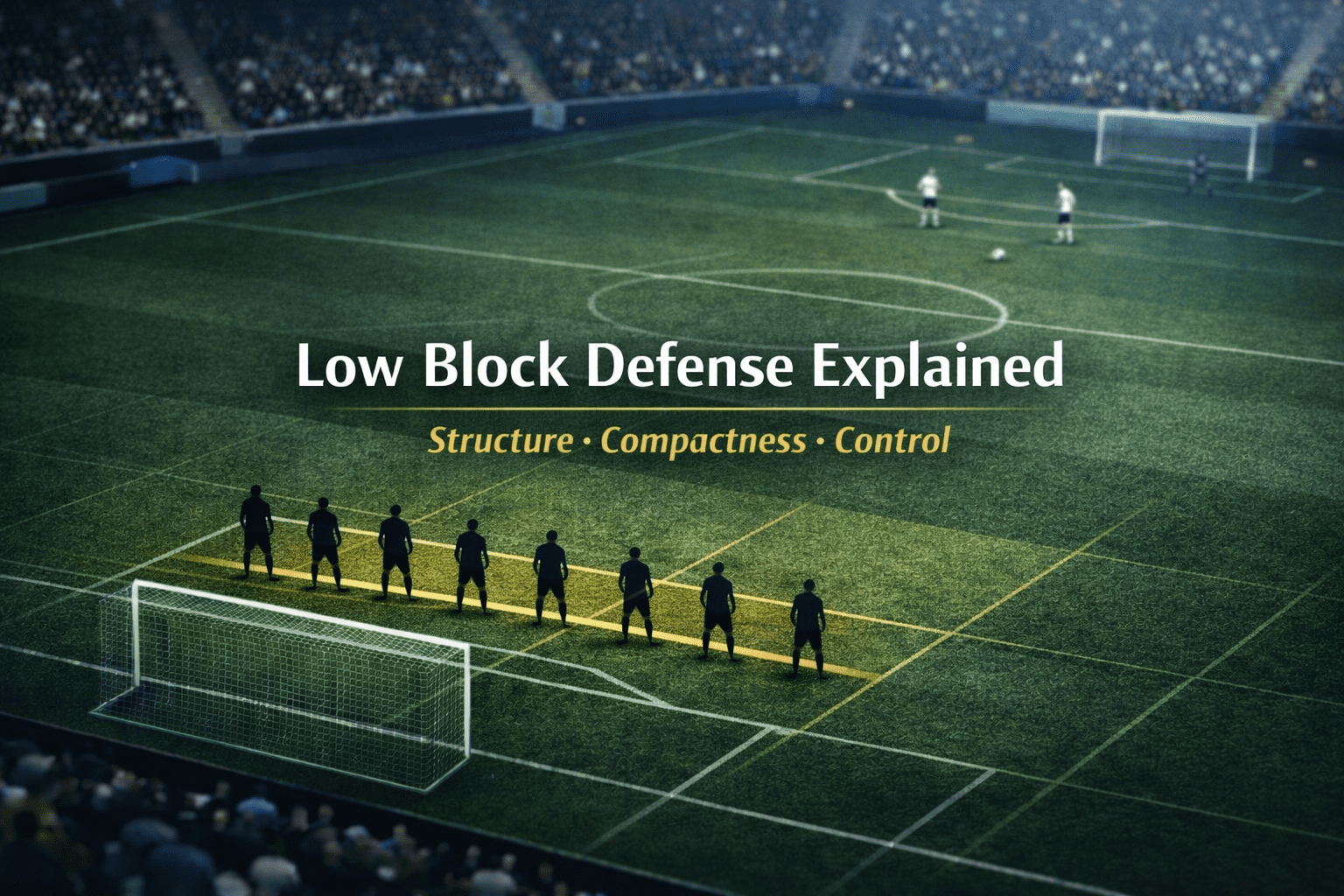
In simple terms: A low block is a defensive setup where a team positions the majority of outfield players deep in their own half, compressing space between defensive and midfield lines to protect the zones closest to goal.
Modern football is often framed as a contest of pressing intensity and attacking ambition. Yet beneath the surface, one of the most enduring and misunderstood defensive strategies remains the low block defense. Understanding the low block meaning in football goes beyond surface judgements – it is a deliberate tactical choice built around spatial control, compactness, and risk management.
This guide explains what a low block is, how it functions structurally, and why teams continue to use it across different levels of the game. Rather than judging the style, the aim here is to understand its logic, strengths, and inherent trade-offs.
Low block defense is one of several defensive strategies explored in the Football Tactics Framework, where we break down how teams defend space, press opponents, and control matches through structure rather than individual actions.
Key Takeaways
- A low block is active, not passive. Defending deep is a deliberate spatial choice – compactness and zone control, not retreat.
- Depth beats territory. Low blocks concede possession by design, trading wide areas for tight control of the zones closest to goal.
- Pressing still exists. Selective triggers – backward passes, poor touches, wide isolation – allow short, controlled bursts of pressure without breaking shape.
- It is risk-shifted, not risk-free. Shot volume accumulates. Fatigue sets in. The low block manages risk, it does not eliminate it.
- Context determines use. Protecting a lead, facing superior opponents, or managing squad limitations – the low block is a situational tool, not a permanent identity.
- Low block ≠ mid-block. The distinction lies in defensive height and pressing intensity – two systems with different objectives and trade-offs.
Table of Contents
Low Block Defense Meaning in Football: A Clear Definition

A low block refers to a defensive setup in which a team positions the majority of its outfield players deep in its own half, usually close to the penalty area. The defensive line sits low, with midfielders dropping back to reduce space between units.
The defining characteristic of a low block is defensive depth, not inactivity. Teams using a low block aim to compress space centrally, protect high-value zones near goal, and force opponents into wide or low-probability actions. Unlike high pressing systems, a low block concedes territory by design – the trade-off is tighter control over the most dangerous areas of the pitch.
Defensive organisation in football must comply with IFAB’s Laws of the Game, which define the boundaries within which all blocking and zonal systems operate.
Defensive Block Height Comparison
| Block Type | Defensive Line Height | Primary Objective |
|---|---|---|
| High Block | Near halfway line | Win possession early |
| Mid-Block | Middle third | Control transitions |
| Low Block | Defensive third | Protect central zones |
A low block defense is therefore not defined by numbers alone, but by where and how space is defended.
Low Block Football Examples: Teams That Use This System
Several elite managers have built successful campaigns around low block principles. Diego Simeone’s Atlético Madrid remains the modern reference point, using a compact 4-4-2 to win La Liga in 2013-14 and reach two Champions League finals. Sean Dyche’s Burnley consistently overperformed in the Premier League using deep defensive organization. More recently, teams facing superior opponents in knockout football—such as Morocco at the 2022 World Cup—have demonstrated how effective low blocks can neutralize possession-dominant sides. Understanding these real-world applications clarifies when and why the low block remains tactically relevant.
The 2024-25 Champions League offered one of the clearest modern demonstrations of the low block at elite level. Simone Inzaghi’s Inter Milan repeatedly deployed a compact defensive shape throughout the campaign, drawing attention from UEFA’s Technical Observer Group on multiple occasions. Against Bayer Leverkusen, Inter’s vertical compactness measured just 16.8 metres from centre-backs to centre-forwards — a number that illustrates how little space they conceded centrally. Against Bayern Munich in the quarter-finals, the same principles applied: Bayern generated the highest xG any side had managed against Inter all season, yet still couldn’t break them down in the first leg. Inzaghi has since moved on to Al-Hilal, but that 2024-25 Inter side remains the contemporary reference point for how a well-drilled low block functions at the highest level.
Defensive Structure of a Low Block Defense
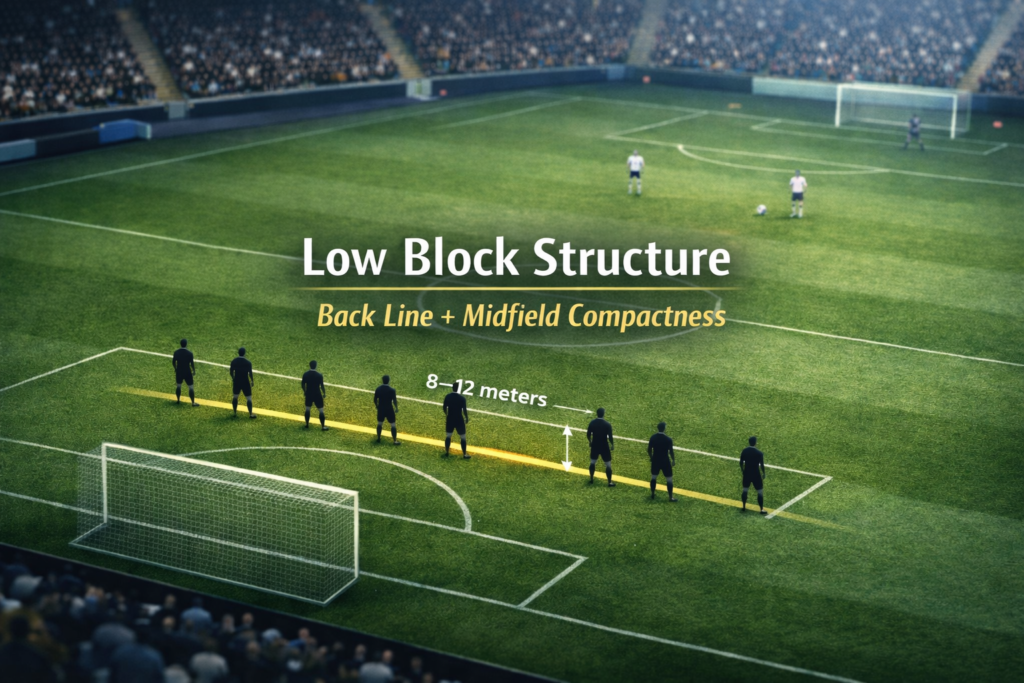
The structure of a low block defense is built around unit cohesion. The team defends in compact horizontal and vertical lines, typically forming two or sometimes three defensive units.
Back Line Positioning
The defensive line sits close to the penalty area, prioritising depth protection against runs in behind, narrow spacing between centre-backs, and minimal gaps between fullbacks and centre-backs. Fullbacks often defend slightly deeper than in higher blocks, reducing exposure to diagonal runs and cutbacks.
Midfield Line Role
Midfielders drop close to the back line to screen rather than press – blocking passing lanes into central attackers, tracking late runners from midfield, and maintaining numerical superiority in front of goal.
Ideal Distances Between Units
| Unit Distance | Typical Range |
|---|---|
| Back line → midfield | 8–12 meters |
| Player-to-player (horizontal) | 6–10 meters |
These distances allow defenders to support one another without over-committing.
The success of a low block depends less on individual duels and more on collective spacing discipline.
How Space Control Works in a Low Block Defense

At the heart of low block defending lies compactness.
Compactness operates in two dimensions:
- Vertical compactness: Reducing space between defensive lines
- Horizontal compactness: Narrowing the team shape toward the center
Central Space Protection
Low blocks prioritize denying access to:
- The penalty spot zone
- Central cutback lanes
- Through balls between center backs
Instead of chasing the ball, defenders focus on occupying zones, allowing passes in harmless areas while protecting critical ones.
Half-Space Management
The half-spaces-areas between the center and wide channels – are especially important. In a low block:
- Wide players tuck inside when the ball is central
- Midfielders shift laterally in unison
- Fullbacks delay rather than aggressively engage
This zonal responsibility reduces the need for last-ditch defending and limits shot quality rather than shot volume.
Pressing Triggers in a Low Block Defense
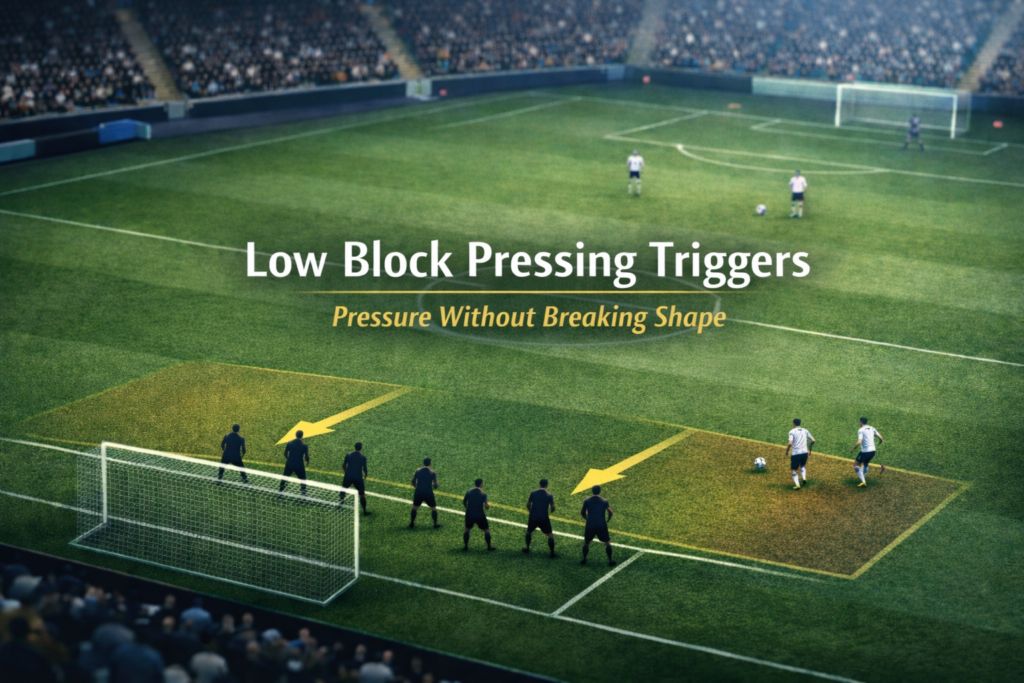
Contrary to common perception, low blocks are not entirely passive. Pressure is applied selectively through pressing triggers.
Typical triggers include:
- A backward pass near the box
- Poor body orientation by the ball carrier
- Heavy touches in wide areas
- Isolated attackers near the touchline
Pressing Trigger Table
| Trigger | Defensive Response |
|---|---|
| Backward pass | Step up collectively |
| Wide isolation | Double-team near touchline |
| Poor control | Short, aggressive press |
| Central congestion | Hold shape, no press |
The key principle is controlled aggression. Pressure is applied only when the risk of breaking compactness is low.
Counter-Pressing Principles explained in our guide.
Strengths and Risks of Low Block Defense
Like all tactical systems, the low block involves trade-offs.
Strengths
1. Central Space Denial
By compressing the area in front of goal, low blocks reduce high-quality chances.
2. Transition Stability
With many players behind the ball, teams are less vulnerable to counter-attacks.
3. Game State Control
Low blocks are effective when protecting a lead or managing inferior physical resources.
Risks
1. Territorial Concession
Sustained pressure can lead to fatigue and loss of concentration.
2. Shot Volume Accumulation
Even low-quality chances can become dangerous over time due to deflections or rebounds.
3. Limited Attacking Outlets
Counter-attacking opportunities may be rare without precise execution.
Low block defending is therefore not “safe” by default – it is risk-shifted, not risk-free.
Low Block vs Mid-Block: Tactical Differences
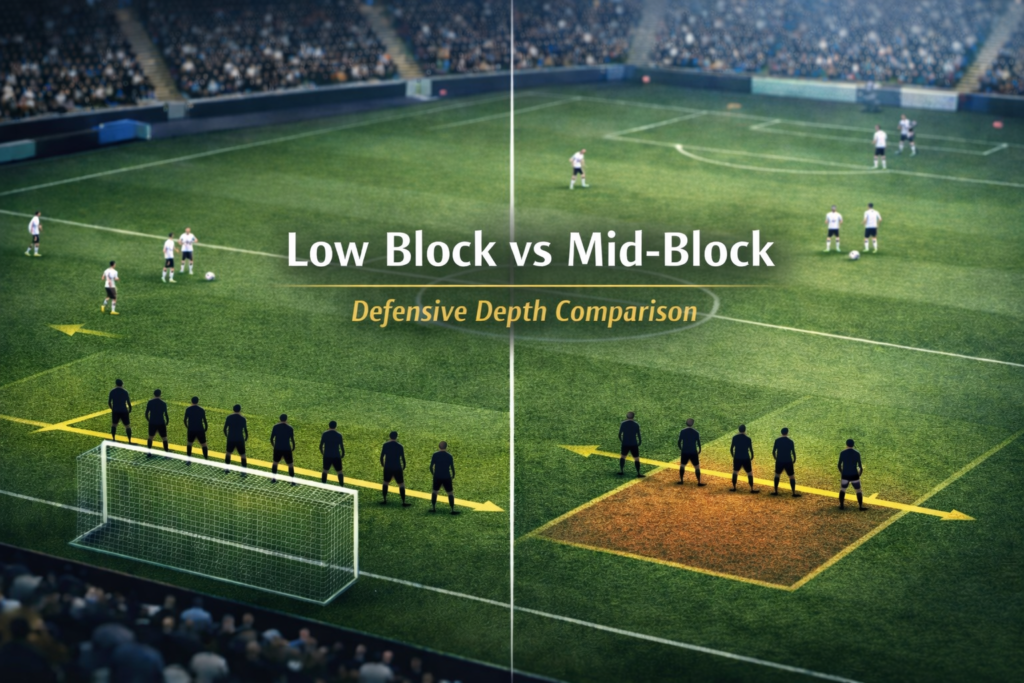
Low blocks and mid-blocks are often confused, but their underlying principles differ.
Comparison Table
| Aspect | Low Block | Mid-Block |
|---|---|---|
| Defensive height | Deep | Moderate |
| Pressing intensity | Selective | Structured |
| Space conceded | Territory | Both territory and space |
| Transition focus | Survival | Control |
A mid-block seeks balance between pressing and protection. A low block prioritizes protection above all else.
Understanding this distinction is crucial when analyzing team behavior without mislabeling intent.
When Does a Low Block Defense Make Tactical Sense?
Low block football tactics are most effective when aligned with specific game contexts.
Common scenarios include:
- Protecting a narrow lead
- Facing opponents with superior technical control
- Knockout or two-legged ties
- Managing physical or squad limitations
It is also a situational tool rather than a permanent identity. Many teams switch into a low block temporarily within matches, especially during late-game phases.
Pulling It All Together
Low block defending is neither cowardly nor outdated. It is a spatial strategy rooted in probability management. By conceding territory, teams gain control over the areas that matter most.
Understanding the low block requires moving beyond surface-level judgments and recognizing football as a game of space, risk, and decision-making. When executed with discipline and clarity, a low block can be one of the most effective defensive tools in the tactical landscape.
The deep history of defensive organisation, from catenaccio through to the modern compact block, is covered properly in several titles on the tactical reading list.
What do you think?
Inter Milan’s 16.8-metre vertical compactness against Leverkusen in the 2024-25 Champions League is the benchmark. But can that level of defensive discipline survive a full 38-game league season without the squad depth to rotate it? Drop your take below.
Want to read any match like this?
The framework behind these breakdowns, in one place. The four phases, a 15-minute method for diagnosing both teams before the drinks break, a printable match-watching worksheet, and 51 terms defined. 40 pages.
Get the pack$9, instant downloadRelated Tactical Breakdowns

Why it connects: The low block and mid-block are often confused but operate on different defensive heights and pressing triggers – this comparison makes the distinction precise.
Low blocks produce the highest PPDA numbers in football – understanding the metric reveals exactly how passive a low-block team looks from a pressing data perspective.

How Elite Teams Defend Without the Ball
Why it connects: The low block is one chapter in a wider defensive system – this breakdown places it within the full structure of how modern teams defend across all five phases.
Speak the language of the game
Get the free 47-term tactical glossary. Gegenpress, half-space, xT, low block, each defined in plain language and linked to a full breakdown. It is yours for an email.
Frequently Asked Questions (FAQs)
Is a low block the same as “parking the bus”?
No. “Parking the bus” is a pejorative term. A low block is a structured defensive system with defined spacing and triggers.
Can elite teams use a low block?
Yes. Tactical choices depend on game state, not status. Elite teams often defend deep when protecting results.
Does a low block eliminate pressing entirely?
No. Pressing exists but is selective and situational.
Is a low block only defensive?
No. It often supports counter-attacking strategies when paired with fast outlets.
Why do teams concede possession in a low block?
Because possession in non-dangerous areas carries less risk than exposing central space.
What does low block defense mean in football?
A low block is a defensive strategy where a team sits deep in their own half, compressing space between the defense and midfield to deny central goal-scoring opportunities.
What is the difference between a low block and a mid-block?
A low block defends closer to the penalty area with minimal pressing, while a mid-block holds a higher line and applies more pressure in the middle third.
Why do teams use a low block defense?
Teams use low blocks to protect leads, neutralize stronger opponents, or manage physical limitations by prioritizing defensive solidity over possession.
Can you read a match?
Six real in-game situations, one tactical read each. See how sharp your eye is, and get the full breakdown after every answer.
Take the test