
Last updated: September 19, 2026
Editor’s Note (updated 7 August 2026): The tournament is over. Spain beat Argentina 1-0 after extra time on 19 July to win their second World Cup. The five shifts below were written before a ball was kicked; the “How the Final Was Won” section judges them against what actually happened.
The 2026 World Cup will not be decided by talent alone.
It will be decided by how teams manage space, energy, and adaptation across a tournament designed to break fixed systems.
The 48-team format, extreme climate variation, and compressed recovery windows create a different tactical environment – one where modern football tactics trends collide with tournament realities. This one will expose every side that mistakes identity for adaptability. For the foundational principles behind these systems, see our complete football tactics framework.
This is not just about 2026 World Cup tactics – it reflects how football tactics are evolving globally.
Key Takeaways
- The high press is a group stage luxury. No squad can sustain pressing intensity across seven matches in summer heat. The teams that survive will press in calculated bursts, not constantly.
- Inverted fullbacks are now a baseline requirement. Nations that arrive without a hybrid fullback profile are structurally behind before kick-off.
- Your squad of 23 is a tactical instrument, not a backup plan. Rotation in 2026 is not about managing fatigue. It is about deploying different tactical functions at different moments.
- Set pieces will decide knockout games. When creativity fails and legs go in the second week, dead ball situations become primary weapons. The data from 2022 made this undeniable.
- Adaptation beats identity. Modern football tactics trends 2026 are reshaping the World Cup – pressing, structure, and squad management now define success more than identity.
Table of Contents
How the Final Was Won: Spain’s Control Masterclass
Spain beat Argentina 1-0 after extra time at MetLife Stadium on 19 July 2026, Ferran Torres finishing in the 106th minute moments after Enzo Fernandez was sent off for a second yellow card. It was Spain’s second world title, sixteen years after 2010.
The one-goal scoreline hides how total the control was. Spain held 65% of the ball, outshot Argentina 20 to 2, and did not concede a single shot on target across more than 120 minutes. They completed 774 passes at 86.4% accuracy, a World Cup final record, and finished on 1.56 expected goals against Argentina’s 0.13 – the lowest figure a finalist has recorded.
The mechanism matters more than the numbers. Luis de la Fuente’s 4-3-3 was not the patient tiki-taka of 2010. It was vertical: possession used to pin Argentina’s narrow 4-4-2 block in place, then Lamine Yamal and Nico Williams released into the space behind it the moment the ball was won. Possession was the delivery system, not the objective – the exact shift flagged in the Spain section below before a ball was kicked, and the read Coaches’ Voice reached afterwards.
Read against the five shifts below, the final returned a clean verdict: selective trigger pressing beat relentless pressing, positional flexibility beat fixed roles, and the side with structural control still had it in the 106th minute. The tournament rewarded control, not chaos.
Mid-Tournament Scorecard: How the 5 Shifts Were Playing Out (4 July 2026)
This analysis was written before a ball was kicked. The group stage and Round of 32 are now complete, the Round of 16 is underway – and the tournament data is grading the predictions in real time:
- Rotation as a weapon – confirmed. Substitutes scored 43 of the 215 group-stage goals, an unusually high share that rewards exactly the squads treating their bench as tactical variation rather than backup.
- Pressing has become transitional, not constant – confirmed. Winning teams have recovered possession roughly four seconds faster than losing sides, and the clearest counter-pressing identities – Pochettino’s USA, Ecuador, Canada – built their group-stage runs on it. Nobody is pressing for 90 minutes in this heat; they press the moment after loss, then recover shape.
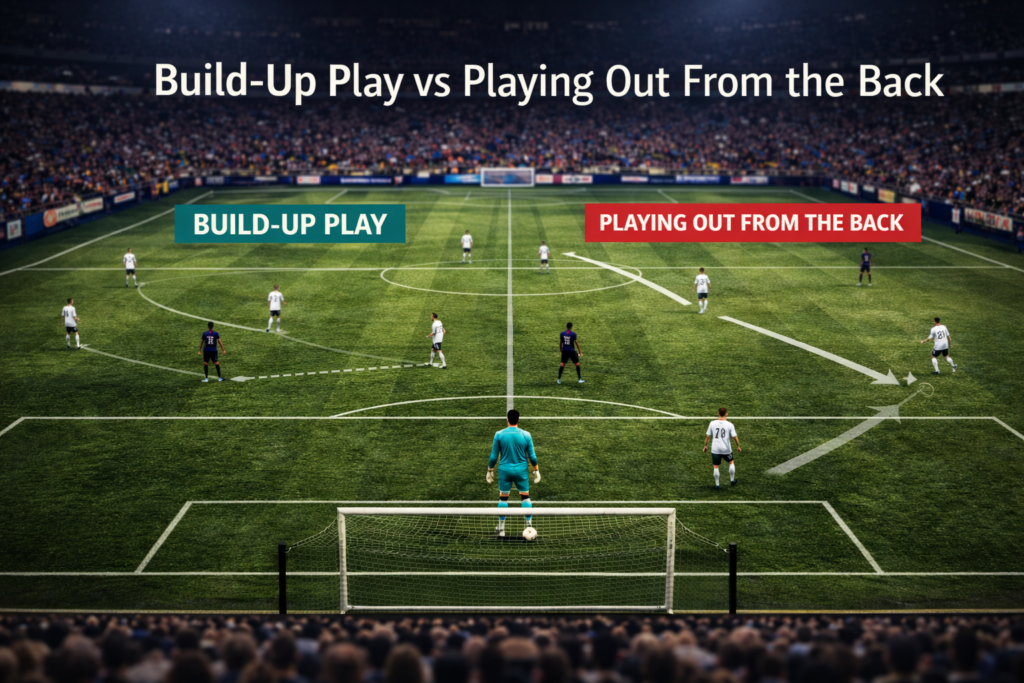
- Build-up evolution has gone further than predicted. Goalkeepers took every goal kick in 2018 and 91% in 2022; at this tournament that figure has collapsed to 52%, with defenders restarting play short while forward passes beyond the defensive line have more than doubled since 2022.
- The brutal-format warning was real. Germany – one of the pre-tournament favourites on paper – went home in the Round of 32, beaten on penalties by a compact, transition-ready Paraguay.
- Finishing variance is deciding the tight games. France converted 10 goals from roughly 5 xG worth of chances in the group stage – elite execution papering over the structural questions raised below.
The five shifts below stand as written – what follows is the framework for watching the rest of the knockout rounds.
How 2026 World Cup Tactics Are Changing?
Let me be direct about something that is getting lost in the excitement about 48 teams and three host nations.
The 2026 World Cup is not just a bigger tournament. It is a fundamentally different competitive environment.
The jump from 32 to 48 teams adds an entirely new knockout round – the Round of 32 – inserts 12 groups of four in place of the old eight, and extends the path to the final from six matches to eight. Group scheduling means some sides will face turnarounds of 72 hours or fewer between games, depending on their draw.
In June heat across Dallas, Los Angeles, Miami, New York, and Mexico City, that difference is not incremental. It is physiological.
Here is what that means tactically. A high press – the kind that Jürgen Klopp built Liverpool F.C. around, the kind that defined the best club football of the last decade – requires two things to function: physical freshness and recovery time.
The 2026 format systematically removes both.
You cannot press the way Bayer Leverkusen press if you played four days ago in 32-degree heat and your squad rotation is limited by the fact that your best eight players are simply better than your next eight.
Every significant tactical decision in 2026 will be made in the shadow of this physical reality. The coaches who accept it early and design around it will be in the semi-finals. The ones who arrive believing their system will hold regardless of conditions will be on a flight home by the second week.
The 5 Tactical Trends That Decided the 2026 World Cup
These shifts are not isolated ideas. They are connected responses to a single constraint: the physical and structural demands of the 2026 tournament.
Every successful team will solve the same problem – just in different ways.
1. From Constant Pressing to Trigger Pressing in Tournament Football
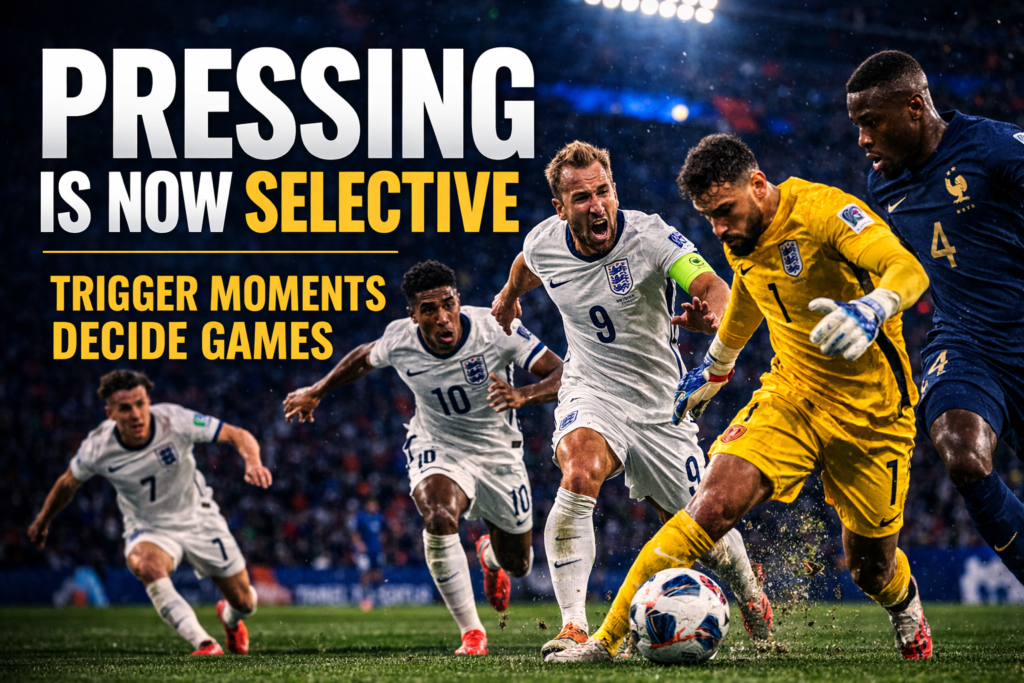
The most important tactical evolution in 2026 will not be visible on a formation graphic. It will be visible in the moments a team chooses to press – and the moments it deliberately does not.
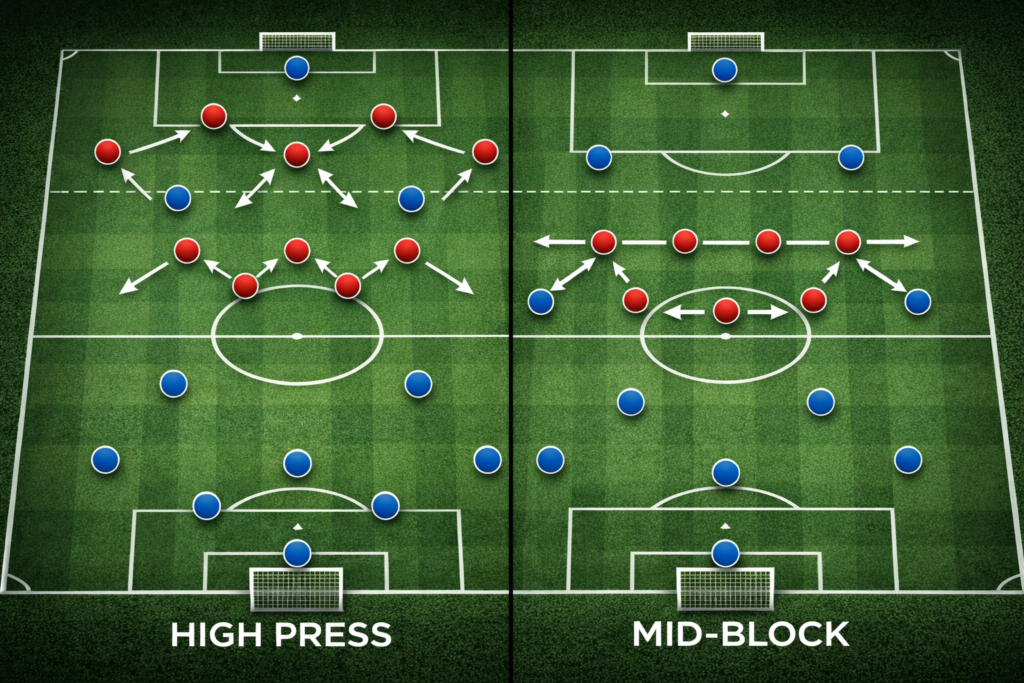
What the best teams will deploy is what analysts call trigger pressing – a mid-block defensive structure that conserves energy by sitting compact, punctuated by explosive, coordinated press activations the instant a specific trigger appears.
A poor touch by the opposition goalkeeper. A backward pass under pressure. A centre-back receiving with their back to goal.
Morocco showed the world the blueprint at the 2022 World Cup. They did not press Spain, Portugal, or Belgium constantly. They pressed them correctly – in specific moments, against specific pass types, into specific zones.
The result was the most tactically disciplined defensive tournament performance in a generation. Every serious 2026 contender is studying that film.
The irony is that trigger pressing, executed well, is actually more psychologically destructive than a constant press. A constant press can be played through with patience. A trigger press creates sudden, unexpected moments of suffocation that no build-up system can fully prepare for.
2. Why Inverted Fullbacks Are Now Standard in Modern Football Tactics Trends

When Pep Guardiola first moved John Stones into midfield during Manchester City F.C.’s build-up phase, it was described as a tactical masterstroke.
When Mikel Arteta built an entire right-side system around Ben White inverting at Arsenal F.C., it felt like club-specific ingenuity.
By 2026, any nation that does not have a version of this role is arriving structurally undermanned.
The reason is simple. The inverted fullback solves the most persistent problem in international football: limited time to drill positional patterns. You cannot teach a national team the full complexity of a positional system in ten days of training camp.
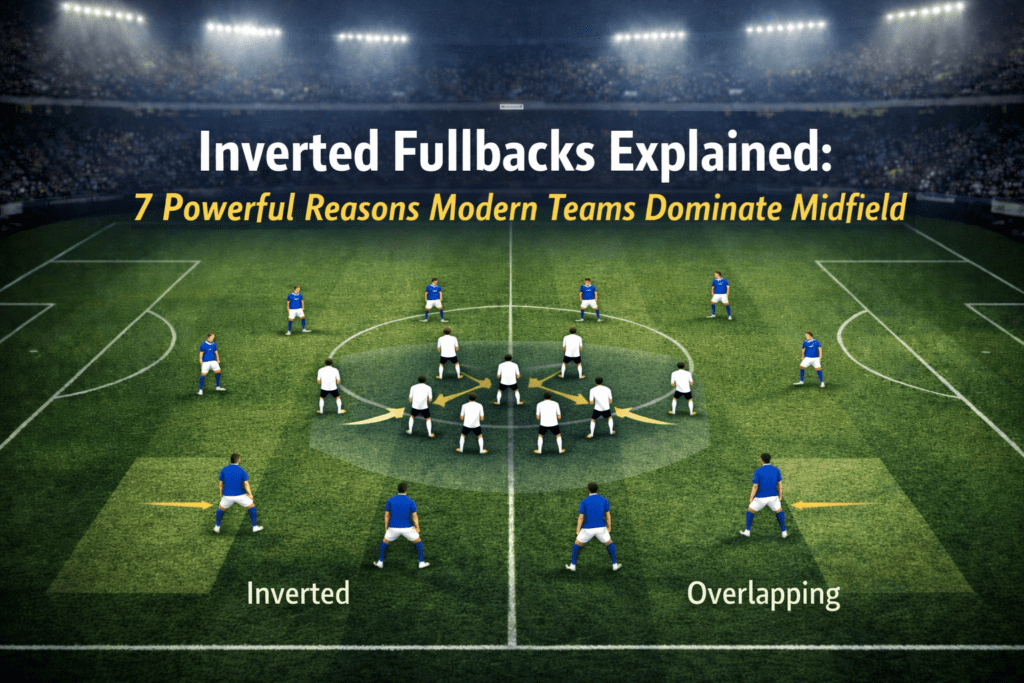
But you can move one fullback inside and immediately create midfield numerical superiority structurally, without requiring the entire squad to learn new movement patterns.
It is the most efficient tactical upgrade available to an international manager. The nations that have not adopted it are not being tactically conservative. They are being tactically negligent.
For the full mechanical breakdown of how this role creates overloads and press resistance, our piece on inverted fullbacks covers exactly why this has become non-negotiable at elite level.
3. Why Squad Rotation Is Now a Tactical Weapon in the World Cup
Here is where I think most pre-tournament analysis will get it wrong.
Commentators will describe rotation as a necessary evil – a concession to the format’s physical demands. The best coaches in 2026 will use it as something entirely different.
Think of how Carlo Ancelotti – now managing Brazil at this very tournament – used to run a Real Madrid C.F. knockout game. When Fede Valverde came off in the 65th minute, he was not simply being replaced by a fresher version of the same player.
He is being replaced by a player with a different tactical profile – one who changes the press structure, the transition speed, or the defensive shape in a way the opposition has not prepared for.
The 2026 managers who think in these terms will have an advantage that compounds over the course of the tournament. By the quarter-finals, their opponents will be trying to prepare for a team that plays differently in every 20-minute block of a match.
4. Why Set Pieces Are Deciding Matches in Tournament Football Tactics Trends
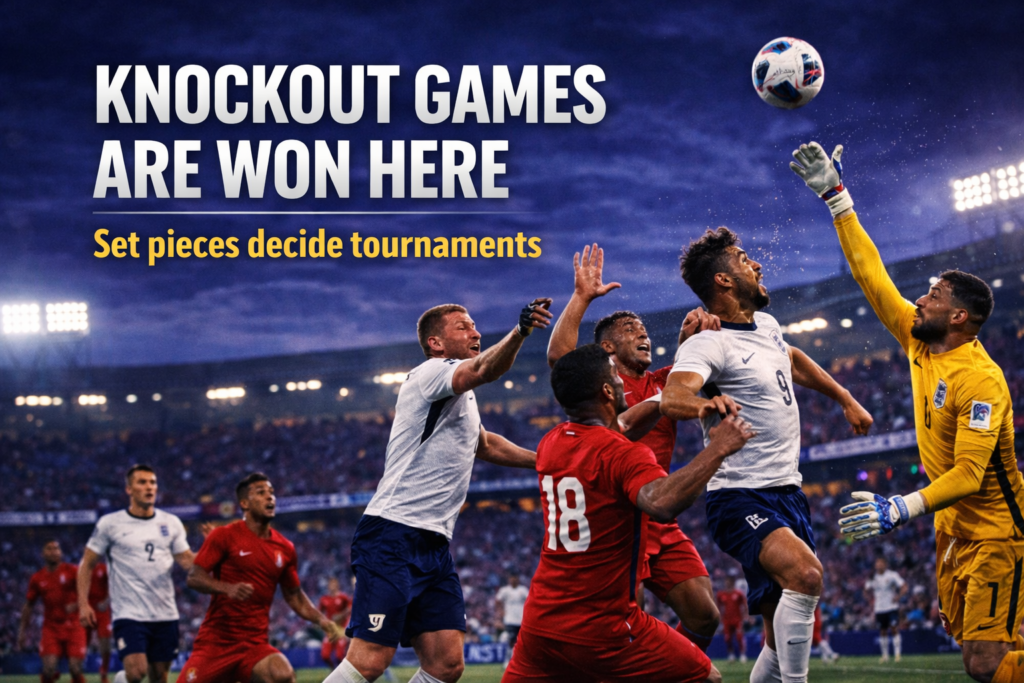
I want to reframe how you think about this, because “set pieces will be important” is the kind of tactical analysis that sounds obvious and gets ignored.
At the 2022 World Cup, set pieces accounted for a striking proportion of knockout stage goals. The reason is mechanical, not random.
As tournament fatigue accumulates, open-play defensive organisation improves – teams drop deeper, press less, reduce the spaces that combination play exploits.
At the same time, individual creativity decreases – tired legs mean fewer successful dribbles, slower reactions, more conservative decision-making.
The net result is clear. The two things that break open organised defences in open play – individual brilliance and pressing-induced panic – become less available in the second week of a tournament.
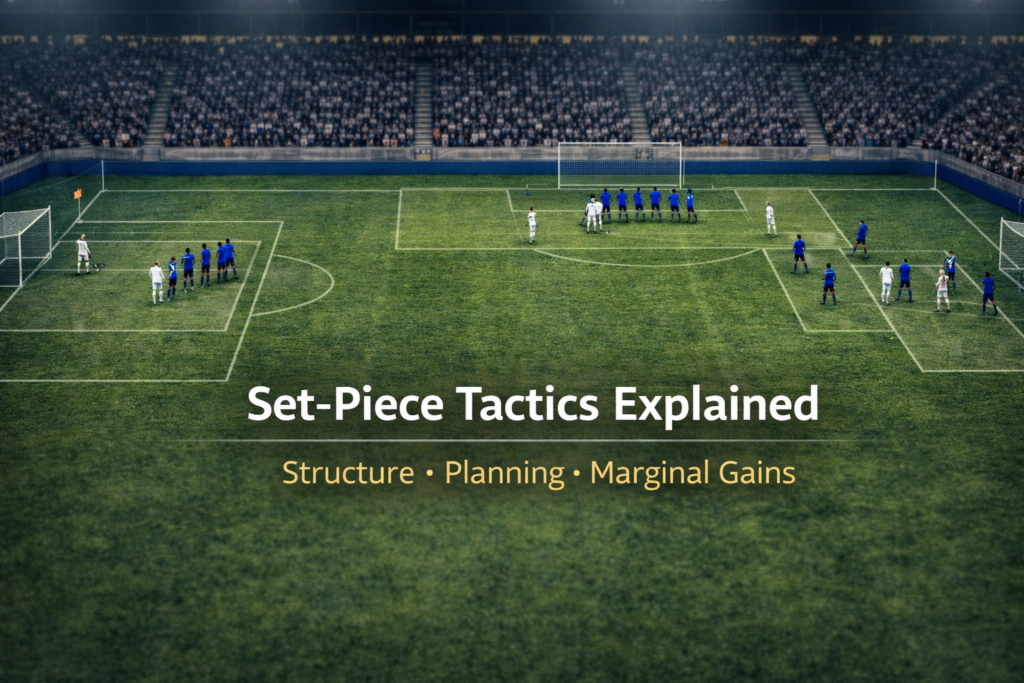
What remains available, regardless of fatigue, is a well-designed set piece routine executed by players who have rehearsed it fifty times.
The nations arriving at 2026 with dedicated set-piece analysts are not just covering a tactical base. They are preparing their primary creative weapon for the moments that matter most.
5. Why Positional Flexibility Defines Modern Football Tactics Trends
The great club teams of the last decade built their dominance on positional specificity.
Every player had a precise function, a precise zone, a precise set of triggers. Manchester City F.C.’s 3-2-2-3 required players who could execute one role with extraordinary precision. It worked at club level because Pep Guardiola had 52 weeks a year and a transfer budget to find exactly the right profile for each position.
International management gives you none of that.
What the 2026 format demands instead is players with a wide usable range across several roles – a midfielder who can press aggressively and hold discipline. A winger who can invert and track back. A striker who can pin defenders and participate in the press.
The players who will be decisive in 2026 are not the ones with the highest ceiling in a single role. They are the ones who can execute three or four roles at a competent level, giving their manager the flexibility to shift structure mid-game without a substitution.
Spain, France, and England: Three Philosophies Under Pressure
Let me show you how the three most technically sophisticated European contenders are navigating these five shifts – and where each of them is most exposed.
Spain: The Possession Empire Going Vertical
Spain’s identity has always been the ball. Juego de Posición at international level, recycling through the thirds, making opponents chase shadows until a half-space opens.
It won them a World Cup and two Euros. It is also the system most threatened by the 2026 format.
Luis de la Fuente’s Spain won Euro 2024 and dropped just two goals across six qualifying matches. They arrive as the highest-ranked side in the draw. Watch Spain’s build-up play carefully going into this tournament. The rigidity of the 2010 generation – Sergio Busquets anchoring, full-backs providing width, wingers holding their lines – has been replaced by something with genuine vertical ambition.
Pedri and Gavi are not pure positional players. They press with ferocity and arrive late into the box. Lamine Yamal on the right creates the kind of 1v1 isolation that classical Positionism specifically designs to avoid.
Spain are evolving. Their 2026 structure is more direct, more transition-aware, and more physically demanding than anything their golden generation produced.
Their vulnerability remains defensive transition – the moment when their build-up is bypassed quickly and the defensive shape has not yet reset. Against a team with a fast striker and a disciplined counter structure, that window is exploitable.
France: The Superteam With an Identity Problem
France are the most talented squad in the tournament. They are also, tactically, the hardest team to define – and I do not mean that as a compliment.
The fundamental tension in Didier Deschamps’ France is between individual profiles and systemic demands.
Kylian Mbappé is a transition weapon, not a hold-up striker. Antoine Griezmann is a free 10, not a wide forward. Aurélien Tchouaméni is a controller, not a press-heavy midfielder.
When the game state creates the space these profiles need, France are devastating.
When it does not – when they need to break down a disciplined low block for 70 minutes in Miami heat – the identity problem becomes visible.
This is France’s 2026 vulnerability in precise terms: a knockout game at 0-0 in the 60th minute, against a well-organised mid-block, when individual brilliance has not arrived on schedule. The format virtually guarantees this scenario will occur.
England: The System That Finally Has a System
For most of my analytical career, watching England at tournaments has been an exercise in tactical frustration. Talented players in incoherent structures, pressing without triggers, attacking without patterns.
That has genuinely changed under Thomas Tuchel. England went through World Cup qualification without conceding a single goal – the first European team in history to do so. The system is recognisable now: Jude Bellingham arriving late into the box as a de facto 8, Bukayo Saka and the right back combining through the right half-space, a midfield built for press resistance, and set-piece delivery distributed across the squad rather than reliant on a single specialist.
More importantly, it is a system designed for exactly the conditions the 2026 format creates. England can transition quickly. They can defend in a mid-block. They do not need to press constantly to function.
Their vulnerability is specific: the transitional seconds between a failed press and a reset mid-block. In those moments, England’s centre-backs face 2v2 situations that expose a lack of elite recovery pace. It is a small window. Against Mbappé or Yamal, small windows are enough.
| Nation | Core System | Biggest Strength | Critical Vulnerability |
|---|---|---|---|
| Spain | Positional possession, increasingly vertical | Ball retention, half-space occupation, Yamal’s 1v1 | Defensive transition when build-up is bypassed quickly |
| France | Individual-led hybrid, transition-dependent | Counter-attack speed, Mbappé in space | Breaking organised low blocks over 70+ minutes |
| England | Mid-block base with triggered press | Set pieces, right-side combinations, press resistance | Transitional seconds between press failure and block reset |
Which Teams Exploited These World Cup Tactical Trends?
Morocco.
I said it earlier and I will make it explicit – with one significant caveat that changes the nature of the argument. The 2022 World Cup semi-final run was not a miracle.
Walid Regragui resigned in March 2026, less than three months before the tournament. Mohamed Ouahbi, a youth coach who guided Morocco’s under-20 side to the 2025 U-20 World Cup title, has taken charge with no previous senior international management experience.
That changes nothing about what Morocco are tactically. It changes everything about whether they can execute it.
The system Regragui built is still there. Mid-block defensive structure. Trigger pressing in coordinated bursts. Second-ball intensity. Set-piece precision that has been rehearsed hundreds of times. Those are not ideas that leave with a manager – they are ingrained in the squad’s muscle memory, led by a captain in Achraf Hakimi who understands every trigger and every shape.
What Regragui gave Morocco was the conviction to trust the system under pressure. At 0-0 against Spain. At 0-0 against Portugal. When the crowd and the scoreboard and the noise all tell you to push higher and take more risks, Morocco held their structure and waited for the moment.
Ouahbi has never managed a senior international side. He has never made that call in a World Cup knockout game with the game on the line.
That is Morocco’s 2026 question. Not whether the system works – it demonstrably does. But whether a first-time senior manager can hold eleven players to it in the moments that matter most.
If he can, Morocco are in the semi-finals again. If he cannot, they exit before the quarter-finals to a team that spots the hesitation.
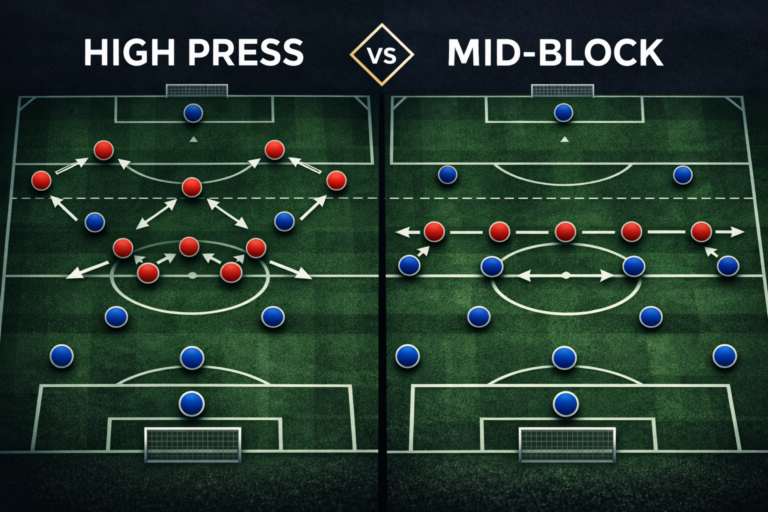
For the defensive architecture that underpins Morocco’s approach, our breakdown of high press vs mid-block covers exactly the structural principles Regragui built into this squad – and that Ouahbi now has to protect.
Final Thoughts: What 2026 World Cup Tactics Revealed
The 2026 World Cup winner will prove something specific about modern football. Not that possession is king. Not that pressing is dead. Not that individual brilliance always wins.
It will prove that adaptation is the highest tactical virtue.
The format demands it. The heat enforces it. The compressed schedule accelerates it.
The team that lifts the trophy in New York will be the one whose manager looked at a 0-0 knockout game in the 65th minute – legs heavy, press broken, the plan not working – and made the adjustment that changed the game. Not because they got lucky. Because they had prepared for that exact moment, with that exact substitution, against that exact defensive structure.
That preparation happened in the months before kick-off. In analysis rooms, in training sessions, in squad selection meetings where a manager was choosing between a slightly more talented player and a slightly more versatile one.
2026 World Cup tactics will reward the coaches who treated this tournament as a problem to be solved, not a stage to be performed on. The 2026 World Cup will not be won on the pitch in July. It is being won in those rooms today.
These are not just World Cup-specific adjustments – they reflect the broader evolution of modern football tactics trends.
Speak the language of the game
Get the free 47-term tactical glossary. Gegenpress, half-space, xT, low block, each defined in plain language and linked to a full breakdown. It is yours for an email.
What do you think?
Mohamed Ouahbi inherits the system Regragui built – mid-block, trigger press, set-piece precision – but has never managed a senior international team. Morocco go into 2026 with the best defensive structure in the tournament and the least-tested manager in the knockout rounds. Is the system strong enough to survive that transition, or has Morocco’s best shot at the final already walked out the door? Make the case in the comments.
Want to read any match like this?
The framework behind these breakdowns, in one place. The four phases, a 15-minute method for diagnosing both teams before the drinks break, a printable match-watching worksheet, and 51 terms defined. 40 pages.
Get the pack$9, instant downloadRelated Tactical Breakdowns
To understand these shifts, you need to understand the systems behind them:
High Press vs Mid-Block
Build-Up Play in Football
Set-Piece Tactics Explained
Inverted Fullbacks Explained
Frequently Asked Questions (FAQs)
Why are 2026 World Cup tactics so different from previous tournaments?
The expansion to 48 teams creates a minimum of seven matches for any team that reaches the final, with compressed rest periods in some group stage scenarios. Combined with summer heat across three host nations, this makes high-intensity pressing systems physically unsustainable across the full tournament. Coaches must design their tactical approach around energy management from the opening game, treating rotation as tactical variation rather than squad management.
Which formation dominated the 2026 World Cup?
No single formation will dominate, but the most successful structures will be fluid hybrid systems – typically a 4-3-3 or 4-2-3-1 in possession that transitions into a compact 4-4-2 or 5-4-1 mid-block out of possession. The critical variable is not the shape but the ability to shift between attacking and defensive structures within the same phase of play, often triggered by specific moments rather than game state alone.
How do set pieces become so important at tournament level?
As tournament fatigue accumulates across multiple matches, open-play defensive organisation improves while individual creativity declines. The spaces that combination play and pressing exploit in open play become smaller and harder to access. Set pieces bypass this problem entirely – a well-designed routine executed by prepared players does not require the same physical output as sustained open-play creativity. At the 2022 World Cup, this effect was visible in the knockout stages, where dead ball situations decided a disproportionate number of tight games.
Which tactical qualities matter most for teams going deep in the 2026 World Cup?
Three qualities separate the quarter-finalists from the early exits: a defensive structure that holds without high-intensity pressing, a set-piece operation with specific rehearsed routines rather than generic deliveries, and a squad with players who can shift tactical function across substitutions rather than simply providing fresh legs.