

Last updated: September 18, 2026
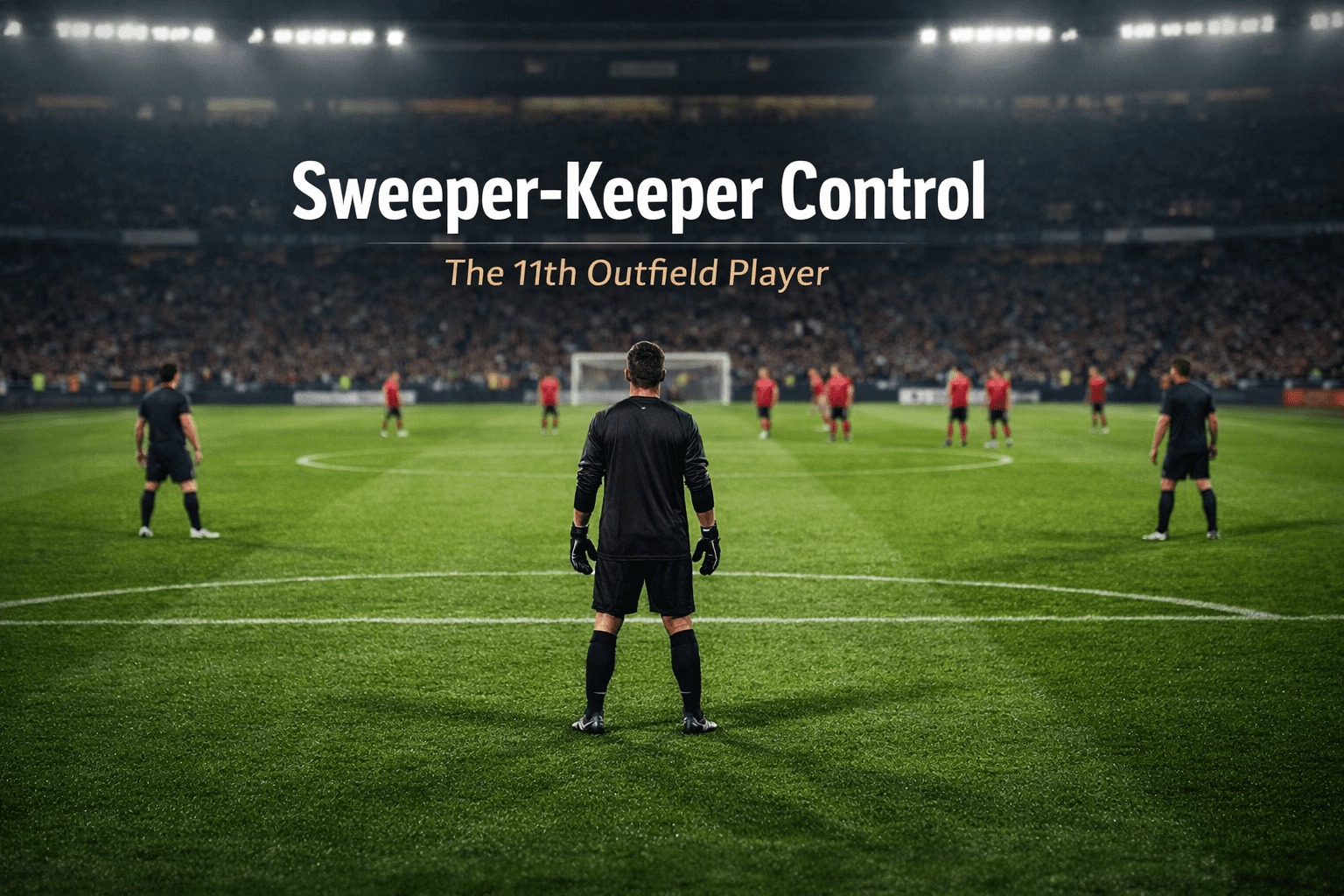
If you watched football in the 90s, the goalkeeper was a distinct entity – often isolated, tasked solely with keeping the ball out of the net. Fast forward to the Guardiola era at Manchester City or Slot’s Liverpool, and that definition has been shredded. The goalkeeper is no longer just a shot-stopper; they are the Sweeper-Keeper, effectively the 11th outfield player.
Sweeper-Keeper Definition: A goalkeeper who operates outside the penalty area to intercept through balls, support build-up play, and act as the 11th outfield player behind a high defensive line.
If you’ve watched teams like Manchester City or Bayern Munich, you’ve seen it – the sweeper goalkeeper stepping outside the box, acting as an extra defender, even dictating build-up play.
This is the sweeper-keeper. The sweeper-keeper isn’t a trend. It’s a structural necessity.
In this guide, we break down what a sweeper keeper is, why it changed modern football, and the elite tactics top teams use to dominate with it. For context on how this metric sits within the complete football tactics framework, the full guide covers every phase from pressing to build-up to defensive structure.
Key Takeaways
- The “+1” Advantage: The Sweeper-Keeper creates a numerical overload in the build-up phase, allowing teams to bypass high presses.
- Defensive Cover: By playing high, they act as a safety net for a high defensive line, clearing long balls before strikers reach them.
- Risk vs. Reward: The margin for error is zero; a mistake usually results in a conceded goal.
- Evolution: From Lev Yashin’s pioneering days to Manuel Neuer’s mastery and Ederson’s distribution.
Table of Contents
What Is a Sweeper-Keeper in Football?

A sweeper keeper is a goalkeeper who actively operates outside the penalty area to support both defensive coverage and build-up play.
Unlike traditional goalkeepers who stay close to their goal line, a sweeper keeper:
- Acts as an extra outfield player in possession
- Clears danger behind a high defensive line
- Helps break opposition pressing by offering a passing option
The role blends goalkeeping with defensive awareness and on-ball responsibility – making the goalkeeper part of the team’s tactical structure.
A Sweeper-Keeper is a goalkeeper who aggressively challenges for the ball outside their penalty area and actively participates in the team’s passing play. They combine the traditional duties of a keeper (shot-stopping, claiming crosses) with the duties of a “sweeper” defender – clearing loose balls, intercepting through-balls, and initiating attacks.
The Historical Evolution
While modern fans associate this role with Pep Guardiola, the seeds were sown decades ago.
- Lev Yashin (The Pioneer): Yashin was one of the first to leave his line to intercept crosses and organize his defense, earning him the nickname “The Black Spider.”
- Gyula Grosics (The Golden Team): The Hungarian keeper of the 1950s often played as a distinct defender, allowing the Mighty Magyars to dominate possession.
- Jan Jongbloed (Total Football): Under Rinus Michels in 1974, the Netherlands used Jongbloed not for his shot-stopping (which was average) but for his ability to wander miles from his goal, facilitating the Dutch “Total Football” fluid system.
However, it was Manuel Neuer who popularized the modern iteration. The core concept he introduced was proactivity. Instead of waiting for the danger to arrive in the six-yard box, the Sweeper-Keeper neutralizes the threat 30 or 40 yards from goal. (Neuer returned from international retirement for one last World Cup in 2026 at age 40, bowing out with Germany in the Round of 32 – but his club legacy at Bayern Munich remains the definitive blueprint for the modern sweeper-keeper role.)
When we talk about “control” in football, we usually refer to midfielders. However, a Sweeper-Keeper dictates the height of the entire team. If the keeper stays on their line, the center-backs must drop deeper, stretching the team vertically and leaving gaps in midfield. If the keeper pushes up, the team stays compact. A decade ago, this positioning would have been viewed as reckless. Today, it is the standard operating procedure for any team with championship aspirations.
A decade ago, this would have been called unnecessary risk.
Now it is standard operating procedure.
The Offensive Pivot: Building from the Back
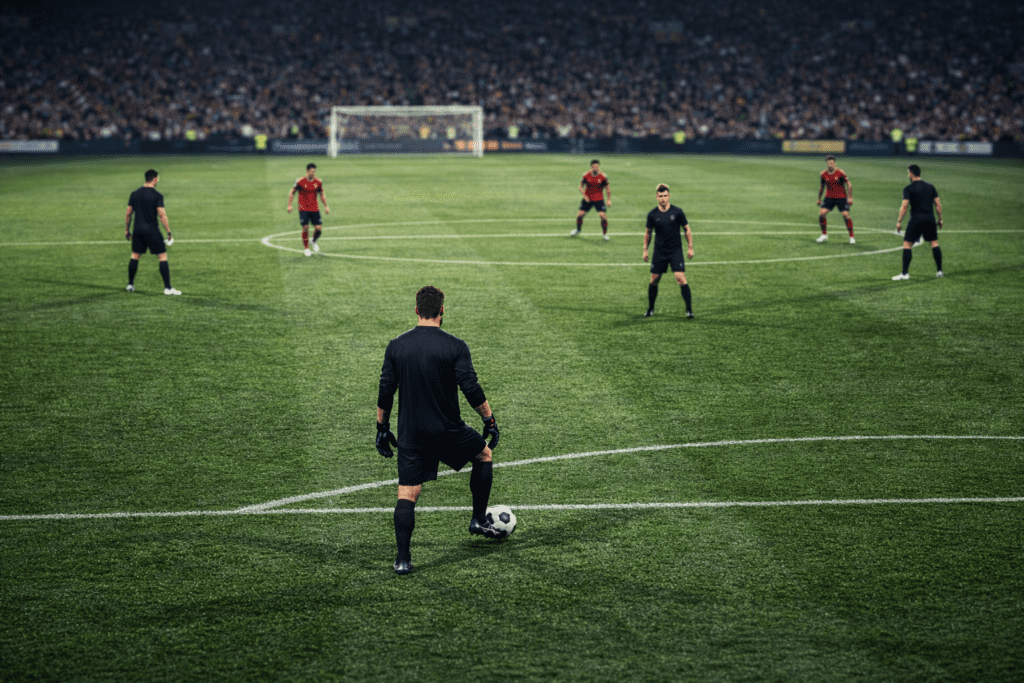
This is where the role becomes critical in modern systems. Think of the goalkeeper not as a goalie, but as a holding midfielder wearing gloves. The Sweeper-Keeper is the foundational piece of the Pillar Strategy: Build-Up Play Explained. Without a keeper who can pass, the entire concept of building from the back collapses.
In the build-up phase, the Sweeper-Keeper provides a constant passing option for center-backs under pressure. When an opponent presses high (Man-to-Man), they usually match up against the 10 outfield players. They rarely mark the keeper. This leaves the Sweeper-Keeper as the “free man” or the +1 overload.
The Passing Angles and Distribution
Elite Sweeper-Keepers like Alisson Becker, Marc-André ter Stegen, or Gregor Kobel possess the passing range of a playmaker. They utilize two primary distribution methods that define their offensive contribution:
- Breaking the First Line (The Rondo): When the center-backs split wide to the edge of the box, the keeper steps up between them. This creates a diamond shape with the holding midfielder (Pivot). If the striker presses the Center-Back, the ball goes back to the Keeper. If the striker presses the Keeper, the ball goes to the open Center-Back or the Pivot. This constant circulation tires the opposition and lures them out of position.
- The Clip (Verticality): Once the opposition commits 5 or 6 players to a high press, they leave space in the wide areas or behind their defensive line. A Sweeper-Keeper must have the technique to play a lofted “clip” pass over the pressing forwards directly to the full-backs or wingers. This single pass can take 6 opponents out of the game instantly.
This forces the opposition into a massive tactical dilemma. Do they press the keeper and risk leaving a midfielder open? Or do they sit back and let the keeper dictate play? By acting as the offensive pivot, the keeper allows the team to maintain possession statistics that were previously impossible.
Protecting the High Line

You cannot play a high defensive line without a Sweeper-Keeper. It is physically impossible.
When teams compress play into the opponent’s half, defenders often stand close to the halfway line. This leaves vast open space behind them – the Zone of Anxiety for traditional back lines.
Traditional coaching manuals hate this idea.
The Sweeper-Keeper mitigates the risk by starting high, often near the edge of the penalty arc, when their team is in possession. If a long ball is launched over the top, the keeper attacks the space before the striker can.
The key is not the sprint.
It’s the starting position.
There’s an uncomfortable truth here that rarely gets discussed: teams don’t adopt sweeper-keepers because it looks modern. They adopt them because without one, the rest of the structure eventually collapses under pressure.
Escaping the Press
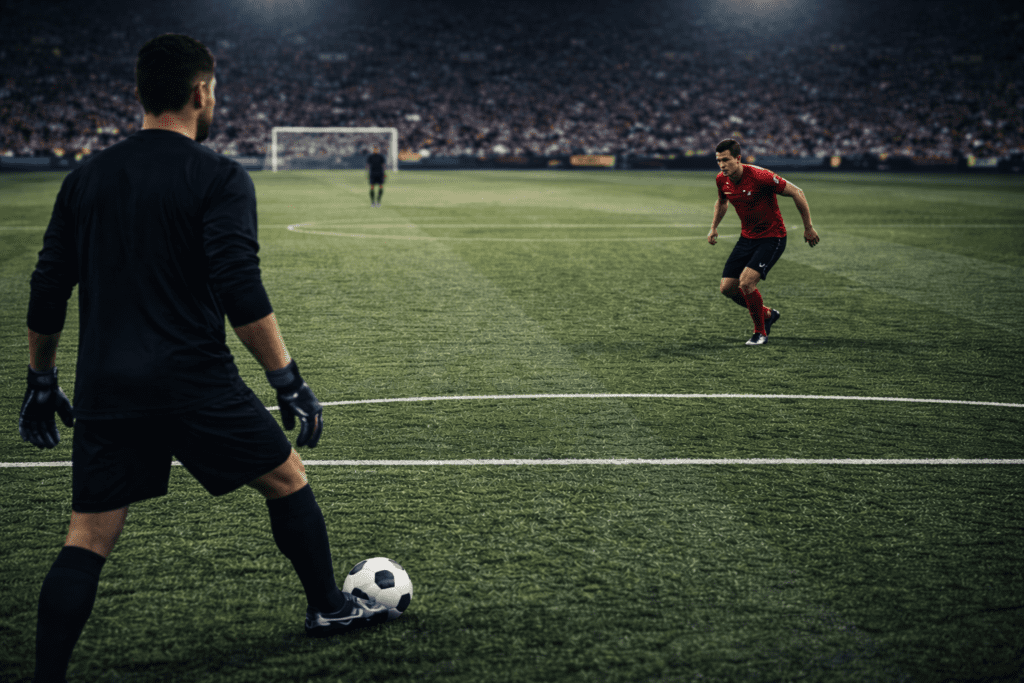
Against aggressive pressing sides, the Sweeper-Keeper becomes a pressure magnet – and that’s deliberate.
The keeper stands as the reset point when the first pass is blocked. Center-backs can widen. The pivot can drop. The press appears set… until one pass removes it entirely.
This isn’t pretty.
It’s ruthless efficiency.
Once opponents commit forward, distribution becomes a weapon. Short passes break pressure. Clipped passes punish overcommitment. One calm touch from the keeper can turn a high press into instant territorial loss.
Data Analysis: Traditional vs. Modern Keepers
To understand the scale of this role, we must look at the data. Below is a comparison between a traditional line keeper and a modern sweeper-keeper.
| Metric | Traditional Keeper (Avg/90) | Sweeper-Keeper (Avg/90) | Tactical Implication |
|---|---|---|---|
| Defensive Actions Outside Box | 0.4 | 1.8 | Active protection of open space |
| Average Pass Length (Yards) | 45.2 | 28.5 | Retention over clearance |
| Touches | 28 | 52 | Integrated into possession |
| Pass Completion % | 65% | 86% | Press resistance is mandatory |
The sweeper-keeper is statistically embedded in the flow of the game.
And even this data understates the impact, because positioning value rarely shows up cleanly in raw numbers.
Case Study: The Ederson Effect
When Pep Guardiola arrived at Manchester City, he made a decision that confused many at the time. Joe Hart was a club legend and an elite shot-stopper. But he was not a Sweeper-Keeper.
Guardiola replaced him with Claudio Bravo, and eventually Ederson. The reason was simple: Guardiola views the goalkeeper as the start of every attack.
For eight seasons the pattern repeated: Ederson waits.
The striker commits.
The pass breaks the press.
That single moment removes an entire defensive line. This is high-risk, high-reward poker played on a grass pitch.
The 2025 postscript makes the case study even sharper. Ederson left for Fenerbahçe in September 2025 after 15 trophies, and City replaced him with Gianluigi Donnarumma – an elite shot-stopper whose distribution has never been his headline skill. Watching a build-up-obsessed club adapt its structure around a less ball-dominant keeper is the clearest demonstration yet that the sweeper-keeper is a system requirement, not a personal style: either the keeper provides the +1, or the team must redesign its first phase.
Best Sweeper-Keepers in Football Right Now (2026 Rankings)
Who are the best sweeper keepers in world football as of 2026? Ranked by how completely they fulfil the role – proactive sweeping, press-resistant distribution, and high-line protection:
- Alisson Becker (Liverpool) – the most complete current example: combines elite sweeping range with world-class shot-stopping and calm distribution under pressure
- Marc-André ter Stegen (Barcelona) – the most press-resistant passer of the generation, though injuries have limited him recently
- Gregor Kobel (Borussia Dortmund) – the best high-line interceptor in Europe, reading danger before it forms
- Ederson (Fenerbahçe) – left Manchester City in 2025 after redefining distribution standards; still the reference for the 60-yard press-breaking pass
- Giorgi Mamardashvili (Liverpool) – the explosive sweeping radius that made him elite at Valencia now develops behind Alisson
- Manuel Neuer (Bayern Munich) – the pioneer, still executing the blueprint at 40; ended his international career after Germany’s Round of 32 exit at the 2026 World Cup
The interesting omission is deliberate: Gianluigi Donnarumma (Manchester City) is arguably the world’s best pure shot-stopper, but his build-up game is the weakest part of his profile – the clearest proof that “great goalkeeper” and “great sweeper-keeper” are not the same job description.
Top 5 Sweeper-Keepers by Pass Completion and Defensive Actions
| Player | Club (2026) | Pass Completion % | Sweeper Clearances/90 | Notable Trait |
|---|---|---|---|---|
| Alisson Becker | Liverpool | 89% | 0.82 | Distribution under pressure |
| Ederson | Fenerbahçe | 91% | 0.74 | Short passing range |
| Marc-André ter Stegen | Barcelona | 88% | 0.69 | Aggressive line positioning |
| Gregor Kobel | Dortmund | 85% | 0.91 | High-line interceptions |
| Giorgi Mamardashvili | Liverpool | 83% | 0.96 | Explosive sweeping radius |
Closing Analysis
The Sweeper-Keeper is not a fad. It is the standard.
Modern football is too fast, too compact, and too organized to afford a passive goalkeeper. The mistakes, when they happen, are catastrophic. But the strategic value of an 11th outfield player outweighs the occasional error.
There is no going back.
The sweeper-keeper’s origins run through Dutch positional thinking, and Brilliant Orange remains the best account of where that instinct came from. It is on the tactical reading list.
What do you think?
Which current goalkeeper do you think is the most complete sweeper-keeper right now – and is there an underrated keeper who does it better than the elite names most people overlook?
Want to read any match like this?
The framework behind these breakdowns, in one place. The four phases, a 15-minute method for diagnosing both teams before the drinks break, a printable match-watching worksheet, and 51 terms defined. 40 pages.
Get the pack$9, instant downloadRelated Tactical Breakdowns
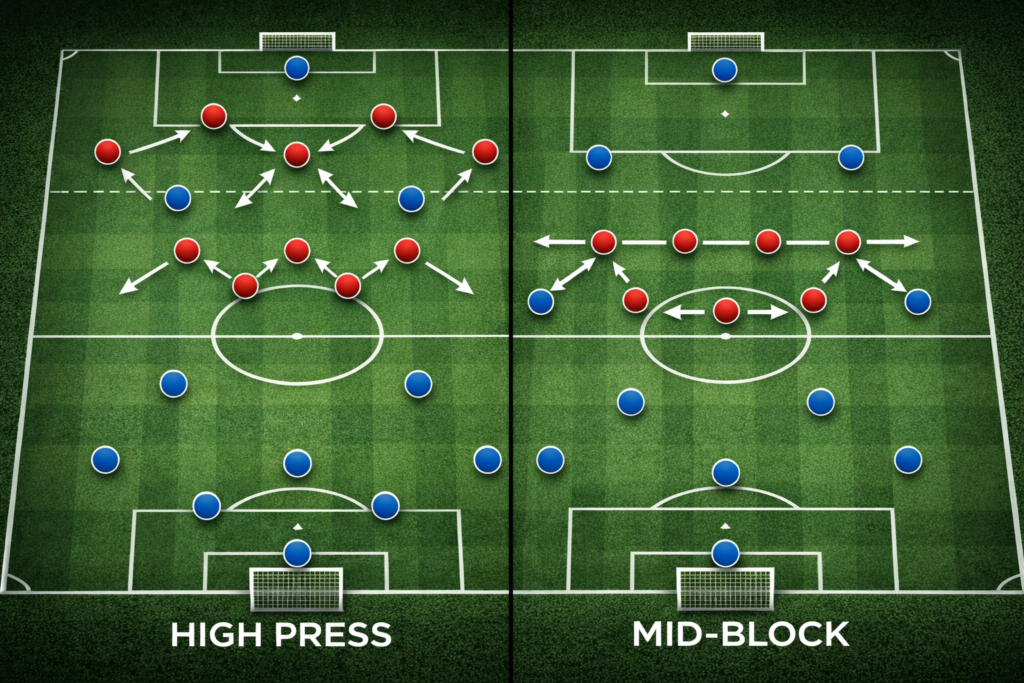
The sweeper-keeper only functions when the defensive line is set high enough to demand it – this is how elite teams build that structure from the back.
Build-Up Play Explained
High Press vs Mid-Block
Speak the language of the game
Get the free 47-term tactical glossary. Gegenpress, half-space, xT, low block, each defined in plain language and linked to a full breakdown. It is yours for an email.
Frequently Asked Questions (FAQs)
What is the biggest risk of using a Sweeper-Keeper?
Being caught out of position. A turnover can lead directly to a goal if recovery is late.
Who is the best Sweeper-Keeper in history?
Manuel Neuer. He perfected the role at the highest level for club and country.
Can a team play a low block with a Sweeper-Keeper?
It is possible, but counter-intuitive. A Low Block Defense naturally keeps the defensive line deep, meaning the keeper doesn’t need to sweep behind them. However, a Sweeper-Keeper is still valuable in a low block for their ability to launch accurate counter-attacks via long throws or passes.
Can you read a match?
Six real in-game situations, one tactical read each. See how sharp your eye is, and get the full breakdown after every answer.
Take the test