


Last updated: September 19, 2026
Juan Román Riquelme wouldn’t survive 20 minutes in Pep Guardiola’s Manchester City. Here’s why.
The #10 used to be the most important player on the pitch.
Everything went through them. They didn’t press or run – they waited, and decided the game. Today, that player doesn’t exist at the elite level. Not because the talent disappeared – but because the game evolved past them.
In this breakdown, we’ll show exactly what changed – and why modern football no longer allows a “luxury” playmaker to survive.
For many fans, that role meant players like Juan Román Riquelme, Zinedine Zidane, or the effortless control of Mesut Özil (now retired) at his peak.
They played at their own pace – They didn’t run – they glided. They didn’t press; they waited.
They were the classic #10: the conductor who shaped the game while everyone else carried the system around them.
But try placing that player into a modern pressing system – and everything breaks.
Key Takeaways
Here’s the shift in simple terms:
- The Pressing Trap: Modern football requires 11 defenders. A traditional #10 who doesn’t press leaves the team outnumbered, creating a defensive hole elite teams exploit.
- Space Compression: The “Hole” (Zone 14) no longer exists. Defenses sit deeper and narrower, suffocating the space where the #10 used to thrive.
- The Evolution of the 8: Creativity has moved deeper. Players like Kevin De Bruyne and Martin Ødegaard are “Free 8s”-playmakers who run as much as box-to-box midfielders.
- System over Individual: The reliance on a single “creator” is too predictable. Modern attacks rely on systemic rotations (automatisms) rather than individual brilliance.
Table of Contents
What is the Traditional #10?
Let’s define exactly what we are mourning here. When I talk about the “Traditional #10,” I am talking about the Enganche – the hook.

Historically, this player operated in the space between the opposition’s midfield and defensive lines. Their primary job was to receive the ball on the half-turn and slide a killer pass through to the striker. They were the primary creative hub. Everything went through them.
Think of the 4-2-3-1 formation that dominated the early 2000s. You had two holding midfielders (the pivot) whose job was to win the ball and give it to the #10. You had two wingers who stayed wide. And you had the #10, floating, drifting, looking for pockets of space.
Critically, their defensive responsibility was zero.
In the era of Arrigo Sacchi or even early Jose Mourinho, you could afford to have one player who didn’t track back. The low block was the standard. If your team lost the ball, the #10 would stay high, waiting for the counter-attack. They were preserving energy for the moment of magic.
The Tactical Diagram:
Imagine a standard pitch. The Traditional #10 occupies a very specific zone-central, just outside the penalty box (Zone 14). But in 2005, the distance between the opposition’s center-backs and their defensive midfielders was often 10-15 yards. That was the “playground.” Today, thanks to compact mid-blocks, that distance is often less than 5 yards. The playground has been paved over.
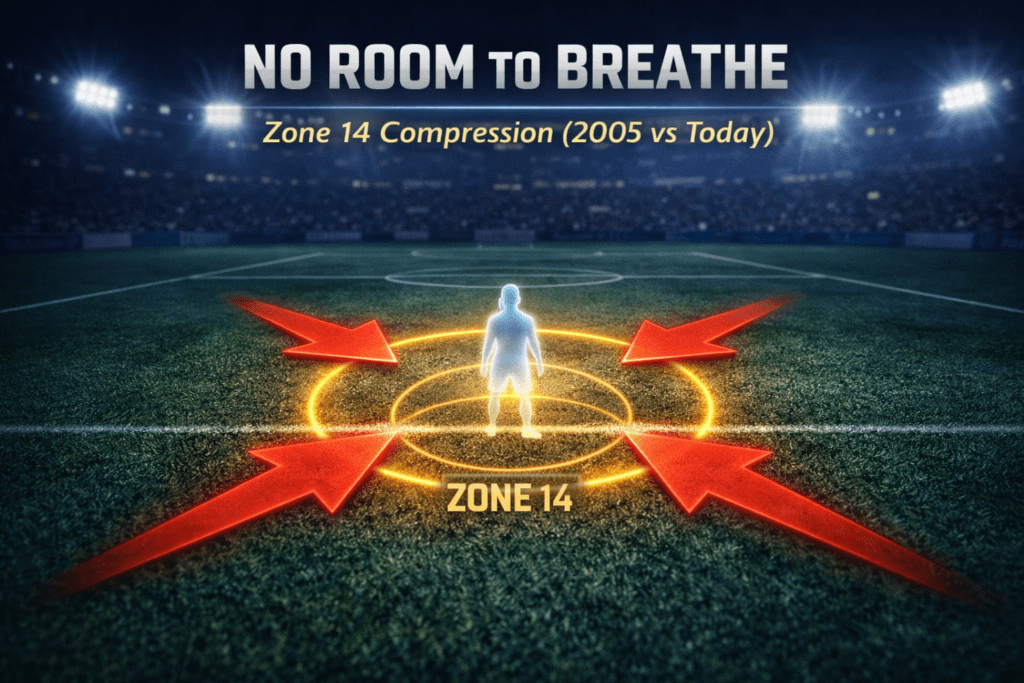
This isn’t just nostalgia talking; it’s physics. As player athleticism increased, the time a player has on the ball decreased. A #10 in the 90s might have had 2.5 seconds to turn and look. Today, they have less than a second before a defensive midfielder snaps into a tackle.
See our breakdown of positional play and spatial control to understand how this space is manipulated in modern systems.
Why Modern Pressing Systems Kill the Classic Playmaker
To truly understand this decline, we don’t need to look further than Arsenal Football Club. They provide the perfect control group for this experiment: The transition from Mesut Özil to Martin Ødegaard.
Mesut Özil was perhaps the last true, world-class Traditional #10. His vision was unparalleled. His ability to weight a pass was alien. But as the Premier League shifted toward high-intensity pressing (led by Pochettino’s Spurs and Klopp’s Liverpool), Özil became a problem.
The creativity did not disappear with him; it scattered into new roles. One heir is the raumdeuter, who interprets space between the lines instead of receiving in a fixed pocket.
Why? Because when Arsenal didn’t have the ball, they were effectively playing with 10 men.
Compare that to Martin Ødegaard today. Ødegaard wears the #8 shirt (mostly acts as a right-sided 8/10 hybrid), but he is the team’s creative hub. The difference? Ødegaard initiates the press. He triggers the defensive structure. He runs over 11km per game.
Let’s look at the data. This comparison highlights the shift in what is required from the creative focal point of a team.
| Metric (Per 90) | Traditional #10 (Archetype: Late Era Özil) | Modern #10/Free 8 (Archetype: Ødegaard/Bruno) |
| Distance Covered | 9.8 km | 11.5 km – 12.5 km |
| Pressing Actions | < 10 | 20+ |
| Defensive Duels | Low Intensity / Avoidant | High Intensity / Aggressive |
| Heat Map | Central, Zone 14 Focus | Half-Spaces, Wings, Box-to-Box |
| Ball Recovery | Rare | Frequent |
| Tactical Role | “Wait for ball” | “Win the ball / Move into space” |
This is the real shift: creativity didn’t disappear – it was redistributed.

The data tells the story. You cannot carry a passenger. In the modern game, the “Creative Midfielder” is expected to have the lung capacity of a box-to-box midfielder and the defensive discipline of a pivot. If you look at Manchester City, Kevin De Bruyne is the ultimate example. He is the best creator in the world, but he is also a physical monster who dominates transitions.
Note: De Bruyne’s 2024-25 season was significantly disrupted by injury, reducing his match contribution – but his role definition as a Free 8 remains the clearest modern template for redistributed creativity.
The Traditional #10 was a specialist. The Modern #10 is a generalist who specializes in everything.
Can Any Team Still Use a Traditional #10? The Exceptions
So, why exactly did the tactic break? Why can’t we just protect the #10?
The weakness lies in the Defensive Transition.

In modern football, the most dangerous moment is the split second you lose the ball. This is where “Counter-Pressing” (Gegenpressing) comes in. When you lose possession, the nearest players must immediately hunt the ball to prevent the opponent from launching a counter.
If your #10 is a “luxury player” who doesn’t counter-press, the opposition has an easy out-ball. They can bypass your first line of pressure instantly.
The “Man-Marking” Death Sentence
Furthermore, defensive tactics evolved. Teams started deploying athletic Defensive Midfielders (CDMs) specifically to man-mark the #10 out of the game. Think of Casemiro, Kante, or Rodri.
If a team relies solely on a Traditional #10 for creativity, and that player is man-marked by a physical beast like Rodri, the entire offensive system shuts down. This is the “Single Point of Failure” problem.
How Elite Teams Countered This:
Managers like Guardiola and Klopp realized that relying on one person in the middle was too risky. Their solution?
- Decentralized Creativity: Don’t have one playmaker; have five. The fullbacks create (Trent Alexander-Arnold), the wingers create (Salah/Saka), and the #8s create.
- The “Free 8” Movement: Instead of a static #10 in the middle, they split the role into two “Free 8s” (e.g., Man City’s De Bruyne and Silva). These players operate in the “Half-Spaces” (the channels between the wing and the center). This forces the defense to stretch. You can mark one #10, but you can’t mark two #8s in different channels without leaving gaps elsewhere.
The Traditional #10 didn’t die because they weren’t skilled. They died because the position became easy to defend against.
Players Who Killed the Number 10 Role Football: Klopp’s Pressing Revolution
Jürgen Klopp’s Liverpool (2015–2024) proved a team could dominate Europe without a traditional playmaker. His gegenpressing system required every attacker to defend – Roberto Firmino, nominally a #9, functioned as a pressing trigger rather than a finisher. This tactical shift forced rival managers to abandon luxury #10s or face losing possession battles entirely. Pep Guardiola followed suit, converting Kevin De Bruyne from a #10 into a box-to-box Free 8 who covers 11 kilometres or more per match. Even Ancelotti’s Real Madrid demanded that Bellingham press high and contribute defensively – a requirement that would have been unthinkable for a classic enganche.
What This Means on the Pitch
I miss the Traditional #10. I miss the arrogance of a player standing still while 21 others ran around him. There was a romance to it.
But football is a Darwinian sport. It evolves or it dies. The species known as the “Traditional #10” failed to adapt to the climate change of high-pressing football.

Does this mean creativity is dead? Absolutely not. Creativity has just changed shape. It has moved into the half-spaces. It has moved out wide to the “Inverted Winger.” It has even moved to the “False 9” striker dropping deep like Harry Kane or Lionel Messi.
The spirit of the #10 lives on, but the position is a relic. If you are a young midfielder reading this, do not model your game on the luxury players of the past. Model your game on the relentless engines of the present. Learn to press. Learn to run. Learn to win the ball back.
Because in modern football, if you don’t work, you don’t play.
What do you think?
Is the traditional #10 truly extinct – or has the role simply evolved into something harder to recognise? Could a player like Riquelme or Özil survive in today’s high-press systems, or has modern football made individual creators impossible?
Want to read any match like this?
The framework behind these breakdowns, in one place. The four phases, a 15-minute method for diagnosing both teams before the drinks break, a printable match-watching worksheet, and 51 terms defined. 40 pages.
Get the pack$9, instant downloadRelated Tactical Breakdowns
The traditional #10 was killed by football pressing systems and space compression – these breakdowns show exactly how modern teams replaced individual creativity with collective structure.
Build-Up Play Explained
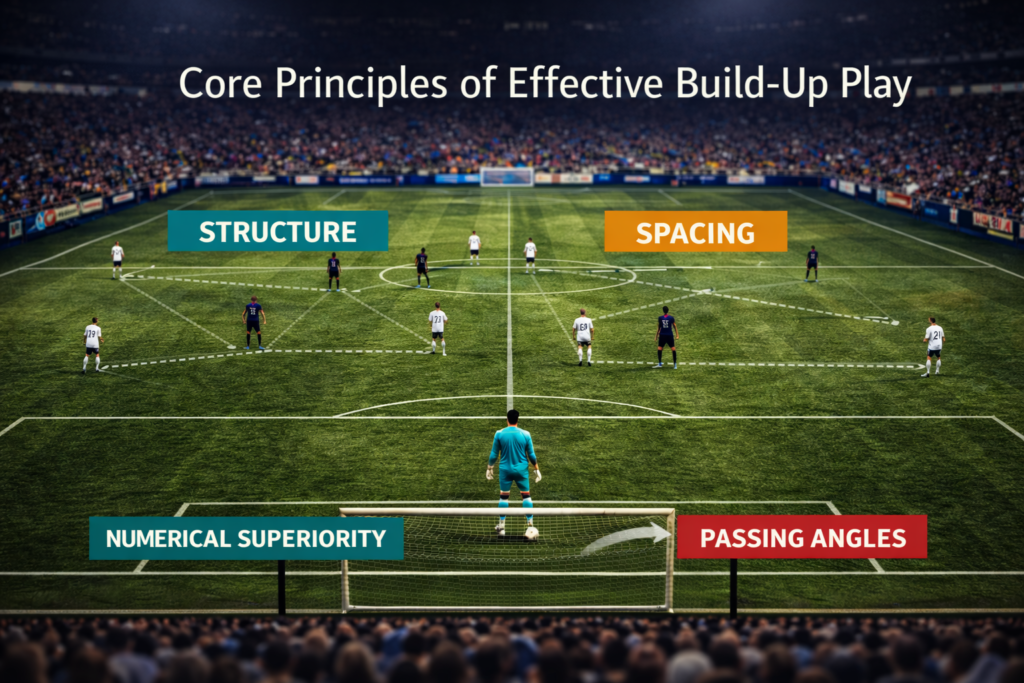
Football Overloads and Isolations

High Press vs Mid-Block
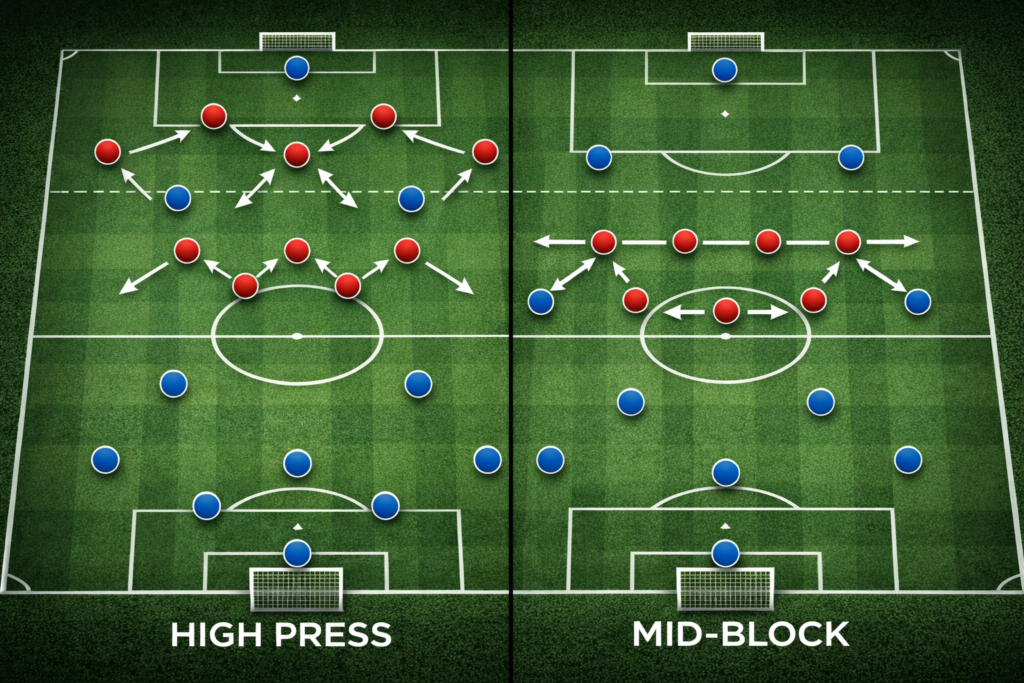
Frequently Asked Questions (FAQs)
What is the difference between a #10 and a False 9?
A #10 is a midfielder who advances to support the striker. A False 9 is a striker who drops deep into midfield. While they often end up occupying the same space (Zone 14), their starting positions and defensive responsibilities differ. The False 9 drags center-backs out of position; the #10 operates behind the lines.
Are there any Traditional #10s left?
At the absolute elite level (Champions League semi-finals)? Very few, if any. You might see elements of it in players like Paulo Dybala or classic South American leagues (Brasileirão or Argentine Primera), where the pace is slightly slower. But in the Premier League, the role has been completely eradicated.
Who is the best example of a “Modern #10”?
Jude Bellingham (at Real Madrid) and Jamal Musiala (at Bayern Munich) are the prototypes. They have the dribbling and vision of a #10, but the physique, engine, and defensive work rate of a box-to-box midfielder. They are “Total Footballers.”
Why did modern pressing systems kill the traditional number 10?
Because a player who doesn’t press leaves the team defending with 10 men. Elite pressing systems like Klopp’s Liverpool required all attackers to contribute defensively, making luxury non-pressers impossible to accommodate.