

Last updated: September 19, 2026
At Anfield in 2018-19, Roberto Firmino completed 41 passes in his own half across the Champions League knockouts. Not in midfield. In his own half. Liverpool’s number 9 spent more time defending than most centre-backs, and Klopp’s side reached two finals on the back of it.
That season, Olivier Giroud won 71% of his aerial duels for Chelsea – the highest rate of any Premier League starter that year, per FBref. Two strikers, two completely different jobs. Both played as the spearhead of their team. Neither could have played the other’s role for a single match.
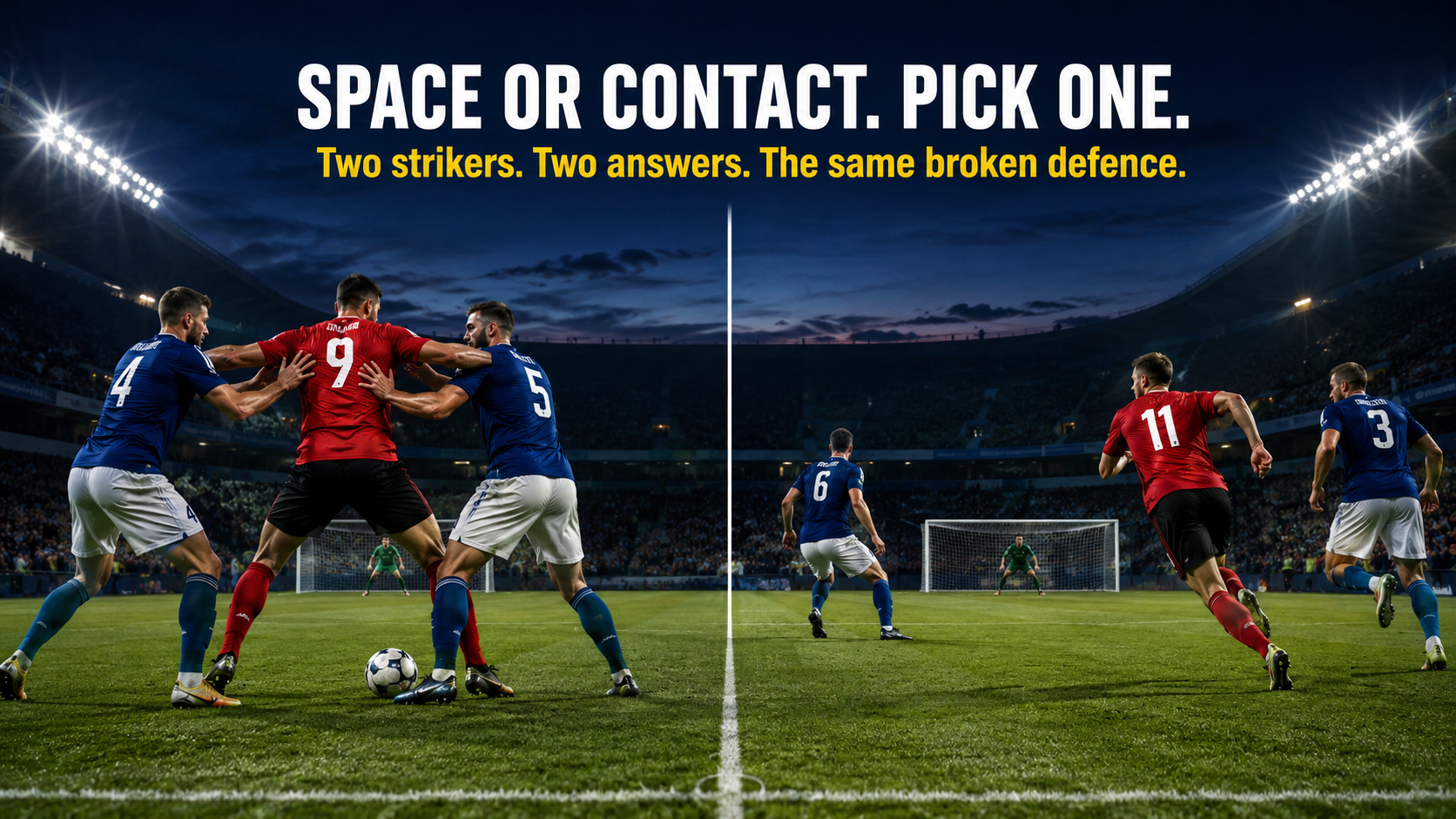
In simple terms: A False 9 creates space by leaving the striker position. A Target Man creates space by holding it.
This article breaks down the False 9 vs Target Man contrast: the mechanism behind each role, the system requirements that make them work, and why the binary has started to collapse at the elite level. For the wider framework these strikers operate inside, see our football tactics hub.
| Role | Position | Key Trait | Best Used In | Player Example |
|---|---|---|---|---|
| False 9 | Drops deep from CF | Space creation | Possession systems | Firmino, Palmer |
| Target Man | Holds CF position | Aerial dominance | Direct systems | Calvert-Lewin, Gyökeres |
| Hybrid Striker | Fluid | Both | High-press + direct | Kane, Benzema |
The False 9 and the Target Man represent two opposing answers to the same question: how do you use your striker to break a defense? One pins defenders in their own half through physical dominance and aerial threat. The other removes himself from the equation entirely – dropping deep, dragging centre-backs out of position, and handing wingers an empty box to run into. The False 9 vs Target Man debate is not about which role is superior. It is about which tool fits your system. Understanding that difference is the foundation of reading modern football.
Key Takeaways
- Opposing Philosophies: The False 9 vs Target Man debate is about Space vs. Contact. One creates space by leaving it; the other creates space by dominating it.
- Defensive Reaction: Target Men pin defenders back; False 9s drag defenders out.
- Wingers are Key: Target Men need crossers; False 9s need runners.
- Evolution: The modern elite striker (Kane, Benzema) often combines traits of both, making the strict distinction less clear at the highest level.
- Situational Use: The Target Man remains the ultimate “Plan B” for breaking down stubborn defenses or chasing late goals.
Table of Contents
Defining the Target Man: The Physical Anchor
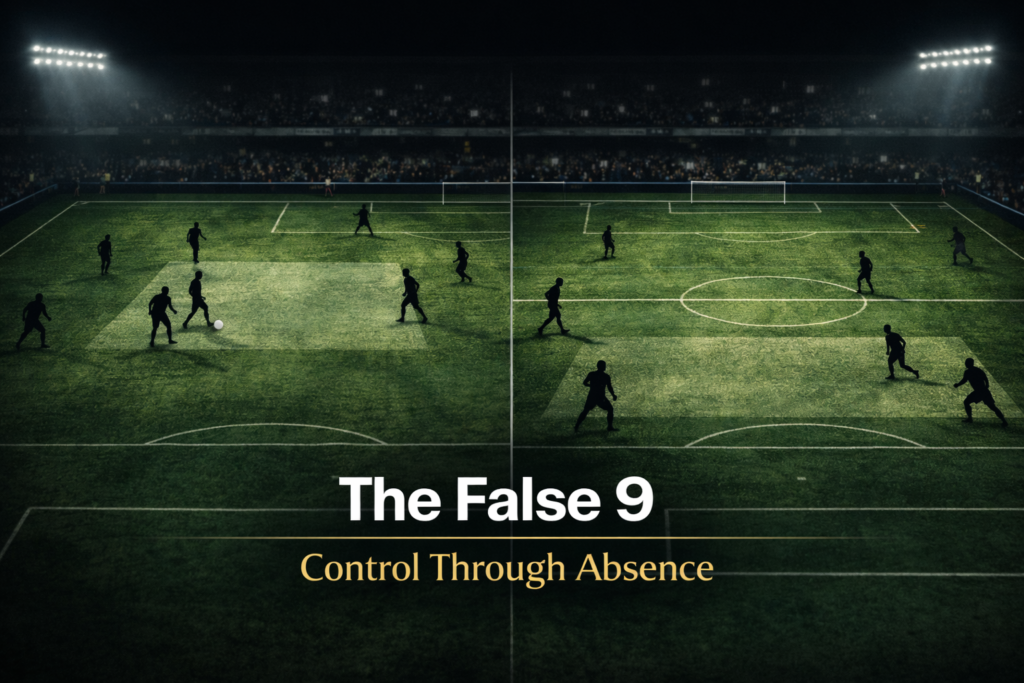
A Target Man is a centre-forward whose primary function is to hold the ball under pressure, win aerial duels, and pin the opposition centre-backs deep. The role is not about height – it is about function. Olivier Giroud, Edin Džeko, and Didier Drogba defined the modern template through hold-up play, not heading alone.
In the modern game, “Target Man” is often used as a slur by tactical analysts. They equate it with “hoof-ball” or a lack of technical ability. This is a gross misunderstanding of the role. A true Target Man is not just a tall player; they are the team’s oxygen outlet. When the midfield is suffocated by a high press, the Target Man provides the “out ball.”
The Wall
Young analysts must watch Olivier Giroud, during his peak years at Arsenal, Chelsea, and AC Milan. He is the archetype. He isn’t fast. He isn’t going to dribble past three players. But play the ball into his chest, and it sticks like glue. The Target Man acts as a wall against which the rest of the team can bounce passes. He pins the opposition center-backs back, forcing them into a physical wrestling match they cannot afford to lose.
This physical pinning is crucial. By occupying the two center-backs, the Target Man creates pockets of space behind him for wingers or attacking midfielders to run into. In a False 9 vs Target Man comparison, this is the primary differentiator: the Target Man craves contact. He wants the defender on his back. He wants to feel the pressure so he can roll his man or lay the ball off to an onrushing midfielder.
The Aerial Threat
We cannot ignore the vertical dimension. The Target Man forces the opposition to defend the entire box, specifically the air. If you are playing against a low block (a defense sitting deep), intricate passing often fails. Sometimes, you need the blunt instrument. You need a cross into the box and a header won through sheer willpower. This creates chaos, second balls, and ugly goals. And in my experience, ugly goals count just the same as the beautiful ones.
The False 9 Role Explained: Architecture of Deception
A False 9 is a striker who deliberately abandons the central striker position by dropping into midfield, creating a numerical overload and a defensive dilemma. The role was popularised at modern elite level by Lionel Messi under Pep Guardiola at Barcelona between 2009 and 2012, though Hungarian and Austrian sides had toyed with the concept as early as the 1930s.
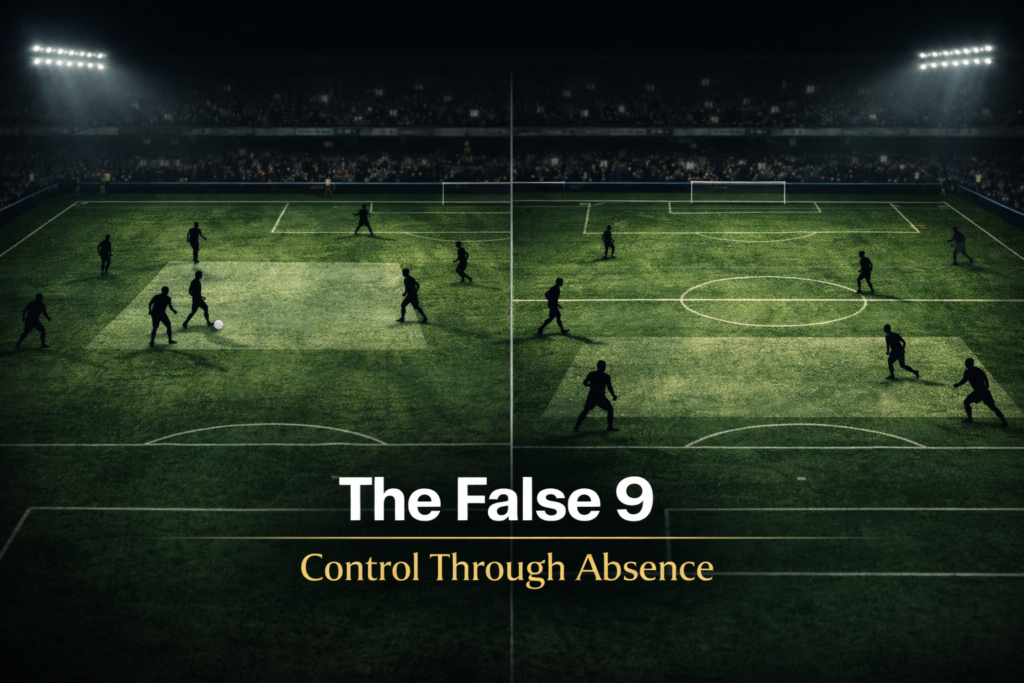
The concept of the False 9 isn’t new (the Austrians and Hungarians toyed with it in the 1930s and 50s), but its modern incarnation is the most disruptive tactical innovation of the last 15 years. The False 9 vs Target Man debate exists because the False 9 breaks the fundamental rule of being a striker: stay up top.
Roberto Firmino at Liverpool is the clearest case study in the False 9 role at elite level. Firmino rarely led the line in a traditional sense – instead, he constantly dropped into the channels between midfield and defence, creating numerical overloads that Mohamed Salah and Sadio Mané exploited on the outside. His goal return was modest by striker standards. His positional disruption was not. Jürgen Klopp built an entire pressing and transition system around a striker whose primary job was to be everywhere except where defenders expected him.
The Vacated Space
The False 9 starts in the striker position but drops deep into the midfield “hole” (the space between the opposition midfield and defense). This creates a nightmare scenario for the opposition center-backs.
I’ve watched world-class defenders like Sergio Ramos and Giorgio Chiellini look visibly confused when facing a False 9. They have a choice:
- Follow the striker: If the center-back follows the False 9 into midfield, he leaves a massive gap in the defense for wingers (like Salah or Mane) to sprint into.
- Stay put: If the center-back stays in his line, the False 9 turns and runs at the defense with momentum, creating a numerical overload in midfield (usually 4 vs 3).
The Midfield Overload
When we analyze False 9 vs Target Man, the False 9 wins on control. By dropping deep, they essentially become an extra midfielder. This allows the team to dominate possession. Think of Lionel Messi at Barcelona or Roberto Firmino at Liverpool. Firmino didn’t score 30 goals a season, but his movement unlocked everything for Salah and Mane. He was the system.
The False 9 requires a high football IQ. It is not about brute strength; it is about timing. It is about knowing when to drop and when to arrive in the box.
Direct Comparison: Power vs. Space
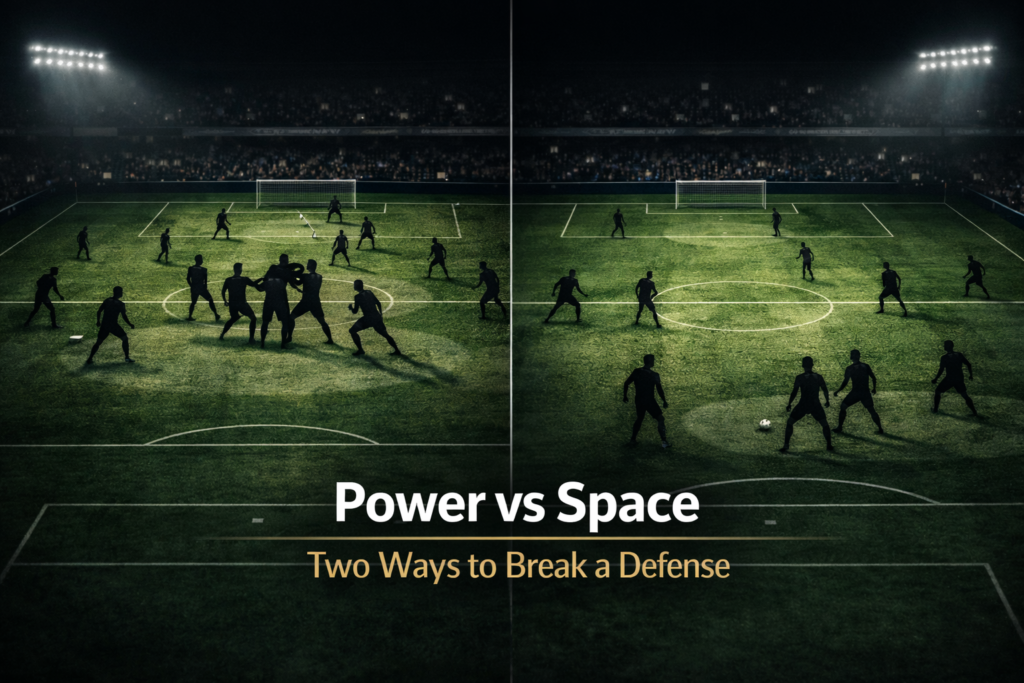
To make this False 9 vs Target Man discussion concrete, let’s look at the direct attributes. I’ve broken this down into a “Tale of the Tape” to highlight where the friction points lie.
| Feature | Target Man | False 9 |
| Primary Zone | The Penalty Box & Opposition Defensive Line | The “Hole” (Zone 14) & Half-Spaces |
| Physicality | High Strength, Height, Aerial Ability | Agility, Balance, Low Center of Gravity |
| Defender Interaction | Engages contact; pins defenders physically | Avoids contact; drags defenders out of position |
| Key Skillset | Heading, Shielding, Lay-offs, Finishing | Dribbling, Through-balls, Vision, Link-up |
| Tactical Goal | Create depth and win aerial duels | Create midfield overloads and exploit gaps |
| Best Wingers | Creators who cross the ball | Goal-scorers who run in behind |
| Archetypes | Olivier Giroud, Edin Dzeko, Didier Drogba | Lionel Messi, Roberto Firmino, Francesco Totti |
The starkest contrast in the False 9 vs Target Man battle is how they treat the opposition center-backs. The Target Man wants to be their nightmare; the False 9 wants to be a ghost they can’t touch.
The Numbers Behind the Roles (2024-25 season averages)
| Metric | Target Man archetype | False 9 archetype | Tactical implication |
|---|---|---|---|
| Aerial duels per 90 | 5.8 | 1.4 | Target Man as primary aerial outlet vs False 9 avoiding contact |
| Touches in own half per 90 | 4.2 | 11.6 | False 9 functions as auxiliary midfielder |
| Progressive passes received per 90 | 8.9 | 4.7 | Target Man as receiver of direct service vs False 9 as combination player |
| Shots per 90 | 3.1 | 2.4 | Target Man finishes more, False 9 creates more |
Data reflects average per-90 metrics for representative starters in each archetype across the 2024-25 top-five European leagues, per FBref. Individual player and seasonal variance applies.
False 9 vs Centre Forward: The Core Distinction
The confusion between a False 9 and a traditional centre forward is understandable – both wear the same shirt number and occupy the same starting position. The difference emerges the moment the ball is in play.
A traditional centre forward stays high, pins the defensive line, and attacks the box. His value is measured in goals and aerial duels won. A False 9 abandons that position deliberately – dropping into midfield to receive, combine, and create the space his teammates will run into.
The tactical implication is significant. Against a traditional centre forward, a centre-back can track and engage. Against a False 9, following him means leaving the defensive line short. Staying means allowing him to receive freely. That dilemma – defend the space or defend the man – is what makes the role tactically disruptive rather than merely positionally unusual.
Best False 9 and Target Man Players in 2026
The False 9 role demands technical excellence and spatial intelligence. The best current exponents include players like Pedro Neto, Cole Palmer, and Bukayo Saka when used centrally – players who vacate the striker position to create rather than finish.
The Target Man archetype remains alive through strikers like Dominic Calvert-Lewin, Richarlison, and players in his mould who anchor the line through physicality and aerial duels.
The real evolution sits in hybrid strikers. Harry Kane and Karim Benzema (during his Real Madrid years from 2018 to 2022) redefined both archetypes – Kane through deep dropping and combination play, Benzema through pure spatial manipulation. Viktor Gyökeres playing style and Erling Haaland now represent the next question: can elite goal volume coexist with positional intelligence?
The Tactical Evolution: Why Both Still Matter
You might think, based on the hype around modern tactics (2025-26 season), that the False 9 has won the war. That the Target Man is a dinosaur. You would be wrong.
In the last three seasons, we have seen a resurgence of the “Number 9,” but with a twist. The False 9 vs Target Man football debate has actually merged into a hybrid role.
The evolution of striker roles in modern football reflects a broader tactical arms race. As defensive structures became more organised and compact, the traditional centre forward – reliant on service and finishing – lost effectiveness against low blocks. The False 9 emerged as a solution: a striker who creates rather than waits. But as defences adapted to that too, the pendulum has partially swung back. Direct systems, vertical pressing triggers, and counter-attacking football have rehabilitated the Target Man as a legitimate elite option. The lesson is not that one role is superior – it is that role effectiveness is always system-dependent.
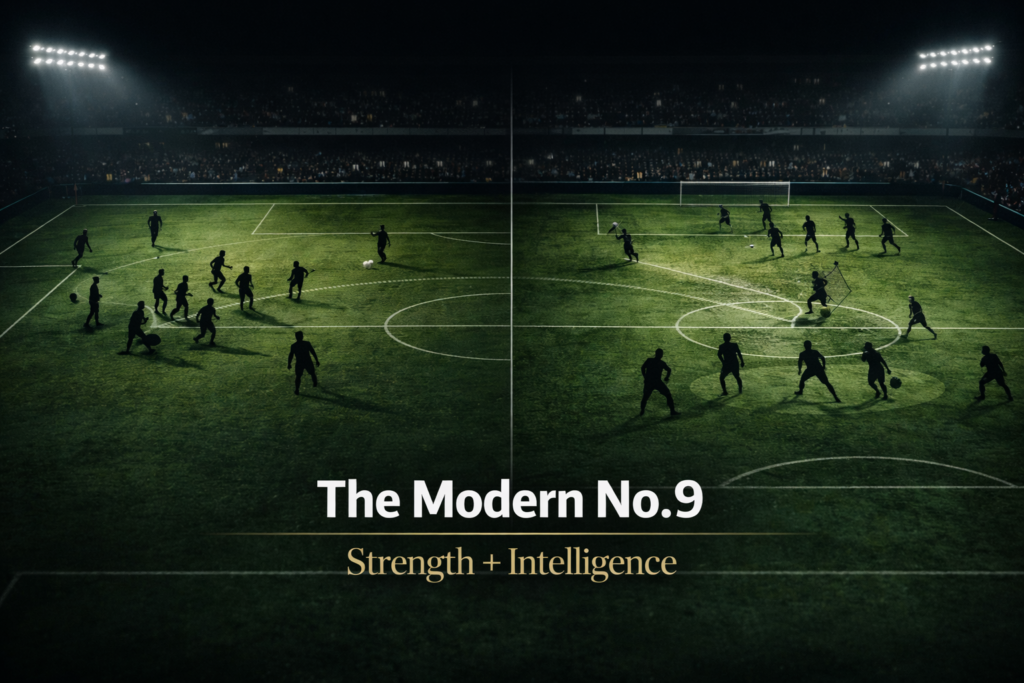
The Modern Hybrid
Look at Erling Haaland or Harry Kane. Harry Kane, in particular, is the perfect synthesis. He has the body of a Target Man – he can win headers, shield the ball, and fight center-backs. But watch him play for England or Tottenham (formerly). He drops deep like a False 9, spraying passes out wide before arriving late in the box.
This evolution suggests that the False 9 vs Target Man binary is dissolving. The best modern strikers must do both. They must be strong enough to hold the ball (Target Man) but intelligent enough to vacate the space when the game is congested (False 9).
However, pure specialists still exist. When a team is chasing a game with 10 minutes left, they don’t bring on a False 9; they bring on a giant Target Man to cause havoc in the box. Conversely, when a team wants to control a game against a low block, the False 9 remains the superior tool to break the lock.
System Requirements: Building Around the Role
You cannot simply plug a player into a system and hope for the best. The False 9 vs Target Man decision dictates your entire team structure.
If You Choose a Target Man…
You need service. A Target Man is useless if he is isolated.
- Wingers: You need traditional wingers or full-backs who can cross the ball accurately.
- Midfield: You need runners who will go beyond the striker to pick up the knock-downs.
- Tempo: You can play more direct. Long balls are a valid strategy, not a sign of desperation.
If You Choose a False 9…
You need movement. A False 9 dropping deep is pointless if nobody runs into the space he creates.
- Wingers: You need “Inside Forwards” (Goal-scoring wingers). Think Son Heung-min or Mo Salah. They must be the primary goal threats.
- Midfield: You need technicians who can play quick, one-touch wall passes to exploit the overload.
- Tempo: Requires patience. You are looking for the perfect opening, not the quick cross.
The False 9 vs Target Man choice is essentially a choice of identity. Do you want to batter the door down, or do you want to pick the lock?
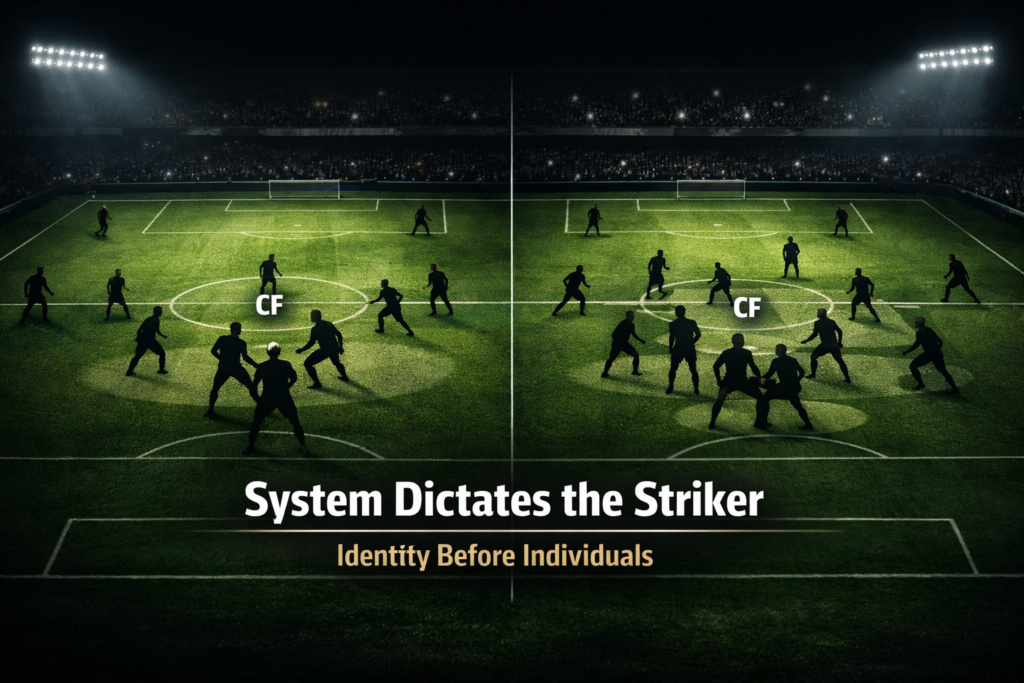
How Defences Counter Both Roles
Neither striker archetype is unbreakable. Both have specific weaknesses elite defences exploit, and the counters are almost mirror opposites.
The False 9 is countered by structural discipline. When the striker drops deep, the centre-back’s instinct is to follow. Diego Simeone’s Atletico Madrid built a decade of European football on refusing that instinct – the centre-back stays, the defensive midfielder steps up to pick up the dropping striker, and the back four holds its line. Pep Guardiola’s Barcelona False 9 worked because La Liga defences kept following Lionel Messi out of position. Champions League knockouts produced fewer goals from the same movement, because elite continental defences had learned to switch off the man and defend the space.
The Target Man is countered by pre-emption. The simplest method is the front-foot centre-back who steps in before the ball arrives – per The Analyst, Premier League centre-backs win an average of 64% of aerial duels when they engage early versus 41% when the striker is allowed to set himself first. Carlo Ancelotti’s Real Madrid centre-backs (Antonio Rüdiger, Eder Militão) routinely engaged a Target Man before the ball landed, neutralising the hold-up sequence before it began. The second method is denying the supply line: cut off the wide crossers and the Target Man becomes an isolated reference point with nothing to attack.
The deeper point is that both counters require coaching at the defensive line, not at the striker. The role isn’t broken; the defensive structure around it is what either contains or releases the threat.
The Bigger Picture
I have spent decades watching this beautiful game, and if there is one thing I have learned, it is that tactical trends are cyclical. The False 9 vs Target Man argument isn’t about one being “better” than the other. It is about the right tool for the right job.
There is a visceral joy in watching a Target Man bully a defender, chest the ball, and volley it home. It connects to the primal roots of the sport. Yet, there is an intellectual beauty in watching a False 9 manipulate an entire defense without touching the ball, creating passing lanes that didn’t exist seconds before.
As you build your tactical knowledge or your own team, don’t ask which is better. Ask yourself: Where do I want the space to be? Do you want it in front of the defense (False 9) or behind it (Target Man) and that is where this breakdown of False 9 vs Target Man will help you?
For a broader view of how striker roles fit within team systems, explore our football tactics framework.
The answer to that question will decide who wears the Number 9 shirt for you.
The false nine’s history, from the Danubian school through to Messi, is told in Inverting the Pyramid – one of the titles on the tactical reading list.
What Do You Think?
Which modern striker do you think best combines False 9 movement with Target Man physicality – and is there a player outside the elite clubs who fits this hybrid role better than anyone gives them credit for?
Want to read any match like this?
The framework behind these breakdowns, in one place. The four phases, a 15-minute method for diagnosing both teams before the drinks break, a printable match-watching worksheet, and 51 terms defined. 40 pages.
Get the pack$9, instant downloadRelated Tactical Breakdowns
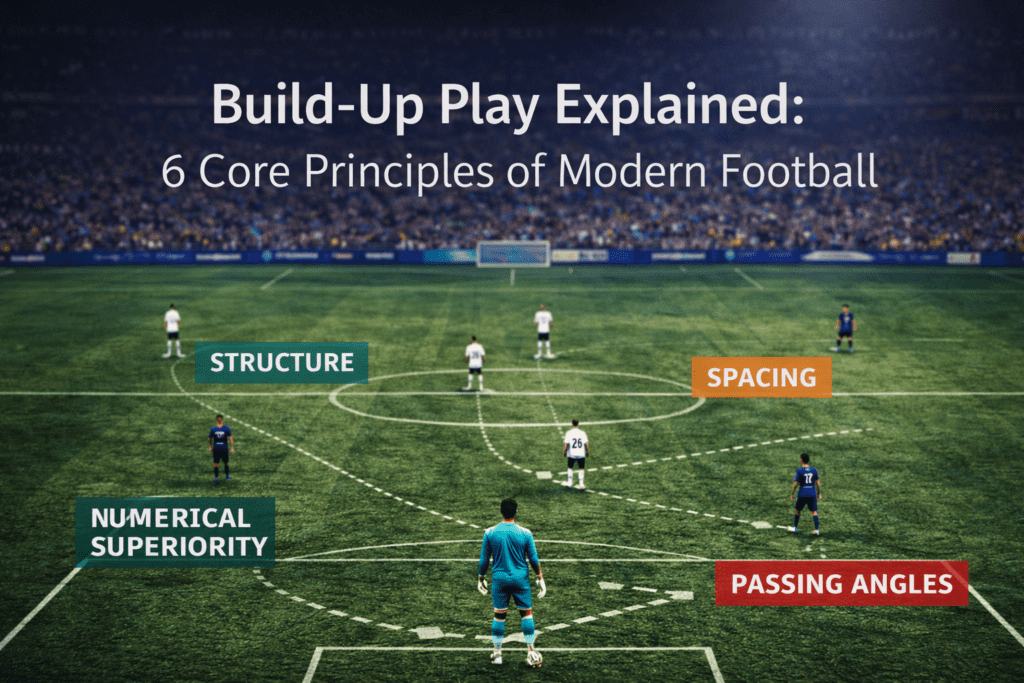
Why it connects: The False 9 only works when the build-up structure creates time on the ball in deep zones – this article breaks down how elite teams manufacture that time.*

Football Overloads and Isolations
Why it connects: A False 9 creates a midfield overload by definition. This article explains the principle behind every overload-and-isolate sequence the False 9 enables.
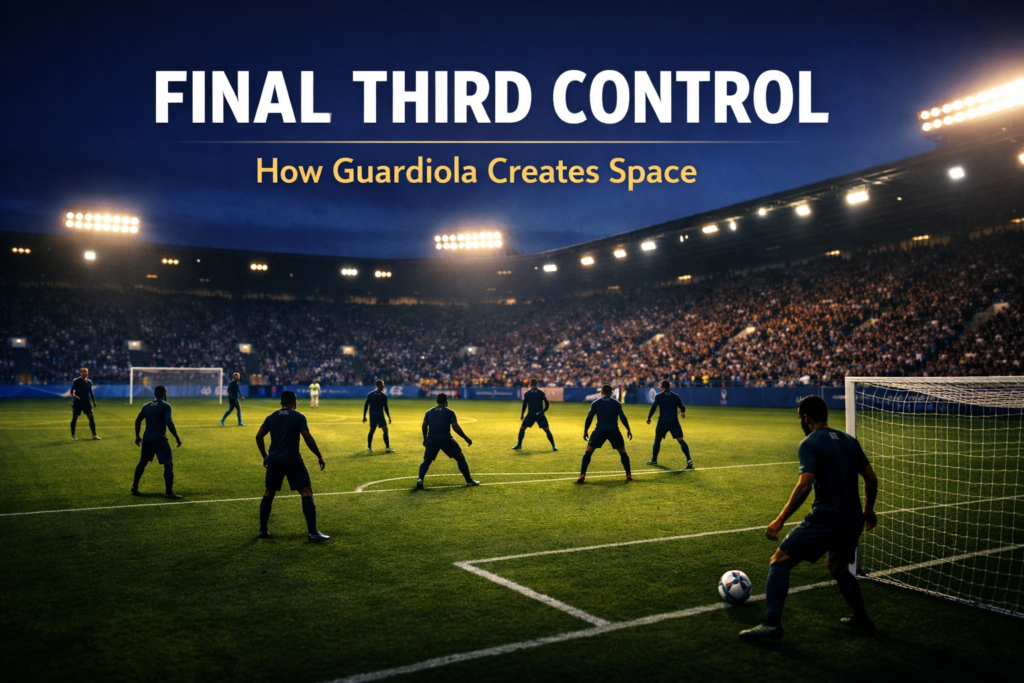
Pep Guardiola Final Third Tactics
Why it connects: Guardiola’s Barcelona False 9 is the canonical reference. His current final-third mechanics show how the same principle has evolved without the original Messi-as-False-9 template.
Speak the language of the game
Get the free 47-term tactical glossary. Gegenpress, half-space, xT, low block, each defined in plain language and linked to a full breakdown. It is yours for an email.
Frequently Asked Questions (FAQs)
Is the Target Man role dead in modern football?
The Target Man role is alive but evolved. Elite clubs now use hybrids like Erling Haaland and Victor Osimhen who combine physical dominance with pace, replacing the pure “big man” template. The tactical need for an aerial outlet and a defender to pin will never disappear from the game, especially against low blocks.
Can a small player be a Target Man?
Yes, a small player can be a Target Man if their function fits. “Target Man” describes the role – shielding, hold-up, lay-offs – not the height. Carlos Tévez and Sergio Agüero performed the function through balance and lower-body strength, though both lacked the aerial threat that defines the traditional version.
Why do teams struggle to defend against a False 9?
A False 9 forces a defensive decision the centre-back is not trained for. Standard zonal and man-marking systems assume the striker stays high. When the striker drops, the defender must choose – follow and leave a gap behind, or hold and concede the midfield overload. That hesitation is what breaks defensive structure.
Who was the best False 9 of all time?
Lionel Messi under Pep Guardiola at Barcelona (2009-2012) is the canonical False 9 performance, per Coaches Voice analysis. Francesco Totti’s earlier interpretation at Roma under Luciano Spalletti proved the role’s viability at the top level and arguably defined the modern template Guardiola later refined.
False 9 vs Target Man: Which is better for youth development?
Neither role is “better” for youth – both teach different skills. The False 9 develops technical control, scanning, and spatial awareness. The Target Man develops resilience, shielding under pressure, and back-to-goal play. A complete striker education includes exposure to both roles before specialisation begins.
What is the difference between a False 9 and a traditional centre-forward?
A traditional centre-forward stays high, pins the defensive line, and attacks the box. A False 9 abandons that position deliberately – dropping into midfield to receive, combine, and create the space teammates will run into. Against a centre-forward, a centre-back can track and engage. Against a False 9, following him means leaving the defensive line short. Staying means allowing him to receive freely. That dilemma is what makes the role tactically disruptive rather than merely positionally unusual.
What is the difference between a False 9 and a number 9?
The number 9 is positional shorthand for a central striker. A False 9 wears the shirt but subverts the role – operating between the lines rather than ahead of the defence. The confusion between the terms reflects how drastically Guardiola-era football redefined what a number 9 is expected to do.
What system suits a False 9 best?
A False 9 requires three structural elements to function: dynamic runners from midfield who attack the space vacated centrally, wide forwards with licence to cut inside and threaten the box, and a possession-based build-up that gives the False 9 time on the ball in deep zones. Remove any one of these and the role becomes a liability – a striker who is neither finishing nor linking play effectively.
Do modern strikers need to play as a False 9?
Not necessarily. The Target Man is undergoing a revival in direct, counter-attacking systems. What modern strikers need is positional flexibility – the ability to read when to hold the line and when to drop. Viktor Gyökeres and Erling Haaland represent two different answers to that question: Gyökeres blends both functions, Haaland refuses the False 9 role entirely and forces the system to adapt around him.