
Last updated: September 19, 2026
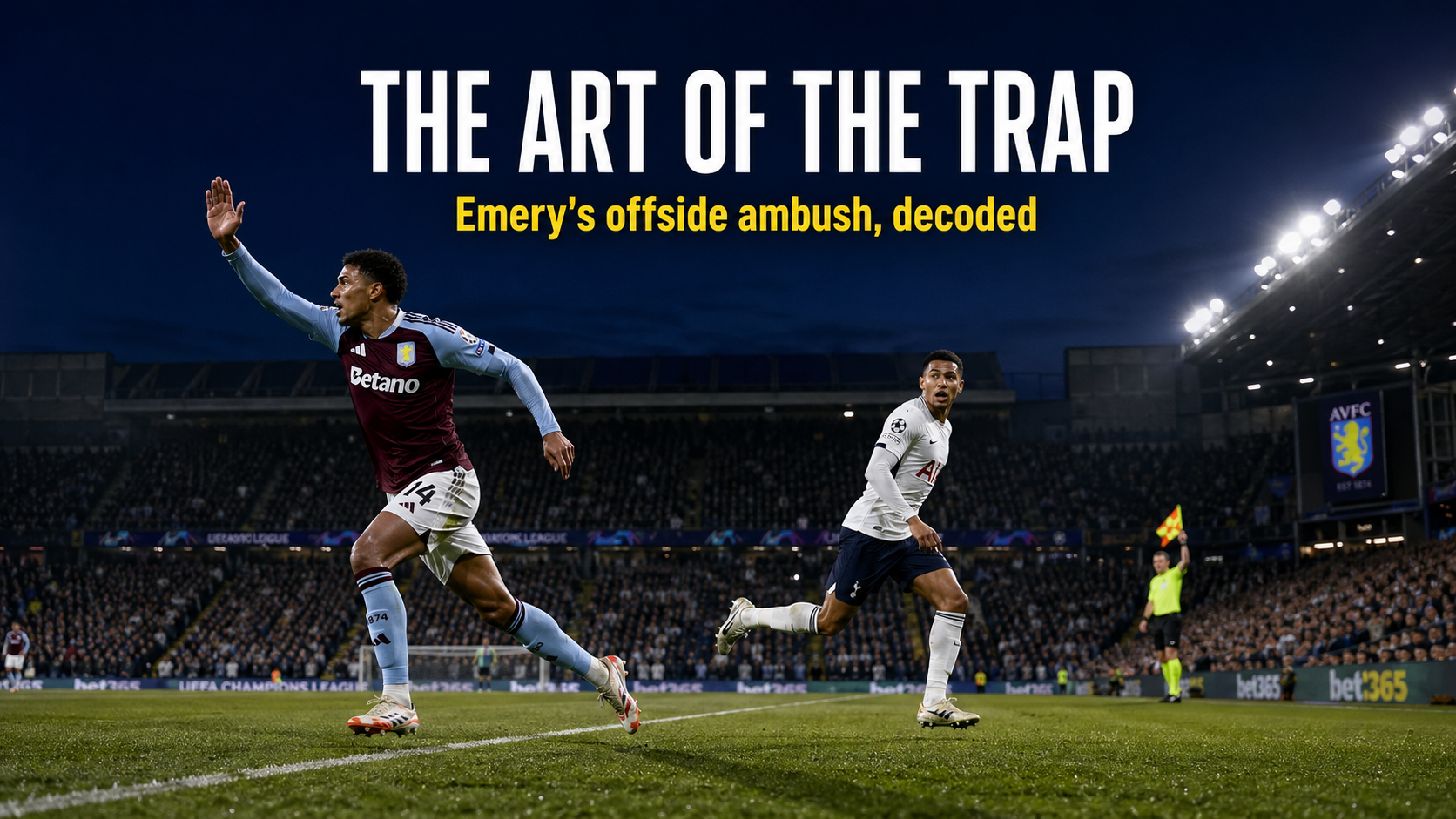
In one 2022-23 match, Aston Villa caught Tottenham offside nine times in ninety minutes. Son Heung-min, one of the fastest finishers in the Premier League, spent the afternoon staring at a raised flag. The match was not a fluke; it was a blueprint. Per Sky Sports analysis of Unai Emery’s first months in charge, Villa caught the opposition offside 63 times in 14 games.
Emery had built a trap. Within the wider football tactics framework, the high line trap is best read as an offensive use of defensive geometry, where the back four and goalkeeper coordinate to deny depth before the ball is even played.
In simple terms: The Unai Emery high line trap is a coordinated offside ambush where Villa’s back four steps up in unison the moment a forward pass is triggered.
This breakdown covers the structure, the personnel, the data, and the precise weakness elite counter-attacking teams have learned to exploit.
Key Takeaways
- The Trap Is Aggressive, Not Passive: Villa’s high line is engineered to bait through balls and catch them offside, not absorb pressure. Emery treats the offside rule as a defensive weapon.
- Line Height Hides the Risk: Sky Sports data showed Villa with the second-deepest passing-sequence start point at 39.43m under Emery, despite stepping their back four up to halfway. Compactness, not absolute position, is the variable.
- The Goalkeeper Is the Insurance Policy: Emi Martinez sweeps behind the line more than any other Premier League goalkeeper, converting failed traps into covered space.
- Personnel Drives the Mechanism: Ezri Konsa commands the line. The trap collapses when he is unavailable.
- The Weakness Is Lateral, Not Vertical: Beating the trap straight is rare. Beating it with a square pass to the far-side is where elite counter-attacking sides have repeatedly hurt Villa.
Table of Contents
What Is the Unai Emery High Line Trap?
The Unai Emery high line trap is a coordinated defensive mechanism where Aston Villa’s back four steps up in unison the moment an opposition pass goes vertical, deliberately playing forward runners offside instead of tracking them.
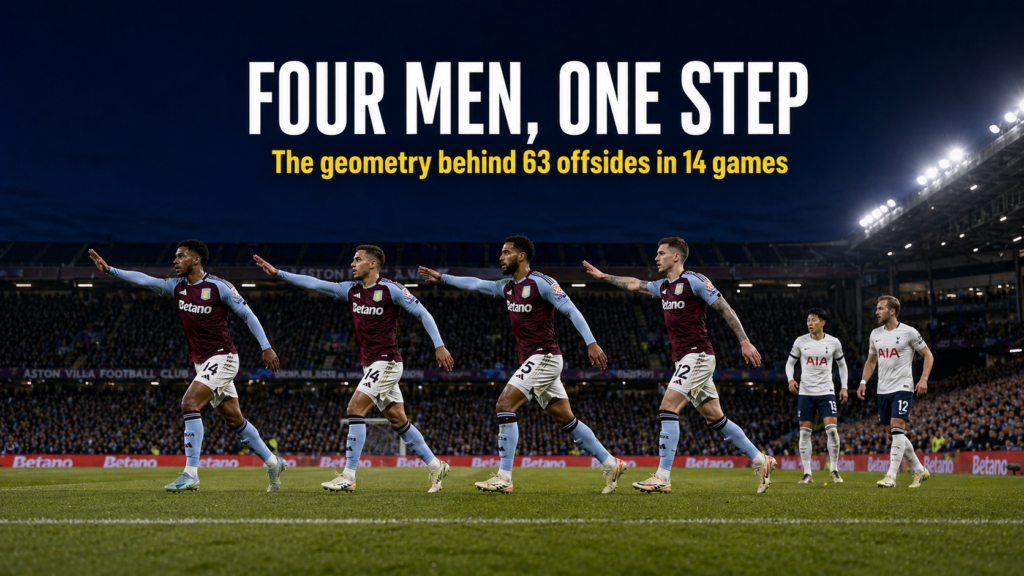
The shape underneath looks ordinary. Villa typically defend in a narrow 4-4-2 or 4-4-1-1, screening passes into rival forwards. What separates Emery’s setup from a textbook mid-block is what happens to the back four. Per Premier League analyst Adrian Clarke, unlike many teams, Villa push their back four up as close to the halfway line as possible. By compressing the space between his lines to under thirty metres, Emery leaves opposition forwards no room to receive in front of the back four. The only viable pass is the one behind it.
The moment that pass is attempted, the line steps up, the flag goes up, and the attack ends without a tackle. This is closer to Arrigo Sacchi’s Milan than to a conservative Spanish back four; instead of defending against runs, Villa invite them.
The Defensive Shape: A 4-4-2 With a Raised Back Four
The shape that makes the trap possible looks deliberately conservative. Two banks of four, narrow channels. What hides inside is the vertical compression. Per Footovision’s tracking, Emery’s side runs a strict medium block paired with a high line and top-four vertical compactness in the league.
That combination is the structural innovation. Most coaches choose: defend high and accept gaps in midfield, or sit deep and accept territorial concession. Emery refuses the trade. The midfield holds its mid-block height, the back four pushes up to halfway, and the gap stays inside thirty metres. The opposition striker cannot drop in to receive because the centre-back follows; he cannot run in behind because the back four is positioned to spring offside. The shape itself does the defending before the trap is even sprung.
The Mechanism: Reading the Forward Pass
The trap is not a posture; it is a trigger. Villa’s defenders read three specific cues, then step in unison.
The first cue is the body shape of the player on the ball. When an opposition midfielder squares up to play forward, the moment of address is the trigger. Konsa and his partner watch the eyes and the planted foot, not the ball. If the pass is going vertical, the line moves before the ball does.
The second cue is the run angle of the receiver. Forwards who lean into the shoulder of the last defender, drifting half a yard beyond the line, are exactly the runners the trap exists for. The defender steps forward two yards, and the runner is gone.
The third cue is the touchline. Wide passes into channels are the trap’s favourite invitation. Once a striker drifts wide, the cover behind disappears, and the line can step without leaving central space exposed.
The trigger is forward shape, not forward pass. By the time the ball is travelling, the line has already moved. That half-second of anticipation is what produces nine offsides against Tottenham in one match. For more on trigger-based defending, see our breakdown of mid-block pressing.
Konsa: The Defender Who Calls the Line
The trap is only as sharp as the player calling it. At Villa, that player is Ezri Konsa.
Konsa has been Aston Villa’s most-used defender in 2025-26, starting 32 matches as right-sided centre-back and inheriting the vice-captaincy from Emi Martinez in November 2025. His pairing with Pau Torres has been Emery’s preferred axis: Torres, signed from Villarreal in 2023, brings the long-passing range; Konsa supplies the timing.
The mechanism falls apart without that timing. Tactics Journal’s 2023 analysis identified Tyrone Mings as crucial in commanding the line, but with Mings reduced to a peripheral role in 2025-26, the burden has shifted entirely to Konsa. Full-backs Matty Cash and Lucas Digne take their cue from the centre-back call. If Konsa steps, they step. If Konsa hesitates, the line is broken.
Martinez: The Sweeper-Keeper as Insurance
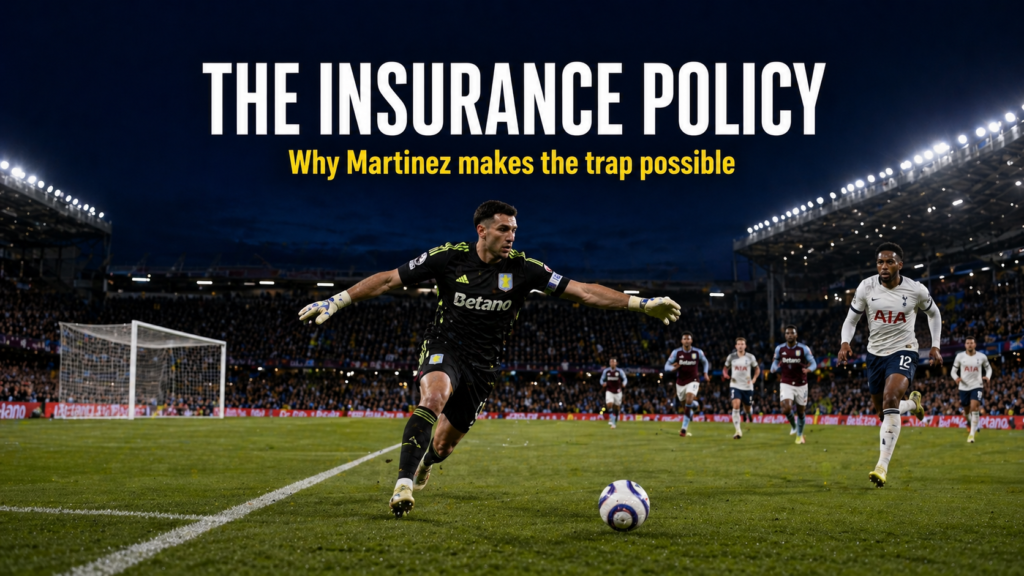
Every high line trap eventually fails. The question is what happens when it does. Emery’s answer is Emi Martinez.
Per Sky Sports, since Emery’s arrival, Martinez has held his starting position high and swept up as the last man more than any other Premier League custodian, while remaining one of the world’s best 1v1 shot-stoppers. The trap fails roughly fifteen percent of the time. Without a sweeper-keeper, that is fifteen percent goals conceded. With Martinez positioned ten yards off his line, ready to charge at any ball played behind, the same fifteen percent becomes a clearance, a corner, or a second-phase reset.
This is why the trap is not portable. Most managers cannot run a 39-metre defensive line because their goalkeeper cannot cover the ground behind it. Emery can run it because Martinez, an Argentina World Cup winner who plays his international football the same way, is built for it.
The Midfield Screen: Why Douglas Luiz Mattered
The defensive line is the visible part of the system. The screen in front of it is what makes it survivable. That role belonged to Douglas Luiz from October 2022 until summer 2024, and his departure for Juventus is the single biggest reason the trap collapsed in 2024-25.
Per The Analyst’s review, Villa shipped four goals from counter-attacks after only 13 games of 2024-25, four times their total in 2023-24 and the joint-most in the league. The system did not change; the personnel did. Amadou Onana and Youri Tielemans, while strong individually, sat less dutifully in front of the line than Luiz had. The trap held; the screen didn’t. Vertical passes into the channel between Villa’s midfield and back four became findable, and once that pass was played, the trap was bypassed before it could trigger. For the wider context of how that rest-defence layer interacts with structural choices like this, see our breakdown on counter-pressing principles.
Why Emery Baits Strikers Into the Trap
The most underrated element of Emery’s system is that the trap is invited, not just defended.
Sky Sports’ tactical analysis observed that Villa’s defenders bait attacks into playing the ball in behind, then adjust their body positioning to catch a forward offside just as the ball is played. The bait works because the mid-block looks beatable. The opposition’s first instinct is to find the runner behind the back four because the space looks open. It isn’t. The defenders are positioned exactly where the offside rule rewards them, defined precisely under Law 11 of the IFAB Laws of the Game.
This is why the trap disproportionately catches teams with pace up front. Sky Sports’ 2022-23 sample identified the most-caught strikers as Marcus Rashford’s Manchester United (seven), Son’s Tottenham (nine), Ivan Toney’s Brentford (six), and Jamie Vardy’s Leicester City (eight). Possession-based teams produce far fewer offside calls because they don’t try to penetrate vertically. Emery has effectively turned an opponent’s strength, fast forwards, into a weakness.
The Data: 63 Offsides, 39.43m, and the 2024-25 Collapse
Numbers reveal what the eye can miss. The table below summarises the verified data points that define the trap’s mechanics across Emery’s tenure, drawn from public sources.
| Metric | Value (Sample) | What It Tells Us |
|---|---|---|
| Offsides won | 63 in 14 games (2022-23, per Sky Sports) | Trap sprung 4.5 times per match |
| Defensive line height | 39.43m (2nd deepest in PL) | Villa pass from deep but defend high |
| Big-chance share on counter | 28% of shots conceded (2024-25, per Opta Analyst) | When trap fails, chance quality is elite |
| Fast-break goals conceded | 4 in 13 games (2024-25) | A 10x increase on 2023-24 |
| Most-caught striker | Son Heung-min, 9 offsides in one game | Pace strikers are the trap’s preferred prey |
Data reflects publicly reported metrics across Aston Villa’s Emery tenure (2022-2026) drawn from Sky Sports analysis, Opta Analyst, and Premier League sources. Individual season variance applies.
The 39.43m figure is the one most coaches miss. Despite running the second-deepest passing-sequence start point in the league, Villa defended high. That apparent contradiction is the system’s signature: passes start deep to draw pressure, but the back four defends thirty-five yards higher because the trap and the sweeper-keeper compress the space behind.
The Weakness: How Liverpool, Newcastle, and Chelsea Beat It
Every system has a counter, and the high line trap has two.
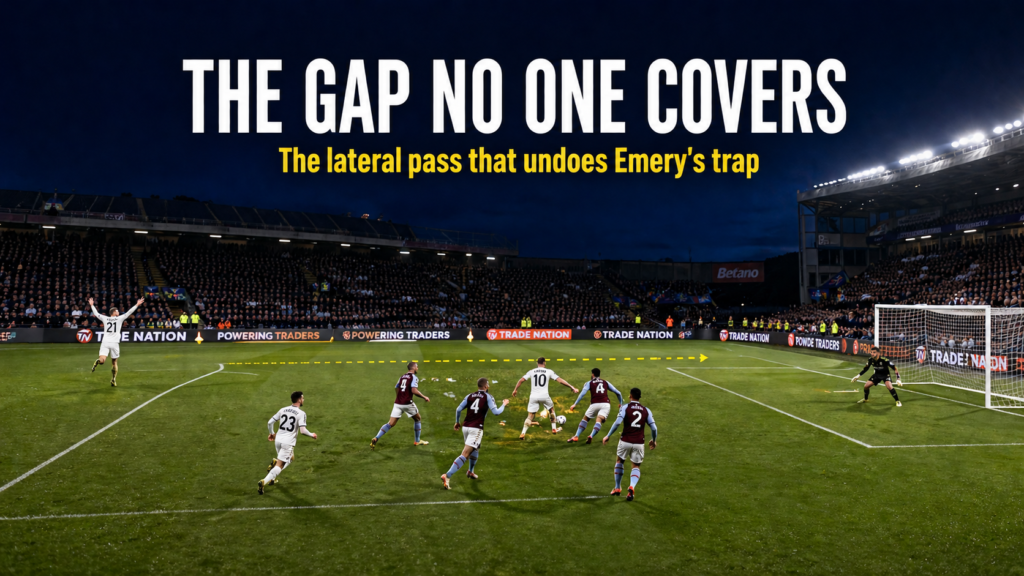
The first is the lateral pass after the line is breached. Tactics Journal’s 2023 analysis identified the structural flaw clearly: when an attacker breaches Villa’s back-line, a slow square ball to the far side leaves an uncontested space, a simple tap-in. When the line steps up to spring the trap, the back four collapse ball-side to cover the central runner. The far-side full-back is left exposed, and a square pass across the eighteen-yard box finds an unmarked runner with no cover.
The second weakness is direct, vertical pace combined with a midfield bypass. Newcastle and Liverpool both exploited this in 2023-24. Per The Analyst, Villa conceded 28% of their counter-attack shots as ‘big chances’, second only to Manchester City. The pattern is consistent: a long, accurate vertical pass over Villa’s midfield bypasses the screen, and a runner sprinting from depth times the run after the ball is played, staying onside.
Chelsea in 2024-25 weaponised both at once in a 4-1 home win at Villa Park: bypass the double pivot with a clipped vertical, attack the channel with a runner from deep, then square the ball laterally once the line was breached. The system held against patient possession football; it crumbled against vertical, accelerated, transition football. Emery has since mixed in lower defensive lines situationally. The trap remains the default; it is no longer the only setting. Our breakdown on low block defending covers the alternative posture.
Closing Analysis
The Unai Emery high line trap is one of the few genuine tactical innovations of the post-Klopp era. It is not a reproduction of Sacchi or Wenger’s Arsenal; it depends on a sweeper-keeper, a vertically compact mid-block, and one centre-back with elite line-reading instincts. Stripped of any of those three, it stops working.
When Konsa is on, when Martinez is sweeping, and when Onana is screening, Villa run a defensive system that looks engineered. When any of those three is missing, the trap does not just fail; it actively concedes high-quality chances at a rate near the league’s worst. Few systems combine this level of upside with this level of fragility, and few managers would even attempt the trade-off. Emery has, and the data shows the line between brilliance and collapse is razor-thin.
What Do You Think?
Emery’s high line trap caught Son Heung-min offside nine times in one match in 2022-23, but in 2024-25 the same system shipped four counter-attack goals in just 13 games, the joint-most in the league. Was the collapse a personnel issue (Douglas Luiz leaving) or a structural one (the trap is fundamentally too risky for the modern Premier League)? Drop your take below.
Want to read any match like this?
The framework behind these breakdowns, in one place. The four phases, a 15-minute method for diagnosing both teams before the drinks break, a printable match-watching worksheet, and 51 terms defined. 40 pages.
Get the pack$9, instant downloadRelated Tactical Breakdowns

Xabi Alonso’s Leverkusen Blueprint
Why it connects: Like Emery, Alonso built a defensive system around a vertically compact mid-block and aggressive ball recovery. The contrast is in the height, Villa step up, Leverkusen step in, but the anticipation logic is identical.

Why it connects: Emery’s high line trap is a mid-block with a raised back four. Understanding the mid-block’s trigger logic is essential to understanding why the trap works.

Counter-Pressing Principles Explained
Why it connects: When Villa’s high line breaks, they need a rest-defence structure to absorb the transition. The 2024-25 collapse showed exactly what happens when that layer is missing.
Speak the language of the game
Get the free 47-term tactical glossary. Gegenpress, half-space, xT, low block, each defined in plain language and linked to a full breakdown. It is yours for an email.
Frequently Asked Questions (FAQs)
How does the Unai Emery high line trap work?
Aston Villa’s back four steps up in unison the moment an opposition midfielder commits to a vertical pass, playing the forward runner offside before the ball arrives. The trigger is the passer’s body shape, not the ball itself. Defenders read forward intent and step on anticipation, which is what allows Villa to spring the trap up to nine times in a single match.
Why is Emery’s high defensive line so risky?
Emery’s high defensive line is risky because it leaves a large area between the back four and goalkeeper exposed if the trap fails. Emery mitigates this with Emi Martinez sweeping high off his line and a compact midfield screen. When either layer is missing, as happened in 2024-25 after Douglas Luiz departed, the system concedes high-quality counter-attacking chances at one of the worst rates in the league.
Which teams have beaten Aston Villa’s high line trap?
Teams that combine vertical pace with patient lateral movement after breaching the line have hurt Villa most. Newcastle, Liverpool, and Chelsea exploited the trap in 2023-24 and 2024-25 by bypassing the midfield screen with long vertical passes and squaring the ball to the far-side once Villa’s back four had collapsed ball-side. The far-post weakness is structural, not accidental.
Can the high line trap work without a sweeper-keeper?
A high line trap is extremely difficult to run without a sweeper-keeper because every failed trap creates space behind the defence. Emi Martinez’s positioning ten yards off his line converts most failed traps into clearances rather than one-on-ones. Without that insurance, the same defensive line would concede a goal nearly every time the trap was broken.
Can you read a match?
Six real in-game situations, one tactical read each. See how sharp your eye is, and get the full breakdown after every answer.
Take the test