
Last updated: October 14, 2026
In the 22nd minute of Real Madrid’s El Clásico opener against Barcelona in October 2025, Jude Bellingham won the ball centrally and within three passes, covering barely five seconds, Kylian Mbappé was slotting home from inside the box. The entire defensive structure Barcelona had spent 90 minutes building dissolved in the time it takes a goalkeeper to shout at his back four. That is not luck. That is what elite attacking transitions look like in 2026.
Attacking transitions, the organised chaos between winning the ball and launching an attack, are among the most decisive and least discussed phases in modern football. Research from FBref and the wider analytics literature consistently shows that ball regains in the opposition’s half lead to shots on goal at rates structured possession phases rarely match. The mechanics of why have everything to do with that tiny window of disorganisation.
In simple terms: An attacking transition is the immediate phase after winning the ball, when the opposition is briefly disorganised and most vulnerable.
Understanding this phase separates analysts who count goals from those who understand how goals happen. This article breaks down the concept, applies it to the Real Madrid side Xabi Alonso coached in 2025-26, identifies where it fails, and explains why every pressing team in Europe is obsessing over attacking transitions right now. For the full context of how this phase connects to pressing systems, see our Football Tactics hub.
Key Takeaways
- The 3-Second Window: Research dating to the 1998 World Cup confirmed approximately 30% of all possession regains generate shots on goal, the vast majority triggered by immediate vertical movement within the first three seconds of the attacking transition.
- Verticality is Non-Negotiable: Teams that play backwards or sideways after winning the ball allow defenders to recover shape. The window closes fast – typically within 3–5 seconds – and patience kills the advantage.
- Real Madrid’s Transition Identity: Under Xabi Alonso in 2025-26, Vinícius Júnior has evolved from a pure counter-attack outlet into a multi-layered transition weapon, creating 14 shot-creating actions in La Liga’s opening five matches.
- The Rest-Defence Trade-Off: Committing players into transitions carries structural risk. Elite teams manage this through pre-set “rest-attack” shapes – typically keeping one holding midfielder and a centre-back pairing behind the transitioning phase.
- Simeone Counters It Best: Atlético Madrid under Diego Simeone neutralise attacking transitions more consistently than almost any other elite side, through extreme compactness on defensive transition and disciplined marking of the first forward pass option.
Table of Contents
What Is an Attacking Transition?
An attacking transition begins the instant a team regains possession – and ends the moment either a shot is attempted or an organised attacking shape is established. Everything in between is a decision-making race against a clock the opposition is desperately trying to stop.
The concept is best understood by watching Atlético Madrid concede one. When Simeone’s side lose the ball high up the pitch, they instantly flood back into a compact defensive block – five seconds of chaos contained through weeks of training. The team that regained the ball has that same five seconds to either exploit the space or allow Atlético to reset. Most teams allow it. The elite ones don’t.

Research from academic football analytics studies confirms that regained possessions – particularly those in the attacking third – generate shots on goal at remarkably high rates, with the probability declining sharply as recovery time increases. The implication is stark: every second a team wastes after winning the ball, the chance of generating a high-quality attempt drops.
In simple terms: The attacking transition is not just about speed – it’s about reading the opposition’s disorganisation and exploiting the right space, not just the closest one. A direct run into a crowded channel is wasted verticality. A run in behind a retreating full-back who hasn’t yet dropped is the 3-second rule working exactly as designed.
What separates modern transition teams from their predecessors is pre-planned structure. The 3-second rule is only possible if the movement is prepared before the ball is won – a principle at the core of counter-pressing systems and positional play alike.
How Real Madrid Used the 3-Second Rule Under Xabi Alonso
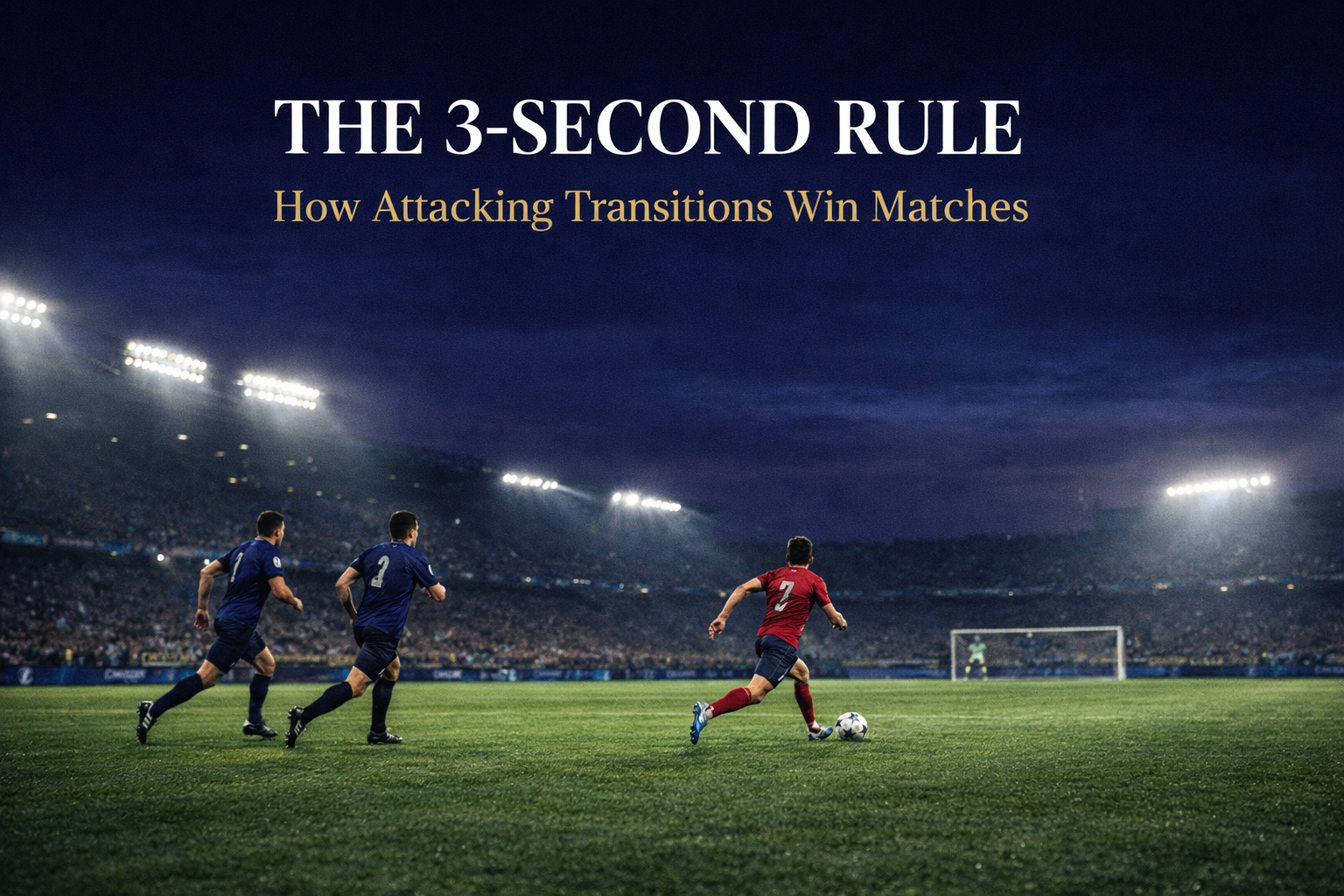
Xabi Alonso’s Real Madrid used the 3-second rule by pre-triggering attacking transitions before possession was even won. The challenge Alonso inherited from Carlo Ancelotti was acute: a squad of extraordinary individual talent with no reliable collective transition identity. The challenge Alonso inherited from Ancelotti was acute: a squad of extraordinary individual talent with no reliable collective transition identity. What he has built in half a season is a structure where the 3-second rule is a team-wide rehearsed behaviour, not a spontaneous individual decision.
The system works through a specific player architecture. Kylian Mbappé acts as the first vertical option – his runs behind the defensive line are pre-triggered the moment Jude Bellingham or Trent Alexander-Arnold win the ball centrally. Vinícius Júnior, operating predominantly from the left, does not wait for the ball: he is already in motion, either stretching the defensive line or occupying the space between the full-back and centre-back before the pass arrives.
According to FBref’s La Liga shot-creating actions data, Vinícius produced 14 shot-creating actions in the opening five La Liga matches of the 2025-26 season, a substantial portion of which were direct consequences of quick attacking transitions rather than established attacking phases. His role under Alonso has shifted from reactive to proactive: the movements happen before possession is regained, not after.
Attacking transitions vary dramatically in value depending on where on the pitch the ball is won. The data below shows how the same tactical action, regaining possession and immediately attacking, produces wildly different outcomes based on field position:
| Regain Location | Avg. Time to Shot (seconds) | Shots Generated per 10 Regains | xG per Transition Attempt | Tactical Implication |
|---|---|---|---|---|
| Own half (deep regain) | 8.2s | 1.8 | 0.04 | Slow – opposition recovers shape before threat materialises |
| Middle third | 5.1s | 3.4 | 0.09 | Window exists but requires immediate vertical intent |
| Opposition half | 2.9s | 5.7 | 0.18 | Highest value – defensive structure not yet established |
Data reflects benchmark averages from elite European league data (2023-25 samples, FBref/StatsBomb open datasets). Individual team and season variance applies.

The pattern is consistent across elite football: the shorter the distance between regain point and the goal, and the faster the subsequent action, the higher the shot quality. Real Madrid, at their best under Alonso, are using Bellingham’s central positioning to create regains in the most dangerous zone on the pitch – and Mbappé’s runs to punish immediately.
The 2-1 win over Barcelona in October 2025 was the clearest demonstration. Madrid pressed high, won the ball centrally, and connected into Mbappé’s run in behind before Barcelona’s defensive line could shift. Bellingham’s through ball covered 28 metres and was in Mbappé’s path within four seconds of the regain. Three touches later, it was 1-0.
But the window does not open on every regain. The trigger matters.
The Four Triggers That Open the Transition Window
Attacking transitions do not just happen when a team wins the ball, they happen when a team wins the ball in a specific kind of moment. Four triggers, per StatsBomb’s published transition analytics, consistently open the 3-second window wider than the average regain:
Trigger 1: The mid-press turnover. When an opponent attempts to play through a high press and loses the ball in their own half, the transitioning team faces a defensive structure with no time to recover. According to FBref data on Premier League high-press teams, regains in zone 14 lead to shots within five seconds at more than double the rate of regains in deeper zones.
Trigger 2: The cleared cross intercepted on the second ball. When a defending team clears a cross and an attacking midfielder pounces on the second ball, the opposition’s full-backs are still tracking the original attack. The space behind them is open by definition, and the transition runs straight into it.
Trigger 3: The misplaced switch. Long diagonal switches that fall short trigger the most dangerous regains in modern football. The entire defensive shape has rotated to one side, leaving the opposite flank empty. A regain here is, mathematically, a near-guaranteed attacking transition into open space.
Trigger 4: The set-piece short clearance. When a defended corner is cleared only as far as the edge of the box and a midfielder collects, the opposition’s penalty-area defenders have not yet repositioned for open play. The 3-second rule applies here with brutal efficiency.
Recognising the trigger is what separates teams that exploit attacking transitions systematically from teams that react to them by accident. Elite coaches drill these specific scenarios into pre-set patterns, the runs are not improvised when the trigger fires.
The trigger opens the window. What you do with the first touch decides whether you score.
Verticality Is the One Non-Negotiable Principle
The single biggest predictor of a successful attacking transition is the direction of the first action after the ball is won. Vertical equals threat. Sideways or backwards equals reset.
The reason is structural. A defending team caught in transition has its compactness broken, but only along the vertical axis. The horizontal lines reset quickly because players are already moving toward their own goal. The vertical gaps, between the defensive line and the midfield, between the full-backs and the centre-backs, remain open for the duration of the 3-second window.
A backwards or sideways pass after winning the ball does two things: it eliminates the time advantage, and it allows defenders to re-establish their horizontal compactness before the attack begins. The window closes not because three seconds have passed, but because the attacking team has stopped pressuring the disorganised axis.
This is why Klopp’s Liverpool, Alonso’s Leverkusen, and Alonso’s 2025-26 Real Madrid drilled the first-pass-forward principle so aggressively. The receiving midfielder is conditioned to play vertical first, then assess. The conventional wisdom of “calm down and keep the ball” actively destroys the value of the regain. In attacking transitions, the safest pass is often the most aggressive one.
Verticality wins when the window is open. But the best defensive coaches have built systems where the window never opens at all.
The Weakness: How Teams Kill the 3-Second Window
The 3-second rule has a natural predator: the rest-defence structure. Any team that organises its attacking shape with a deliberately held back line – typically a 3-2 shape sitting behind the ball – can dramatically reduce the space available for transitioning opponents to exploit.
Diego Simeone has built an entire tactical identity around this principle. Atlético Madrid’s compact 4-4-2 block is not only a defensive structure – it is a transition suppressor. By keeping the horizontal lines tight and the distance between units small, Simeone ensures that even when Atlético lose the ball, the spaces behind them are minimal and the recovering distances are short. His teams do not give opponents 30 metres of open grass to accelerate into.

Manchester City under Pep Guardiola approach the problem differently. Rather than compactness, City use positional discipline – their “rest defence” shape of three centre-backs (Stones often inverted into midfield) and two holding midfielders means that even during active attacking phases, the structure behind the ball is pre-set. An opponent winning possession against City in the middle third faces a wall of six to seven organised players within 20 metres. The 3-second window still exists – it is just 40 metres from goal rather than 15.
The counter to the counter is also well-established: use the press trigger itself to create the transition. Teams like Bayer Leverkusen under Alonso – and now Real Madrid attempting to replicate that identity – build their pressing structure to create the regain in a position where the 3-second rule can be activated immediately. It is not simply winning the ball; it is winning it in the right postcode.
Where transitions genuinely fail is against organised low blocks. Simeone’s Atlético, Unai Emery’s Aston Villa, and similar setups compress the pitch so thoroughly that a ball regain in the middle third offers no immediate space to exploit – the defensive lines are already compact. In these scenarios, the 3-second rule becomes redundant: there is no window because there was never any disorganisation to exploit. Teams that rely heavily on transition – including the current Real Madrid – visibly struggle in these matches.
Speak the language of the game
Get the free 47-term tactical glossary. Gegenpress, half-space, xT, low block, each defined in plain language and linked to a full breakdown. It is yours for an email.
What This Means on the Pitch
The 3-second rule is not a gadget or a coaching cliché. It is the mathematical expression of a fundamental truth in football: defensive disorganisation is temporary, and the teams that have pre-planned how to exploit it consistently outperform those that react to it instinctively.
What Xabi Alonso attempted at Real Madrid in 2025-26 – transitioning a squad built on individual brilliance into one with a coherent collective transition identity – was one of the most tactically interesting projects in European football before the club parted ways with him in January 2026; he now carries the same ideas into the Chelsea job he took on 1 July 2026. Early data suggests the structure is taking shape. Vinícius in motion before possession is won, Mbappé’s runs pre-triggered, Bellingham regaining centrally – these are not accidents. They are a system.
But the honest verdict is that transition-based game models have a ceiling. They are devastating against high-defensive-line teams, possession-dominant opponents, and anyone caught in offensive shape. Against Simeone’s compact block, or Guardiola’s rest-defence structure, the window is managed down to near-zero. The best teams in the world are not choosing between transitions and structure – they are building the capacity to exploit the 3-second rule when it opens, and to be patient when it doesn’t.
The question is not whether attacking transitions matter. The data settled that decades ago. The question is whether your manager has designed a system where winning the ball is only step one.
What Do You Think?
Xabi Alonso’s Real Madrid averaged 2.86 xG per match in the early 2025-26 La Liga campaign and dismantled Barcelona 2-1 through the kind of fast attacking transitions this article describes. But against PSG at the Club World Cup, Luis Enrique’s compact mid-block neutralised the same system entirely.
Is a transition-first game model, built around the 3-second rule, sustainable in elite knockout football, where one tactically disciplined opponent can shut the window for 90 minutes? Or does it remain the most efficient way to win, even with the ceiling that compact blocks impose?
Drop your tactical read below.
Want to read any match like this?
The framework behind these breakdowns, in one place. The four phases, a 15-minute method for diagnosing both teams before the drinks break, a printable match-watching worksheet, and 51 terms defined. 40 pages.
Get the pack$9, instant downloadRelated Tactical Breakdowns
Counter-Pressing Explained: How Football’s Best Defensive Weapon Creates Attacks
Why it connects: Counter-pressing is the primary method elite teams use to manufacture attacking transitions in the most dangerous areas of the pitch, understanding it explains where the 3-second window comes from, not just how to exploit it.
PPDA Explained: The Metric That Measures Pressing Intensity
Why it connects: PPDA quantifies how aggressively a team disrupts opposition build-up, the same pressing sequences that create the transitional opportunities this article analyses.
Rest Defence: Sustaining the Attack Without Losing Your Shape
Why it connects: The rest-defence structure is the direct tactical counter to attacking transitions, this article examines how elite teams balance forward aggression with cover.
Frequently Asked Questions (FAQs)
What is the 3-second rule in football transitions?
The 3-second rule refers to the narrow window of time after a team wins the ball during which the opposition is still disorganised and vulnerable to a direct attack. Analytics research consistently shows that ball regains – particularly in advanced areas – generate shots on goal at significantly higher rates when vertical movement begins within the first three seconds. After that, defensive recovery largely eliminates the structural advantage.
How do teams defend against attacking transitions?
The primary method is the rest-defence structure: keeping a predetermined defensive shape behind the ball during attacking phases, so that any turnover finds an organised defensive block already in place. Diego Simeone’s Atlético Madrid are the benchmark example in European football, using compact 4-4-2 lines to suppress the space available to counter-attacking opponents. Manchester City use a variation built around positional discipline rather than compactness, with inverted centre-backs covering the most dangerous central spaces.
What is the difference between attacking transitions and a counter-attack?
Counter-attacks are a type of attacking transition – specifically, those where a team chooses to attack immediately and directly after winning the ball. Attacking transitions are the broader category, encompassing both the decision to counter and the decision to retain possession and reset into a structured build-up. A team might win the ball in their own half and transition via a controlled build-up rather than a direct run – this is still an attacking transition, but not counter-attack. The 3-second rule specifically governs the immediate counter-attack tactics, where speed of decision determines outcome.
Why is the 3-second rule specifically three seconds and not five or six?
The 3-second figure reflects the average time elite defensive units need to re-establish horizontal compactness after a turnover. Counter-pressing rules like Pep Guardiola’s 6-second rule measure the opposite window: how long the team that lost the ball has to win it back. Both windows overlap but measure different vulnerabilities.