


Last updated: September 19, 2026
Watch Jorge “Koke” Resurrección in the 2020-21 La Liga title run-in for Atletico Madrid and you will notice something strange. The captain rarely sprints past his striker. He rarely appears in the opposition box. Yet the moment Yannick Carrasco pushes high on the left, Koke is there covering the empty lane behind him. The moment Kieran Trippier attacks the right wing, Koke is already drifting across to plug the half-space midfielder. He is not a box-to-box midfielder. He is not a number 10. He is doing the oldest, least glamorous job in Spanish football tactics.
He is playing the carrilero role – and it is the reason Diego Simeone’s team functioned as more than the sum of its parts.
In simple terms: A carrilero is a central midfielder who shuttles sideways between the centre and the flanks to keep the team balanced.
This piece breaks down what the carrilero actually does, why a role that looked obsolete a decade ago is quietly returning at elite level, and where it still breaks down against modern pressing.
Key Takeaways
- Horizontal, not vertical: Unlike a box-to-box midfielder, the carrilero shuttles laterally from centre to flank, rarely making runs into the box.
- Structural, not statistical: Carrileros produce few goals and assists but stabilise entire tactical systems, which is why their value is invisible on highlight reels and obvious on xG-against tables.
- Formation-specific: The role works almost exclusively in a 4-4-2 diamond, 4-3-1-2, or modern systems with inverted fullbacks, where a midfielder must cover the wide areas the fullback vacates.
- Koke is the template: Atletico Madrid’s captain has played 700+ matches as a carrilero-type shuttler under Simeone since 2011, winning two La Liga titles without ever fitting a conventional position.
- The modern revival: Teams using inverted fullbacks, like the Xabi Alonso Leverkusen side of 2023-24, now need a shuttler midfielder more than ever to cover the half-space their fullback has abandoned.
Table of Contents
What Is the Carrilero Role?
The word comes from the Spanish carril, meaning “lane” or “track”. A carrilero is literally a lane-runner – a central midfielder whose job is to slide sideways into the wide channels when his team needs him there, then slide back to the middle when it does not. Football Manager adopted the term around 2018 and translated it as “shuttler”, which is actually a decent description of what the player physically does for ninety minutes.
Think of it this way. In Xavi Hernandez’s Barcelona, Xavi circulated the ball from a fixed central zone. In Steven Gerrard’s Liverpool, Gerrard attacked the opposition box. The carrilero does neither. He occupies the space between the number 6 and the touchline, tucking back in whenever the fullback overlaps and tucking wide whenever the winger inverts. He is, in Rubén Baraja’s own words about his Valencia days under Rafa Benítez, the player who “goes where the team needs a body”.
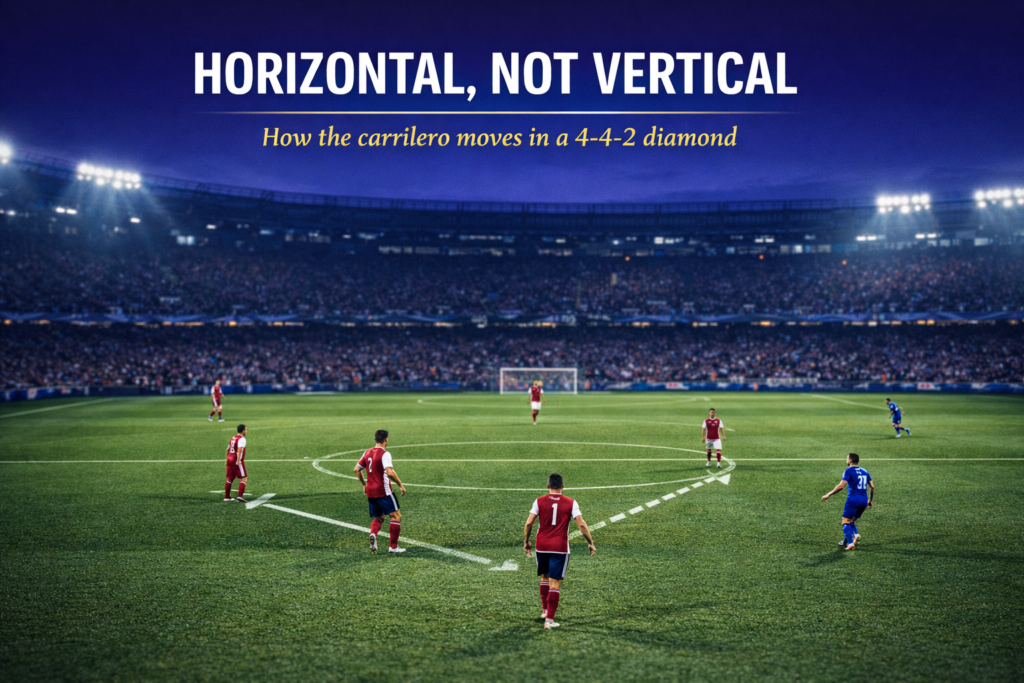
That functional definition is why the role is so badly understood. Carrileros do not top passing charts. They do not rack up tackles in fixed defensive zones. They rack up distance covered and progressive passes out of wide areas that should not have existed. In a tactical ecosystem that increasingly rewards specialists, the carrilero is the last true generalist – and that is exactly why elite coaches keep bringing him back, particularly in systems built around inverted fullbacks.
How Simeone’s Atletico Madrid Built a Title on Koke as Shuttler
Koke has played over 700 official matches for Atletico Madrid – more than any other player in the club’s history. He has never won the Ballon d’Or. He has never been the leading scorer or assister in La Liga. What he has done is play a carrilero-type shuttler role under Diego Simeone for the better part of fourteen seasons, across multiple Atletico title runs and two Champions League finals.
The 2020-21 La Liga-winning season is the cleanest case study. Atletico lined up nominally in a 4-4-2 under Simeone, but in possession it frequently became a 3-diamond-3 as Mario Hermoso dropped deeper alongside the centre-backs and Trippier pushed higher on the right. That inverted-fullback shape creates a predictable problem: the left half-space behind the attacking winger is now exposed. Someone has to cover it without leaving the centre of midfield empty. Koke, drifting horizontally from his central base, did that job every single match.

The numbers tell the story even if they undersell the value. Under Simeone, Atletico Madrid have conceded fewer than 30 La Liga goals in four separate seasons per FBref’s historical defensive records – a level of stability almost unheard of in a pressing-era league. Koke’s contribution is structural, not flashy. Here is how the tactical load distributes in a typical Atleti system compared to more conventional midfield setups.
Carrilero vs Box-to-Box vs Mezzala: Role Comparison
| Metric | Carrilero (Shuttler) | Box-to-Box Midfielder | Mezzala |
|---|---|---|---|
| Primary movement axis | Horizontal (lateral) | Vertical (end-to-end) | Diagonal (half-space advance) |
| Typical goals per season | Low (1-4) | Moderate (4-8) | Moderate-high (5-10) |
| Defensive zone | Wide + central cover | Central only | Advanced half-space |
| Ideal formation | 4-4-2 diamond, 4-3-1-2, inverted fullback systems | 4-3-3, 4-2-3-1 | 3-5-2, 4-3-3 with inverted fullbacks |
| Prototype player | Koke, Rubén Baraja, N’Golo Kanté (Chelsea 3-5-2 phase) | Steven Gerrard, Arturo Vidal | Kevin De Bruyne, Nicolò Barella |
Data reflects generalised role characteristics across modern top-five European leagues. Individual manager interpretations and player adaptations produce significant variance.
What Simeone figured out before most of Europe is that a shuttler buys you two players for the price of one. When Trippier or Marcos Llorente bombed forward on the right, Koke was already covering the space behind. When Carrasco or Antoine Griezmann tucked inside on the left to attack the half-space, Koke was the recycler who kept the ball in Atletico’s control rather than losing it in transition.
Rafa Benítez’s Valencia used the same logic two decades earlier with Baraja alongside David Albelda – Valencia won La Liga in 2001-02 and 2003-04 scoring only 75 and 71 goals respectively, because the midfield denied opposition transitions rather than creating highlight chances. According to a Coaches’ Voice masterclass by Benítez, the Albelda-Baraja double pivot was the structural core of the whole system, not a by-product of it.
Why the 4-4-2 Diamond Is the Natural Habitat of the Carrilero
The 4-4-2 diamond is the formation the carrilero was effectively invented for. The shape has a single defensive midfielder at the base, a single attacking midfielder at the tip, and two shuttlers on either side – the carrileros. Without them, the diamond collapses.
The reason is geometric. A diamond is narrow by definition. Two strikers, a number 10, and a holding midfielder all occupy central zones. If the fullbacks do not provide width, the entire team is stacked in a vertical column that any decent low block can compress. The carrileros are what stretch the diamond into a workable attacking shape – they slide out wide to give the fullbacks underlapping options, then slide back centrally to deny opposition counter-attacks through midfield.
Rafa Benítez’s Valencia ran this exact pattern with Rubén Baraja and David Albelda from 2001 to 2004. The Coaches’ Voice masterclass on the system explicitly identifies the double pivot as the structural core – per Benítez’s own analysis, the diamond’s success was a function of the shuttler duo, not the front four. Manuel Pellegrini’s Villarreal ran a similar logic with Marcos Senna in the late 2000s. The pattern is constant across decades because the geometry is constant.
What changed in modern football is that the pure 4-4-2 diamond fell out of fashion above Championship level. But the structural problem the diamond solved – two shuttlers covering wide channels in a narrow base – did not disappear. It just got rebranded.
The Inverted Fullback Revival: Why the Carrilero Is Quietly Returning
Pep Guardiola was the first elite coach to formally rediscover the carrilero problem, even if he never used the word. When John Stones started inverting from right-back into central midfield at Manchester City in 2022-23, City’s structure suddenly had a familiar imbalance: one side had a wing-back high up the pitch, the other had a fullback acting as a second pivot. The half-space behind the inverted fullback was exposed. Per The Analyst’s tactical breakdown of City’s 2022-23 treble season, that exposure cost goals in early-season fixtures until the midfield rotation was rebuilt to cover it.
Xabi Alonso solved the same problem at Bayer Leverkusen during the 2023-24 Bundesliga title-winning season. Granit Xhaka, nominally part of a double pivot alongside Exequiel Palacios, performed shuttler-like duties whenever Álex Grimaldo pushed high and the left-sided centre-back stepped up. Per Bundesliga.com’s analysis, Xhaka recorded 2,893 touches in his first 25 league matches – 600 more than any other player in the division, much of it from drifting laterally to cover space the inverted fullback vacated. He was not a carrilero by name. He was a carrilero by function.
The pattern is now repeating across elite Europe. Wherever a coach uses an inverted fullback, a carrilero-type midfielder appears nearby. Manchester City under Pep Guardiola, Arsenal under Mikel Arteta with Jorginho or Thomas Partey in specific phases, Real Madrid under Xabi Alonso during 2025-26 with Eduardo Camavinga or Aurélien Tchouaméni taking lateral coverage shifts. The role has not been formally renamed. But the carrilero is back.
Where the Carrilero Role Breaks Down
The carrilero’s weakness is the same as its strength: it is a structural role. Structural players are exposed the moment the structure stops holding.
The first problem is high-intensity, man-oriented pressing. When a team using counter-pressing principles, like Jürgen Klopp’s Liverpool or RB Leipzig under Marco Rose, presses a 4-4-2 diamond with three strikers stepping onto the pivot and the carrilero simultaneously, the lateral-movement specialist cannot escape because his passing options in wide areas are also being tracked. The carrilero needs time to scan and distribute. Modern counter-pressing denies that time systematically. That is why Simeone has had to evolve Atletico toward a more possession-oriented 4-4-2 in recent seasons, and why a pure diamond is now rare above Championship level.

The second problem is attacking ceilings. A team built around carrileros rather than mezzalas concedes creative burden to their number 10 or their fullbacks. If the number 10 is injured or marked out – as happened repeatedly when Atletico faced elite Champions League opposition between 2015 and 2019 – the whole attack stalls. The shuttler does not unlock defences. He maintains equilibrium while someone else unlocks them. Against a low block with ten players behind the ball, equilibrium is worthless.
The third problem is recruitment. Mezzalas like Kevin De Bruyne can be identified on FBref in twenty seconds by looking at progressive passes and xA. Carrileros score averagely on every single metric – and exceptionally on the metrics that are not public. That makes them brutally hard to scout and even harder to sell to boards, which is why so many elite clubs instead spend £50m on a mezzala and hope the fullbacks figure out the balance problem themselves. They usually do not.
Managers who actively exploit systems that lean on carrileros – Simeone, Xabi Alonso in his Leverkusen title-winning 2023-24 season with Granit Xhaka performing shuttler-like duties from a double pivot – tend to do so by pressing the opposition’s wide spaces aggressively in transitions, forcing the opposing carrilero into rushed decisions in areas he cannot dominate.
Final Thoughts
The carrilero is the role football keeps forgetting and coaches keep quietly resurrecting. It is unfashionable because it does not produce content. It produces control. And control, at its best, looks like nothing happening – which is the single hardest thing to sell in the attention economy of modern football punditry.
My view is that we are about to see a shuttler revival, not a decline. The current fashion for inverted fullbacks creates a structural imbalance that only a carrilero-type midfielder can solve without redesigning the whole tactical system. Pep Guardiola noticed it with John Stones dropping into midfield. Xabi Alonso handled it at Leverkusen with Xhaka orbiting the centre circle. The next wave of tactical innovation will not be about inventing new roles. It will be about rediscovering old ones like the carrilero and rebuilding them for a pressing-era game. The question is not whether the shuttler returns. It is which manager reintroduces him first at genuine elite level.
What Do You Think?
Koke is the highest-appearance player in Atletico Madrid’s history and has never made a single FIFPRO World XI. Is the carrilero role genuinely underrated by modern football analytics, or is there something about shuttlers that just does not scale to elite Champions League knockout football where you need match-winners more than system-holders? Share your take below.
Want to read any match like this?
The framework behind these breakdowns, in one place. The four phases, a 15-minute method for diagnosing both teams before the drinks break, a printable match-watching worksheet, and 51 terms defined. 40 pages.
Get the pack$9, instant downloadRelated Tactical Breakdowns

Why it connects: Inverted fullbacks and carrileros solve opposite sides of the same structural problem – this piece explains why modern managers pair them.
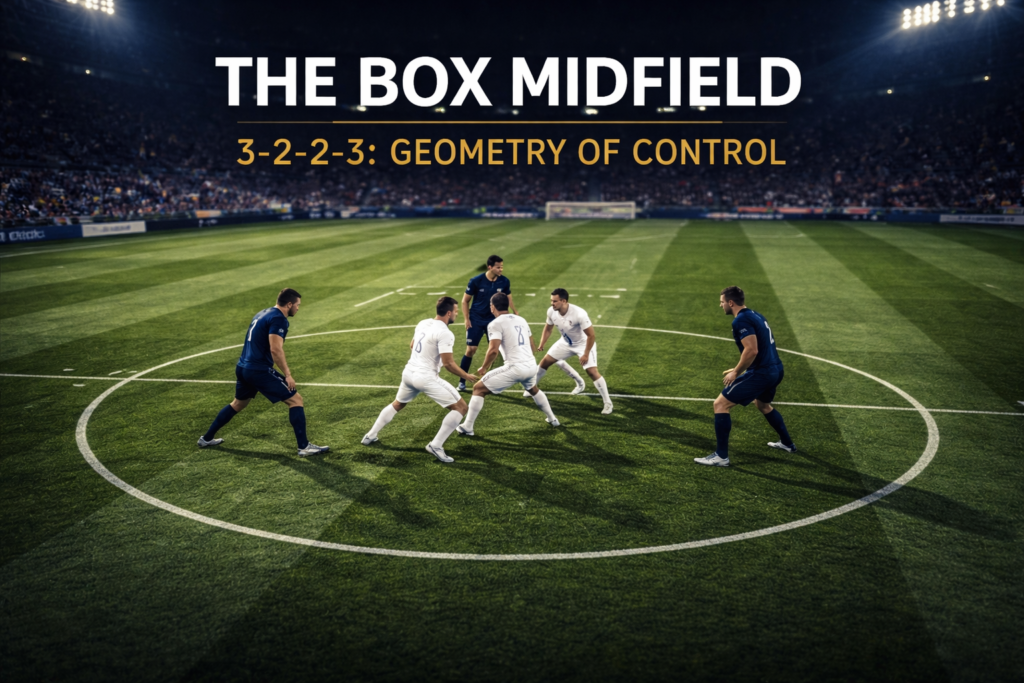
The Box Midfield (3-2-2-3) Explained
Why it connects: The 3-2-2-3 is the newer tactical evolution that replaced the 4-4-2 diamond in elite football, and it changes how shuttler-type midfielders are deployed.
Speak the language of the game
Get the free 47-term tactical glossary. Gegenpress, half-space, xT, low block, each defined in plain language and linked to a full breakdown. It is yours for an email.
Frequently Asked Questions (FAQs)
What does carrilero mean in football?
Carrilero is a Spanish term meaning “lane-runner” or “shuttler”. It describes a central midfielder who shuttles laterally between the centre of the pitch and the flanks to provide cover and balance, particularly in narrow formations like the 4-4-2 diamond or systems using inverted fullbacks.
What is the difference between a carrilero and a mezzala?
Both occupy wide central positions, but their job descriptions are opposite. A mezzala pushes forward into the attacking half-space to create chances and score, while a carrilero drifts sideways to cover defensive space and recycle possession. Mezzalas are attackers; carrileros are balance players.
Which formation uses a carrilero?
The carrilero role is most commonly deployed in the 4-4-2 diamond and 4-3-1-2, where two shuttlers flank a holding midfielder. Modern variants appear in 3-5-2 systems and in 4-3-3s where one fullback inverts – in those cases, a carrilero fills the wide half-space the inverted fullback has vacated.
Is N’Golo Kanté a carrilero?
Yes, Kanté played a carrilero-type shuttler role under Maurizio Sarri at Chelsea, particularly in the 3-5-2 phase, where he moved laterally on the right of midfield to support the wing-back and defend the half-space. Earlier in his career he was a pure defensive midfielder, so the role was adapted to his profile rather than inherent to it. His engine and positional intelligence made him one of the best modern interpreters of the role outside Spain.