
Last updated: October 15, 2026
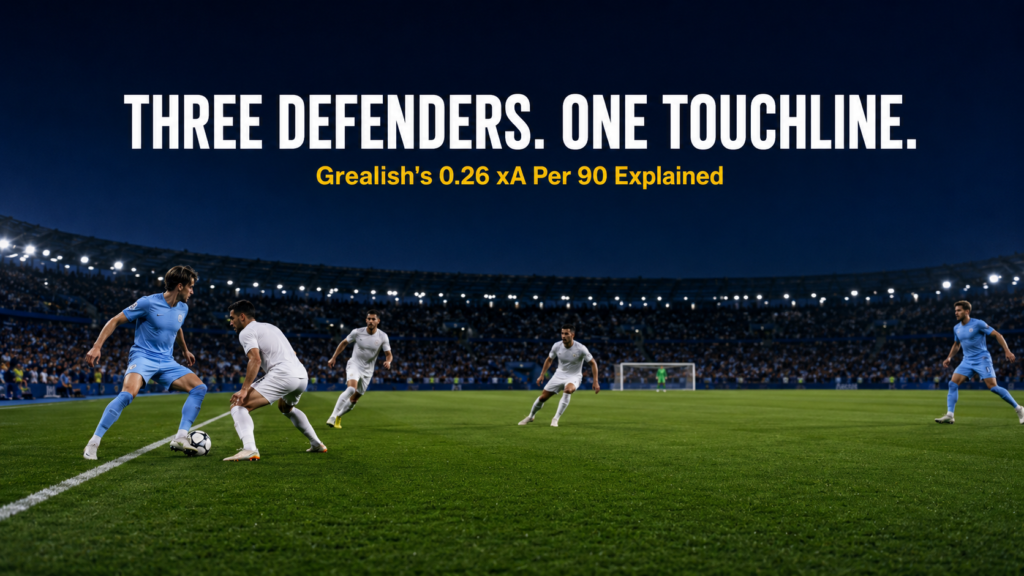
In April 2023, Jack Grealish averaged 0.26 expected assists from open play per 90 minutes for Manchester City – the second-highest figure in the Premier League that season, trailing only Kevin De Bruyne, per Sky Sports. The number is unusual not for its size but for its source. Grealish posted it from the left touchline, a zone where the conventional winger’s job is to beat his marker and cross. Pep Guardiola had asked him to do something different. He had asked him to stand still, hold the ball, and bend the opposition’s defensive shape around him.
This is the Wide Playmaker. It is one of the most misread roles in modern football because it looks, on first watch, like a winger who has gone wrong. Read our Modern Roles Hub for the full taxonomy of how attacking positions have evolved.
In simple terms: A Wide Playmaker is a creator who operates from the touchline to drag defenders out of central zones, then slips passes into the space they leave behind.
This article breaks down what the role actually does, why elite managers prefer it to a conventional winger, and where its weakness sits.
Key Takeaways
- Gravity, not penetration: A Wide Playmaker is judged by the defenders he pulls out of position, not the dribbles he completes. The role is engineered to manipulate shape, not to beat full-backs.
- The cut-back zone is the target: Per Opta-tracked data referenced by Analytics FC, the highest-value creation zone is the wide cut-back area just outside the penalty box, and Wide Playmakers are positioned to live there.
- Grealish is the modern template: Under Pep Guardiola at Manchester City, Jack Grealish averaged 0.26 open-play xA per 90 in 2022-23, ranking second only to Kevin De Bruyne, per Sky Sports.
- The role replaces the touchline winger: Where a traditional winger stretches the pitch to cross, a Wide Playmaker stretches it to create overloads elsewhere.
- It dies against a double-team: Bukayo Saka’s 2025-26 Arsenal season shows the structural cost when opponents commit two markers to a wide creator and force the team to find another creative source.
Table of Contents
What Is a Wide Playmaker?
A Wide Playmaker is a touchline creator whose job is to manipulate the opposition’s defensive shape by holding possession in wide zones and inviting pressure, then releasing the ball into the space that pressure has opened. The role looks like a winger but functions like an attacking midfielder shifted forty yards to the side.

The distinction matters because conventional wingers are judged by direct outputs: dribbles past, crosses delivered, shots created off the cutback. A Wide Playmaker, by contrast, “will act as the team’s primary source of creativity, drifting inside to find space from which to play the killer ball and create chances”, per The Higher Tempo Press. The reference benchmark is not the winger; it is the No. 10 who has been moved from central midfield to the flank. The Higher Tempo Press
Think of Atletico Madrid’s Koke under Diego Simeone in the mid-2010s. Per The Higher Tempo Press, Koke received the ball wide far more often than centrally, yet his passes flowed from the half-space inwards. He was a central playmaker who had been issued a touchline as a postal address. That is the lineage the modern Wide Playmaker descends from, sharpened by Pep Guardiola’s positional school into a specific tool with a specific function.
Why Elite Teams Use a Wide Playmaker Instead of a Winger
The Wide Playmaker exists because elite teams have run out of central space to attack. A conventional winger is a luxury when opponents already pack the middle of the pitch with eight defenders behind the ball.
The strategic problem is described well by Analytics FC. “An emerging tactical trend amongst the more progressive elite-level managers is the use of overloads/rotations in one zone to draw attention away from a different zone (which the team will then look to exploit the space within after a quick switch for example). The use of players with gravity has been an age-old strategy to draw defensive attention into a certain area, freeing up attacking teammates in other zones.” The Wide Playmaker is that gravity well, deliberately placed where central space is harder to find. Analytics FC
Why the wide zone, specifically? Because the touchline is the one place on the pitch where a creative player can hold the ball without immediate central pressure. “Coming in from the wing allows the Wide Playmaker to escape the hustle and bustle of central midfield and can result in him being unmarked by opposition players.” The player gains a half-second of decision time that a No. 10 in the centre simply does not get. That half-second is where the killer pass is born. The Higher Tempo Press
The trade-off is honest. A team running a Wide Playmaker sacrifices vertical penetration on that flank for control of the opposition’s defensive shape. Most elite managers consider the trade worth making.
The Grealish Template: How Guardiola Industrialised the Role
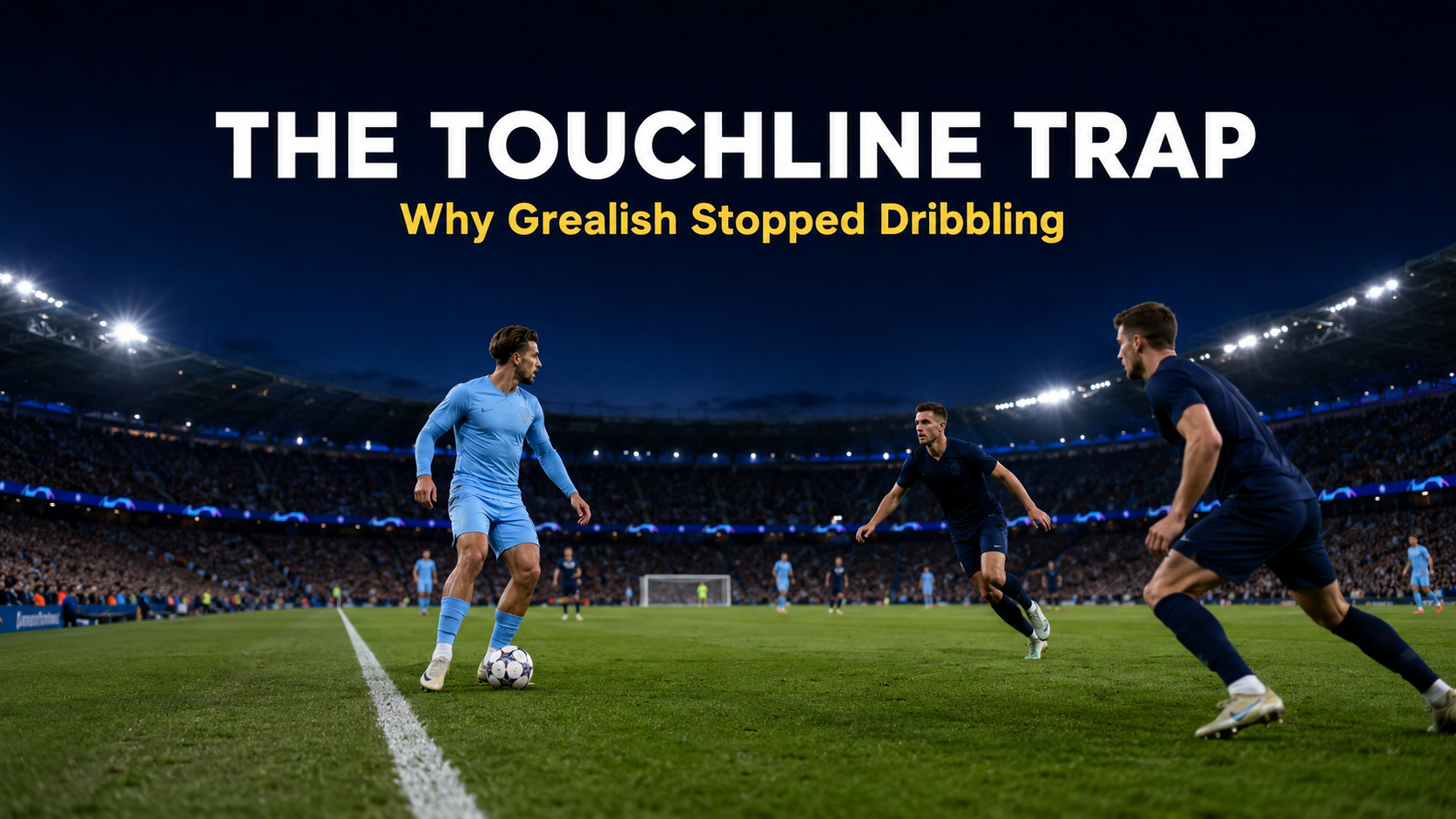
Jack Grealish’s transformation under Pep Guardiola at Manchester City between 2022 and 2024 is the cleanest case study of the modern Wide Playmaker. At Aston Villa under Dean Smith, Grealish had operated as a free-roaming central creator. “It’s so different to what I was used to at Aston Villa,” Grealish told Sky Sports. “Playing for Dean Smith, he’d say to me, ‘go and find where you think the weak link is in the defence. If you want to, go to the right, in the middle, or hug the touchline’.” Sky Sports
Guardiola took that freedom away. “Guardiola’s wide players are asked to stay high and wide when City have possession, the intention being to stretch opposition defences and create space in central areas.” The output, eventually, was the 0.26 open-play xA per 90 figure – second only to De Bruyne in the 2022-23 Premier League. Grealish lifted a Treble in that season, with Coaches’ Voice noting his role in City’s final-third attacking line of three alongside Bernardo Silva. Sky Sports
The mechanics are visible in any 2022-23 City match. Grealish receives a pass on the touchline at half-way. He does not dribble. He waits. The opposition right-back steps to engage. The right-sided midfielder shifts across to cover. A passing lane opens into the half-space, where one of City’s No. 10s arrives unmarked. The ball goes through. The cut-back follows. A goal is generated from a wide zone where the conventional winger never threatened to cross.
Wide Playmaker vs Conventional Winger – The Output Comparison
| Metric | Conventional Winger | Wide Playmaker (Grealish 2022-23) | Tactical Implication |
|---|---|---|---|
| Touchline width usage | Hugs line to stretch defence | Hugs line to draw defenders | Same position, different intention |
| Average dribble completion | High (purpose: beat marker) | Moderate (purpose: hold ball) | Wide Playmaker prioritises retention |
| Open-play xA per 90 | Typically 0.15-0.20 | 0.26 (per Sky Sports) | Wide creator outperforms most pure wingers |
| Crosses per 90 | 4-6 | 1-2 | Wide Playmaker plays cutbacks, not crosses |
| Defensive recoveries in own half | Low | Moderate (recovery runs to 2v1) | Role demands defensive contribution |
Data reflects average Premier League winger metrics versus Grealish’s 2022-23 Manchester City season per Sky Sports and FBref. Individual team and season variance applies.
The Half-Space Connection: Why the Wide Playmaker Lives Between Lines
The Wide Playmaker is not really a wide player at all. He is a half-space player who starts wide. Understanding this distinction unlocks the role’s deeper function.
The half-space is the vertical channel between the touchline and the centre of the pitch, the zone between the opposition full-back and centre-back. It is the most dangerous area of the pitch to receive in because defenders must choose whether to step out or hold their line. Wide Playmakers exploit that decision. They start on the touchline to stretch the back line, then drift into the half-space the moment the ball arrives, forcing the choice.
This is why Wide Playmakers are almost always played on their inverted foot. A right-footed creator on the left flank, like Grealish, naturally opens his body inwards as he receives, which positions him to play a line-breaking pass with his stronger foot. The touchline becomes a launching pad, not a destination. For the broader theory of why this zone is so valuable, our half-space defensive analysis covers the defending side of the same problem.
The Saka Variant: A Wide Playmaker With Goal Threat
Bukayo Saka at Arsenal under Mikel Arteta is the Wide Playmaker variant that adds direct goal threat to the creative function. The mechanism is identical to Grealish’s – hold the touchline, draw pressure, exploit space – but Saka adds the threat of cutting inside and shooting on his left foot, which forces a different defensive response.
Saka finished the 2025-26 season with 11 goals in 49 appearances in all competitions for Arsenal, seven of them in 31 league games, despite recurring Achilles and knee problems (figures updated October 2026 to the final season totals). The numbers are deflated by injury but the function is unchanged. Arsenal’s attacking shape is built around Saka’s gravity on the right; the moment opponents commit a second defender to him, central space opens for Martin Odegaard.
This is the second-generation Wide Playmaker. Where Grealish’s threat is almost purely creative, Saka’s combination of creation and finishing forces the opposition to defend two threats with one defender. When the system works, the team scores. When it breaks, it breaks badly.
The Weakness: How to Counter a Wide Playmaker

The Wide Playmaker has one structural weakness that elite opposition managers exploit ruthlessly: he is, by design, a slow attacker. The role requires the player to hold the ball, scan the pitch, and wait for movement. That waiting is what makes the creation possible. It is also what makes the role vulnerable.
The counter is the double-team. Commit the full-back and the near-side central midfielder to the Wide Playmaker every time he receives. Force him to release the ball within two seconds. The pass either goes backwards, which kills the attack, or forwards into traffic, which gives possession away. This is the strategy Diego Simeone has used against possession-dominant opponents for a decade at Atletico Madrid, per the analysis on Coaches’ Voice and IFAB-style positional coverage. The Wide Playmaker becomes a spectator on his own flank.
The counter requires courage because the double-team leaves a 4v3 elsewhere on the pitch. Elite teams accept that trade because the alternative – letting the Wide Playmaker dictate from the touchline – is worse. The Saka injury data from 2025-26 hints at a related cost. When the Wide Playmaker is the system’s primary creative outlet and he is removed, either by marking or by injury, the team has no fallback creator and the attack stalls.
The teams who beat possession sides at the highest level – Atletico Madrid under Simeone, Unai Emery’s high-line trap systems – do so by attacking the Wide Playmaker’s slowness with intensity. The role is brilliant against passive defending. Against aggression, it bleeds.
Final Thoughts
The Wide Playmaker is not a position. It is a question disguised as a position. The question is whether a team’s creativity is best served by putting its most intelligent player in the centre, where space is scarce, or on the touchline, where space exists but the angles are harder. Pep Guardiola answered the question one way and won a Treble doing it. Diego Simeone has spent a decade proving the answer can be reversed against the right opponent.
The fact that Grealish’s career arc has now run from Aston Villa free-roamer to Guardiola’s touchline creator to David Moyes’s Everton outlet says something about the role’s limits. The Wide Playmaker requires a system that can absorb its slowness and convert its gravity. Without that system, the player looks like an underperforming winger. With it, he looks like the best wide creator in Europe. The role does not produce stars. It rewards systems.
What Do You Think?
Grealish posted 0.26 open-play xA per 90 in 2022-23 at City – second only to De Bruyne. But he hasn’t replicated those numbers since, and his career has now moved from a Champions League winner to a mid-table Everton on loan, a deal renewed for a second season in 2026-27. Is the Wide Playmaker role only worth it when surrounded by elite teammates, or can a mid-table side genuinely benefit from one? Drop your take below.
Want to read any match like this?
The framework behind these breakdowns, in one place. The four phases, a 15-minute method for diagnosing both teams before the drinks break, a printable match-watching worksheet, and 51 terms defined. 40 pages.
Get the pack$9, instant downloadRelated Tactical Breakdowns
The Carrilero Evolution: The Shuttler in Modern Midfield
Why it connects: The Carrilero and the Wide Playmaker share the same underlying job – manipulate the opposition’s shape from a half-space they’re not supposed to occupy. Reading them together clarifies why the half-space dominates modern tactics.
The Raumdeuter (Space Investigator)
Why it connects: Where the Wide Playmaker creates the gravity, the Raumdeuter exploits the space it produces. The two roles are functional opposites that often appear in the same attacking system.
Why it connects: Every Wide Playmaker’s mechanism depends on attacking the same defensive zone. The defending-side breakdown shows exactly what the Wide Playmaker is trying to break.
Speak the language of the game
Get the free 47-term tactical glossary. Gegenpress, half-space, xT, low block, each defined in plain language and linked to a full breakdown. It is yours for an email.
Frequently Asked Questions (FAQs)
What is a wide playmaker in football?
A Wide Playmaker is a creative attacking player who operates from a wide position to manipulate the opposition’s defensive shape and create chances through passing rather than dribbling. The role positions a creator on the touchline so he can hold possession, draw defenders out, and slip passes into the space behind them. Jack Grealish under Pep Guardiola at Manchester City became the modern template for the role.
How is a wide playmaker different from a winger?
A winger is judged on penetration – beating defenders, crossing, and shooting – while a Wide Playmaker is judged on the chances his positioning creates for others. The winger threatens the goal directly from wide areas. The Wide Playmaker threatens the goal indirectly by manipulating where defenders stand. Most Wide Playmakers cross less, dribble less aggressively, and pass into the half-space more than conventional wingers.
Why do top teams use playmakers in wide areas?
Elite teams use Wide Playmakers because central space is increasingly compressed by opposition mid-blocks and low blocks. Putting a creator on the touchline gives him time and space that a central No. 10 cannot find, while still allowing him to feed central runners. The trade-off is a loss of direct touchline penetration, which top managers consider a worthwhile exchange for control of the opposition’s shape.
Which players are the best wide playmakers in modern football?
Jack Grealish at Manchester City between 2022 and 2024 set the modern standard, posting 0.26 open-play xA per 90 in the 2022-23 Treble season, per Sky Sports. Bukayo Saka at Arsenal under Mikel Arteta is the contemporary variant that adds goal threat to the creative function. Bernardo Silva served as a similar wide creator for Manchester City throughout the same era, often paired on the opposite flank to Grealish.