

Last updated: September 19, 2026
At Euro 2016, Toni Kroos averaged 82 opponents bypassed per match, per IMPECT’s published tournament data. Not beaten in a duel – rendered inactive entirely, placed behind the ball by a single action. Traditional stats logged him as an accurate passer. The packing football metric revealed he was systematically dismantling defensive structures every time he received possession.
That distinction matters more than it first sounds. Pass completion percentage tells you whether a team kept the ball. It tells you nothing about whether that ball moved anyone closer to goal. Stefan Reinartz, a former Bayer Leverkusen midfielder, understood this after watching Brazil control over 50% of possession in their 1-7 loss to Germany at the 2014 World Cup. More ball, fewer defenders bypassed, no goals. Volume was irrelevant; direction was everything.
In simple terms: The packing football metric counts the number of opposition players that a single pass or dribble renders inactive, placing them behind the ball.
This article breaks down how the packing football metric works, why it exposes the limits of conventional passing data, how Arne Slot’s title-winning Liverpool demonstrated its principles in 2024-25, and where the metric genuinely falls short. For the full analytical context, start with our football analytics metrics hub.
Key Takeaways
- Possession is not progression: A team can record 65% possession without bypassing a single defensive line. The packing football metric separates ball retention from genuine vertical threat.
- Invented from frustration: Stefan Reinartz and Jens Hegeler founded IMPECT after the 2014 World Cup, where Brazil’s possession dominance against Germany produced 7 goals against, not for – proof that standard metrics were measuring the wrong thing.
- Two-player credit: Packing awards points to both the passer who bypasses opponents and the receiver who found space to collect, making it one of the only mainstream metrics that values intelligent off-ball movement.
- Liverpool 2024-25: Liverpool led the Premier League in progressive pass distance with 93,682 metres, per Total Football Analysis – the kind of vertical commitment the packing football metric is designed to capture.
- Useful, not infallible: Per StatsBomb research, around 70% of packing variation can be explained by forward passes and dribbles alone – making context and position essential to interpretation.
Table of Contents
What Is the Packing Football Metric?
The packing football metric counts the number of opposition players that a pass or dribble bypasses in a single action, leaving them behind the ball and outside the defensive phase. It was developed by IMPECT, the Cologne-based analytics company founded by Stefan Reinartz and Jens Hegeler in 2014.
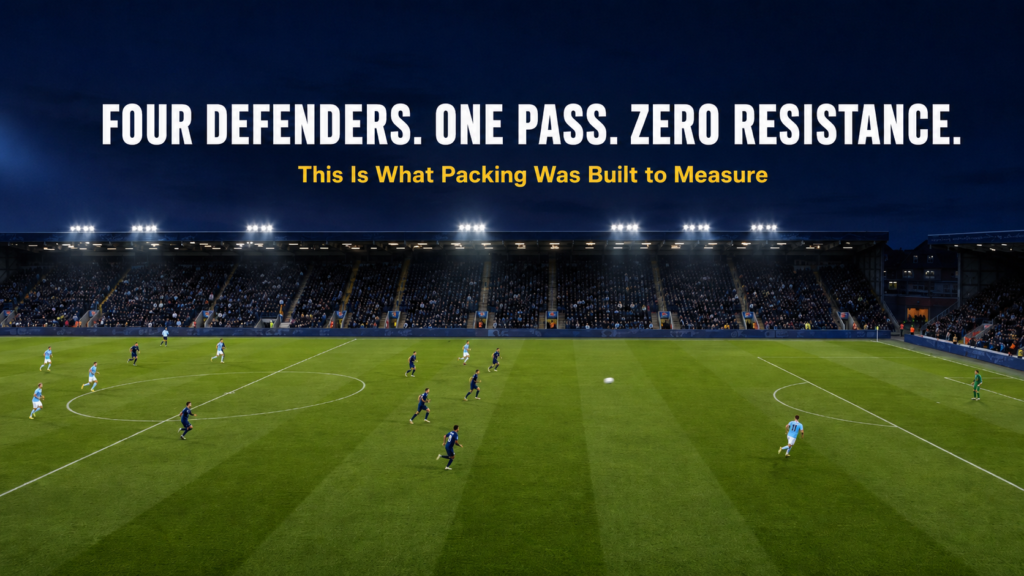
The metric works on a single principle: every opposition player that a pass or dribble physically bypasses earns the executing player one point. A through ball that skips past four defenders earns four packing points. A square pass to a teammate with nobody between him and the goalkeeper earns zero. The cumulative total across a match is called the Packing Rate.
What separates packing from earlier metrics is that it credits two players simultaneously. The passer earns points for the opponents bypassed by the delivery. The receiver earns the same points for the movement that created the space to receive it. A striker dropping between lines to collect and turn is doing something the pass completion column will never capture – the packing football metric is built to capture exactly that.
IMPECT also tracks a sub-metric called Impect, which weights bypassed defenders at a higher value than bypassed midfielders or forwards. The logic is straightforward: eliminating the last line of organised defence is categorically more dangerous than bypassing a pressing forward who is already out of position.
Why IMPECT Built Packing After Brazil 1-7 Germany
Packing was conceived as a direct response to a specific tactical embarrassment for traditional analytics. Stefan Reinartz and Jens Hegeler, then active midfielders at Bayer Leverkusen, watched Brazil dominate possession against Germany in the 2014 World Cup semi-final. Brazil lost 1-7. Every conventional metric pointed toward control; the scoreline proved control was meaningless.
Reinartz launched IMPECT out of that frustration the same year. The premise was that passing accuracy, ball possession, and duel ratios had been shown, in academic studies cited at Cologne Sports University, to have no significant correlation with match outcomes. A new layer of measurement was needed, and that layer became packing.
The metric debuted on German television during Euro 2016 through broadcaster ARD. Toni Kroos topped the tournament’s average packing chart at 82 opponents bypassed per match, per IMPECT’s published tournament data. Eden Hazard topped the Impect sub-metric for specifically bypassed defenders, averaging nine per match – more than double the next nearest competitor in that category.
How the Packing Football Metric Is Calculated?
Each pass or dribble in a match generates a packing score equal to the number of opposition players the action leaves behind the ball. Forward passes carry the standard multiplier. Sideways passes are weighted lower, and backward passes can carry a negative multiplier in some implementations, including the open-source variant documented by Samira Kumar Varadharajan in the Python football-packing library.
A worked example: a midfielder in his own half plays a vertical pass that travels through a four-man midfield press, reaching a striker who has dropped between lines. Three midfielders are now behind the ball. The forward who pressed the ball-carrier is also bypassed. Packing score: four. The receiving striker is also awarded four points for the movement that opened the receiving lane.
What makes packing distinct from raw progressive pass counts is the explicit per-player tally. A 30-metre progressive pass that travels through empty space scores zero on packing. A 12-metre pass that threads through three defenders scores three. Distance is not the unit; defensive elimination is.
Packing vs Progressive Passes: What’s the Difference?
Progressive passes measure whether a pass moved the ball significantly closer to the opponent’s goal. The packing football metric measures how many opponents that pass actually bypassed. They overlap heavily but are not interchangeable.
Per FBref’s published definition, a progressive pass is one that moves the ball at least 10 yards closer to the opponent’s goal, or any completed pass into the penalty area. Distance is the gate. Defensive elimination is incidental to the count.
Packing inverts that logic. A pass can score high on packing without qualifying as progressive in distance terms – for example, a tight 12-metre pass that threads through three pressing defenders. Conversely, a 40-metre diagonal switch into empty space scores high on progressive pass distance but adds zero to a team’s packing total, because no opponent was bypassed by the trajectory.
For tactical analysis, the two metrics answer different questions. Progressive passes tell you how often a team advances territory. The packing football metric tells you how often a team disrupts the opponent’s defensive structure while doing so.
How Arne Slot’s Liverpool Embody Packing Principles?
Liverpool’s 2024-25 Premier League title win under Arne Slot is the clearest modern case study for the packing football metric in practice, even though Liverpool do not publish IMPECT data directly. The underlying behaviour the metric measures was the foundation of how Slot’s team won.

Liverpool led the Premier League in progressive pass distance with 93,682 metres across the 2024-25 season, per Total Football Analysis – a figure that reflects Slot’s insistence on purposeful forward movement rather than lateral recycling. The player most responsible for sustaining that directness from deep was Ryan Gravenberch.
Moved into a deeper pivot role by Slot at the start of the campaign, Gravenberch ranked third in the Premier League for progressive carry distance at 5,313 metres, per Sports Mole – ahead of almost every attacking midfielder in the division. Per the Premier League’s own Young Player of the Season analysis, only Manchester City’s Mateo Kovacic carried the ball further toward the opponent’s goal across the campaign.
That is precisely the packing football metric profile in motion: a midfielder who refuses to pass sideways when the opponent’s shape can be disrupted vertically. Gravenberch’s 2,430 completed passes across 48 appearances in 2024-25, per Liverpool FC, were not remarkable for volume. They were remarkable for direction. The majority advanced Liverpool into territory where the opponent’s defensive block was already diminishing.
The table below illustrates how packing principles translate into match context, using benchmark profiles from European top-division clubs:
| Metric | Low-Packing Team Profile | High-Packing Team Profile | Tactical Implication |
|---|---|---|---|
| Pass Completion % | 88-92% | 78-85% | High completion does not indicate vertical threat |
| Progressive Pass Distance per match | Under 2,400m | Over 2,600m | Directness is measurable through distance, not count alone |
| Bypassed defenders per attacking sequence | 1-2 | 3-5 | More defenders bypassed = fewer organised defenders to beat in the final third |
| Receiver involvement in packing score | Low (ball played to feet in space) | High (receiver makes runs between lines) | Off-ball movement is as important as the pass itself |
Data reflects average benchmark profiles across European top-division clubs. Individual team and season variance applies.
The Receiver Score: Why Movement Earns Points Too
The packing football metric is, to date, the only mainstream public metric that awards points to the player receiving a line-breaking pass as well as the one delivering it. That single design choice changes how off-ball movement gets valued.

Per IMPECT’s published methodology, every bypassed opponent generates two entries in the dataset: one credited to the passer, one credited to the receiver. A striker who consistently finds pockets between the opposition’s midfield and defensive lines accumulates a high “received” packing score across a season, even if his goal and assist columns look modest.
Mesut Özil’s career-long ranking near the top of received-packing charts is the clearest illustration. At Euro 2016, Özil ranked second behind Italy’s Graziano Pellè for opponents bypassed as a pass receiver, per IMPECT’s tournament breakdown – despite Pellè being a target man and Özil a creative midfielder. The two profiles arrived at similar numbers through completely different movement patterns. The packing football metric was the only data source capable of placing them on the same scale.
For coaches and scouts, this dual-credit feature is the metric’s most practical contribution. A player who looks ordinary on standard dashboards but accumulates high received-packing scores is doing something genuinely valuable that other data layers miss entirely.
Where the Packing Football Metric Fails
The packing football metric is a useful lens. It is not an infallible one. StatsBomb’s analysis of Euro 2016 packing data found that around 70% of the variation in average packing scores could be explained by just two pre-existing metrics: forward passes per 90 and successful dribbles per 90. The proprietary dataset adds genuine value, but the gap over freely available metrics is narrower than IMPECT’s marketing suggests.

The first structural limitation is that packing treats bypassed players equally regardless of context. A through ball that bypasses a goalkeeper charging from his line earns the same point as a routine pass that slips past a high-pressing forward already out of position. The quality of the defensive organisation being bypassed is invisible to the raw score.
Second, the metric is acutely position-dependent. Midfielders and inverted fullbacks will naturally generate higher packing numbers than centre-backs or wide forwards operating close to the touchline. Per The Football Analyst’s published guidance, comparing a holding midfielder’s packing score to a centre-back’s is an analytical category error. The gap reflects role, not quality.
Diego Simeone’s Atlético Madrid exploit this structural blind spot indirectly. By compressing the space between defensive and midfield lines to within 20-30 metres, Simeone reduces the available windows for line-breaking passes. The packing rewards for individual actions shrink. The metric still records what happens, but the rate of high-value actions drops sharply against well-organised low-block defences.
The packing football metric is also blind to timing. A pass that bypasses four opponents 10 seconds before a phase breaks down is indistinguishable, in the raw data, from the same pass leading directly to a goal opportunity.
Where This Leaves Us
The packing football metric is not the future of football analytics. But dismissing it because its outputs correlate with simpler metrics misses the point of what it is for. Packing was built to make visible the thing every coach already knows but cannot easily quantify: pass completion is the wrong proxy for passing quality.
What the metric genuinely adds is dual credit – the recognition that a receiver’s intelligent movement is as analytically significant as the passer’s decision. In a game where Expected Goals models have already shifted attention from volume to quality, packing pushes the same logic upstream into build-up play.
Liverpool’s 2024-25 title win was built on vertical directness. Gravenberch’s role at its centre was built on the exact behaviours the packing football metric is designed to measure. Whether Slot’s staff use IMPECT data specifically is beside the point. The underlying principle – that bypassing opponents is more valuable than retaining the ball beside them – shaped how that team played and how they won. The question worth sitting with is whether your own analysis of passing currently accounts for direction, or just completion. If it does not, you are measuring the wrong thing.
What Do You Think?
Ryan Gravenberch ranked third in the Premier League for progressive carry distance in 2024-25 at 5,313 metres, per Sports Mole – but sat only in the 55th percentile for progressive passes among midfielders in Europe’s top seven leagues. That gap is interesting. Elite at advancing vertically with the ball at his feet; average at doing so through passing alone. Does that make him a high-packing player or a packing illusion – someone who moves the ball forward physically but without consistently bypassing organised defensive lines through delivery? Drop your take below.
Want to read any match like this?
The framework behind these breakdowns, in one place. The four phases, a 15-minute method for diagnosing both teams before the drinks break, a printable match-watching worksheet, and 51 terms defined. 40 pages.
Get the pack$9, instant downloadRelated Tactical Breakdowns
PPDA Explained: The Metric That Measures Pressing
Why it connects: Packing measures how effectively teams break defensive lines going forward; PPDA measures how effectively they prevent opponents from doing the same going backward – reading both together gives you a complete picture of a team’s positional control.

Expected Threat (xT) Explained: Measuring Danger on the Ball
Why it connects: xT quantifies how much a ball action increases the probability of a goal; packing tells you how many opponents that action bypassed to reach that threatening position – the two metrics are sequential steps in the same analytical chain.
Field Tilt Explained: Beyond Possession
Why it connects: Field tilt measures where on the pitch a team is winning the ball back; packing explains why some high-tilt teams are genuinely dangerous while others merely look like they are – directness in possession is the variable that separates the two.
Speak the language of the game
Get the free 47-term tactical glossary. Gegenpress, half-space, xT, low block, each defined in plain language and linked to a full breakdown. It is yours for an email.
Frequently Asked Questions (FAQs)
What does the packing football metric mean in football statistics?
The packing football metric counts the number of opposition players that a pass or dribble bypasses in a single action, leaving them behind the ball and outside the defensive phase. Developed by IMPECT, it awards points to both the passer and the receiver. That dual-credit feature is what makes it one of the only public metrics that directly values intelligent off-ball movement, not just passing skill.
What is the difference between the packing football metric and progressive passes?
Packing counts opponents bypassed by an action; progressive passes count distance gained toward goal. The two overlap but are not interchangeable. A 12-metre pass through three defenders scores high on packing and low on progressive distance. A 40-metre diagonal into empty space scores the opposite way. Packing adds defensive-elimination context that distance-based progressive pass counts cannot provide.
Which players have historically scored highest on the packing football metric?
Deep-lying midfielders and creative passers with line-breaking delivery typically generate the highest packing totals. Toni Kroos averaged 82 bypassed opponents per match at Euro 2016, per IMPECT, the highest tournament average that summer. In the 2024-25 Premier League, players like Ryan Gravenberch and Trent Alexander-Arnold rank among the division’s most progressive ball-carriers, per Premier League data – exactly the profiles packing was designed to quantify.
How can the packing football metric be applied to scouting and recruitment?
Packing helps scouts identify players who break lines rather than recycle possession. A midfielder with a high packing score per 90, filtered against comparable leagues, signals press-resistance and vertical decision-making under pressure. Per The Football Analyst’s published scouting guidance, combining packing rate with Expected Threat and progressive carry data produces the clearest profile of genuine ball-progression value for recruitment shortlists.