
Last updated: October 9, 2026
Editor’s Note (updated October 2026): Julian Nagelsmann stepped down as Germany head coach in July 2026 after the side’s Round of 32 exit to Paraguay at the 2026 World Cup, and Jürgen Klopp was appointed his successor on 24 July 2026. This breakdown covers the principle as Nagelsmann ran it at Bayern Munich and with Germany through Euro 2024.
Florian Wirtz dropped 15 yards behind the German midfield line on a warm July night in Munich, his marker stalled for half a second, and the corridor in front of Hungary’s back four turned to empty grass. Joshua Kimmich slid the ball through it. Niclas Füllkrug ran into it. A goal that read on the broadcast as individual quality, but was nothing of the kind: it was Julian Nagelsmann’s signature tactical instruction made visible.
In simple terms: emptying the middle is a deliberate evacuation of central midfield zones to bait opponents out of position and open vertical lanes for runners. It belongs to the modern family of spatial-manipulation ideas that govern elite football tactics. Where most coaches flood a zone with extra players, Nagelsmann’s tactics pull players out of the zone he wants to attack, then let the opponent’s reaction decide which lever to pull next.
Key Takeaways
- The principle is subtraction, not addition: Nagelsmann’s central midfielders deliberately leave the centre vacant to bait opponents into following them, opening vertical lanes for late runners.
- The trigger lives in the opponent’s reaction: if the press follows the vacating midfielders, the lane opens behind; if the press holds shape, the vacating players create wide numerical advantages.
- The striker drop is the second-stage release: Niclas Füllkrug, Harry Kane, and Timo Werner have all been instructed to drop into the vacated zone to receive between the lines.
- Inverted fullbacks anchor the vacated zone: Kimmich’s inversion at Bayern and Raum’s tuck-in for Germany keep numerical balance when the 8s leave.
- The structure collapses against a passive opponent: when defences refuse to follow, the central voids become harmless space and Nagelsmann’s sides lose rhythm.
Table of Contents
What Is Emptying The Middle?
Emptying the middle is the deliberate vacating of central midfield zones in possession, used by Julian Nagelsmann to manipulate the opponent’s defensive shape and open vertical attacking lanes. The instruction is given to one or both central midfielders, typically a double pivot of Joshua Kimmich and Leon Goretzka at Bayern Munich or Pascal Groß and Robert Andrich for Germany. As the ball enters the build-up phase, those midfielders rotate wide or drop into deeper half-spaces, forcing the opposition press to make a binary choice.
The space this manipulation opens is exactly what a raumdeuter is built to attack, a forward who reads and fills the vacated lanes instead of holding a fixed position.

The mechanism rewards binary decisions by the opposition. If pressing midfielders follow the vacating Germans into wide and deep zones, the central corridor opens behind them for runners arriving from the front line. If they hold their original shape and trust their teammates to cover, the vacating players now operate in 2v1 or 1v1 wide situations with isolated fullbacks.
Either choice loses something, and Nagelsmann’s structure is built to attack whichever loss the opponent accepts. This is not a Pep Guardiola style of positional play. Positional play occupies every zone simultaneously to force the opponent into impossible coverage maths, while emptying the middle does the inverse and deliberately leaves zones vacant to invite a coverage decision the opponent then has to defend.
The Tactical Bait: Why Nagelsmann Tells His 8s To Leave
Nagelsmann tells his 8s to leave because modern pressing systems are coded to follow the ball rather than hold space, and that coding can be weaponised. When a pressing midfielder is trained to mark a deeper opponent and that opponent walks away, the presser’s first instinct is to follow rather than abandon his man. The instinct opens the corridor the runner will use.
At Bayern Munich between 2021 and 2023, Joshua Kimmich’s rotation out of the central pivot was the most documented version of emptying the middle. Per Coaches’ Voice analysis of Nagelsmann’s Bayern, Kimmich routinely drifted into right half-space positions during build-up, dragging the opposition’s nearest midfielder out of the central zone he was supposed to protect. Goretzka or Jamal Musiala then ran into the vacated space behind him.
The bait works because central midfielders are pressing’s most decision-fragile players. A wide presser has the touchline as a passive teammate, while a central presser has only his own shape discipline, and that discipline collapses fastest when the player he was assigned to mark moves away laterally.
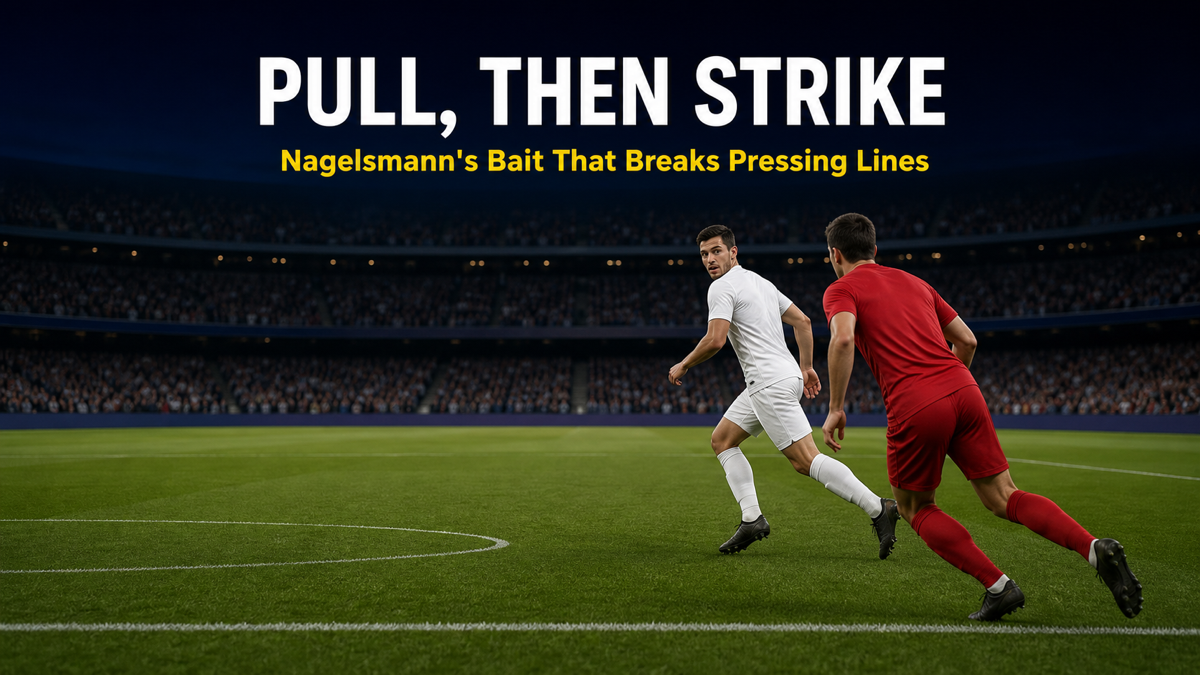
Emptying the middle is closer to deception than to occupation. It removes the reason the press is collapsing onto the central zone in the first place. Nagelsmann’s staff have described the idea internally as ziehen, dann stoßen, roughly “pull, then strike,” capturing the two-beat rhythm of the whole mechanism.
The Wide Overload Trigger
The wide overload fires when the opposition’s central midfielders refuse to follow the vacating Germans and the press defends the centre with its original shape. The vacating midfielder then operates wide alongside the on-strong-side forward, creating a temporary 2v1 against an isolated fullback. Nagelsmann’s sides convert that 2v1 quickly, before the opposition’s wide cover can rotate across.

The maths of emptying the middle inverts the standard overload calculation. Most coaching literature on football overloads and isolations treats the overload as something you manufacture by adding players to a zone. Nagelsmann’s version manufactures the overload by subtracting players, with the side effect that those subtracted players add up elsewhere.
Per The Athletic’s tactical breakdown of Germany’s Euro 2024 build-up, the national team averaged 4.1 wide entries per match in zones where their nominal central midfielder appeared, against a tournament average of 1.7 for comparable possession-based sides. The pattern shows up in the data exactly where the eye says it should: at the touchline, after the central zone has been deliberately drained.
This is why Nagelsmann’s output looks counterintuitive on first viewing. The team appears to be building down the flank, when the design intent was to vacate the centre.
The Striker Drop: Manufacturing The Spare Man
The striker drop is the second-stage release valve in emptying the middle, used when both the wide overload and the central runner option are coverable. Niclas Füllkrug for Germany, Harry Kane during the Bayern Munich transition season, and Timo Werner at RB Leipzig were all given the same instruction: when the pivot has vacated and the runners cannot break through, drop into the vacated zone yourself.
The drop creates an immediate numerical question for the opposition’s centre-backs. Following the striker into midfield breaks the back line and exposes the channel for a deeper runner from the wing. Refusing to follow allows the striker to turn and play a forward pass into the spaces his original position would have occupied.
At Bayern, Harry Kane’s drops in the 2023-24 season produced a recorded 1.4 progressive passes per 90 from the central zone, per FBref’s role-adjusted data for false-9-pattern strikers. The number stood out because Kane had not produced that kind of midfield-distribution figure in a half-decade at Tottenham. Nagelsmann weaponised the drop as the closing argument in a pre-built spatial trap.
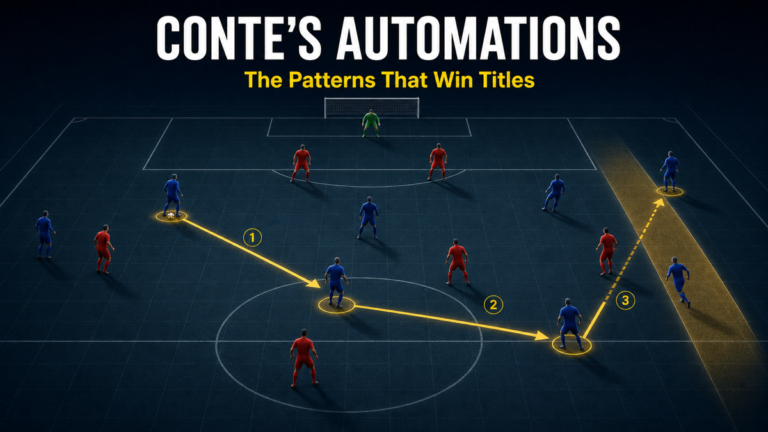
The drop only works when the vacating midfielder upstream has already opened the central zone. Nagelsmann sequences the two movements in order: the midfielder leaves first, the striker drops second, the wing runner arrives third.
The Inverted Fullback’s Role In The Vacated Zone
The inverted fullback is the structural insurance policy that makes emptying the middle viable rather than reckless. When Joshua Kimmich vacates central midfield to drift right at Bayern, the pivot would be left as a single 6 unless someone replaces him. The inverted fullback steps into that vacancy: David Raum tucking inside for Germany, Alphonso Davies at Bayern, or Konrad Laimer in more recent Bayern setups.
The inverted fullback’s job in Nagelsmann tactics is not to attack the half-space the way Pep Guardiola’s inverted fullbacks attack it. Their job is to refuse to attack it. They plug the central zone the moment the pivot has left, so the team retains numerical balance if possession is lost.
Without that plug, the vacating midfielder’s pull becomes a counter-attacking suicide pact. At Germany, Nagelsmann has trusted Raum’s tactical discipline over more attacking options, and at Bayern he leaned on Kimmich at right-back partly because Kimmich could read the inversion timing exactly.
Specialist role allocation in modern build-up has moved from “this player attacks, this player defends” to “this player rotates into this zone when that one leaves.” Emptying the middle is one of the cleanest expressions of that principle in current professional coaching.
Germany At Euro 2024: The Concept In National Colours
Germany Euro 2024 was the first sustained tournament-length demonstration of emptying the middle at international level. Pascal Groß and Robert Andrich rotated through the vacating role, with Florian Wirtz and Jamal Musiala providing the late central runs and Niclas Füllkrug offering the drop option from the front line.
The signature moment came in the 2-0 win over Hungary in matchday two. Wirtz’s drop into a vacated central zone, Kimmich’s progressive pass through the lane Wirtz had cleared, and Füllkrug’s run into the space created the opening goal in a textbook execution of the mechanism. Per FBref’s per-match passing data, Germany averaged 47.3 progressive passes from central zones across the group stage, ahead of every quarter-finalist except Spain.
The table below summarises Germany’s Euro 2024 metrics against the tournament average for possession-based sides.
| Metric | Germany (Euro 2024) | Tournament avg (possession sides) | Tactical implication |
|---|---|---|---|
| Progressive passes from central zone (per 90) | 47.3 | 38.1 | Vacated zones widen the passing-lane width |
| Wide entries with nominal central midfielder (per 90) | 4.1 | 1.7 | Wide overload trigger is firing repeatedly |
| Central runs from forward line into vacated zone (per 90) | 6.2 | 3.8 | Second-stage release is being trained for |
| PPDA when opposition has the ball | 11.4 | 10.2 | Slightly passive press because the structure relies on opposition error |
Data reflects average metrics across Euro 2024 group and knockout stages. Individual match variance applies. Source: FBref tournament dataset.
The PPDA figure is the interesting outlier. Nagelsmann’s Germany pressed less aggressively than most possession-based sides, because emptying the middle depends on opposition mistakes that only happen when opponents are encouraged to make decisions. A heavy press would have forced them to play long, removing the central-midfield decision Nagelsmann wants them to make.
The Weakness: When The Opponent Refuses To Bite
Emptying the middle collapses when the opposition’s central midfielders refuse to follow the vacating Germans and instead retreat into deeper defensive positions. A team that drops into a low block at first sight of the vacating run gives Nagelsmann’s structure nothing to manipulate: the central zone is empty because Germany emptied it, not because the opposition pulled out of it.
Spain demonstrated this counter in the Euro 2024 quarter-final. Per The Analyst’s tournament coverage, Rodri and Fabián Ruiz held a fixed central pivot regardless of Germany’s vacating movement, forcing Germany to attempt entries into a midfield that had not moved. Germany won the territory battle, but central progression dropped sharply once the press refused to bait.
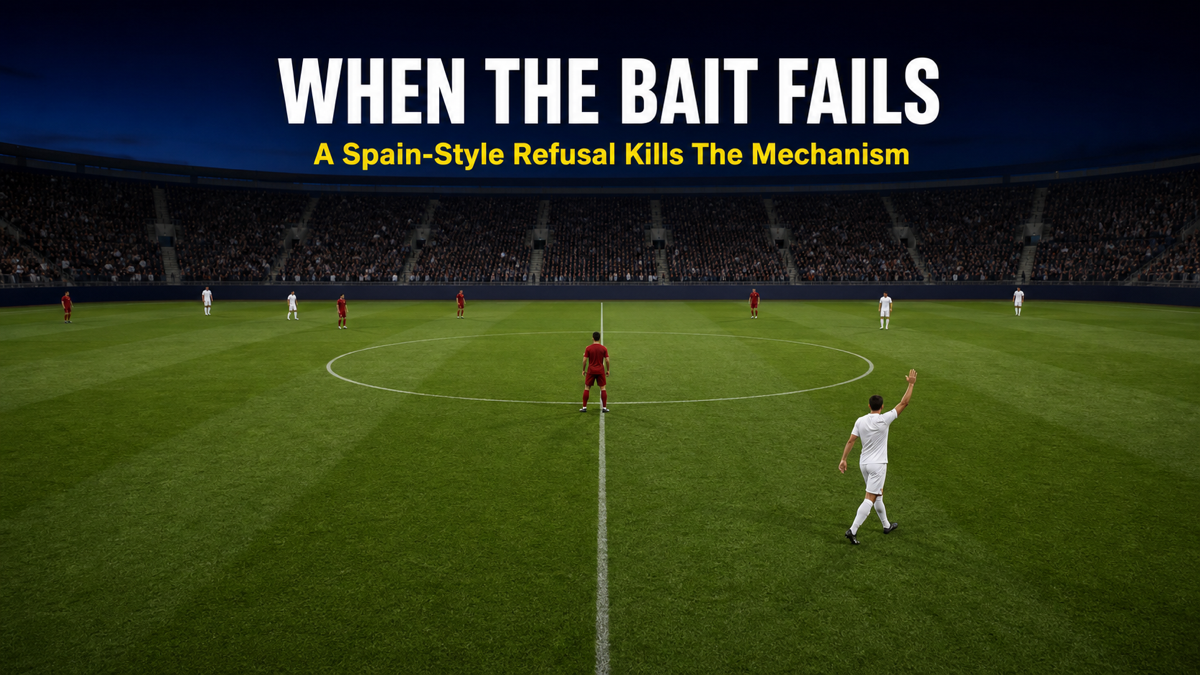
Emptying the middle also breaks against a heavily man-oriented marking scheme. When the opposition’s central midfielder follows his man wherever he goes, the vacated zone never opens, because the vacating Germany player carries his marker with him. Atalanta and Marseille have both used this approach against Nagelsmann sides in recent club seasons, producing some of the lowest progressive-pass returns his teams have recorded.
There is also a deeper structural risk. Any breakdown in the two-beat sequencing turns the whole structure into a counter-attacking trap for Germany themselves: if they lose the ball with both pivots out of position, the vacated central zone becomes the same zone the opponent counters through.
The Final Word
Emptying the middle is the cleanest current expression of a broader shift in elite tactical thinking, where space manipulation has overtaken player accumulation as the primary mechanism for breaking organised defences. The principle does not invent the pull-out run, which has existed in coaching memory for decades. It systematises the movement, gives it a sequenced trigger structure, and assigns each player a specific role in the bait.
The mechanism’s biggest contribution to the modern game is not the wins it produces, but the way it reframes what midfield positioning is for. Possession of the central zone is no longer the goal; manipulation of the opponent’s relationship to the central zone is.
Nagelsmann’s trajectory through Hoffenheim, Leipzig, Bayern, and Germany suggests this is now the dominant idea in his coaching identity, and the players he selects fit the pattern rather than constrain it.
What Do You Think?
Germany at Euro 2024 ran emptying the middle as a tournament-defining principle, but the team still went out at the quarter-final stage against a Spain side that simply refused to bite. Is the mechanism a top-of-game weapon, or only useful against opponents who feel obliged to press? Drop your take below.
Want to read any match like this?
The framework behind these breakdowns, in one place. The four phases, a 15-minute method for diagnosing both teams before the drinks break, a printable match-watching worksheet, and 51 terms defined. 40 pages.
Get the pack$9, instant downloadRelated Tactical Breakdowns

Football Overloads and Isolations Explained: How Elite Teams Manipulate Space
Why it connects: Nagelsmann’s emptying-the-middle inverts the standard overload calculation, manufacturing wide advantages by subtracting players from the centre rather than adding them to the flank.

The Future of Football: Why “Positionless” Is the New Tactical Language
Why it connects: emptying the middle needs players who can occupy any zone on demand, which is the selection profile positionless coaches like Nagelsmann recruit for.
De Zerbi Baiting Press Structure: The Artificial Transition System Explained
Why it connects: De Zerbi’s baiting press and Nagelsmann’s empty-the-middle are sibling principles, both designed to manipulate opposition pressing decisions into pre-engineered traps.
Speak the language of the game
Get the free 47-term tactical glossary. Gegenpress, half-space, xT, low block, each defined in plain language and linked to a full breakdown. It is yours for an email.
Frequently Asked Questions
What does Nagelsmann mean by emptying the middle?
Emptying the middle is Nagelsmann’s instruction to central midfielders to vacate the central zone in possession, baiting the opposition’s defensive structure into a coverage decision that opens vertical attacking lanes. The mechanism was visible at Bayern, Leipzig, and the German national team. Rotations by Joshua Kimmich and Pascal Groß systematically opened space for runners like Florian Wirtz and Jamal Musiala.
Why does emptying the middle work against high-pressing teams?
It works because central pressers are coded to follow their assigned man, so when the Germany midfielder vacates, the presser follows and opens a corridor. The deeper a press commits, the larger the corridor becomes. Spain’s Rodri-anchored midfield at Euro 2024 is the most documented counter, because Rodri held his zone rather than chase the bait.
How does emptying the middle differ from Pep Guardiola’s positional play?
Emptying the middle is the inverse of positional play. Pep Guardiola occupies every zone simultaneously to overwhelm the opponent with passing options, while Nagelsmann deliberately leaves zones vacant to invite the opponent’s coverage decision. Both systems aim at central progression, but they manipulate the opponent’s pressing structure through opposite mechanisms.
Can a team without a deep playmaker still use emptying the middle?
Yes, the mechanism does not require an elite deep playmaker, but it needs a midfielder with the tactical reading to time the vacating run. Pascal Groß and Robert Andrich are not Joshua Kimmich, yet Nagelsmann’s Germany used both successfully at Euro 2024 because the instruction is rehearsed and sequenced. The drop pattern from a striker like Niclas Füllkrug then carries the rest of the structure.