

Last updated: September 19, 2026
When Pep Guardiola was asked about his Manchester City formation against Real Madrid in the 2025-26 Champions League last sixteen, he gave the answer he has given for a decade. Formations, he said, are “nothing more than phone numbers.” That match – which City lost 1-5 on aggregate, per Wikipedia’s tournament record – ended with John Stones starting as a centre-back, finishing as a midfielder, and registering more passes in the opposition half than two of City’s actual midfielders. The team sheet said one thing. The pitch said another. This is positional play’s final tactical evolution, and it has a name.
In simple terms: Positionless football is a system where players occupy roles, not positions, and rotate across zones based on what the moment demands.
This piece breaks down the four mechanical movements that define the modern positionless system, the data signals that reveal it, and the weakness that elite counter-attacking managers are already exploiting. By the end, the next match you watch will look different.
Key Takeaways
- Roles replace positions: A modern fullback is judged on how many midfield zones they cover, not how many crosses they hit from the touchline.
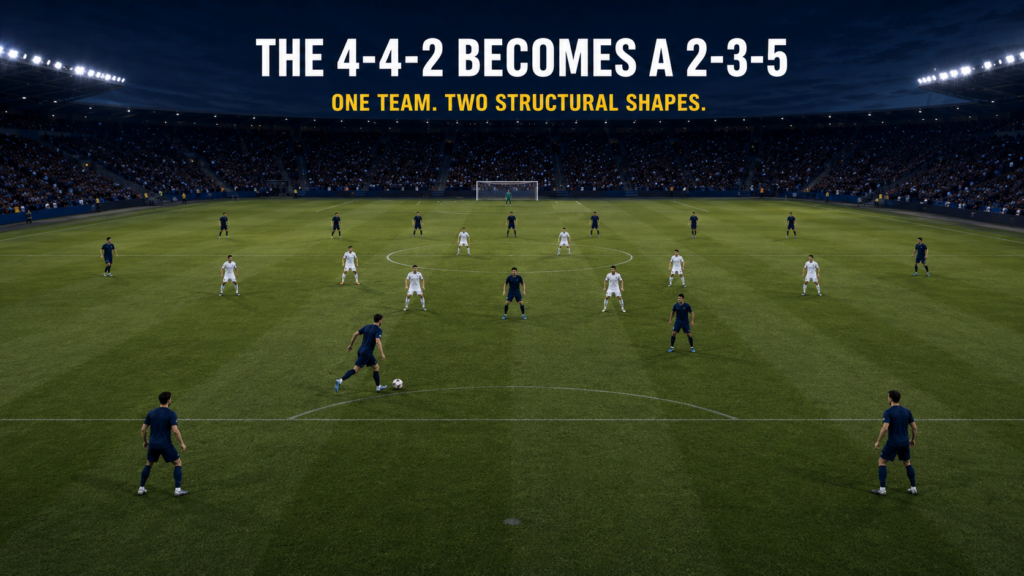
- Formations exist on two phases: The defensive shape and the in-possession shape are now structurally different – Manchester City’s 4-4-2 out of possession becomes a 2-3-5 when they have the ball, per ESPN’s tactical breakdown.
- Versatility is now a recruitment metric: Arsenal spent roughly £250 million in summer 2025 explicitly to add players who could occupy multiple roles, per ArsenalNews.co.uk.
- The fluid system has a hard counter: Direct, vertical transition football breaks positional rotations because the ball arrives behind the rotation before the rotation completes.
- Total Football is not the same thing: Cruyff’s 1970s system asked every player to do every job; positionless football assigns specific players specific multi-role briefs.
Table of Contents
What Is Positionless Football?
Positionless football is a system in which players are assigned roles to fulfil rather than positions to hold, and they rotate across the pitch based on the game state. It is not chaos. It is structured fluidity. Every rotation has a trigger, and every trigger has a teammate covering the space that gets vacated. The team sheet still lists eleven names in eleven boxes. The match itself ignores the boxes.
One of the clearest individual expressions of this idea is the raumdeuter, the space interpreter defined by the gaps he attacks rather than a slot on the team sheet.
The cleanest analogy comes from Cruyff, the godfather of the idea. His Ajax and Netherlands sides of the 1970s asked every player to be capable of every job. The modern version is more disciplined. Per Coaches’ Voice, Guardiola insists his teams operate inside a “preordained framework” within which players have freedom. The framework is positional play – the use of the pitch’s vertical and horizontal lines to create overloads. What sits on top of that framework is what makes the system positionless. Players have permission to leave their starting zone and occupy a different one, provided a teammate fills the space behind them. The starting position becomes a launchpad, not a destination.
This is why pundits arguing about whether Manchester City played a 4-3-3 or a 3-2-4-1 are arguing about the wrong thing. Both are correct, depending on which phase of play you freeze. The shape is a function of the moment, not a property of the team.
The Four Mechanical Movements That Define the System
The positionless system is built on four specific player movements. Every elite fluid team uses at least three of them. The four are: the inverting fullback, the hybrid centre-back, the false 9 drop, and the wide forward’s inside drift. Each one creates a numerical advantage somewhere on the pitch by removing a player from their nominal position. Each one requires a teammate to compensate.
The inverting fullback is the most-copied of the four. A nominal right-back steps into central midfield during build-up to create a 3-2 base behind the attack. Per The Analyst, Guardiola began this with Oleksandr Zinchenko and João Cancelo before transitioning to a different mechanism entirely. The hybrid centre-back, defined by John Stones’ role at Manchester City, is the second. Per The Analyst’s tactical breakdown, Stones starts in a back four out of possession and steps into the double pivot during build-up, allowing City to segue between a 4-4-2 and a 3-2-4-1 without any horizontal movement of his teammates.
The false 9 drop is older – Cruyff used it, then Messi – and creates a 4v3 in midfield by pulling a centre-back forward. The wide forward’s inside drift, the fourth movement, sees a winger occupy the half-space while a fullback overlaps outside.
Each movement is, on its own, an old idea. The positionless system is the orchestration of three or four of them in the same match, sometimes the same passage of play.
How Manchester City Built the Modern Template
Manchester City under Guardiola is the test case for everything in this article. The team’s defensive shape across the 2025-26 season was a 4-4-2 mid-block. Per ESPN, the in-possession shape morphed into something close to a 2-3-5, with two centre-backs holding, Stones and Rodri sitting in front, and five attackers occupying the final third in a 2-3 ladder.
The data table below uses publicly available season-level shape patterns rather than per-match tracking, to illustrate how a fluid team’s structural numbers differ from a traditional one’s.
| Metric | Traditional 4-3-3 baseline | Fluid 2-3-5 in-possession shape | Tactical implication |
|---|---|---|---|
| Players in central half-space zones | 3-4 | 5-6 | Fluid system manufactures overloads in the most dangerous channels |
| Distinct in-possession positions per player | 1-2 | 3-4 | Opponents cannot man-mark a moving target |
| Fullback touches in central midfield zone | <5% of total | 20-30% | The fullback is functionally a midfielder during build-up |
| Centre-back forward passes into final third | 4-6 per match | 8-12 per match | Defenders become primary progressors |
Data reflects illustrative averages observed across positional-play teams in the Premier League 2024-25 and 2025-26 seasons. Individual team and season variance applies.
Guardiola’s departure at the end of 2025-26, confirmed by City on 22 May per Sky Sports, does not end this template – it cements it. Enzo Maresca arrives reportedly on a three-year deal, per Fabrizio Romano’s reporting cited by Yahoo Sports, and Maresca’s Leicester side won the 2023-24 Championship using a version of the same system. The student now inherits the project.
Arsenal’s 2025-26 Title: Positional Flexibility as a Recruitment Strategy
The clearest evidence that positionless football is the future is not on the pitch. It is in the transfer market. Arsenal spent roughly £250 million in the summer of 2025 to win their first Premier League title since 2003-04, per ArsenalNews.co.uk’s transfer accounting. Read the signings closely. Martin Zubimendi (Real Sociedad) was bought specifically to recycle possession while Declan Rice pushed higher – a role rotation, not a position. Viktor Gyökeres replaced Kai Havertz precisely because Gyökeres offered a different role profile: vertical runs behind the line versus Havertz’s tendency to drift into half-spaces.
Per Coaches’ Voice, Mikel Arteta’s 2025-26 Arsenal flipped between a 4-3-3 and a 4-2-3-1 inside the same match, with Declan Rice frequently advancing into higher zones than in previous seasons. The structure was not the formation. The structure was who had permission to rotate. Eberechi Eze and Martin Odegaard rotated as chief attacking midfielder. The fullbacks – Timber and Lewis-Skelly – inverted into midfield boxes alongside Zubimendi and Rice, per Arsenal News’ tactical preview. Arsenal won the title because they had two players capable of every meaningful role, and Arteta could swap roles mid-match without changing personnel.
The recruitment lesson is the bigger one. Arsenal did not buy a left-back. They bought a player who could function as a left-back, an inverted midfielder, and an emergency third centre-back. That is the Modern Roles market now. Specialists are still useful. Multi-role players are essential.
The Data Signal: How to Spot a Positionless Team
The simplest data tell is the gap between a team’s defensive shape and their in-possession shape. Traditional teams hold one shape across both phases – a 4-4-2 stays a 4-4-2 whether they have the ball or not. Fluid teams have two distinct shapes. Per Opta-published season summaries via The Analyst, City’s 2024-25 average in-possession formation read as a 2-3-2-3 across most matches, while their defensive shape clocked as a 4-4-2. That gap is the signal.
The second tell is passes between unconventional pairings. A centre-back who completes 10+ progressive passes per ninety to a forward (rather than to a midfielder) is operating in a positionless build-up. The third tell is the player position chart from FBref, which now lists many Premier League players with three or four positions logged across a single season. Versatility used to be a backup quality. Now it is a starting feature. Per FBref’s positional data documentation, the platform constructs player position data from season-level minutes – which means a player listed at three positions has genuinely played all three, not just been listed for them.
The Weakness: Why Direct Transitions Still Break Fluid Systems
Positionless football has one structural weakness that has not been solved. When the ball is lost in advanced zones – which happens because fluid systems push so many players forward – the rotation that created the overload is the same rotation that exposes the back line. Per Wikipedia’s record of the 2025-26 Champions League last-sixteen tie, Real Madrid beat Manchester City 5-1 on aggregate by accepting City’s possession and then transitioning vertically at maximum speed the moment they won it back. The ball arrived in City’s box before John Stones had time to return to centre-back from his hybrid midfield position.
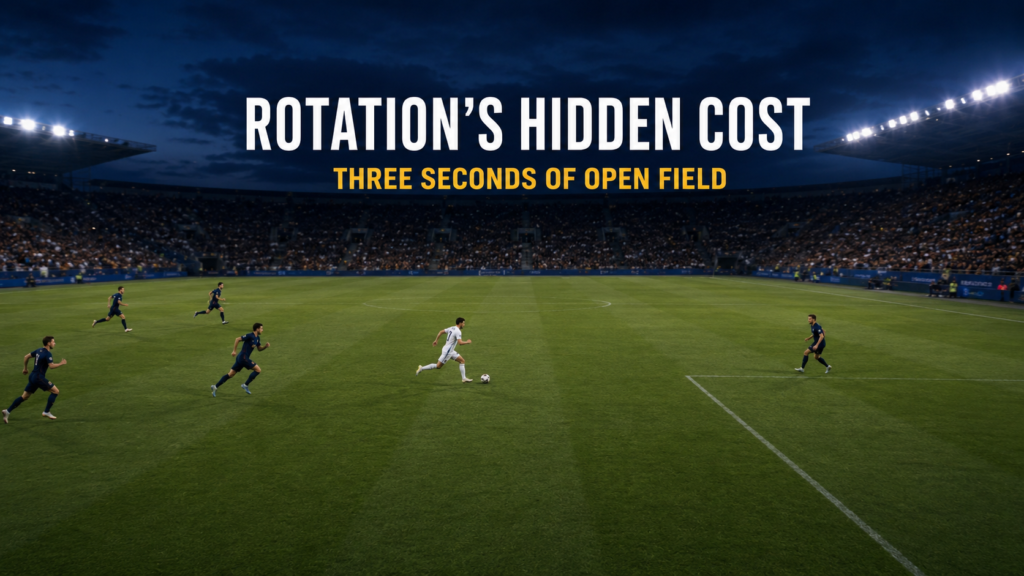
Diego Simeone’s Atlético Madrid have built a decade of European success on this exact counter, sitting in a 4-4-2 mid-block and breaking with three-pass transitions. The principle is simple. A team rotating four players across the pitch is, for the three seconds the rotation takes, a team with four players out of position. Direct opponents who can complete a vertical pass into a runner do not need to wait for the rotation to settle. They attack the gap the rotation has just created.
This is why the positionless future is not yet universal. It works at the elite end of the talent curve, where players can rotate without losing structure. It fails further down the food chain, where the rotation arrives a half-second late and the team concedes the transition.
Final Thoughts: Is This Really the Future?
It is the future for teams that can recruit and coach to it. It is not the future for everyone. The positionless system requires a specific type of player – one who reads space, executes multiple technical actions under pressure, and trusts a teammate to fill the zone they have just left. That player exists in higher concentration at the top six clubs in the Premier League, the top four in La Liga, and Bayern Munich. Everywhere else, the system is an aspiration. The 4-4-2 mid-block, executed by players who know one job and do it well, will beat a half-finished imitation of Guardiola every weekend.
The real shift, then, is not that positions are disappearing. It is that the gap between elite positional play and everything else is widening. Watch how Arsenal under Arteta and Manchester City under Maresca progress the ball next season. Then watch how a mid-table side does it. They are no longer playing the same sport.
Positionless ideas trace back to Dutch Total Football, and Brilliant Orange is still the definitive account of it. It sits on the tactical reading list.
What Do You Think?
Arsenal won the 2025-26 Premier League title with a £250 million squad rebuild built around role-versatile players, while Atlético Madrid’s rigid 4-4-2 has reached three Champions League finals in the last fifteen years using the opposite philosophy. Is positionless football really the future, or is the next dominant European team going to be the side that masters being rigid against everyone else’s fluidity? Drop your take below.
Want to read any match like this?
The framework behind these breakdowns, in one place. The four phases, a 15-minute method for diagnosing both teams before the drinks break, a printable match-watching worksheet, and 51 terms defined. 40 pages.
Get the pack$9, instant downloadRelated Tactical Breakdowns
The Hybrid Centre-Back (The “Stones” Role) Why it connects: This article references John Stones’ hybrid role as one of the four mechanical movements that define positionless football – the full breakdown of how the role works belongs in its own dedicated piece.
Inverted Fullbacks Explained Why it connects: The inverting fullback is the most-copied of the four positionless movements detailed above, and the role’s mechanics deserve their own deep-dive.
Pep Guardiola’s Final Third Mechanics Why it connects: Guardiola’s in-possession 2-3-5 shape is the case study at the centre of this article, and the final-third structure that shape produces is treated in its own breakdown.
Speak the language of the game
Get the free 47-term tactical glossary. Gegenpress, half-space, xT, low block, each defined in plain language and linked to a full breakdown. It is yours for an email.
Frequently Asked Questions (FAQs)
What is positionless football?
Positionless football is a system in which players are assigned roles to fulfil rather than positions to hold, and they rotate across the pitch based on the phase of play. The team sheet lists eleven names in eleven nominal positions, but the team’s in-possession shape is structurally different from its out-of-possession shape. Coaches such as Pep Guardiola and Mikel Arteta use the system to create numerical overloads in central zones.
Who invented positionless football?
The modern positionless system has no single inventor, but Johan Cruyff’s 1970s Total Football is its philosophical origin. Per Coaches’ Voice, Pep Guardiola – Cruyff’s disciple at Barcelona – codified the current version using inverting fullbacks and hybrid centre-backs. Mikel Arteta, Ange Postecoglou, and Roberto De Zerbi have each adapted the framework for their own squads since.
How is positionless football different from Total Football?
Positionless football builds on Total Football but adds structural discipline. Cruyff’s 1970s Ajax and Netherlands sides asked every player to be capable of every job, with rotations triggered by feel. The modern version assigns specific players specific multi-role briefs – John Stones plays centre-back and midfielder, not striker and goalkeeper. Per ESPN, the system grants freedom inside a “preordained framework,” not without one.
Is positionless football the future of the game?
Positionless football is the future at the elite end of the talent curve, but not universally. The system requires players who can rotate without losing structural integrity, and that player profile is concentrated at top-six Premier League clubs and continental superclubs. Per ArsenalNews.co.uk, Arsenal’s 2025 summer spend of roughly £250 million was explicitly designed to add multi-role profiles – the recruitment lesson elite clubs have already absorbed.