
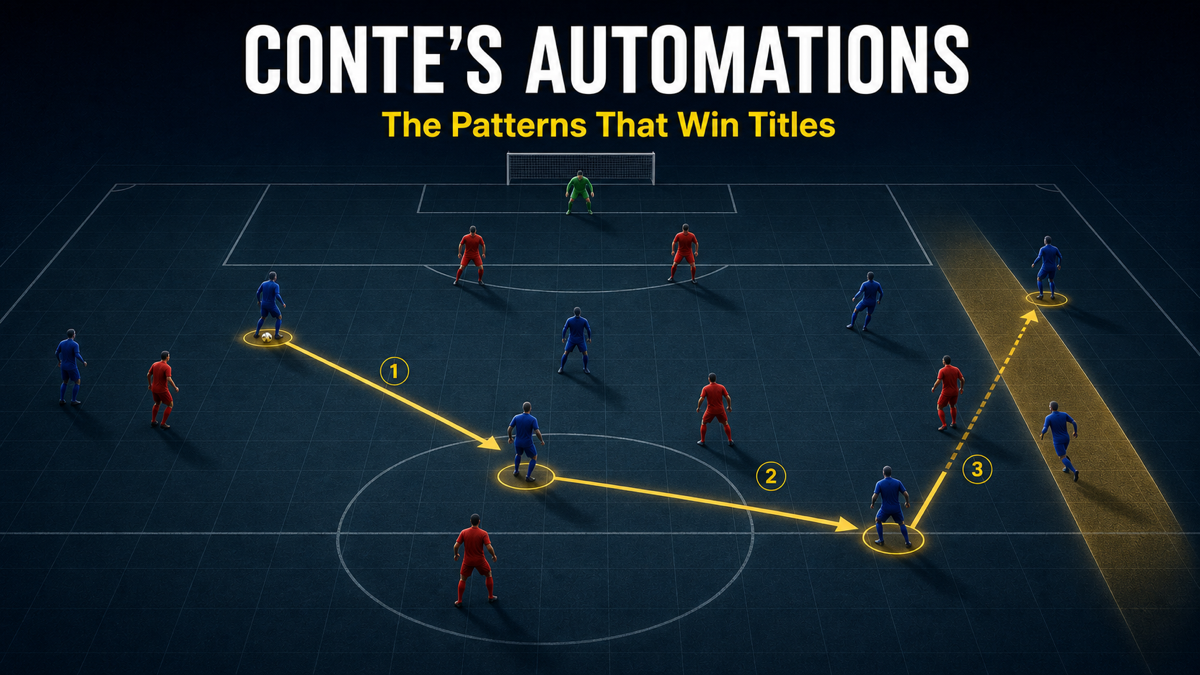

Picture the 87th minute of a tight Serie A night. Napoli work the ball from Alex Meret out to a right-sided centre-back, and the same three-pass sequence they have drilled all week begins to unfold. The wing-back pins the full-back, the near-side striker drops, and the channel opens exactly where Antonio Conte said it would. That goal looks like improvisation. It is rehearsal.
This is the heart of patterns of play: pre-agreed sequences that let footballers act faster than thought. The best modern coaches do not leave progression to instinct, they script it, and few script it more obsessively than Conte. If you want the wider map of how these ideas fit together, start with our football tactics hub.
In simple terms: these are the rehearsed passing and movement routines a team repeats until they fire automatically under pressure.
Key Takeaways
- Patterns are rehearsed, not random: Conte’s teams repeat fixed passing and movement sequences until they become automatic under pressure.
- The back three is the trigger: Build-up automation starts with a 3-2 base that bypasses the first pressing line before the opponent can set.
- Wing-backs create the overload: The signature pattern floods one flank to pin a full-back and free the channel behind it.
- Data backs the method: Napoli’s 2024-25 title run paired elite expected-goals-against numbers with a repeatable scoring structure.
- Predictability is the cost: Once opponents read the sequence, the same automation that creates chances can be turned into a trap.
Table of Contents
What Is a Pattern of Play in Football?
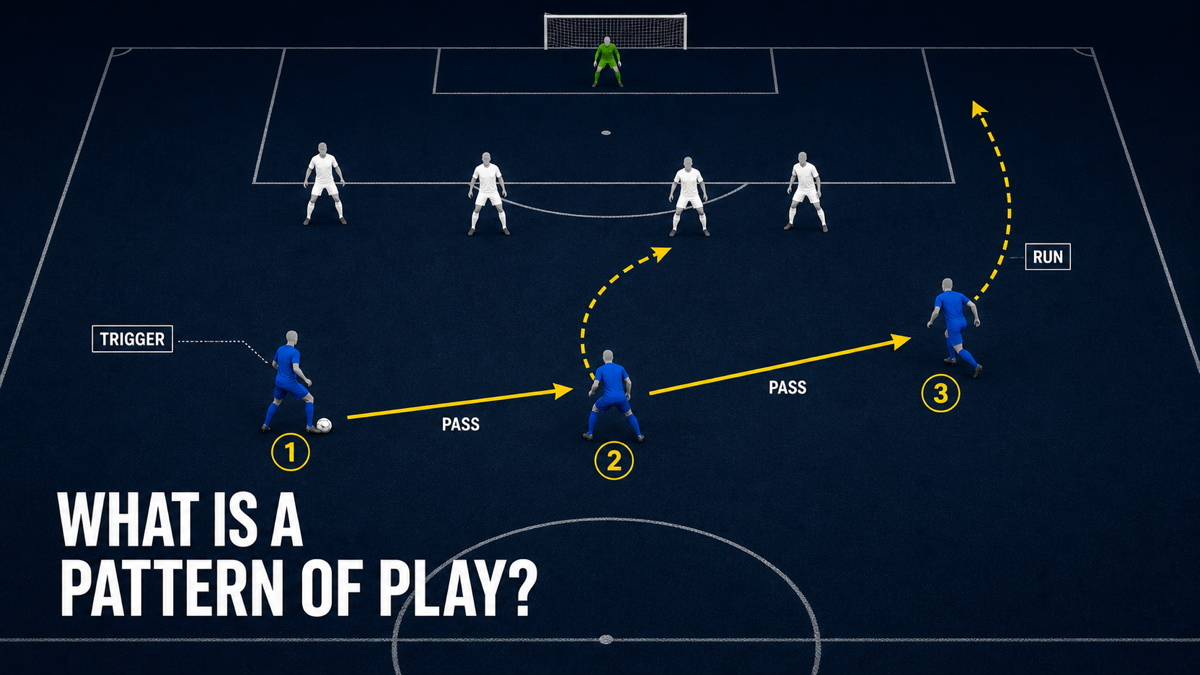
A pattern of play is a pre-rehearsed sequence of passes and movements a team repeats to progress the ball or manufacture a chance. Coaches call these automatisms: trained responses that fire without conscious decision. The aim is speed, because a player who already knows the next three actions moves before the defender can react.
Think of it as a set-piece that happens in open play. A corner routine is choreographed down to the step, and Conte simply extends that logic to build-up, midfield progression, and the final third.
These football automatisms are not rigid scripts that strip away freedom. They are defaults. When the live picture matches what was drilled, the sequence runs automatically; when it does not, the player improvises from a trained base rather than from nothing.
That is why elite patterns of play look mechanical and fluid at the same time. The structure is fixed, but the triggers are read live. Conte’s real skill is choosing which few sequences to drill so heavily that they survive the chaos of a real match.
Why Conte Scripts Almost Everything
Antonio Conte tactics rest on a simple belief: control comes from repetition, not inspiration. He has won league titles in three countries by reducing the number of decisions his players must make in real time. The fewer the choices, the faster and more synchronised the execution.
His preferred vehicle is the Conte 3-5-2 system, a shape that hands him a back three, two wing-backs, and a packed central spine. The structure is not the strategy, though. It exists to host the sequences he drills into it.
Where a possession purist might trust players to find their own solutions, Conte hands them the solution in advance. Training is built around repeating the same handful of routines hundreds of times. By matchday the movements are muscle memory rather than calculation.
This is why his teams can look almost robotic in their best spells. Wing-backs arrive at the same moment, strikers split into the same channels, and the ball travels the same lanes. It is co-ordination engineered through rehearsal, not the spontaneous chemistry that defines a more relationist approach.
The Back-Three Build-Up Automation
Conte’s first automation begins the instant his goalkeeper collects the ball. The two wide centre-backs split, the central defender holds, and one midfielder drops to form a 3-2 base. This shape is engineered to beat the opponent’s first pressing line before it can organise.
The pattern has a clear sequence. The ball goes wide to a centre-back, the pressing forward jumps to close him down, and that movement is the cue for the holding midfielder to show into the space just vacated. One pass through the line, and Napoli are progressing with numbers.
This is structured build-up play reduced to a reflex. Players are not scanning the whole pitch for options. They are running a rehearsed answer to a specific press.
The clever part is that the automation scales. Against a passive mid-block, the back three simply carries the ball forward unopposed. Against an aggressive high press, the same patterns of play create the overload needed to play through it, because every Napoli player already knows where the free man will appear.
The Wing-Back Overload That Defines His Teams
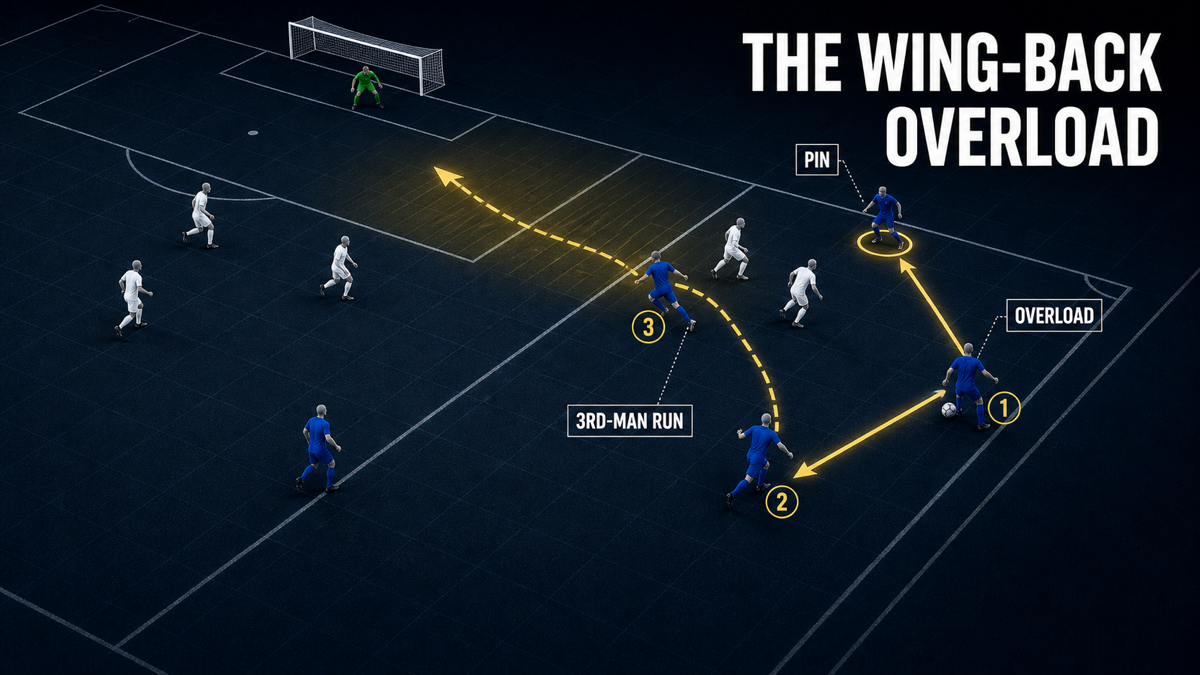
If one image defines Conte, it is two players attacking the same flank. The wing-back overload is his most recognisable automation, and it works by deliberately building a numerical advantage out wide. A wing-back pushes high, a striker drifts toward the same channel, and a central midfielder shuttles across to support.
Suddenly three Napoli players occupy a zone the opponent defends with two. These are the overloads and isolations that pin a full-back in place and force a defensive decision with no clean answer. Cover the wing-back, and the channel opens; cover the channel, and the wing-back is free to deliver.
The finishing move is usually a third man run. The first pass draws the defender, the second pass sets the trap, and a late runner attacks the space behind. None of it is improvised, because the runners know the timing from rehearsing the wing-back overloads until they fire on instinct.
This is where the patterns of play turn from progression into genuine threat. Napoli scored repeatedly across 2024-25 from variations of this single idea. Opponents could often see it coming and still fail to stop it, because well-drilled timing beats reactive defending more often than it should.
What the Data Says About Conte’s Napoli
Automations are worth drilling only if they show up in results. Conte’s 2024-25 Napoli offer a clean test case, because a side rebuilt over one summer won Serie A on structure rather than individual brilliance.
The numbers describe a team that controlled games at both ends. A title-winning points total sat on top of strong defensive metrics, and the expected-goals figures suggest the performance was earned. According to FBref, the underlying output tracked closely with the actual table.
| Metric | Napoli 2024-25 |
|---|---|
| Points | 82 |
| Record (W-D-L) | 24-10-4 |
| Goals for | 59 |
| Goals against | 27 |
| Goal difference | +32 |
| Expected goals (xG) | 52.9 |
| Expected goals against (xGA) | 29.6 |
| Goals against per game | 0.71 |
Figures are illustrative season-level estimates drawn from public data and may differ slightly from final official totals. Check the live source before citing.
The story in the table is balance. A low expected-goals-against number shows the structure protected the box, while the scoring stayed efficient rather than spectacular. That is exactly what a repeatable method is built to deliver: fewer wild swings, more controlled outcomes across a long season.
The Weakness: When the Automation Gets Read
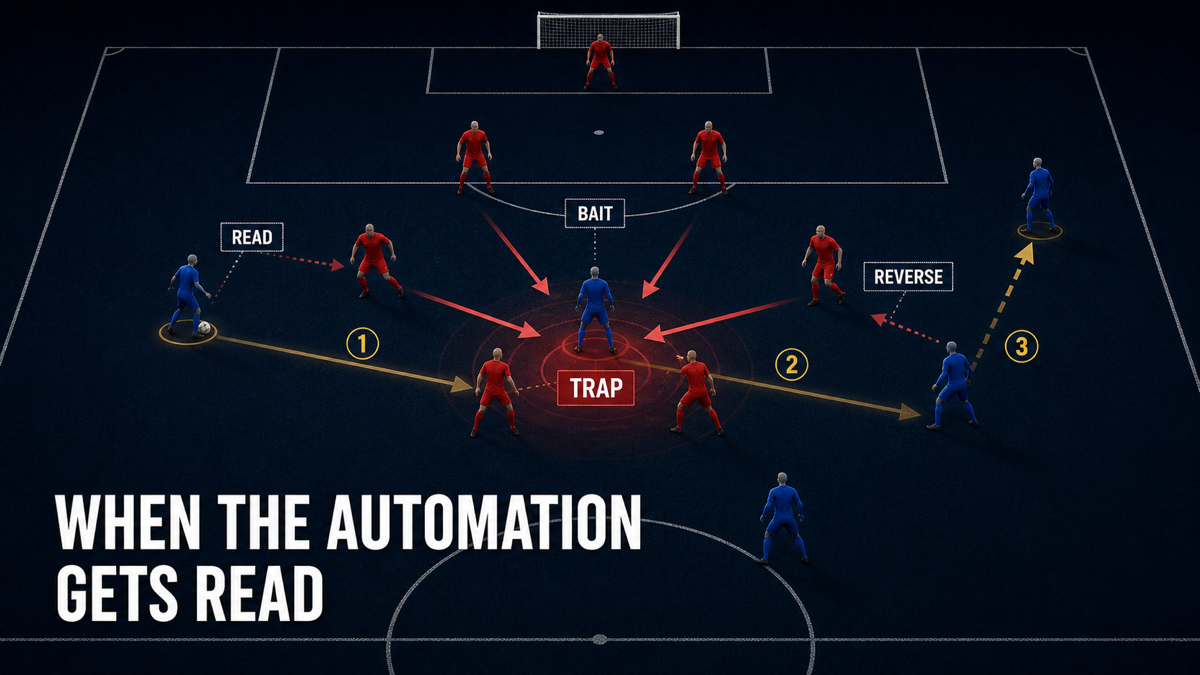
Every automation carries the same flaw: what is repeatable is also predictable. A side that drills the same sequences teaches opponents precisely what to expect, and elite analysts now map these sequences before kick-off. Once the trigger is known, the trap can be reversed.
The counter is to bait the pattern rather than block it. A structure-baiting coach like Roberto De Zerbi will happily let the first pass into the back three happen, then spring a co-ordinated trap the instant the holding midfielder drops into his rehearsed slot. The automation becomes the bait.
Aggressive man-marking is the other answer. A coach in the mould of Marcelo Bielsa assigns a runner to each scripted role, so the wing-back overload meets a defender who already knows where the ball is going. Rehearsed timing means little when the space it targets is occupied in advance.
This is the paradox at the centre of Conte’s method. The harder he drills a sequence, the more lethal it becomes and the more readable it grows. His best teams answer that by carrying two or three options for each situation, so a defence that solves one is punished by the next.
Pulling It All Together
Conte’s automations divide opinion, and they should. To critics, scripting every sequence drains the spontaneity that makes football worth watching. To admirers, it is simply professionalism: stripping luck out of a game that punishes the unprepared.
My own view sits closer to the second camp. The 2024-25 title was not an accident, and you do not control a 38-game season on charisma. Conte’s patterns of play gave a reshaped squad a repeatable way to win, which is the hardest thing in the sport to manufacture.
The honest caveat is that the method has a ceiling. Against the very best, who can read and reverse a sequence in real time, repetition alone is not enough. Conte’s next task, wherever he lands, is whether his automations can evolve faster than the analysts paid to break them.
What Do You Think?
Was Napoli’s 2024-25 title a triumph of Conte’s drilled automations, or proof that elite repetition fails the moment a smarter opponent reads the script? Tell us where you land in the comments.
Want to read any match like this?
The framework behind these breakdowns, in one place. The four phases, a 15-minute method for diagnosing both teams before the drinks break, a printable match-watching worksheet, and 51 terms defined. 40 pages.
Get the pack$9, instant downloadRelated Tactical Breakdowns

The Ancelotti Anti-System: How Player Autonomy Beat the Era of Positional Play
Why it connects: Ancelotti’s player-autonomy model is the philosophical opposite of Conte’s scripted sequences.

De Zerbi Baiting Press Structure: The Artificial Transition System Explained
Why it connects: De Zerbi shows how a rehearsed build-up structure can be baited and turned against the side running it.

Game Models in Football: Why Elite Teams Pick Transition or Possession First
Why it connects: Conte’s patterns sit inside the wider game-model choice every elite coach has to make first.
Speak the language of the game
Get the free 47-term tactical glossary. Gegenpress, half-space, xT, low block, each defined in plain language and linked to a full breakdown. It is yours for an email.
Frequently Asked Questions
What are patterns of play in football?
Patterns of play are pre-rehearsed sequences of passes and movements a team repeats to progress the ball or create chances. They work like open-play set-pieces, letting players act on trained instinct rather than slow, in-the-moment decisions.
Why does Antonio Conte rely on automatisms?
Conte uses automatisms to cut down in-game decisions and sharpen co-ordination. By drilling a few sequences until they become reflexive, his teams execute faster and more reliably under pressure, which is how the Conte 3-5-2 system has won titles in three different countries.
What is the main weakness of scripted patterns of play?
The main weakness is predictability. Because the sequences repeat, opponents can scout and reverse them, baiting the pattern or man-marking each scripted run. Conte answers this by drilling several variations per situation, so one solved sequence is punished by the next.
How are football automatisms different from total improvisation?
Football automatisms are trained defaults, not rigid scripts. When the live picture matches the rehearsed trigger, the sequence fires automatically; when it does not, players improvise from a trained base, which is faster and more co-ordinated than reacting from nothing.