
Thomas Tuchel took the England job in January 2025, and by the end of 2026 World Cup qualifying his side had done something no European team had managed before: win every qualifier without conceding a single goal. The clean sheets grabbed the headlines. The geometry underneath them did the work.
That geometry has a name in Tuchel’s world. It is positional play, the disciplined occupation of space that turns eleven footballers into a moving grid. Long before England, this approach built a Champions League at Chelsea and a title at Bayern Munich, and it rests on one idea Tuchel repeats to every squad he inherits: when everyone knows where everyone else is standing, the ball moves faster than any press can chase it. That is the heart of how elite teams build possession under pressure.
In simple terms: Positional play is a system where players occupy fixed zones so the team can attack with structure instead of improvisation.
This is the geometry of that possession structure: the lanes, the staggered heights, the spare man, and the single weakness that turns the whole grid into a cage.
Key Takeaways
- Structure buys speed: Tuchel’s positional play fixes each player to a zone so the ball can be moved first-time, before an opponent’s press arrives.
- The 3-2 base: His build-up shape uses three defenders plus two pivots to outnumber the first line of the press and manufacture a spare man.
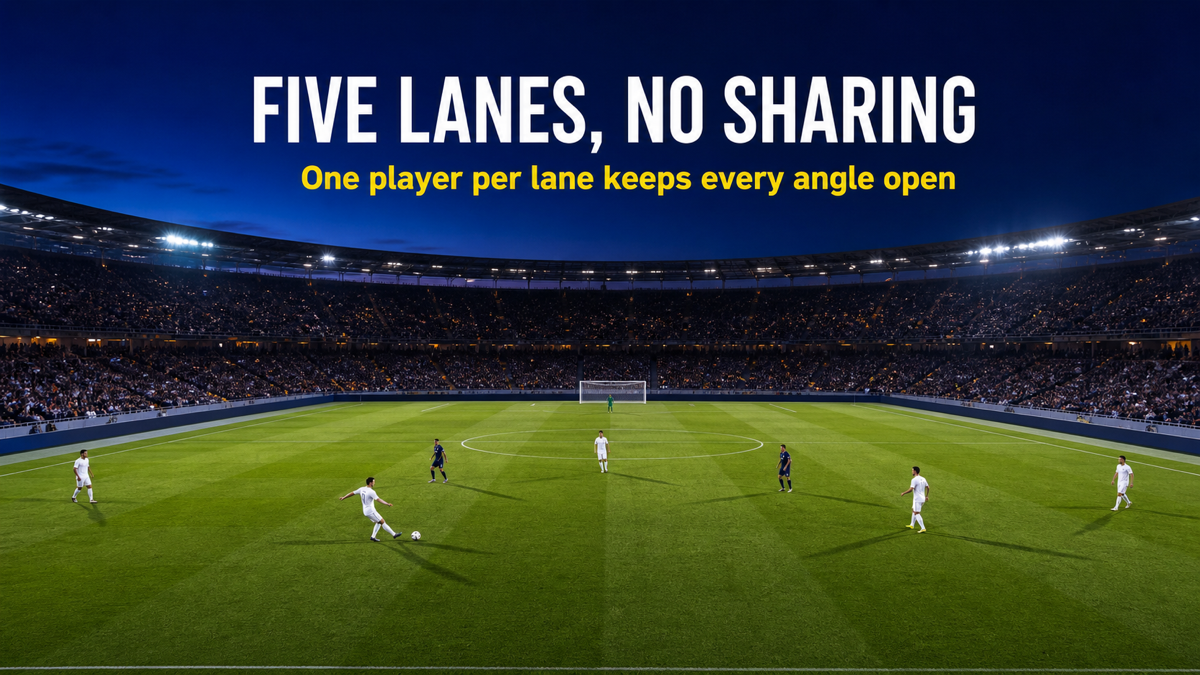
- Five lanes, no sharing: No two players occupy the same vertical lane, which guarantees passing angles across the full width of the pitch.
- Half-spaces are the trigger: The diagonal channels between full-back and centre-back are where the structure turns control into a line-breaking threat.
- The cage risk: When rotations stop, the same rigid grid that controls a game can trap a team deep in its own half.
Table of Contents
What Is Tuchel’s Positional Play Geometry?
Tuchel’s positional play geometry is a possession structure in which every outfield player occupies a pre-agreed zone, so the team always keeps the passing triangles that beat a press. The pitch is treated as a grid of five vertical lanes and horizontal bands, and players are assigned to spaces rather than left to drift. The result looks less like ten footballers and more like a lattice that slides as a unit.
Think of it the way a chessboard governs a knight. The piece is free, but the squares are fixed, and the fixed squares are what make the freedom useful.
Tuchel has been explicit about why he coaches it this way. He believes a disciplined structure lets a team play faster, because every player already knows where his nearest option is standing before the ball arrives. That is the opposite of the romantic idea of possession as spontaneous passing.
At Chelsea, as StatsBomb analysis described, this shape was a 3+2 platform that let the wider centre-backs step forward and the wing-backs climb high. The zones never emptied. When one player advanced, another slid across to fill his lane, and the possession structure held its shape through every phase.
The 3-2 Build-Up: Manufacturing the Spare Man
The 3-2 build-up is Tuchel’s tool for creating a free man against the opponent’s first line of pressure. Three defenders spread across the back and two pivots sit just ahead, forming a five-player base that outnumbers most pressing fronts. Against a two-striker press that is a three-versus-two; against a lone striker it is a three-versus-one.
The spare man is the whole point of the build-up. If the press cannot cover every builder, one defender always has time to carry the ball forward or thread a pass into midfield. Tuchel’s system is designed to guarantee that overload before a single pass is played.
This build-up shape also protects against the counter. With five players behind the ball in structured positions, a turnover meets an organised rest defence rather than open grass. The possession structure defends itself.
The Five-Lane Grid: Why No Two Players Share a Line
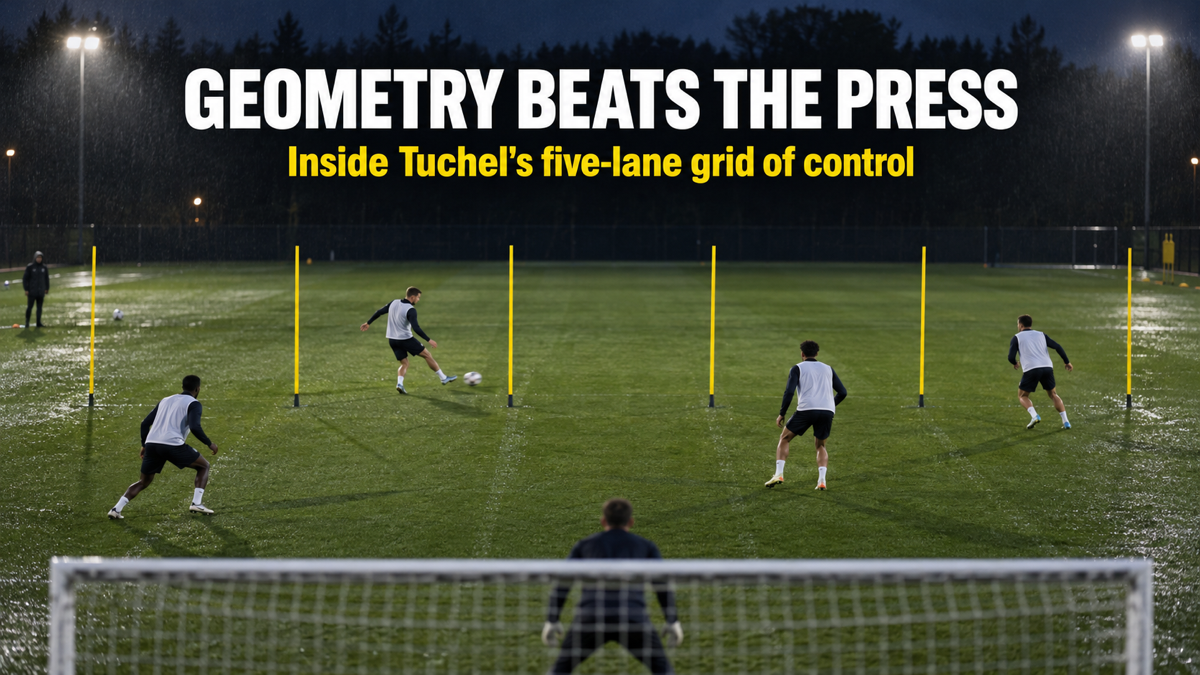
The five-lane grid is the simple rule that no two teammates stand in the same vertical strip of the pitch. Tuchel divides the width into five lanes: two touchlines, two half-spaces, and the central channel. Each lane holds one player at a time, which keeps the passing angles open and the pitch stretched to its limit.
This is the same logic that underpins the 3-2-2-3 box midfield used across the elite game. Spread the occupation, and the defence has to spread with you. Every gap the opponent leaves becomes a lane Tuchel’s side is already standing in.
When a teammate drifts into an occupied lane, the rule forces a rotation, because someone else must vacate. That constant tidying is what keeps positional play legible to the players living inside it.
Wing-Backs: The Width Valve That Stretches the Grid
Wing-backs are the release valve in Tuchel’s positional play. By holding the widest lanes and climbing high, they pin the opponent’s full-backs deep and stretch the defensive block from touchline to touchline. That width is precisely what opens the half-spaces inside them.
At Chelsea, Tuchel’s wing-backs pushed level with or ahead of the attacking midfielders, both threatening crosses and dragging markers out of shape. The wider centre-backs, César Azpilicueta among them, then advanced through the inside channel to add a second layer of width.
These wing-back rotations are not decoration in Tuchel’s system. They are how the possession structure manufactures a spare attacker in the final third, swapping the roles of wide and inside players until a defender is left choosing between two men.
Half-Spaces and the Staggered Diamond
Half-spaces are where Tuchel’s positional play turns control into genuine threat. These are the two diagonal channels between full-back and centre-back, the zones from which a receiver can face goal, thread a pass, or drive at the last line. Tuchel staffs them permanently.
The players in those channels form staggered diamonds with the pivot and wing-back, so there is always a short forward option and a safe backward one. Nobody stands flat. Staggering the heights is what keeps a passing lane open even when the nearest defender steps out to press.
England’s attacking patterns lean on exactly this. The half-spaces feed the runners, and the structure feeds the half-spaces. Break one link and the structure simply recycles and tries the next diamond.
Positional Rotations Without Losing the Shape
Positional rotations are how Tuchel keeps positional play unpredictable without ever breaking it. Players swap lanes and heights, but the zones stay filled, so the geometry survives even as the personnel inside it move. The shape is fixed; the faces occupying it are not.
The table below shows how positional play changes appearance by phase while keeping the same underlying grid. The possession shares are illustrative benchmarks, not match data.
| Phase | Typical Shape | Illustrative Possession Share | What the Structure Buys |
|---|---|---|---|
| Build-up (first phase) | 3-2 base | 65-75% | A spare man against the press |
| Progression (second phase) | 3-2-2-3 grid | 55-65% | Open half-space receivers |
| Final third | 2-3-5 overload | 45-55% | A free attacker in the box |
Illustrative ranges across positional-play sides, not a specific match or season.
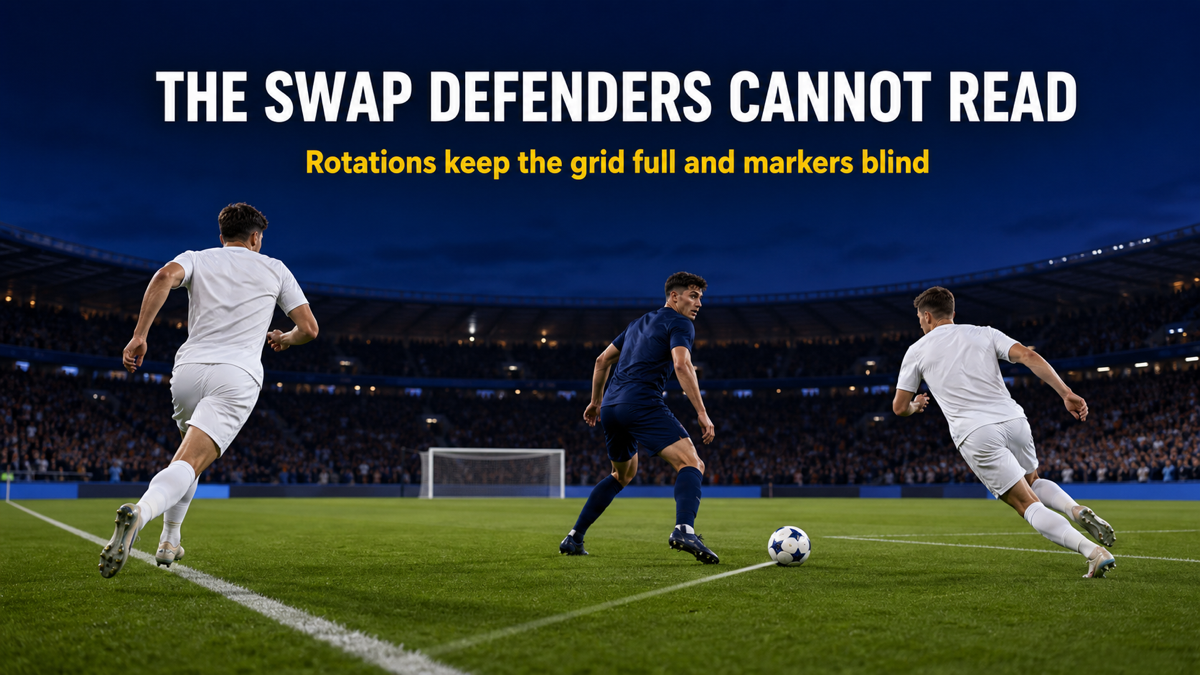
Rotation is also a pressing trap in disguise. When Tuchel’s team loses the ball mid-rotation, players are already spread across every lane, so the counter-press has a body near the ball wherever it is lost. Positional play, done well, is a defensive system wearing an attacking coat.
From Chelsea’s Champions League to England’s Clean Sheets
The proof of Tuchel’s positional play sits in the trophy record. At Chelsea he won the 2021 Champions League months into the job, reorganising a drifting squad around the 3-2 structure almost overnight, per Coaches’ Voice. At Bayern Munich he added a Bundesliga title with the same spatial principles.
England is the current laboratory. In qualifying for the 2026 World Cup, Tuchel’s side won all eight games without conceding, the first European team to manage that over a campaign of six or more games, and at the tournament itself they went out to Argentina, losing 2-1 on 15 July, per England Football. A back line that never has to scramble is usually a back line standing in the right zones.
The through-line across all three jobs is a refusal to trade structure for talent. Tuchel inherits gifted players and gives them a positional play grid, and the possession structure is what converts individual quality into repeatable control.
The Weakness: When the Grid Becomes a Cage
The weakness in Tuchel’s positional play is that the same grid which creates control can become a cage. When rotations slow and players cling to their zones out of caution, the structure stops manufacturing spare men and starts inviting pressure onto its own edge. Control curdles into containment.
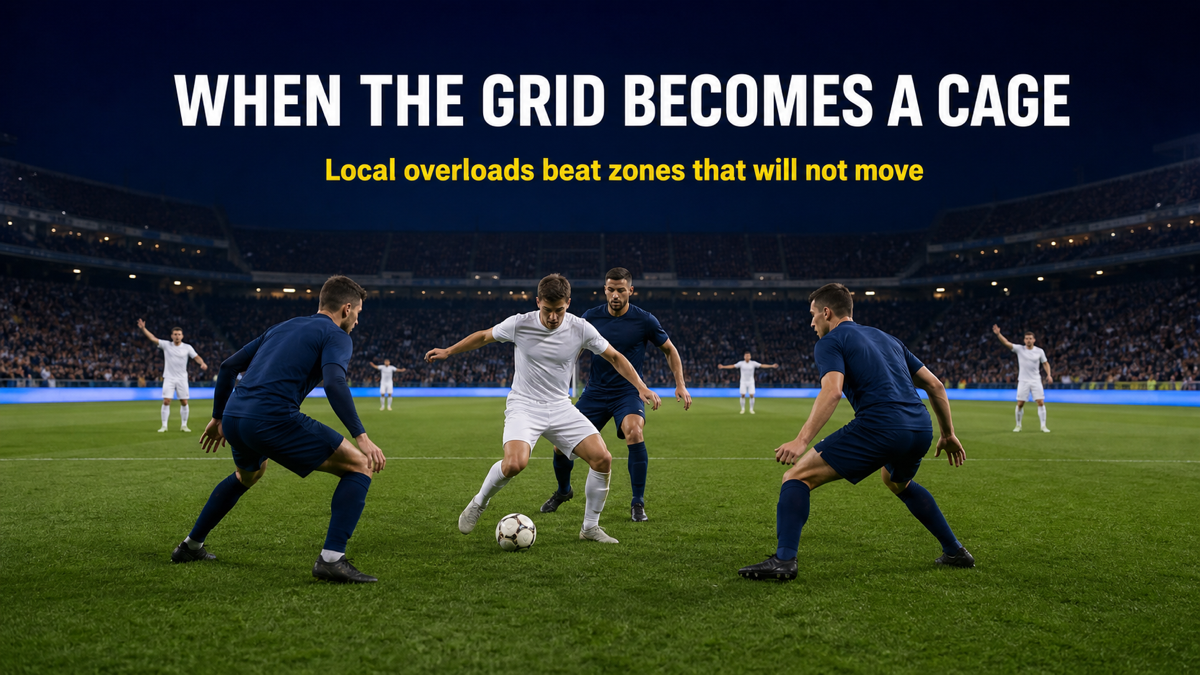
Relational sides exploit this directly. Coaches who prefer fluid, combination-heavy football, the approach mapped out in relationism versus positionism, flood one zone with more bodies than the grid was built to match. Positional play answers space beautifully; it struggles against sudden local numbers.
The other counter is a great pressing trap. If an opponent lets Tuchel’s builders keep the ball and springs on the predictable pass into the half-space, the very predictability that makes positional play fast can make it readable. Pep Guardiola’s most aggressive pressing teams have punished exactly that hesitation.
Final Thoughts
Tuchel’s positional play is not the prettiest football on the planet, and it was never meant to be. It is a machine for control, and machines are judged by output: a Champions League, a Bundesliga, a World Cup qualifying run without a goal conceded and a World Cup semi-final. The structure delivers.
The open question is whether control alone is enough at the very top. The grid wins you the phases of a game, but tournaments are decided in the chaotic minutes when the grid breaks and someone has to improvise. Tuchel’s bet is that better structure buys better improvisation, and the next trophy will test whether his possession structure has one more gear.
What Do You Think?
Tuchel’s England reached the 2026 World Cup without conceding a goal and went out in the semi-finals, yet critics still call his positional play too cautious. Is a flawless defensive structure the sign of tactical mastery, or a ceiling that stops a talented squad from ever cutting loose? Drop your take below.
Related Tactical Breakdowns
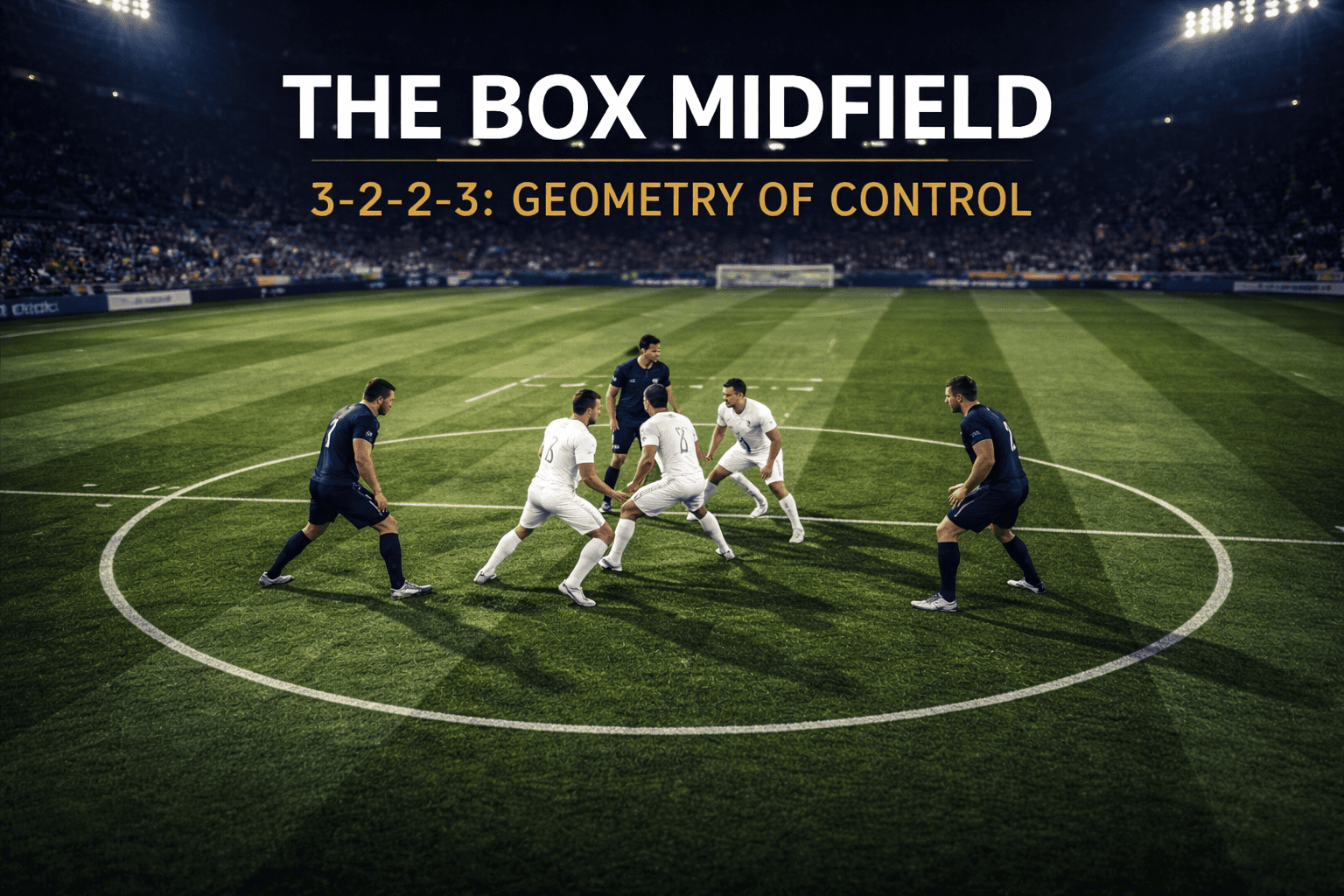
Box Midfield Tactics (3-2-2-3): How Elite Teams Dominate Possession
Why it connects: The 3-2-2-3 box is the same five-lane positional grid Tuchel builds his possession structure on.
Relationism in Football: The Complete Tactical Guide (2026)
Why it connects: It maps the exact tactical divide Tuchel sits on, and the relational style built to break a positional-play grid.
7 Pep Guardiola Final Third Tactics That Dismantle Defenses
Why it connects: Guardiola is the positional play benchmark whose final-third mechanics Tuchel’s structure is measured against.
Learn to read a match like an analyst
Get the free 33-page Starter Pack, How to Read a Football Match (the Four Phases, a 15-minute match read, a printable worksheet), plus the 70+ term tactical glossary. Both are yours for an email.
Frequently Asked Questions
What is Tuchel’s possession structure in simple terms?
Tuchel’s possession structure is a positional play system where every outfield player occupies a fixed zone on a five-lane grid. This keeps passing triangles open and lets the team move the ball quickly. The structure gives Tuchel control in build-up, progression, and the final third.
Why does Tuchel use a 3-2 build-up shape?
Tuchel uses a 3-2 build-up shape to create a spare man against the opponent’s press. Three defenders and two pivots outnumber most pressing fronts, so one builder is always free. That free man is what lets his side progress the ball calmly under pressure.
How do half-spaces work in positional play?
Half-spaces work as the attacking channels between full-back and centre-back where Tuchel’s players receive and turn toward goal. Occupying them permanently gives the team line-breaking angles. The wing-back rotations stretch the pitch wide so those half-spaces open up inside them.
Is Tuchel’s positional play the same as Guardiola’s?
Tuchel’s positional play shares Guardiola’s core idea of occupying zones to control space, but it is more defensively cautious. Tuchel prioritises a secure rest defence and clean sheets, as England’s goal-free qualifying campaign showed. Guardiola pushes more bodies forward in sustained attack.
Cite this article
Khara, J. (2026, November 6). Tuchel’s Positional Play: Inside a Geometric Possession Structure. KharaSportsDaily. https://kharasportsdaily.com/tuchel-positional-play/