

Forty-one passes. That is how long Enzo Maresca’s Manchester City kept the ball before Rayan Cherki beat Jeremie Frimpong and scored the third goal at Anfield on 11 October, the longest sequence to end in a Premier League goal since September 2023, according to Opta Analyst. Two months into the season, the Maresca Man City blueprint is already readable, and it offers a live case study in football tactics after a decade of one manager’s ideas.
From a distance, the team still looks like Guardiola’s. Up close, the machine has been rebuilt: Rodri was sold to Barcelona in August, the full-backs now step inside, and the press hunts players instead of zones.
In simple terms: Maresca’s Man City keeps Guardiola’s possession but builds with inverted full-backs, a new double pivot and a man-to-man press.
The sample is small: the patterns below come from the first six league games, up to 11 October, plus the Community Shield and the Champions League defeat to PSG, so every pattern is an early reading rather than a verdict. Even so, five shifts already separate Maresca’s football from Guardiola’s: the full-backs, the pivot, the width, the press and the game management.
Key Takeaways
- The full-backs moved inside: At Anfield, Nico O’Reilly and Matheus Nunes occupied the inside channels in settled possession, per Coaches’ Voice, while Man City’s wingers held the width.
- Rodri’s job was split in two: With Rodri sold to Barcelona on 18 August, Elliot Anderson and Enzo Fernández now share the base of the Man City midfield.
- The press follows players: Maresca’s Chelsea pressed man-to-man with a PPDA of 10.72, more aggressive than Man City’s 11.55 over the same 18 months, per Premier League analysis.
- Seven from seven, then a stumble: Man City won their first seven league games, scoring 16 and conceding five in the first six, before losing 2-1 at Aston Villa on 24 October. Arsenal and Paris Saint-Germain have both exposed the new structure.
- The weakness is the outside lane: When both full-backs tuck in, a turnover leaves the touchline lanes empty, the space Arsenal attacked against Man City in the Community Shield.
Table of Contents
What Is the Maresca Man City System?
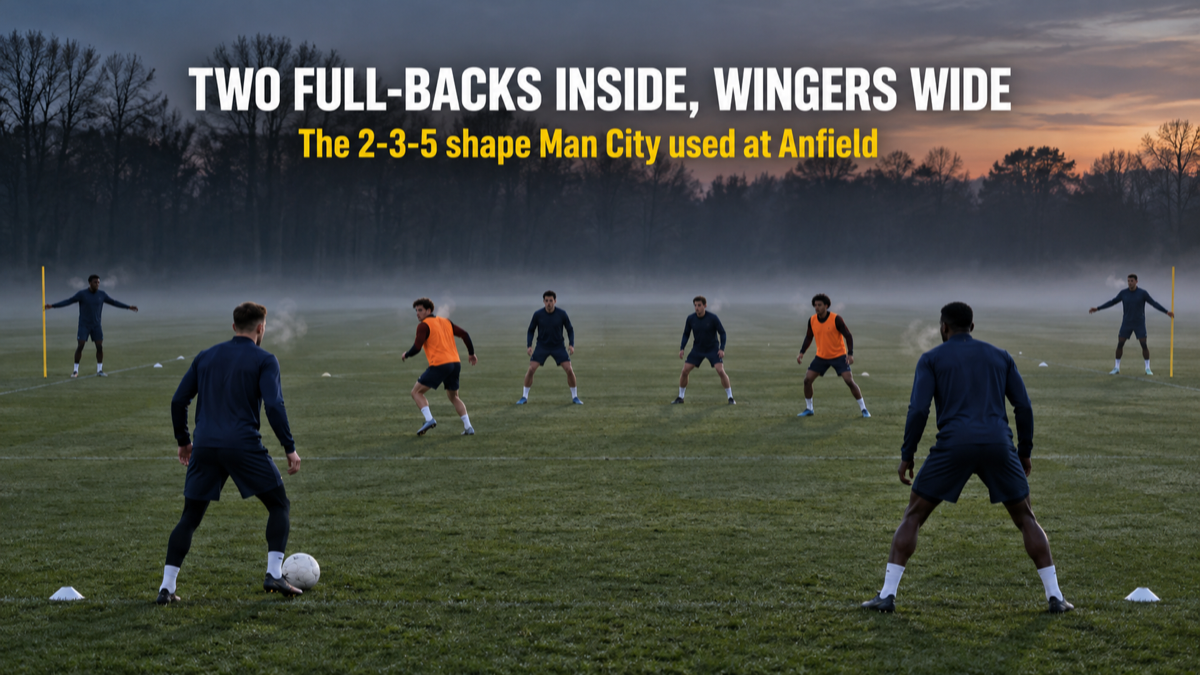
The Maresca Man City system is a 4-2-3-1 on the team sheet that becomes a 2-3-5 or 3-2-5 in settled possession, with full-backs stepping inside and wingers pinned to the touchline. Chelsea fans will recognise it: under Maresca in 2024-25, Marc Cucurella or Malo Gusto left the full-back line to form a 3-2-5 or 3-3-4, a pattern the Premier League’s own coaching analysis documented in January 2025.
The logic is spatial. Wingers stay high and wide to stretch the back line and open gaps between full-back and centre-back, while the extra bodies inside give the pivot short passes under pressure.
The extra midfielder now comes from a different place. Guardiola’s final third tactics leaned on a box midfield, often completed by a centre-back such as John Stones stepping forward. Stones left for Inter this summer, so Maresca builds the Man City overload from the full-back slots instead.
From One Inverted Full-Back to Two: The Man City Build-Up
Man City’s build-up changed between August and October, from one full-back inverting to both full-backs playing inside. The first version failed publicly in the Community Shield on 16 August, a 3-0 defeat to Arsenal.
According to Sky Sports’ review, O’Reilly’s move into midfield to create Maresca’s preferred 3-2 base left space that Noni Madueke ran into, and Arsenal anticipated it. Arsenal scored all three goals from open play.
By October the shape had evolved. At Anfield, per Coaches’ Voice’s tactical analysis, “the full-backs O’Reilly and Matheus Nunes occupied the inside channels” in settled possession, producing a 2-3-5 or 2-2-1-5 with Cherki ahead of Anderson and Fernández.
Two inverted full-backs gave Man City extra passing options between the wingers and Erling Haaland. Defensively, the same pair held up: Nunes stopped several of Bradley Barcola’s bursts on the counter and O’Reilly contained Víctor Muñoz, per the same analysis.
Man City’s Pivot Without Rodri: Anderson and Fernández
Maresca replaced Rodri with a partnership rather than a player. Rodri joined Barcelona on 18 August, Anderson arrived from Nottingham Forest in July, and Fernández followed from Chelsea on deadline day, reuniting with his former manager.
Anderson brings the ball-winning. He won possession 10 or more times in 11 Premier League games last season, the most of any player, per Opta Analyst’s squad audit, and at Anfield he tracked Florian Wirtz when the German dropped deep before handing him to Rúben Dias.
Fernández is the connector in the Man City midfield. He drops beside the centre-backs to start moves, scored a near-post free kick against Sunderland, and slid the pass that led to Haaland’s header against Coventry City.
The trade-off is control. Rodri could govern a match alone from the base, whereas the Anderson and Fernández partnership shares that load, which buys more legs but less of a single controlling voice.
Cherki Between the Lines, Width From the Wingers
Rayan Cherki is the Man City number 10, and his job is to become the spare man between the opponent’s midfield and defensive lines. Coaches’ Voice noted that when Liverpool pushed a midfielder onto the double pivot, Cherki dropped deep to become that spare man. He also created 3.02 chances per 90 last season, second-most among players with 1,000+ Premier League minutes, per Opta Analyst.
Width comes from wingers who stay wide and attack one-on-one. Haaland’s first league goal of the season, at Selhurst Park, was a header from Antoine Semenyo’s cross, and his winner against Coventry came the same way.
Jérémy Doku showed the other weapon at Anfield. On as a 56th-minute substitute, he completed five dribbles, the most of any Man City player per Opta Analyst, and his drive into the box dragged Liverpool apart for Haaland’s first-time finish.
How Man City Press Now: Man-to-Man, Not a Zonal Mid-Block
Maresca’s Man City press opponents man-to-man, a clear break from the zonal mid-block of Guardiola’s final seasons. Between 1 July 2024 and 30 December 2025, Maresca’s Chelsea recorded a PPDA of 10.72 against City’s 11.55, per analysis published by the Premier League, where a lower number means a more aggressive press.
Old Trafford on 13 September showed the template before the red card. Per Coaches’ Voice, Phil Foden pressed out-to-in from the right, Haaland pressed the centre-back and then the goalkeeper while blocking the return pass, and Nunes jumped onto Manchester United’s left-back while Marc Guéhi slid across to cover.
The aggression was missing in August. In the Community Shield, Sky Sports described a high line with a passive press that left gaps behind it, so the Old Trafford version marks real progress.
Six From Six: What the Early Man City Results Show
The early results confirm a winning structure, but the six-game sample flatters it in places. Man City won all six, scoring 16 and conceding five, which levelled the best start to a managerial reign in Premier League history alongside Guardiola, Carlo Ancelotti and Ole Gunnar Solskjaer, per Yahoo Sports. A 3-2 win over Ipswich on 17 October then made it a record seven, before a 2-1 defeat at Aston Villa on 24 October ended the run.
| Date | Opponent | Result | What it showed |
|---|---|---|---|
| 23 Aug | Bournemouth (H) | W 2-1 | Came from behind; Guéhi and Joško Gvardiol scored late |
| 28 Aug | Crystal Palace (A) | W 4-1 | Cherki brace, one from distance; Haaland header from a Semenyo cross |
| 5 Sep | Coventry City (H) | W 1-0 | Fernández debut; his pass started Haaland’s headed winner |
| 13 Sep | Manchester United (A) | W 1-0 | Ten men from the 23rd minute after Foden’s red card |
| 20 Sep | Sunderland (H) | W 5-3 | Five scored, three conceded to Brian Brobbey |
| 11 Oct | Liverpool (A) | W 3-0 | All three goals came after Liverpool went down to ten men |
Man City’s six Premier League matches from 23 August to 11 October 2026, compiled from match reports, Coaches’ Voice and Opta Analyst.

Game Management: The Ten-Man Win at Old Trafford
Maresca’s Man City proved at Old Trafford that they can win without dominating the ball. After Foden’s straight red card in the 23rd minute, Man City dropped into a narrow 4-4-1 block and stopped stepping out to press, per Coaches’ Voice.
Late on, the shape became a 5-3-1, with a wide player dropping to match United’s advancing full-back. Maresca’s own summary was blunt: “we just dropped waiting for them.”
The second-half switch mattered as much as the block. Iliman Ndiaye replaced Cherki, City went more direct, and Haaland’s winner began with Ndiaye winning a second ball from a long Gianluigi Donnarumma pass.
At eleven against eleven, the instinct reverses. The 41-pass move for Cherki’s goal came with Man City already 2-0 up at Anfield, a sign that Maresca still protects leads with the ball when numbers allow. Across the 90 minutes, Coaches’ Voice’s match data credits Man City with 66% possession.
The Weakness: The Empty Lane Behind Man City’s Full-Backs
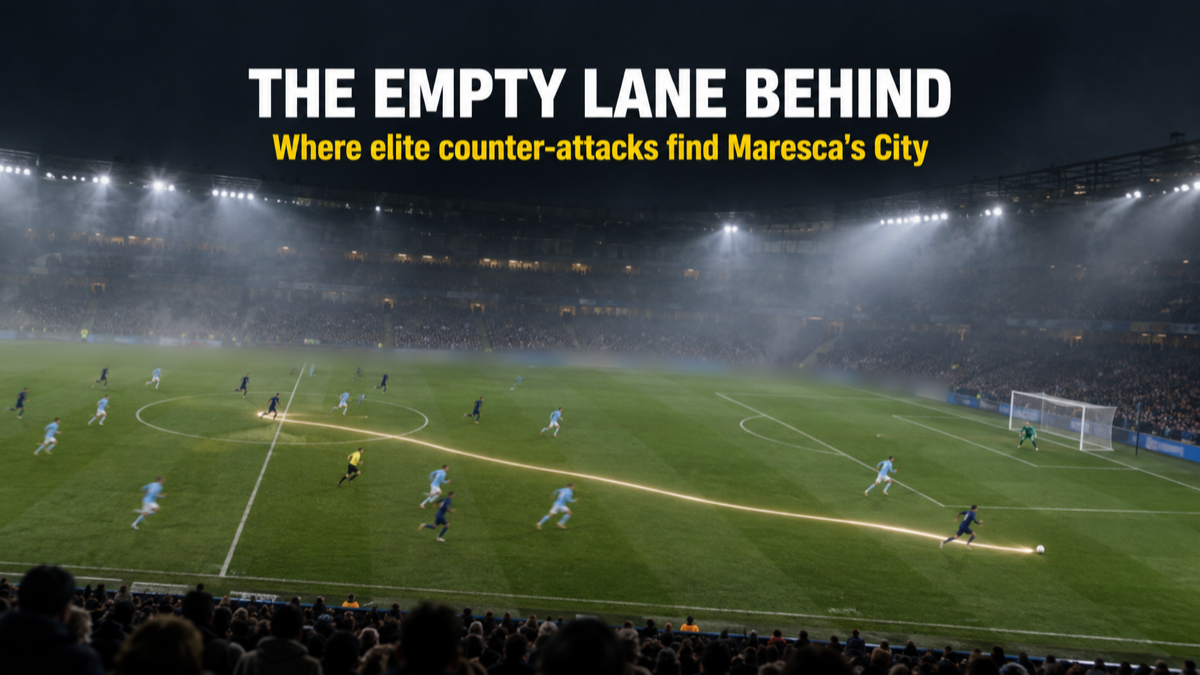
Maresca’s Man City are most vulnerable when an elite midfield wins the ball and attacks the wide lanes the inverted full-backs have vacated. Arsenal exposed it in the Community Shield, and PSG’s opener at the Etihad came from exactly the kind of counter-attack the structure invites.
Against PSG at the Etihad on 14 October, Man City were 3-0 down after 32 minutes, and the opener came on the counter, per Opta Analyst. PSG hit the target with seven of their 10 first-half shots, and it was the first time City had trailed by three at half-time at home since January 2012.
The same report shows Maresca has a correction. He changed the shape at half-time, bringing on Nunes, Ayyoub Bouaddi and Ndiaye, and City produced 1.78 of their 2.57 expected goals after the break in a 4-2 defeat.
The structural issue is rest defence. With both full-backs already inside, nobody guards the outside lane after a turnover, and a man-to-man press that loses one duel leaves a free runner in open grass. Mikel Arteta’s Arsenal and Luis Enrique’s PSG both have midfields that press the double pivot and runners who attack that space.
Even Sunderland found the gaps. Brian Brobbey scored a hat-trick in the 5-3 win, and Maresca admitted afterwards, “I prefer to win 1-0 than 5-3.”
Final Thoughts
Maresca has not built Guardiola’s City without Guardiola. He has built a different team that still wants the ball, but finds its extra midfielder at full-back, splits Rodri’s job between Anderson and Fernández, and presses players instead of space.
Life after Guardiola at Man City is ahead of schedule domestically: seven straight wins, a record start and a 3-0 win at Anfield, even if Aston Villa ended the run on 24 October. The PSG night is the better measure, because elite opponents can target the outside lanes and the two-man pivot that the new structure exposes.
The verdict for now is that Maresca has kept Guardiola’s possession and changed almost everything underneath it. The open question is whether the inverted full-backs can survive the next elite midfield that hunts the double pivot, or whether Man City will need a single controller after all.
What Do You Think?
Man City won their first six league games but trailed PSG 3-0 after 32 minutes at the Etihad. Is Maresca’s two-full-backs-inside build-up a title-winning structure, or a system that only works until an elite midfield hunts the Anderson and Fernández pivot? Drop your take below.
Related Tactical Breakdowns
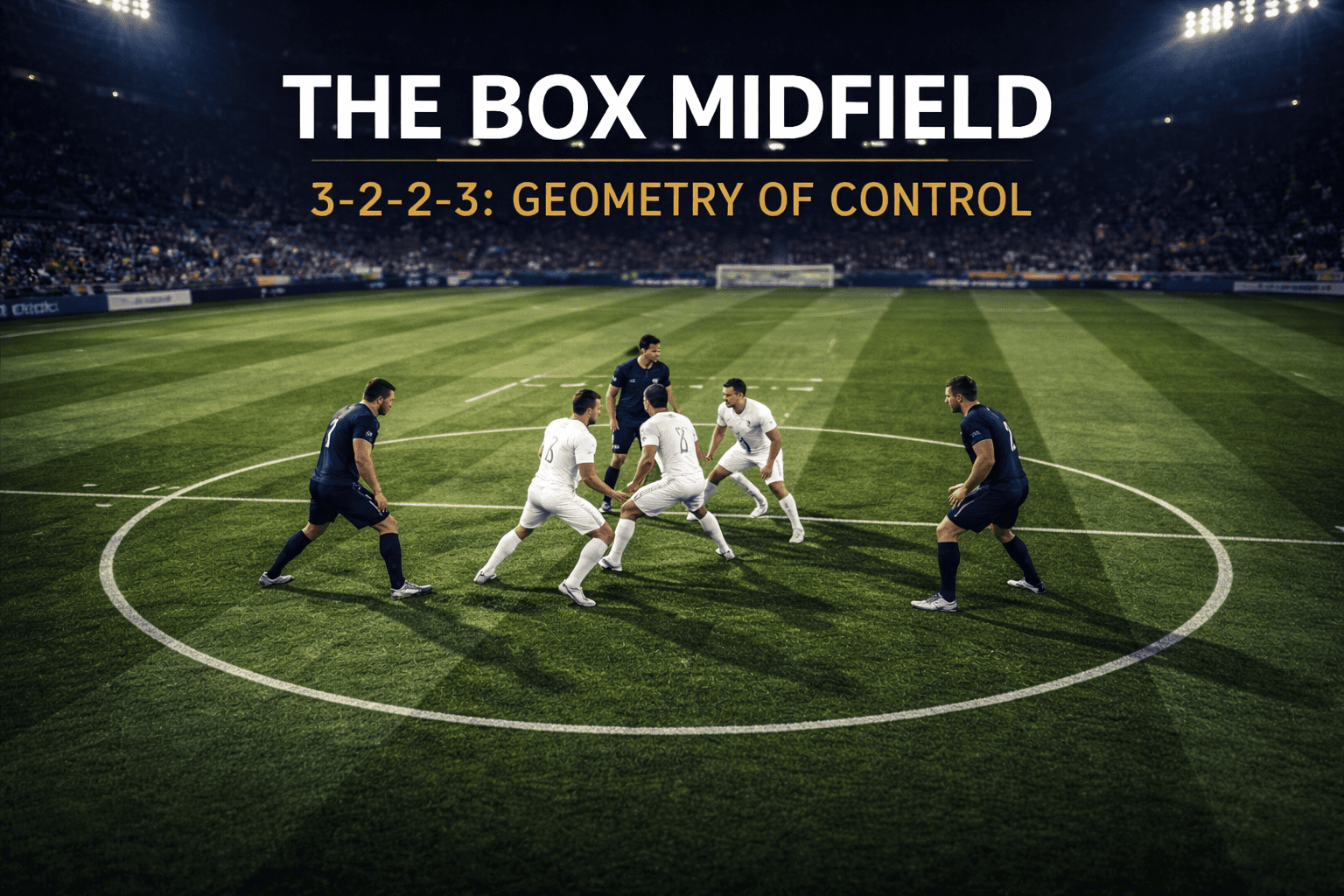
Box Midfield Tactics (3-2-2-3): How Elite Teams Dominate Possession
Why it connects: Guardiola built his midfield box with a stepping centre-back, while Maresca’s Man City now builds the same overload from the full-back slots.

Bielsa Man Marking: How One Idea Turns Eleven Players Into Hunters
Why it connects: Maresca’s man-to-man press inherits the same trade-off Bielsa accepted, where one lost duel leaves a free attacker in open space.
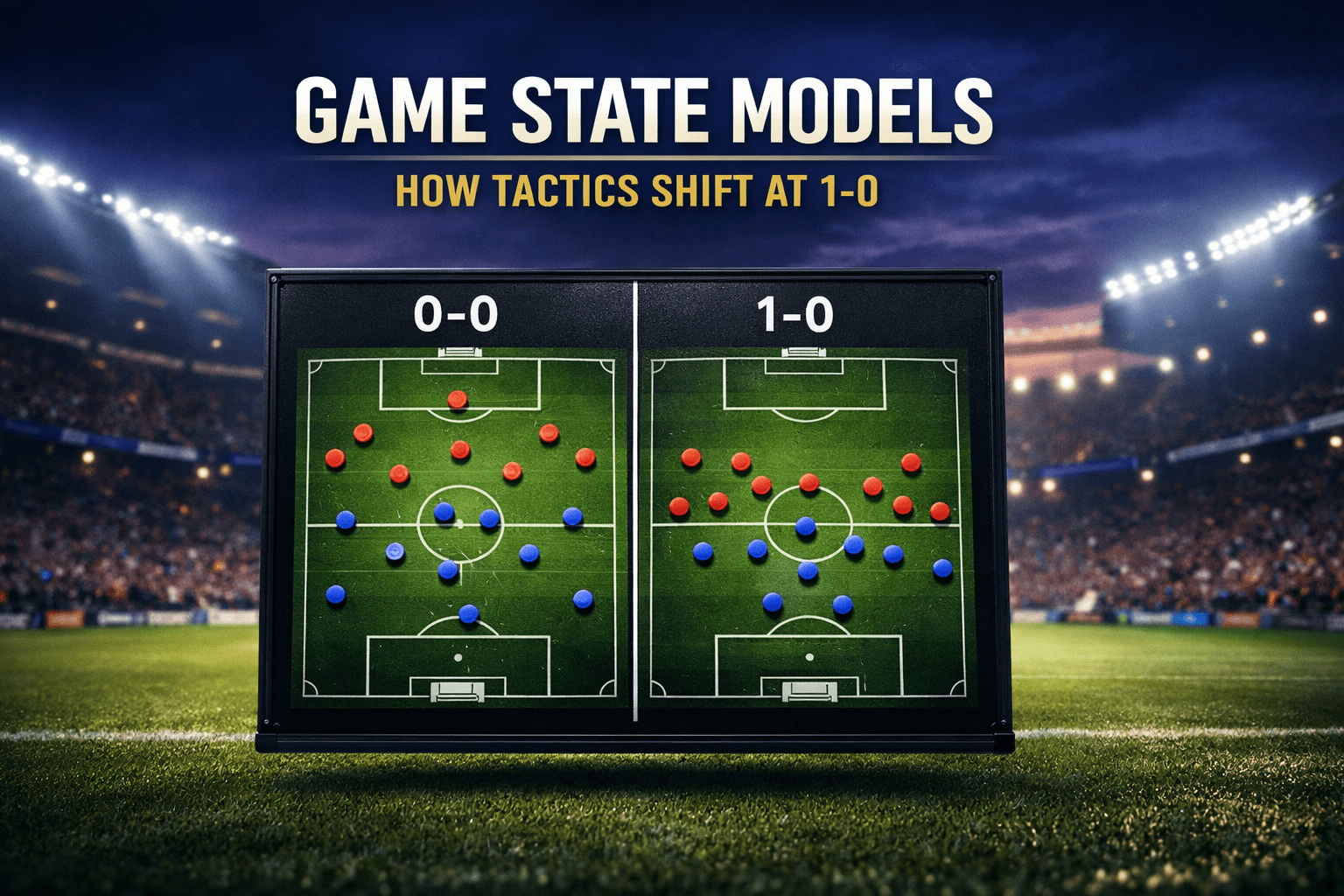
Game State Models Explained: How Elite Teams Shift Tactics the Moment They Score
Why it connects: The 4-4-1 block at Old Trafford and the 41-pass move at Anfield show how a scoreline and a red card reshape a game plan.
Learn to read a match like an analyst
Get the free 33-page Starter Pack, How to Read a Football Match (the Four Phases, a 15-minute match read, a printable worksheet), plus the 70+ term tactical glossary. Both are yours for an email.
Frequently Asked Questions
What Is the Maresca Formation at Man City?
The Maresca formation at Man City is a 4-2-3-1 that becomes a 2-3-5 or 3-2-5 in possession. Both full-backs often step into the inside channels while the wingers hold the touchline. Out of possession, the team returns to a back four and presses man-to-man.
How Is Maresca’s Man City Different From Guardiola’s?
Maresca’s Man City differ from Guardiola’s in where the extra midfielder comes from and how they press. Full-backs, not a stepping centre-back, create the midfield overload. The press follows players instead of holding a zonal mid-block, and a double pivot of Elliot Anderson and Enzo Fernández has replaced Rodri.
Who Replaced Rodri at Man City?
No single player replaced Rodri, who joined Barcelona on 18 August 2026. Maresca split the role between Elliot Anderson, signed from Nottingham Forest, and Enzo Fernández, signed from Chelsea on deadline day. Anderson tracks dropping playmakers and wins the ball, while Fernández drops in to start the build-up.
Does Maresca Use Inverted Full-Backs at Man City?
Yes, Maresca uses inverted full-backs at Man City, often two at once. At Anfield in October, Nico O’Reilly and Matheus Nunes occupied the inside channels in settled possession, per Coaches’ Voice. The risk is the empty wide lane behind them whenever City lose the ball, which Arsenal exploited in the Community Shield.