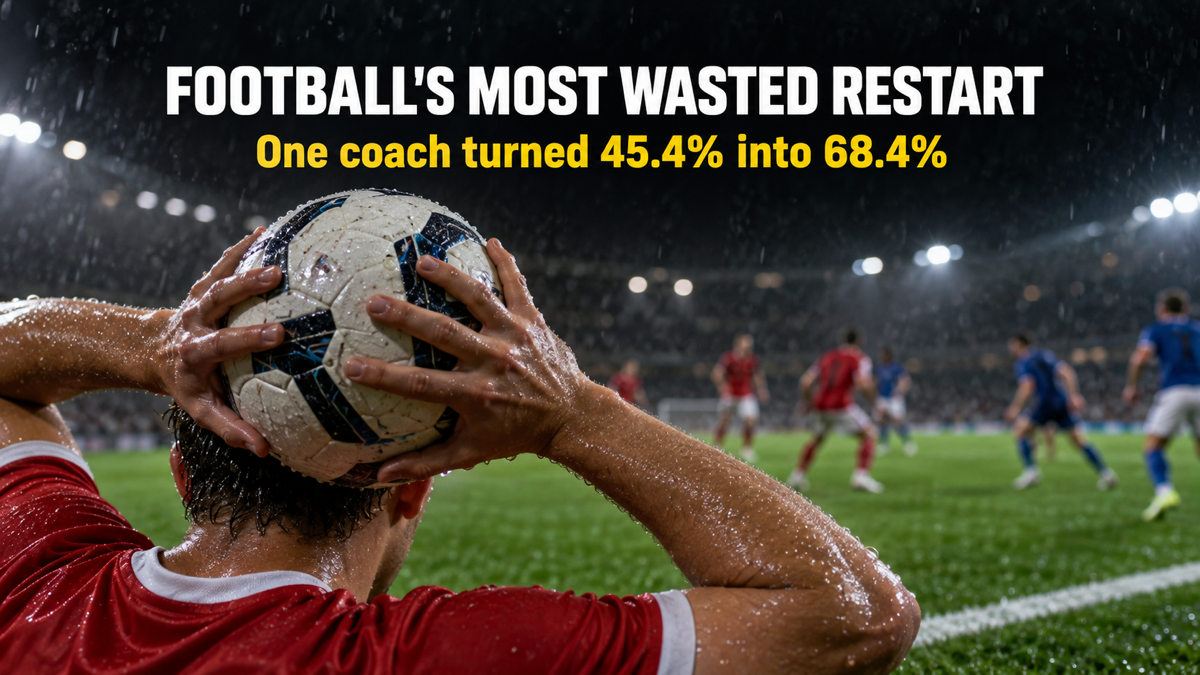

In the summer of 2018, Jurgen Klopp hired a coach whose only job was the throw-in. Liverpool had just finished a season ranked 18th in the Premier League at keeping the ball from the line, retaining possession from only 45.4 percent of their throws, per figures reported by Coaches’ Voice. Twelve months after Thomas Gronnemark arrived, that number was 68.4 percent, the best in England. No transfer fee, no new signing, no formation change. Just a restart that happens roughly 40 to 50 times a match, finally treated as part of football tactics rather than an interruption to them.
In simple terms: Throw-in tactics are rehearsed routines and movement patterns designed to turn the restart into retained possession rather than a coin flip.
This piece breaks down why the throw is the most wasted possession source in the game, what the data says about direction and speed, and how specialists rebuilt it.
Key Takeaways
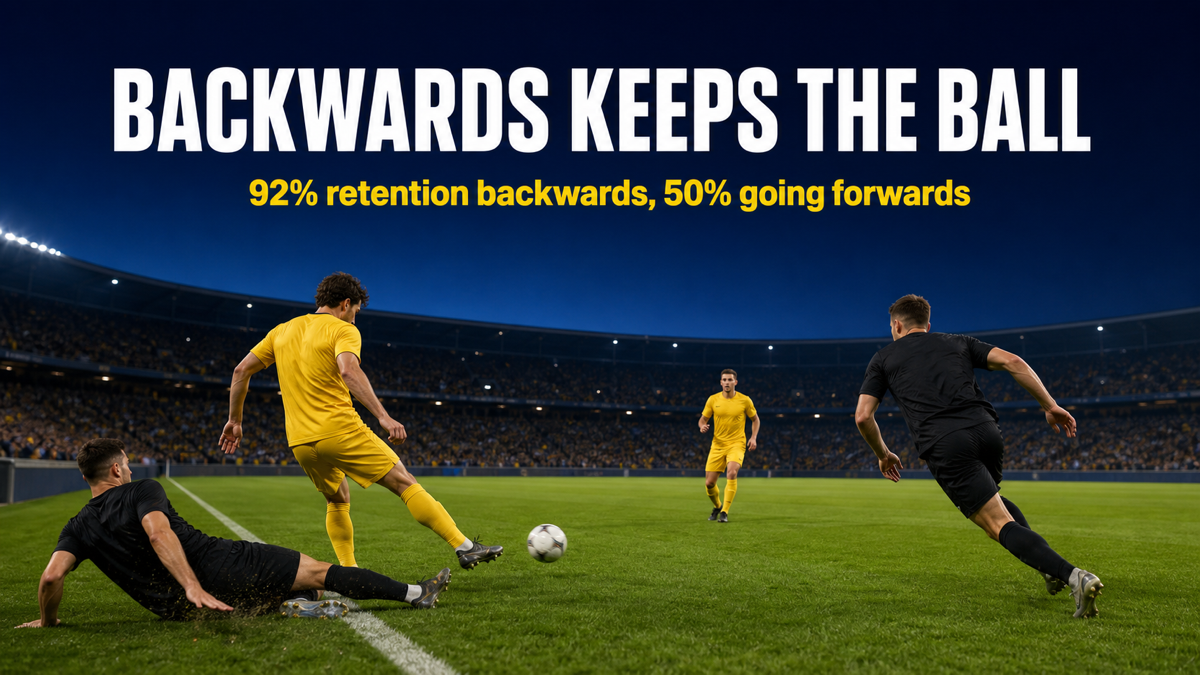
- Direction decides retention: Backwards throws retained possession 92.1 percent of the time across Europe’s top five leagues in 2022-23, lateral 71.2 percent, forwards just 49.8 percent, per research in the International Journal of Performance Analysis in Sport.
- Speed is a weapon: Throws taken within 5 seconds produced a 94.4 percent first-contact success rate, falling to 78.3 percent after 15 seconds, per the same study.
- Specialist coaching pays: Liverpool jumped from 18th to 1st for keeping the ball from the touchline within a year of hiring Gronnemark, per Coaches’ Voice.
- The line cuts both ways: Elite pressing teams treat the throw as a trigger, using the touchline as an extra defender to force the low-percentage long ball down the channel.
Table of Contents
What Are Throw-In Tactics?
Throw-in tactics are pre-planned delivery choices, receiver movements and support structures that decide whether a team keeps the ball after a throw from the touchline. The concept covers three broad tools, the categories Gronnemark drilled at Liverpool: long, fast and clever.
Long means distance as a weapon. Fast means restarting before the opponent’s defensive shape exists. Clever means choreographed movement that frees a receiver under pressure.
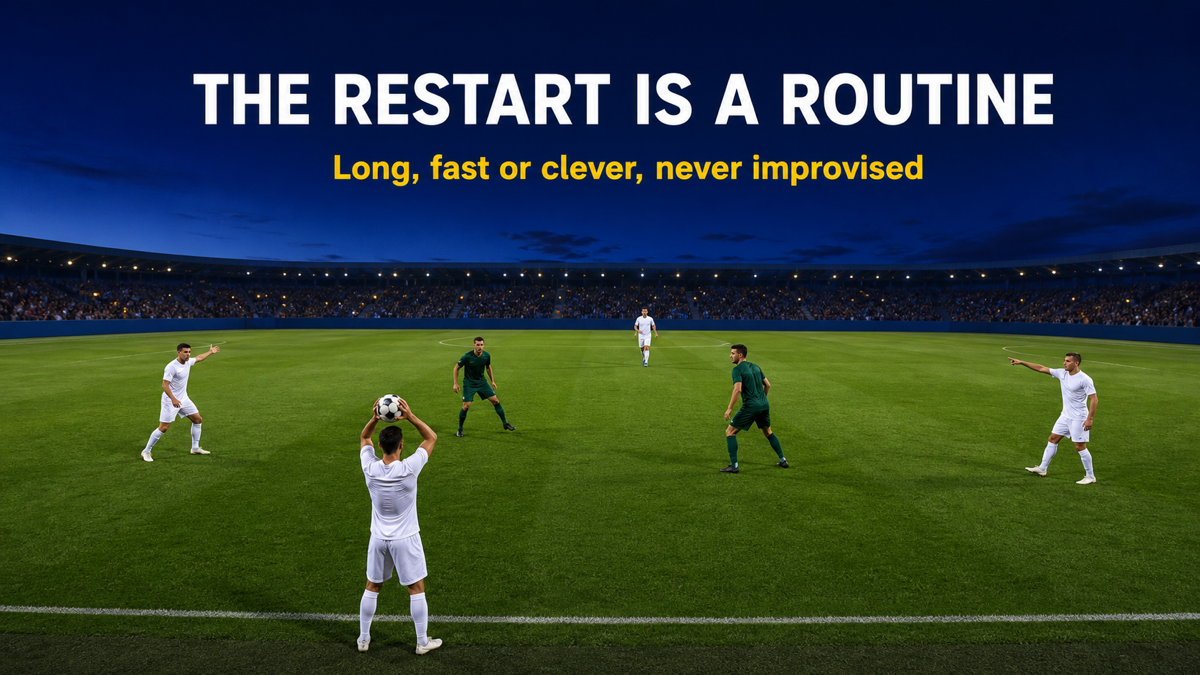
The rules make the restart deceptively hostile. Law 15, the IFAB’s throw-in law, requires both feet on or behind the touchline and a two-handed delivery from behind the head, while opponents need to stand only two metres away. The taker cannot score directly and cannot touch the ball twice.
Watch Manchester City take a throw-in deep in their own half and the structure is obvious. Two short options show at angles, a third man drops to receive the layoff, and the fullback taking it already knows the first two passes that follow. Compare that with a mid-table side hurling the ball down the line to a marked winger and you are watching the difference between possession retention and a voluntary turnover.
The Direction Problem: Why Backwards Beats Forwards
Direction is the single biggest variable in whether a throw-in survives. Research on every top-flight throw of the 2018-19 Premier League season, published in the International Journal of Sports Science & Coaching, found that possession retention collapses as the delivery goes forward. The table below shows the pattern.
| Delivery direction | Possession retained | Tactical implication |
|---|---|---|
| Backwards | 92.1% | Reset through the goalkeeper or spare centre-back; invites the press but keeps the ball |
| Lateral | 71.2% | Safe into feet; needs a layoff option to escape the touchline squeeze |
| Forwards | 49.8% | A coin flip; only justified with a target man or a rehearsed flick-on routine |
Possession retention across Europe’s top five leagues in 2022-23, per Stone et al. in the International Journal of Performance Analysis in Sport (2025).
The same study found timing just as decisive. Deliveries taken within 5 seconds achieved a 94.4 percent first-contact success rate, against 78.3 percent when the taker waited more than 15 seconds. Every second of delay lets the defensive block organise, mark the short options and squeeze the receiving zone.
The analytical conclusion is uncomfortable for traditionalists. The instinctive choice, forward and long down the line, is statistically the worst one available. Teams that value the ball go backwards or sideways quickly, then progress through their normal build-up structure.
Gronnemark’s Liverpool: Long, Fast and Clever
Gronnemark’s impact at Anfield is the clearest proof that throw-in coaching transfers directly into results. Liverpool’s ball retention from the touchline rose from 45.4 percent, third worst in the division, to 68.4 percent, first, within a season of his 2018 arrival, per Coaches’ Voice. In 2019-20, the title-winning season, Liverpool scored 14 goals from moves that began with a throw-in.
The “clever” category did the heaviest lifting. Receivers were taught to create separation in the final two seconds before delivery, using double movements to arrive on the half-turn with a passing angle already open. That skill connects directly to scanning before receiving, because the receiver who has already checked his shoulder knows whether to bounce the ball back or turn.
Speed mattered just as much. Klopp’s side took their throws fast enough to attack a defence still jogging into shape, converting a dead ball into a live transition. The restart became an extension of their counter-pressing identity rather than a pause in it.
The Long Throw Revival: Delap’s Ghost and the Data Era
The long throw never died, it just went out of fashion. Rory Delap made Stoke City’s touchline a set-piece factory between 2008 and 2011, with flat 35-metre deliveries that functioned as corners and helped a promoted side survive on direct chaos.
Analysts mocked it. Defenders hated it.
The data era rehabilitated the idea, selectively. A long throw into the box trades the 49.8 percent retention problem for direct chance creation, which is a rational trade in the final third but a terrible one in your own half. Clubs that invest in set-piece coaching now treat that weapon as a designed play with rehearsed blockers, near-post flicks and second-ball structure, the same principles covered in our breakdown of why defending corners comes down to coaching.
Brentford’s early Premier League seasons showed the modern version. Their staff scripted restart routines in the attacking third while keeping deliveries in their own half short and safe, a split strategy the raw retention numbers reward.
The Weakness: When the Touchline Becomes a Trap
Throw-in tactics fail hardest against teams that press the restart itself. The touchline acts as a twelfth defender, cutting the receiver’s field of options in half before anyone moves. A well-drilled opponent marks every short option man-to-man, stations a spare defender on the likely layoff, and dares the taker to go long into a 49.8 percent contest.

Marcelo Bielsa’s Leeds United made this a signature, locking onto every receiver the moment the ball left play. Diego Simeone’s Atletico Madrid squeeze the near zone so aggressively that the safe backwards option becomes the only option, then push their block up to compress the reset. The throw-in becomes a pressing trigger, exactly the mechanism elite sides use in open play.
The counter to the counter is structure. Liverpool under Gronnemark kept a third man behind the receiver as a guaranteed bounce-back option, accepting a backwards restart to preserve possession retention rather than feeding the trap. Teams without that rehearsed escape route give the ball away in the worst possible place: wide, deep and with their shape stretched along the touchline.
Final Thoughts
The throw-in is the cheapest marginal gain left in elite football. It requires no transfer budget, no tactical revolution and no squad depth, only the humility to admit that something happening 40-plus times a match deserves rehearsal. Liverpool paid one specialist coach and turned the league’s third-worst retention into its best while winning the Champions League and the title.
The lesson generalises beyond Anfield. Set-piece coaching has become standard at ambitious clubs, yet plenty of sides still treat the throw-in as dead time between real football. The data says otherwise, and the gap between 49.8 percent and 92.1 percent is a coaching decision, not a talent one.
The next competitive edge is already in plain sight. Which club industrialises it next?
What Do You Think?
Liverpool lifted their touchline retention from 45.4 to 68.4 percent with one specialist hire, yet most clubs still leave the restart uncoached. Is a dedicated throw-in coach now essential staff, or does that budget belong in open-play analysis? Drop your take below.
Related Tactical Breakdowns

Set-Piece Tactics Explained: How Modern Teams Win from Dead Balls
Why it connects: The restart from the line sits in the same dead-ball family as corners and free kicks, but with retention rather than shooting as the first objective.
Why Elite Players Master Receiving on the Back Foot
Why it connects: The receiver’s first touch under touchline pressure decides whether the restart survives, and back-foot receiving is the skill that wins that moment.
Pressing Triggers: The Decision Behind Every Elite High Press
Why it connects: Elite pressing sides treat the opposition restart as a trigger, the exact mechanism that makes an uncoached touchline routine so dangerous.
Learn to read a match like an analyst
Get the free 33-page Starter Pack, How to Read a Football Match (the Four Phases, a 15-minute match read, a printable worksheet), plus the 70+ term tactical glossary. Both are yours for an email.
Frequently Asked Questions
Why did Liverpool hire a throw-in coach?
Liverpool hired Thomas Gronnemark in 2018 because they ranked 18th for keeping the ball from throw-ins, at 45.4 percent. Klopp wanted a repeatable fix for a restart occurring dozens of times per match. Within a season Liverpool led the league at 68.4 percent, per Coaches’ Voice.
How quickly should a throw-in be taken?
Within about 5 seconds is optimal, per research on Europe’s top five leagues published in the International Journal of Performance Analysis in Sport. Throw-ins inside that window produced a 94.4 percent first-contact success rate. Waiting beyond 15 seconds let defences organise and dropped success to 78.3 percent.
What direction keeps possession best from the line?
Backwards deliveries keep possession best, retaining the ball 92.1 percent of the time across Europe’s top five leagues in 2022-23. Lateral options retained 71.2 percent. Forward deliveries fell to 49.8 percent, which makes the instinctive ball down the line the statistically worst choice.
Is the long throw an effective tactic?
Yes, but only in the attacking third, where trading retention for box chaos makes sense. Rory Delap’s Stoke City turned it into a corner-equivalent weapon. In deeper zones the same delivery is a voluntary turnover roughly half the time, so elite sides script it selectively.
Cite this article
Khara, J. (2026, November 13). How Elite Teams Turn the Throw-In Into a Possession Weapon. KharaSportsDaily. https://kharasportsdaily.com/throw-in-tactics/