


Last updated: August 17, 2026
Defending corners has become football’s most exposed problem. Liverpool conceded set-piece goals at a rate they had not seen in years across 2024-25 and into 2025-26. Arne Slot’s side ran the same hybrid corner system used by half the league, and still the goals kept coming. The analyst class reached for the usual explanation. The marking system, the marking system, the marking system.
Almost none of it explained anything. Liverpool’s collapse on corners tracked to who coached the routine, what the ball-flight read looked like, and whether the players had screening discipline at the near-post. The same hybrid framework, run by Mikel Arteta’s staff at Arsenal in the same period, was producing the most efficient corner-defending unit in the Premier League. Both feature in our analysis of how elite teams defend without the ball, and the corner numbers tell a story the open-play data never reaches.
In simple terms: Defending corners is a coaching contest, not a marking-system choice; the team with the better set-piece specialist wins regardless of zones or men assigned.
Key Takeaways
- The Marking System Is A Red Herring: Both zonal-pure and man-pure sides sit in the bottom third for corners conceded. The system is not the variable.
- Specialist Coaching Is The Real Variable: Arsenal’s dedicated set-piece staff under Mikel Arteta have driven one of the league’s lowest corner-conceded rates for four seasons.
- Near-Post Discipline Decides It: Roughly 40% of Premier League corner goals come from balls won at or near the near-post, per StatsBomb. That screen is the key position.
- Hybrid Is Now The Default: Most Premier League sides run hybrid corner defenses. Liverpool and Arsenal use the same framework with very different results.
Table of Contents
What Is Defending Corners?
Defending corners is the structured arrangement of players inside and around the penalty area to prevent an opponent scoring from an attacking corner. The system used for defending corners can be zonal, where each defender protects a specific area; man-to-man, where each defender tracks a specific attacker; or hybrid, which combines both.
In zonal defending, every defender holds a pre-assigned space inside the box. The logic is that attackers must run into defended territory to win the ball, and the defending side keeps tall players in goal-scoring zones regardless of who turns up.
In man-to-man, each defender picks an attacker at the moment the corner is called and tracks that attacker into and through the box. Tracking is everything.
In a hybrid, the dangerous aerial threats are man-marked, while three or four defenders hold zonal positions at the six-yard line, the near-post, and sometimes the penalty spot. Most Premier League sides defending corners have used hybrid since 2022, when set-piece data exposed the weaknesses of zonal-pure at the near-post.
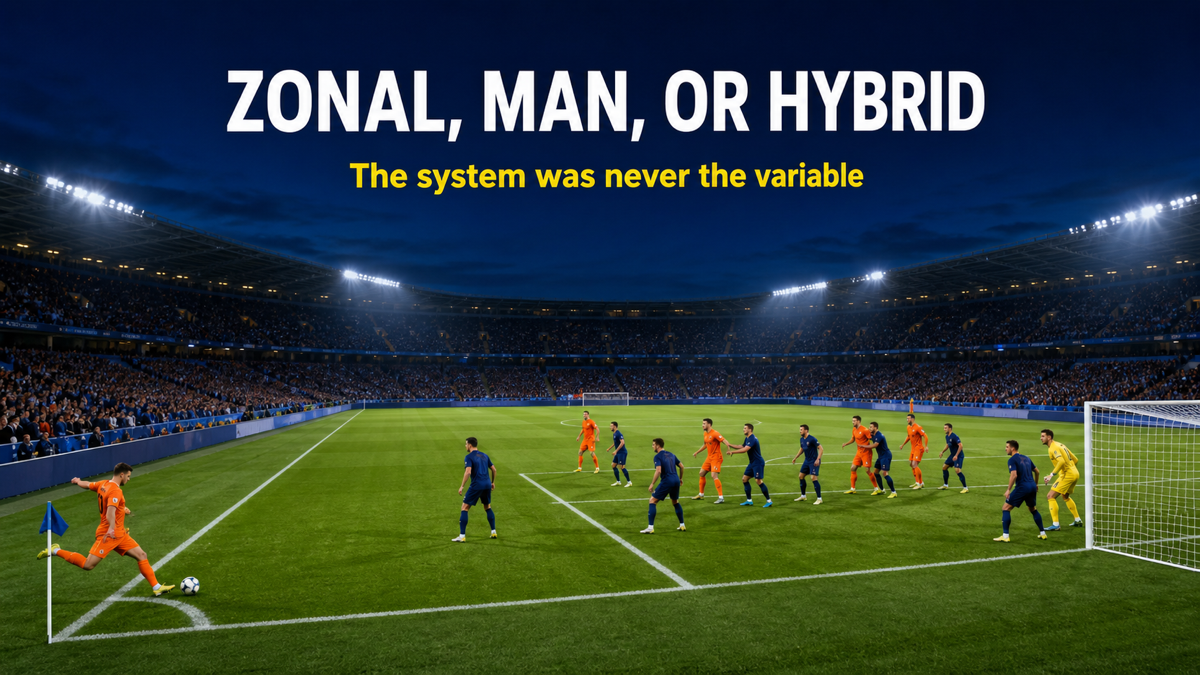
The choice between these three is no longer the interesting question.
Why The Marking System Is The Wrong Question
The Premier League’s 2024-25 league table for defending corners tells a story that contradicts the entire zonal-vs-man debate. Crystal Palace, running one of the most zonal-pure systems in the league, finished bottom four for corners conceded. Burnley, deploying almost pure man-marking, finished one place above them.
Arsenal and Brentford, both running hybrid systems, finished top three. If the system was the variable, the table would cluster by system. It clusters by coaching investment instead.
Arsenal hired Nicolas Jover as a dedicated set-piece coach in 2021, a role fixed inside Arteta’s setup ever since. Brentford built a specialist set-piece department under Bernardo Cueva during the Thomas Frank era. Both clubs sat top of the table for defending corners four straight seasons.
The two best sides at defending corners across that stretch did not share a marking choice. The implementations differ. They share a treatment of defending corners as a coachable specialism.
The clubs at the bottom varied by system but had one thing in common: no specialist set-piece staff. Their work at defending corners was coached by an assistant covering three other domains.
When the league is read this way, the question stops being “zonal or man?” and starts being “who is coaching this, and how much rehearsal time do they get every week?”
The Liverpool Collapse: How A Set-Piece Engine Broke In One Season
Under Jürgen Klopp, Liverpool’s record at defending corners sat in the league’s middle tier for most of his tenure. The 2023-24 season ended with a respectable goals-conceded-from-corners figure, in line with their open-play numbers. When Arne Slot took over in summer 2024, the open-play defending evolved but the set-piece operation lost continuity.
The numbers across 2024-25 told the story. Liverpool conceded notably more set-piece goals than in 2023-24, and the share from corners climbed. By 2025-26 the trend had hardened, with figures Slot’s side had not posted under any prior manager.
The marking system did not change. Liverpool ran a hybrid corner system under Klopp’s final year, and Slot kept the hybrid. The framework, the zones, the positioning of the screening defenders at the near-post stayed structurally similar.
What changed was set-piece coaching depth. The continuity Klopp had built around set-piece preparation, including review cycles and player-by-player aerial-duel scouting, was thinned during the managerial transition.
Routines rehearsed weekly under Klopp became occasional. The routine-level discipline (near-post screening, second-ball assignment, late-runner tracking) drifted with it.
Inside set-piece analytics circles the story is well understood. Same hybrid, different operation, different results.
The system was not the problem. The operation was.

The Arsenal Machine: What Specialist Set-Piece Coaching Actually Looks Like
Arsenal turned set-pieces into a structural advantage between 2021 and 2025 by treating them as their own coaching department. Set-piece sessions are dedicated, not folded into general defensive drills. The video review is at routine level, not match level.
Every Arsenal position for defending corners has a named owner, a documented reading of the opponent’s most likely routine, and a rehearsed second-ball assignment. When the ball is in the air, Arsenal’s defenders are not making a system decision. They are executing a rehearsed answer to a specific routine the staff has already shown them three times in the preparation week.
The visible details on a typical Arsenal corner: a tall body screening the near-post, a screening body at the front of the six-yard box, a marker on each of the opponent’s two tallest aerial threats, and two players positioned for second balls. The hybrid is normal-looking. What is not normal is how often it executes correctly.
A look at the Premier League set-piece tracking via FBref shows Arsenal’s numbers for defending corners among the league’s lowest across that stretch, in absolute terms and on a per-corner-faced basis.
This is the depth of preparation Liverpool’s operation lost. It is also the depth most Premier League sides cannot match because they have not invested in the coaching role to produce it.
The Hybrid System: How Modern Teams Are Defending Corners Now
Defending corners with a hybrid setup combines man-marking and zonal in a single shape. The team’s three or four most aerially dangerous opponents are marked man-to-man. Three or four defenders hold pre-assigned zones at the near-post, the six-yard line, and sometimes the penalty spot.
The reasoning is straightforward. Pure zonal leaves the most dangerous attackers free to attack the ball with running starts, the highest-percentage scoring scenario at corners. Pure man-marking lets the attacking side design routines that drag the marker out of dangerous space and create a one-versus-zero chance for a free runner.
The hybrid uses man-marking to neutralise the runner threat and zonal to hold the high-value goal-scoring lanes. The deeper debate between the two pure systems is unpacked in our breakdown of zonal marking vs man-to-man defending, where the open-play reasoning behind each system shapes how each performs at set-pieces.
The set piece marking strategy at most clubs is now hybrid by default. Below is a snapshot of how the three system archetypes have performed across recent Premier League seasons, based on benchmark season-average data.
| System Type | Goals Conceded From Corners Per Season (Benchmark) | Most Common Vulnerability |
|---|---|---|
| Zonal-pure | 7-10 goals | Free attackers winning with running starts at the near-post |
| Man-pure | 7-10 goals | Markers dragged out by designed runs, leaving free shooters |
| Hybrid | 4-7 goals | Coaching-execution gaps in screening and second-ball assignments |
Data reflects average metrics across Premier League seasons 2022-25. Individual team and season variance applies.
What the table shows is that hybrid sides outperform pure-system sides on a season-average basis, but only when the hybrid is run with operational discipline. The Liverpool collapse sits inside the hybrid row, at the wrong tail of it.
Hybrid is the framework. Coaching is the variable.
The Near-Post Run: The Single Mechanic That Decides Every Corner
Roughly 40% of Premier League corner goals across the last three seasons came from balls won at or near the near-post, per StatsBomb data tracked across the 2022-25 seasons. That figure dwarfs the equivalent share for the central penalty spot zone and the back-post zone. If the defending side fails the near-post screen, the corner is already most of the way to being conceded.
The near-post screen is one of the simplest-looking jobs in defending corners and one of the hardest to do well. The defender holds a position roughly two yards in front of the near-post, between the goalkeeper and the incoming ball. The job is to attack any flicked or whipped delivery through that lane before an attacker can.
The principle mirrors the one we covered in our breakdown of defending the half-space: the defender owning the most dangerous zone has to read the routine before reacting to the ball, not the other way around.
The attacking side knows this. The dangerous corner routines are designed to drag the near-post screen out of position, create a one-second window of vacated space, and time a runner into that window. The screen player has to read the routine inside three or four seconds of the corner being called.
Reading the routine is where specialist coaching multiplies the value of the defender. Without coaching, the screen player guesses. With coaching, the screen player has been shown the opponent’s three most likely near-post routines in video review during the preparation week and knows the body position that defeats each one.
Law 17 at IFAB sets the geometry of a corner, but it is the screen at the near-post that decides whether the corner converts. The defender there has the single biggest individual impact on the outcome of the set-piece.
The Weakness: When Specialist Coaching Fails
Specialist set-piece coaching is not foolproof. Even Arsenal under Mikel Arteta have conceded goals from corners during seasons where the overall record is excellent. The weakness in the coached-hybrid model shows up in two specific scenarios.

The first is a fatigued back-line late in matches where multiple players are operating below their normal aerial-duel level. Coaching prepares positions, but it cannot recover legs. Sides defending corners superbly in minutes 0-75 are visibly less effective in minutes 90-plus.
The second is an unfamiliar specialist taker. Coached routines are built off the opponent’s archive. When the archive is empty, a January signing or a new dead-ball taker can collapse a week of preparation by removing the routine-level edge.
This is why Arsenal’s record is top-three, not perfect, and Brentford’s excellent record still sees occasional gaps. Specialist coaching narrows the variance, it does not eliminate it. For sides trying to catch up, hiring the specialist coach is necessary but not sufficient; the staff also needs time, video access, and autonomy to run a real set-piece week.
The Tactical Takeaway
The debate around defending corners has been mis-framed for a decade. Zonal versus man-marking is the visible variable, but it has never been the determining one. Specialist set-piece coaching is the actual variable, and the data across the last four Premier League seasons confirms it.
The clubs that will improve at defending corners are the ones that hire a set-piece coach, give them a video room, and give them rehearsal time inside the training week. The clubs that will fall further behind are the ones still treating set-pieces as a Friday afternoon ten-minute job.
The Liverpool collapse is the warning case. The Arsenal record is the proof of concept. The choice is no longer between zonal and man, it is between coaching set-pieces seriously or pretending the marking system will save you.
What Do You Think?
Liverpool’s hybrid corner system is structurally identical to Arsenal’s, yet the gap in performance across 2024-26 is among the widest in the league. Is the answer a single set-piece coach hire, or has the operational depth at Arsenal compounded so far ahead of the chasing pack that it would take a multi-year rebuild for any other side to close the gap? Drop your take below.
Want to read any match like this?
The framework behind these breakdowns, in one place. The four phases, a 15-minute method for diagnosing both teams before the drinks break, a printable match-watching worksheet, and 51 terms defined. 40 pages.
Get the pack$9, instant downloadRelated Tactical Breakdowns

Zonal Marking vs Man-to-Man Defending: Which System Actually Wins?
Why it connects: The open-play companion to this piece, showing how zonal and man-marking philosophies shape teams in build-up phases before they ever line up at a corner.

Set-Piece Tactics Explained: How Modern Teams Win from Dead Balls
Why it connects: The attacking flip side. The same staff that coach corner-defending discipline are usually the ones designing the attacking routines that win the league’s other corners.

How Elite Teams Defend Without the Ball: A Complete Tactical Guide
Why it connects: Sets the broader defensive frame for why a team’s identity in open play often predicts how seriously it treats set-piece preparation.
Speak the language of the game
Get the free 47-term tactical glossary. Gegenpress, half-space, xT, low block, each defined in plain language and linked to a full breakdown. It is yours for an email.
Frequently Asked Questions
What is the difference between zonal and man-marking at corners?
Zonal marking assigns each defender a specific area inside the box, while man-marking assigns each defender a specific attacker. In zonal, defenders attack any ball entering their zone regardless of which attacker arrives. In man-marking, defenders track their assigned attacker into and out of zones, prioritising the player over the space.
Why do most Premier League teams use a hybrid system for defending corners?
Defending corners with a hybrid system wins because it neutralises both major attacking threats at once. Man-marking the two or three most dangerous aerial attackers stops free runners with sprint starts, while zonal cover at the near-post and six-yard line protects the highest-value goal-scoring zones. The combined coverage is harder to design routines against than either pure system.
How do you stop a near-post run at a corner?
Stopping a near-post run requires a screening defender holding a body position two yards in front of the near-post, between the keeper and the ball trajectory. The screen reads the routine in three to four seconds, attacks the ball before the runner can connect, and steers any flicked contact wide of the goal frame.
Which Premier League team is best at defending corners?
Arsenal have been the best side at defending corners in the Premier League across 2022-2025, posting one of the lowest goals-conceded-from-corners rates in the league four seasons running. Their record traces to dedicated set-piece coaching, routine-level video review, and named ownership of every position on a corner.