

Last updated: October 27, 2026
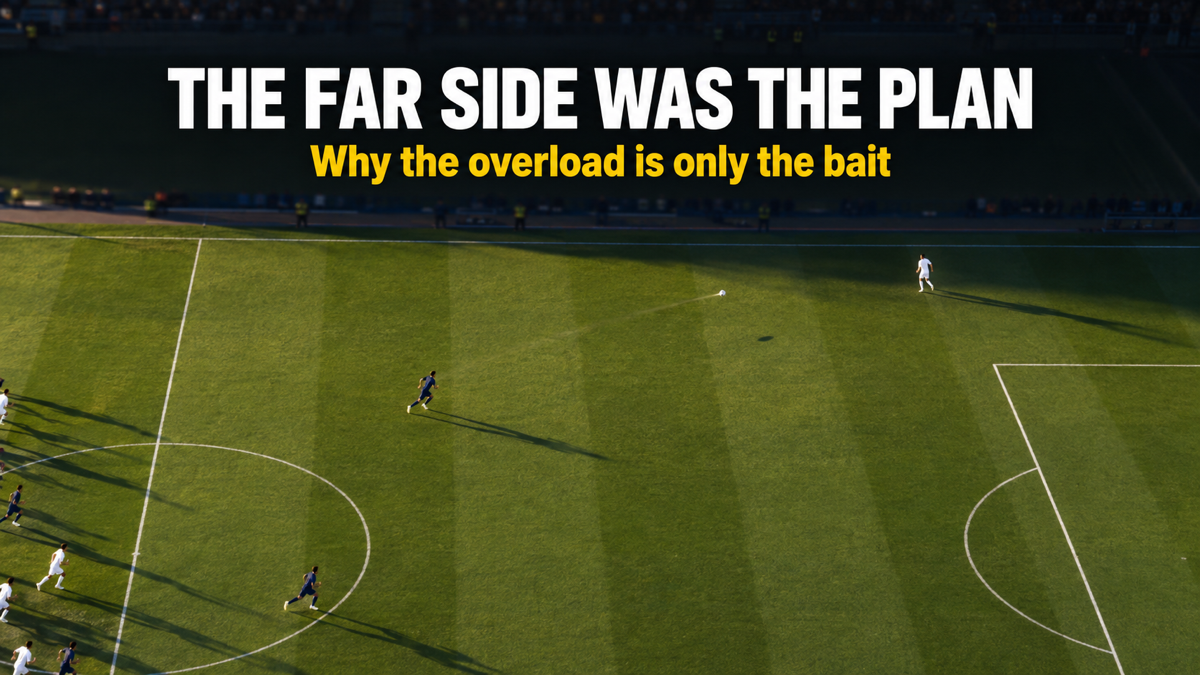
Trent Alexander-Arnold barely glances at the three team-mates crowding the right touchline in front of him. He plants his standing foot, opens his body, and clips a 50-yard ball to the opposite wing, where a winger waits alone against a single full-back. The overload on the right was never the destination. It was the lure, and the switch of play was the weapon all along.
Elite teams treat one flank as a magnet and the other as the kill zone. Pull a defence one way, then move the ball faster than they can slide back. This is the heartbeat of modern build-up play, where progression is less about the crowded side and more about the empty one.
In simple terms: A switch of play is a long cross-field pass from a crowded flank to a free attacker on the far side.
Key Takeaways
- The overload is bait: Crowding one flank drags defenders across, and the goal is the space this vacates on the far side, not a breakthrough where the players are stacked. The switch of play cashes it in.
- The pass beats the slide: A driven cross-field pass crosses 40 metres faster than a back four can shuffle to reset, so the ball arrives before the marker does.
- Trigger on commitment: The switch of play only works the instant the far-side defender steps in to help, so release it before he recovers.
- The diagonal decides everything: A driven flat ball isolates instantly, while a lofted diagonal ball buys safety but gifts the defence time to cover.
- Compactness is the counter: Defences that refuse to over-shift, protecting the far half-space, dare you to switch and recover before the ball lands.
Table of Contents
What Is a Switch of Play?
A switch of play is a long pass that moves the ball quickly from one flank to the opposite one to attack space the defence has abandoned. The pass itself is simple. The intelligence sits in the seconds before it, when a team deliberately overloads one side to drag the opposition across.
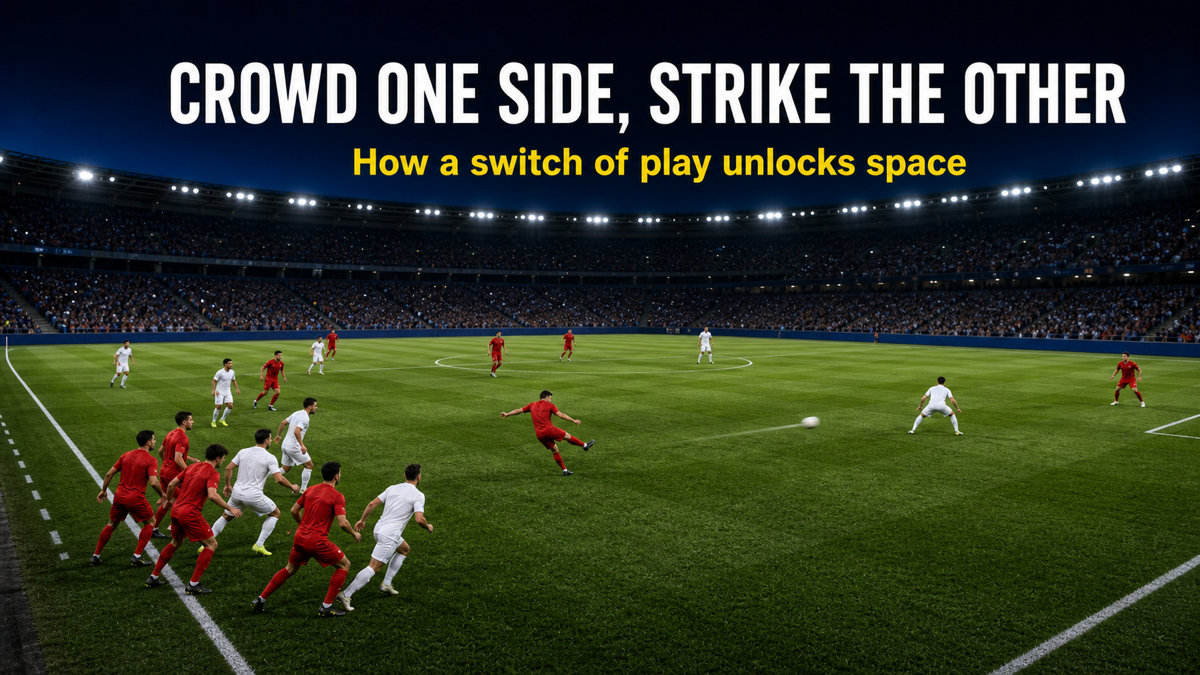
Picture Manchester City building down the right under Pep Guardiola. Five blue shirts gather near the touchline, the defence shifts to smother them, and the left winger drifts into 40 yards of grass.
The switch of play that follows is not done for its own sake. It is the cash-out on space the team manufactured on purpose.
A clean switch of play changes the question the defence has to answer. Instead of defending the ball, they are suddenly defending a one-versus-one on the far touchline with no cover. Coaches’ Voice frames it as building aggressively on one side before switching to find a player who can attack in space.
The Overload Is Bait, Not the Goal
The overload exists to be abandoned. Its job is to commit defenders to one flank so the ball can be moved to the other, which is why the best teams care less about the crowded side than the empty one. This is the principle coaches call overload to isolate: commit extra players to one side, draw defenders across, then free an attacker on the far side.
KharaSportsDaily breaks down the full mechanics of how teams manufacture an overload and then isolate a winger elsewhere. The point worth isolating here is narrower. The overload is the setup, and the switch of play is the punchline.
Get the bait wrong and the whole move dies. Stack too few players and the defence never shifts. Stack too many, hold the ball too long, and they recover their shape before you switch the play at all.
Timing is the hidden variable. The switch of play must leave just as the far-side defender tucks in to help his overloaded team-mates. Release it a beat early and there is no overload yet, a beat late and the point of attack is already covered.
Why the Ball Moves Faster Than the Block
A switch of play works because a passed ball travels faster than defenders can run. A back four shuffling sideways covers ground at a jog, while a driven cross-field pass crosses the same 40 metres in a fraction of the time. The defence is always chasing a ball that has already arrived.
That speed gap is the entire economic case for switching play. Shift the ball quicker than the block can slide, and the far-side attacker receives before his marker is set. Shift it slower, through a row of short passes, and the defence simply walks across with you.
The table below frames the trade-off between delivery types. The figures are illustrative estimates of how a switch of play behaves against an organised block, not match data.
| Delivery method | Approx. time to cross a 40m switch | Defensive block response | Net effect on the far side |
|---|---|---|---|
| Driven flat diagonal | Around 1.5 seconds | Block barely shifts a stride | Clean one-versus-one isolation |
| Lofted diagonal ball | Around 2 to 2.5 seconds | Block slides several metres | Receiver wins the air, defender closing |
| Sequence of short passes | 4 seconds or more | Block fully re-sets | Isolation lost, attack recycled |
Illustrative figures, not data from real matches.
The lesson sits in the top row. The faster and flatter the diagonal, the less time the defence has to rebalance, and the cleaner the isolation on the far touchline.

The Diagonal That Does the Damage
The diagonal ball is the moment the whole move lives or dies. A switch of play can be driven flat, clipped with loft, or bent back against the defence’s momentum, and each choice changes the kind of chance that follows. The execution, not the idea, separates a switch of play that isolates from one that just moves the ball sideways.
A driven flat diagonal is the assassin’s choice. It reaches the far winger almost instantly and lets him attack a back-pedalling full-back at speed. This driven switch of play is the ball Trent Alexander-Arnold has built a reputation on.
A lofted diagonal ball trades speed for security. It clears the pressing line entirely but hangs long enough for the defence to shuffle across, so the receiver often wins the ball with a defender already arriving. It beats the press, but it rarely beats the cover.
Who strikes the pass matters as much as how. The deep-lying distributor, often an inverted full-back stepping inside, has the angle and the time to switch the play before the picture changes.
Scanning is everything. The best players switch the point of attack off a picture they took two seconds earlier, not the one in front of them.
The Weakness: A Block That Refuses to Chase
The switch of play fails against a defence disciplined enough not to take the bait. Teams that hold a compact shape and refuse to over-shift simply dare you to switch, betting they can slide back before the diagonal lands. The overload pulls at nothing, and the far-side isolation never appears.
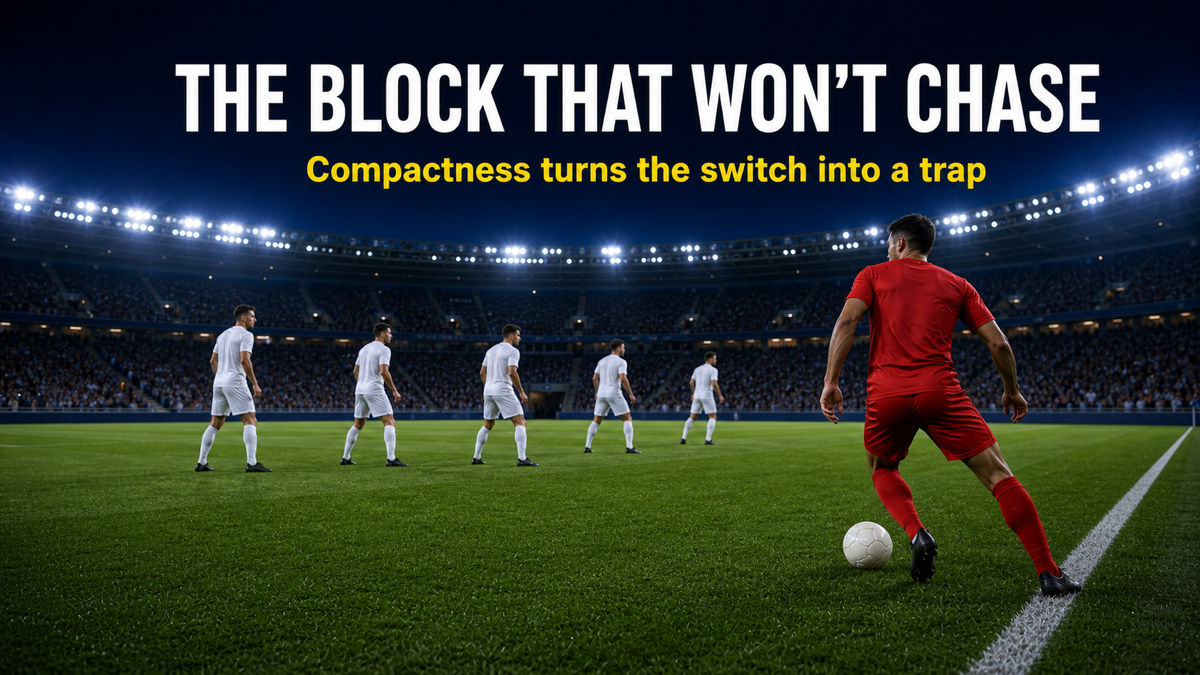
This is why elite half-space defending is the cleanest counter. A back line that keeps its far-side full-back tucked in, protecting the inside channel rather than chasing the ball, leaves the switch of play with nowhere dangerous to land. The winger may receive, but he receives going backwards with the touchline as a second defender.
Pressing the passer is the other answer. If the deep distributor cannot lift his head, the cross-field pass becomes a hopeful clip rather than a measured strike. Diego Simeone’s Atlético Madrid have spent a decade making the switch of play look like the only option, then swarming the receiver the instant it arrives.
There is also a self-inflicted failure. Switch too early and the overload has not committed anyone, switch too late and the point of attack is gone. The mechanism punishes impatience as harshly as it punishes a slow defence.
What This Means on the Pitch
The switch of play is one of football’s great acts of misdirection. The crowd watches the overload, but the goal is built on the side nobody is looking at. That is what separates it from simply moving the ball wide.
Treat it as a finishing move, not a default. The teams that punish defences are not the ones that switch the play most often, but the ones that switch it at the exact moment a defender commits. The pass is easy, and the patience to wait for the bait to bite is not.
The next time a side floods one flank and the move looks like it is going nowhere, watch the far winger instead. That is where the switch of play was always going to end.
What Do You Think?
Trent Alexander-Arnold’s long diagonals make the switch of play look effortless, but Diego Simeone’s Atlético spent a decade proving a compact block can turn it into a trap. So which wins a one-off knockout tie: the team that switches play to isolate, or the defence that refuses to chase it? Drop your verdict below.
Want to read any match like this?
The framework behind these breakdowns, in one place. The four phases, a 15-minute method for diagnosing both teams before the drinks break, a printable match-watching worksheet, and 51 terms defined. 33 pages, free.
Get it freeFree PDF, sent to your inboxRelated Tactical Breakdowns

De Zerbi Baiting Press Structure: The Artificial Transition System Explained
Why it connects: De Zerbi baits a press to spring one man free, while the switch baits a whole block to free a winger, the same trick on a bigger canvas.

The Third Man Run: 3 Secrets Elite Teams Use to Shatter Defensive Lines
Why it connects: Both engineer a free attacker by moving defenders, the switch working across the pitch and the third-man run working through the lines.

Zone 14 in Football: What It Is, Why It Matters, and How Teams Exploit It
Why it connects: When the isolated winger beats his man, the cut-back most often targets Zone 14, the central space the switch was built to unlock.
Learn to read a match like an analyst
Get the free 33-page Starter Pack, How to Read a Football Match (the Four Phases, a 15-minute match read, a printable worksheet), plus the 70+ term tactical glossary. Both are yours for an email.
Frequently Asked Questions
What is a switch of play in football?
A switch of play is a long cross-field pass that moves the ball from a crowded flank to a free attacker on the opposite side. Teams use it to escape pressure on one wing and attack space on the other. The best switches arrive before the defence can slide across to cover.
Why do teams overload one side before switching play?
Teams overload one side to drag defenders across and empty the far flank before switching play into it. The crowded side is bait, not the target. Once the defence commits, a quick switch isolates an attacker one-versus-one where the cover used to be.
How fast does a switch of play need to be?
A switch of play needs to be fast enough to beat the defence’s sideways shift, which a driven flat diagonal manages in well under two seconds. A lofted diagonal ball is slower and gives the block time to recover. Speed of pass against speed of shift decides whether the isolation survives.
Which players are best at switching play?
Deep distributors with long passing range are best at switching play, with Trent Alexander-Arnold the standout for his driven cross-field diagonals. Inverted full-backs and deep playmakers get the time and angle to scan and strike. Coaches’ Voice notes elite wingers like Khvicha Kvaratskhelia thrive as the receiver of these switches.