

Introduction
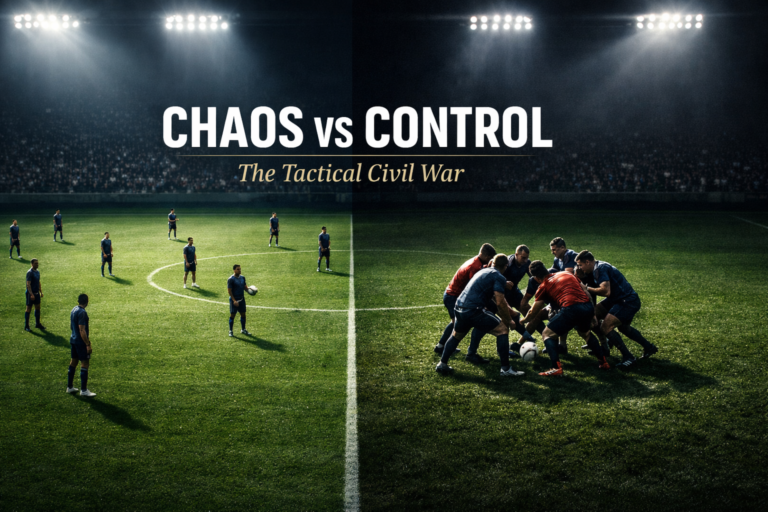
For nearly a decade, Liverpool FC was defined by Jurgen Klopp’s “Heavy Metal” football – a chaotic, high-intensity style built on pure emotion, vertical speed, and the feeling that the car was always about to fly off the tracks. But in 2025, the music at Anfield has changed.
Under Arne Slot tactics, the chaos has been replaced by control.
While the formation on the TV screen might look familiar to the casual observer, the the mechanisms underneath are radically different, marking a major shift in Arne Slot tactics compared to Klopp’s era. I’ve watched this Liverpool side evolve week by week, and the shift is undeniable: They are no longer looking to win the ball back and sprint towards goal in 3 seconds; they are looking to “kill you with passes.”
What is the Arne Slot Style?
In short, Arne Slot plays a controlled, possession-based 4-2-3-1 that relies on a double-pivot in midfield, patient build-up from the back, and the use of a traditional #10 to link play. Unlike Klopp’s vertical rushes, Slot’s team is happy to stand still on the ball, bait the opponent into pressing, and then slice through them with precision.
This guide breaks down the tactical evolution at Anfield—from the new midfield structure to the pressing triggers—so you can understand exactly how the Reds have transformed into a possession machine. (For a deeper dive on how metrics track this control, read our guide on Field Tilt Explained).
Key Takeaways: The Arne Slot Blueprint
- The 4-2-3-1 Shift: Slot has abandoned the flat 4-3-3 for a 4-2-3-1, using a “Double Pivot” (two holding midfielders) to offer more protection and control in central areas.
- “Kill Them With Passes”: The team uses short, safe passes (Rondo style) to bait opponents into pressing, opening up space behind them.
- The #10 Role: Unlike Klopp, who bypassed the midfield, Slot uses a dedicated #10 (like Szoboszlai) to operate “between the lines” and connect the attack.
- Controlled Pressing: The press is less manic and more structural, often forming a 4-4-2 block to deny central passing lanes rather than chasing every ball.
- The “Pausa”: Players are instructed to pause on the ball to invite pressure—a concept known in Spanish football as La Pausa.
Enjoying the analysis?
Don’t Just Watch Football. Understand It.
Join KharaSportsDaily and receive occasional deep tactical insights most fans miss.
Occasional analysis. No match reports. No noise.
Table of Contents
The System: Why the 4-2-3-1 Changed Everything
If you look at the team sheets, you might see a 4-3-3 listed. Do not believe it. In possession, Arne Slot’s Liverpool operates in a distinct 4-2-3-1 or sometimes a 2-4-4 shape.
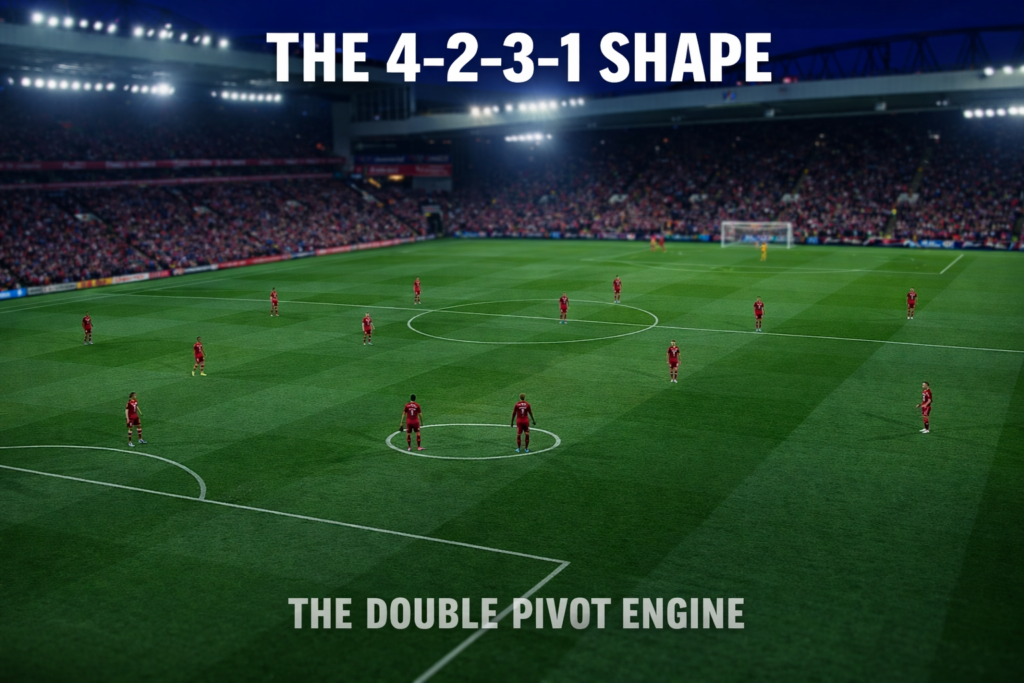
Why does this matter?
In the Klopp era, the single #6 (Fabinho) was often left alone to cover the entire width of the pitch while the #8s bombed forward. It was exciting, but it was fragile. If the counter-press failed, the defense was exposed.
Slot fixes this with the Double Pivot. By keeping two midfielders deep (usually Gravenberch and Mac Allister), Liverpool creates a “box” with their center-backs.
- The Benefit: It gives them a 4v2 or 4v3 numerical superiority against almost any team that tries to press them.
- The Result: They don’t just clear the ball; they play through the pressure.
This structure allows the fullbacks to pick their moments. Trent Alexander-Arnold doesn’t have to invert constantly to become a midfielder because there are already two midfielders there. He can now operate as a traditional overlapping threat or an inverted playmaker depending on the game state.
Build-Up Play: The Art of Baiting the Press
The most visually striking difference in the Arne Slot era is the speed of play. This patience is a hallmark of Arne Slot tactics, where the lack of speed in the first phase is intentional. in the first phase.
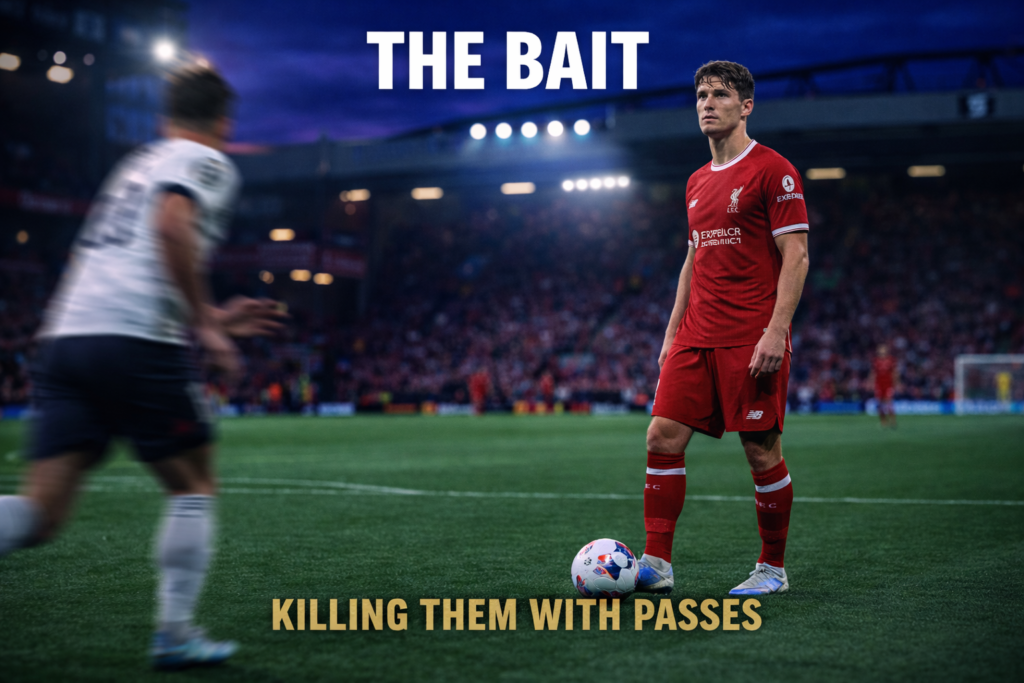
I call this “The Bait.”
Watch closely when Virgil van Dijk or Alisson has the ball. They will often stop dead. They will put their foot on the ball and wait. Why?
- Klopp’s Philosophy: Move the ball fast to unsettle the defense.
- Slot’s Philosophy: Hold the ball to annoy the defense.
Slot wants the opponent to step out of their defensive shape. He knows that if a striker gets impatient and sprints at Van Dijk, a gap opens up behind that striker. That is the moment Liverpool strikes.
The “Rondo” Effect
Once the press is triggered, Liverpool executes rapid, one-touch triangles to bypass the first line of defense. This is classical Dutch “Total Football” principles modernized for the Premier League. They aren’t passing for the sake of possession; they are passing to move the opponent’s structure until a lane opens for a vertical pass to the #10.
The Midfield Makeover: The Double Pivot
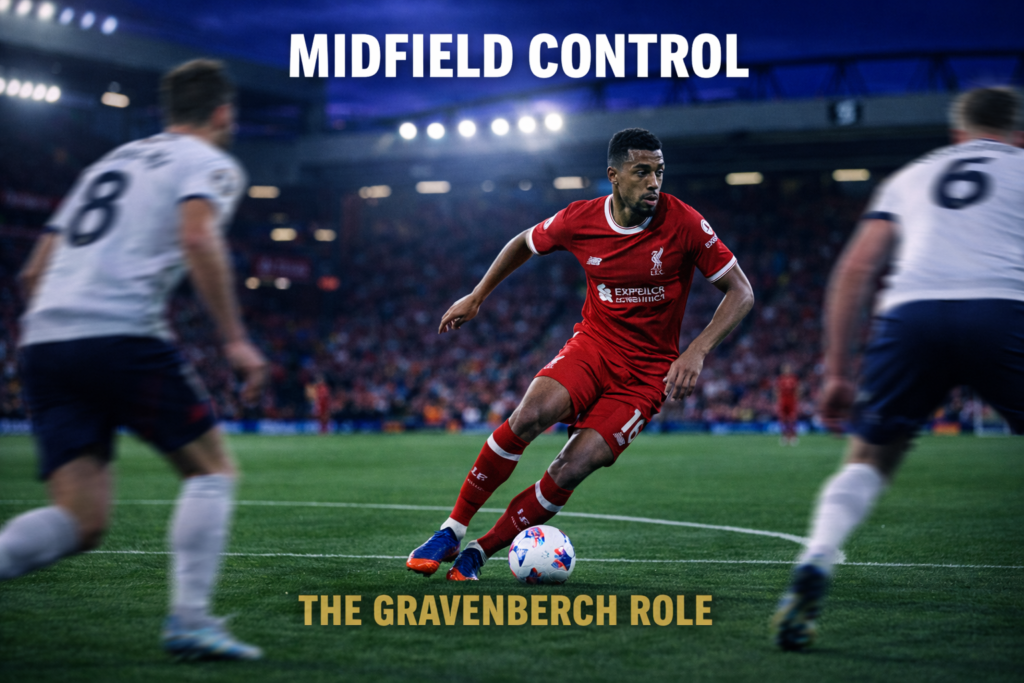
The biggest individual beneficiary of Slot’s tactics has arguably been Ryan Gravenberch. Under the previous system, he was often lost—too attacking for a #6, not defensive enough for a Klopp midfield.
In Slot’s 4-2-3-1, he has been reborn.
Playing in the “Double Pivot,” Gravenberch isn’t asked to be a destroyer. He is asked to be a “carrier.” His ability to receive the ball under pressure, turn, and drive forward (ball-carrying) is the engine of this system.
The #10 Problem (Solved)
For years, Liverpool didn’t play with a number 10. The creativity came from the wings (Salah/Mane) or the fullbacks (Trent/Robbo). Slot has reintroduced the central playmaker.
Whether it’s Dominik Szoboszlai or Harvey Elliott, the #10 in this system has a crucial job: Float.
They drift into the “pockets” of space between the opponent’s midfield and defense. When the Double Pivot baits the press, the #10 becomes the escape valve.
Comparison: Arne Slot vs Jurgen Klopp
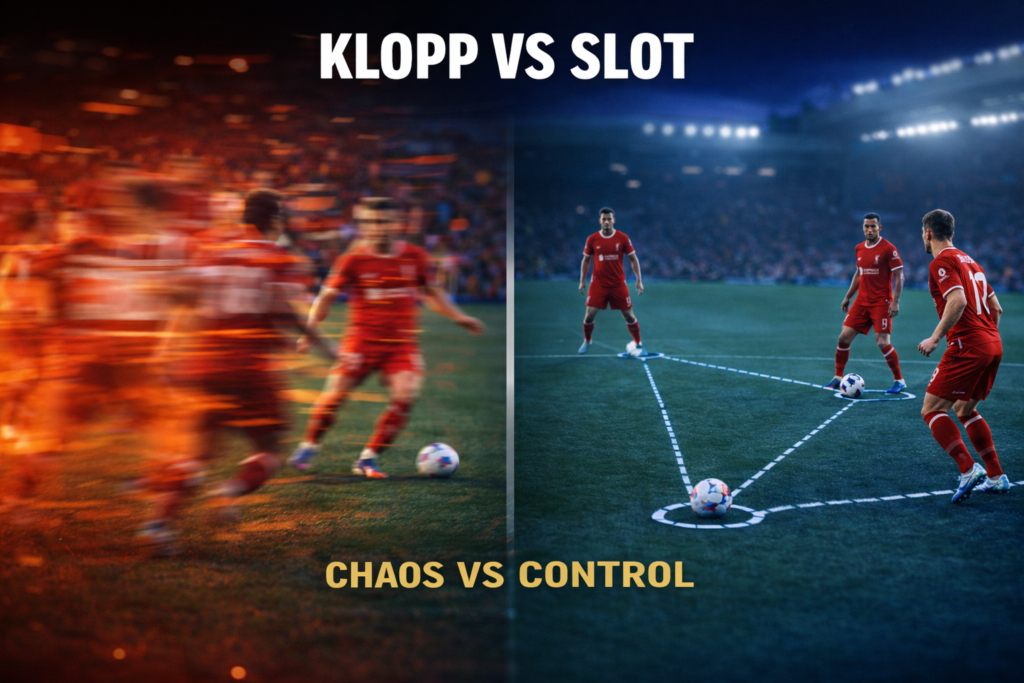
To truly understand the evolution of Arne Slot tactics, we have to compare the two styles side-by-side., we have to compare the two styles side-by-side. Both managers want to win, but their definition of “control” is opposite.
| Feature | Jurgen Klopp (Heavy Metal) | Arne Slot (Controlled Chaos) |
| Formation | 4-3-3 (Single Pivot) | 4-2-3-1 (Double Pivot) |
| Tempo | 100mph / Vertical & Fast | Variable / Slow Build-up, Fast Finish |
| Possession Goal | Create Chaos & Transitions | Create Space & Overloads |
| Midfield Role | Workhorses / Cover Ground | Technicians / Keep Ball |
| Defensive Shape | High Line / Man-to-Man Press | Mid-Block / Cutting Passing Lanes |
| Risk Level | High (End-to-End) | Moderate (Control First) |
The Weakness: Where is the System Vulnerable?
No tactical system is invincible. While Slot’s approach minimizes the “basketball” style transitions that plagued Klopp’s final season, it introduces new risks.

1. The High Line Risk
Because Liverpool compresses the pitch to keep possession, their defensive line remains extremely high. If an opponent manages to bypass the Double Pivot with a long ball, the center-backs are often left in a footrace.
2. Over-Playing at the Back
The insistence on “baiting the press” can lead to dangerous turnovers near their own box. We have seen moments where a slightly misplaced pass from Alisson or a center-back leads directly to a high-quality chance for the opposition.
3. Stagnation
Against a Low Block (teams that refuse to press), Slot’s system can sometimes look too passive. Without the chaos of Klopp’s style, breaking down a team that sits 10 men behind the ball requires extreme precision from the #10 and wingers.
Final Thoughts
The success of Arne Slot tactics relies on this patience. He has not just tweaked Liverpool, he has rewired them.
He has taken a team built on emotion and adrenaline and taught them the value of patience. The 4-2-3-1 provides the defensive stability that was missing, while the focus on “control” allows them to manage games without burning out by the 60th minute.
Is it less exciting than “Heavy Metal” football? Perhaps.
Is it more sustainable for a 38-game title charge? Absolutely.
Understanding this shift is critical for watching Liverpool in 2025. When you see them passing sideways at the back, don’t scream “Get it forward!” Recognize that they are setting a trap – and waiting for the opponent to step into it.
Enjoyed this breakdown?
Don’t Just Watch Football. Understand It.
Join KharaSportsDaily and receive occasional deep tactical insights most fans miss.
Occasional analysis. No match reports. No noise.
Frequently Asked Questions (FAQs)
What formation does Arne Slot play at Liverpool?
Arne Slot primarily utilizes a 4-2-3-1 formation. This differs from Jurgen Klopp’s traditional 4-3-3 by using two deep-lying midfielders (a double pivot) to control possession and protect the defense, while deploying a dedicated #10 attacking midfielder.
How is Arne Slot’s tactics different from Jurgen Klopp?
The main difference is tempo and control. Klopp favored “Heavy Metal” football—fast, vertical, and chaotic. Arne Slot prefers a more patient, possession-based approach, often slowing the game down to bait opponents into pressing before attacking the space they leave behind.
What is the “Double Pivot” in Slot’s system?
The Double Pivot refers to the two central midfielders (often Gravenberch and Mac Allister) who play in front of the defensive line. Their job is to recycle possession, resist pressure, and connect the defense to the attack, providing a stable base that allows the fullbacks to attack.
About the Author
Football Tactician & Analyst. breaking down elite systems for coaches and fans.

[…] Positionism, or Positional Play, is likely what you are most familiar with. It is the dominant ideology of European football. Think of Manchester City, Arsenal, or Arne Slot’s Liverpool. […]