
Last updated: September 19, 2026
If you have watched Manchester City suffocate an opponent in their own half for 90 minutes, you aren’t just watching elite attacking; you are watching elite defending. The reason Guardiola’s teams can commit seven players forward without fear is not because they are reckless – it is because their “Rest Defense” is flawless.
In modern football, what you do when you have the ball determines how vulnerable you are when you lose it. This is the paradox of possession: to attack safely, you must be prepared to defend instantly.
This is the concept of Restverteidigung, or Rest Defense. It is the tactical insurance policy that allows high-octane teams to sustain pressure. In this breakdown, we will move beyond the buzzwords and dissect how you can organize your structure to kill counter-attacks before they even begin.
For context on how this metric sits within the complete football tactics framework, the full guide covers every phase from pressing to build-up to defensive structure in possession.
Key Takeaways
- Rest Defense: The structure your team holds behind the ball while attacking – your tactical insurance against the counter.
- The Golden Ratio: Most elite teams use a “3-2” or “2-3” shape to cover the width of the pitch during possession phases.
- Prophylaxis: The goal is to prevent the counter-attack from starting, not merely react to it once it has.
- The Inverted Fullback: In modern systems, this role serves as a key rest defense mechanism — freeing the team to attack while maintaining structural cover.
Table of Contents
What is Rest Defense?
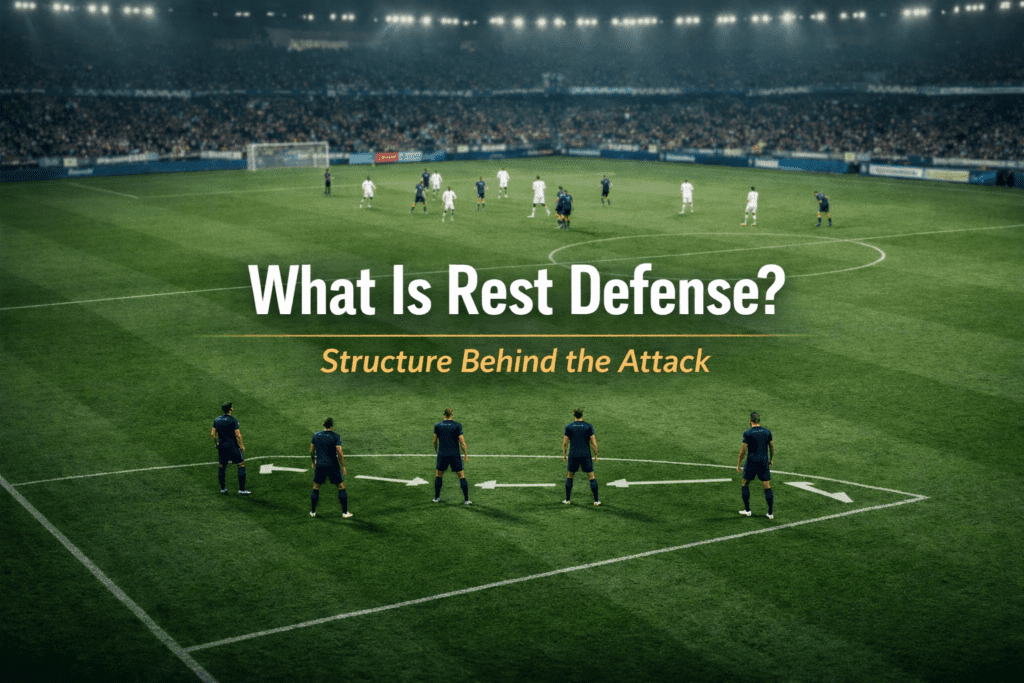
Let’s strip away the complexity. Rest Defense is simply the structure your team maintains behind the ball while you are attacking. It is the “rest” of the defense that isn’t actively involved in the creation of a goal scoring chance.
For decades, coaches taught players to “join the attack.” However, in the high-pressing era of the last 15 years, blindly joining the attack is suicide. If you lose the ball and your fullbacks are by the opposing corner flag, one long ball eliminates your entire defensive line.
Rest Defense serves two primary functions:
- Immediate Counter-Pressing: By positioning players close to the ball carrier, you can press instantly upon a turnover. (We discussed this in our deep dive on Counter-Pressing Explained).
- Delaying the Counter: If the immediate press fails, the Rest Defense structure forces the opponent wide or slows them down, allowing the attacking players to recover.
Think of it as a safety net. The tighter the net, the more aggressively your acrobats (attackers) can perform.
The Two Primary Structures: 2-3 vs. 3-2
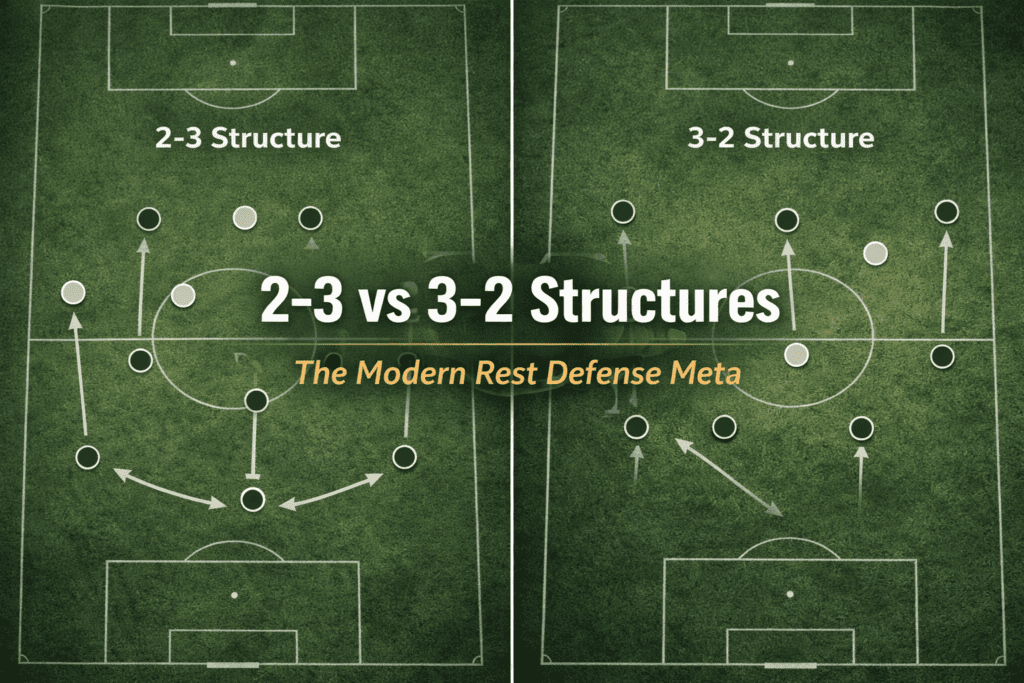
When we analyze the top five European leagues, two distinct shapes dominate the landscape. These shapes usually involve five players attacking and five players defending (including the goalkeeper, essentially a 4+1 structure).
The 2-3 Structure (The Ajax/Barcelona Model)
This was the staple of the classic Dutch school. You leave your two Center Backs (CBs) deep and centrally located. Ahead of them, the Fullbacks (FBs) tuck inside to sit alongside the Defensive Midfielder (DM).
The advantage of this shape is the massive central barrier it creates. When the opponent clears the ball, it almost always drops to the feet of the inverted fullbacks sitting in that second line. The trade-off is exposure in the wide channels – if the opponent keeps fast wingers high and wide, the space behind the tucked-in fullbacks can be exploited on the transition.
The 3-2 Structure (The City/Arsenal Model)
This has become the “meta” in the Premier League recently. Here, you form a back line of three players (often a CB-CB-CB or LB-CB-RB hybrid) with a double pivot of two midfielders in front of them.
This shape creates a “W” or “M” formation behind the ball.
The advantage here is superior coverage of the half-spaces. Three players across the back line handle the width of the pitch more effectively against a high front three. This structure is also the foundation of the Box Midfield (3-2-2-3) covered in our previous breakdown – the stable 3-2 base is what allows the two attacking tens to roam free higher up the pitch.
How to Defend Counter-Attacks Before They Start
Most coaches teach players to sprint back after losing possession. That is already too late. True counter-attack prevention happens during your own attack — by pre-positioning your Rest Defense players to cut off the three most dangerous passing lanes: the central vertical, the weak-side switch, and the direct ball in behind. Elite teams use spacing metrics of 8–12 meters between each line to ensure the net is tight enough to catch any transition before it becomes a chance on goal.
The Principles of Prophylactic Marking

Rest Defense is not passive; it is active. The best defenders in the world – think Virgil van Dijk or William Saliba – are constantly scanning while their team attacks. They are engaging in “Prophylactic Marking.”
This is a medical term adapted for football: taking action to prevent a disease (the counter-attack) before it happens.
When your winger has the ball, your full-back shouldn’t just be watching. They should be moving tight to the opponent’s winger. They are marking a player who doesn’t have the ball yet.
The “Lock on” Rule:
In a good Rest Defense system, the closest defender must “lock on” to the opponent’s outlet player. If the turnover happens, that defender is already touching the opponent, preventing them from turning.
If you are 10 meters away when the turnover occurs, you are too late. The transition has already begun.
Data Analysis: Structure Success Rates
To understand which structure works best, we looked at transition data from the 2023/24 Champions League group stages. We compared teams utilizing a primary 2-3 shape versus a 3-2 shape.
| Metric | 2-3 Structure (e.g., Barca) | 3-2 Structure (e.g., Man City) |
| xG Conceded per Counter | 0.12 | 0.08 |
| Middle Transition Stops | 65% | 78% |
| Wide Transition Stops | 72% | 55% |
| Pass Completion Under Pressure | 82% | 88% |
Note: figures above are illustrative estimates based on observed transition patterns from publicly available Champions League analysis – not proprietary tracking data. For verified tracking data, see FBref’s transition metrics and StatsBomb’s open data repository.
Analysis: The data suggests the 3-2 structure is significantly more robust to undersrabd how to stop counter-attacks in football (Middle Transition Stops), which are statistically more dangerous. However, the 2-3 rest defense structure handles wide counters better due to the wider starting position of the inverted fullbacks in the second line.
The 3-2 is superior for teams that dominate central possession, while the 2-3 suits teams that force play wide.
Case Study: Guardiola’s Evolution
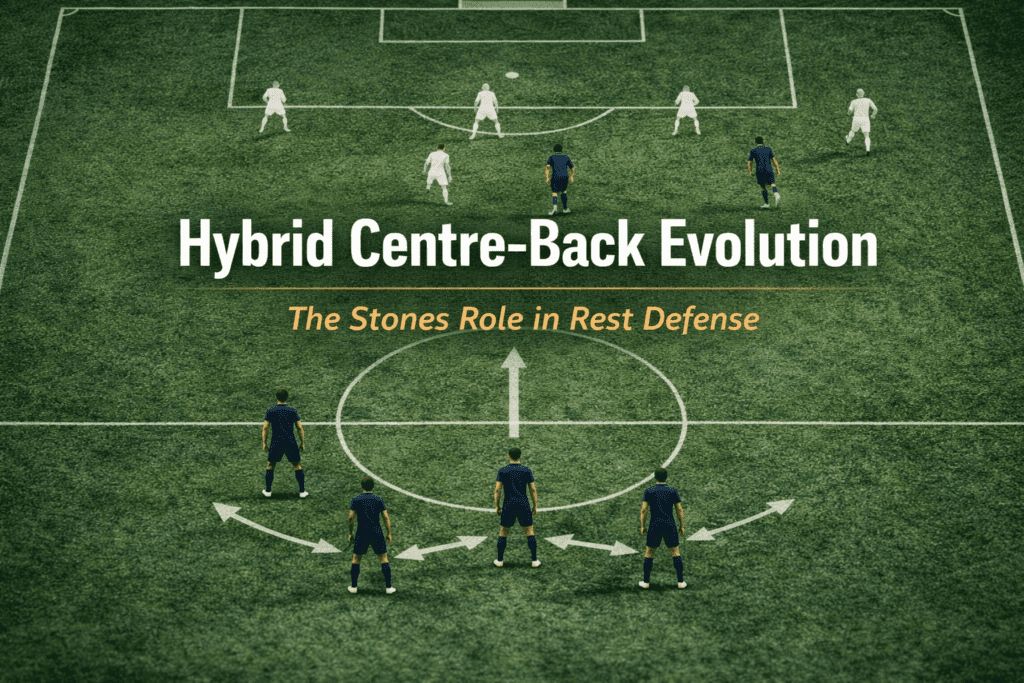
As of the 2024–25 season, Guardiola continues to evolve City’s rest defense principles — but the foundational structures he built remain the benchmark.
To understand Rest Defense Football, you must study its master: Pep Guardiola.
2009-2011 (Barcelona): Pep used a high 2-3. Alves and Abidal would often push high, but Busquets would drop between Pique and Puyol, or Abidal would tuck in. It was fluid but relied heavily on the individual brilliance of Puyol to win 1v1 duels in vast spaces.
2017-2019 (Man City Centurions): The dominance of the “Inverted Fullback“. Delph or Zinchenko moved into midfield to create a 2-3 or 3-2 depending on the phase. This cluttered the midfield, making it impossible for teams to play through the center.
2023 (The Treble): The evolution to the “Hybrid Centre-Back” (The Stones Role). Stones stepped up from CB to DM. This created the most robust Rest Defense we have ever seen. With four natural center-backs on the pitch (Ake, Dias, Akanji, Stones), City had physical dominance in transition that they lacked with smaller fullbacks.
They could sustain attacks for 5 minutes at a time because if the ball popped loose, a 6’2″ defender was there to win the duel immediately.
Training Drill: How Rondos Build Rest Defense Instincts
How do you coach this? You cannot just tell players to “stay back.” It requires cognitive conditioning.
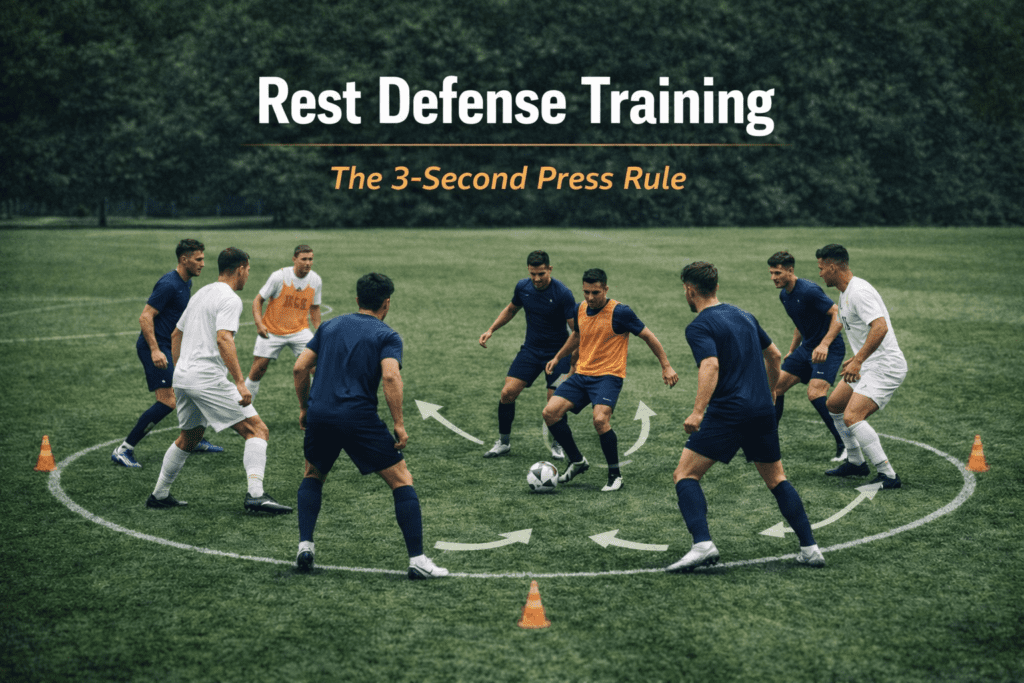
The humble Rondo is the starting point. In a 4v2 or 5v2 rondo, the players on the outside are the “attackers,” and the two in the middle are the “defenders.” However, consider the transition moment.
The Drill:
Set up a positional game (6v4 + 2 Neutrals). The team in possession tries to keep the ball.
The constraint is simple: if the possession team loses the ball, they must physically touch the opponent who won it within three seconds. This forces players to maintain short distances from one another at all times. If the passing structure is too wide, the press cannot happen – and that means rest defense fails. If the structure stays compact, the rest defense tightens naturally. The lesson connects directly back to counter-pressing: you cannot press what you are not already close to.
Mental Concentration
The most difficult part of Rest Defense is not tactical; it is psychological. It is boring.

It requires a player to remain hyper-alert while their team is having fun attacking. While the striker is attempting a bicycle kick, the Rest Defense unit is communicating, pointing, and shuffling three meters to the left.
The “What If” Game:
Elite defenders play the “What If” game constantly.
- “What if the winger loses the ball now?”
- “What if the pass is intercepted?”
If the answer is “we are in trouble,” they adjust their position immediately. This is the hallmark of a disciplined team. When you see a team collapse after losing the ball (think Manchester United in transition during the 2023/24 season), it is rarely a lack of speed – it is a lack of Rest Defense structure and mental alertness.
The Final Word
Rest Defense is the unsung hero of modern tactical dominance. It is the foundation that allows creative players to express themselves. By securing the space behind the ball, you aren’t just defending; you are sustaining the attack. You are telling the opponent: “Even if you win the ball, you are going nowhere.”
As we look toward the future of tactics, expect to see even more fluid Rest Defense structures, with players rotating seamlessly between the “3” and the “2” lines. But the principle will remain the same: Attack with 5, Defend with 5.
If you master this, you master the transition. And if you master the transition, you win the game.
What Do You Think?
Is rest defense the most underrated skill in modern football — and do you think enough coaches at grassroots level actually teach it, or is it still seen as something only elite clubs bother with?
Want to read any match like this?
The framework behind these breakdowns, in one place. The four phases, a 15-minute method for diagnosing both teams before the drinks break, a printable match-watching worksheet, and 51 terms defined. 40 pages.
Get the pack$9, instant downloadRelated Tactical Breakdowns
Rest defense only holds when your team can also press immediately after losing the ball — these breakdowns cover both sides of the transition moment.
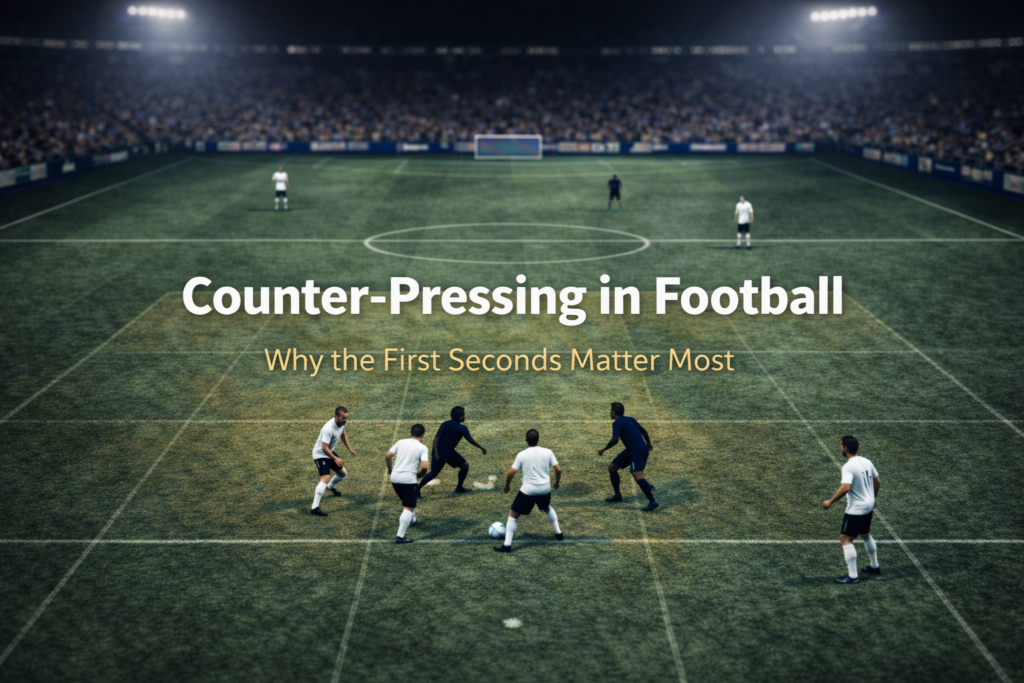
Counter-Pressing Explained
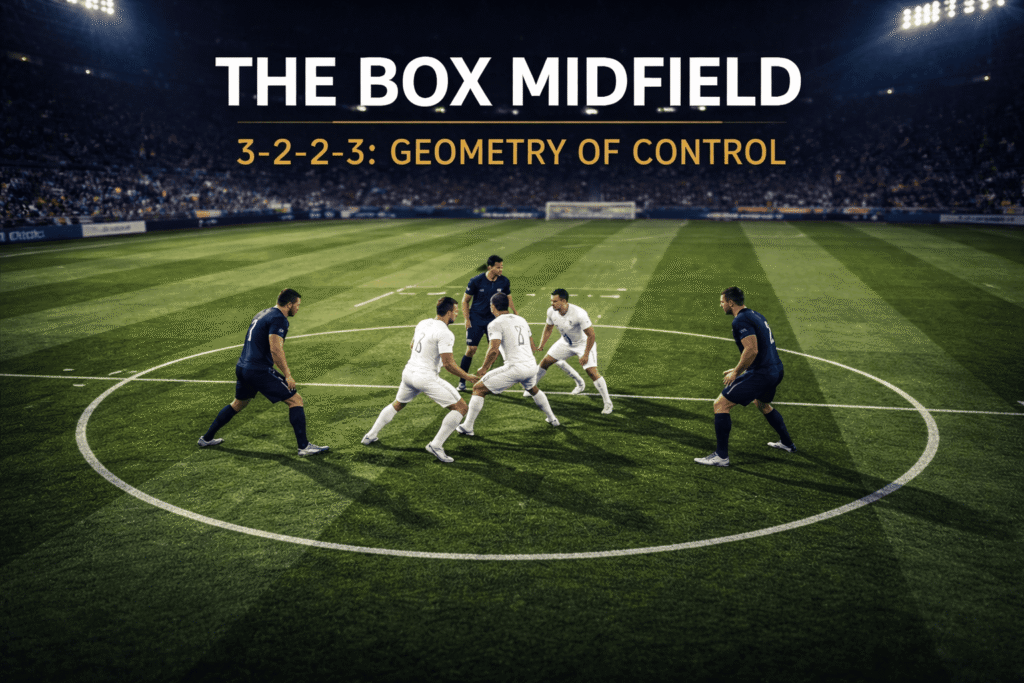
Box Midfield Tactics (3-2-2-3)
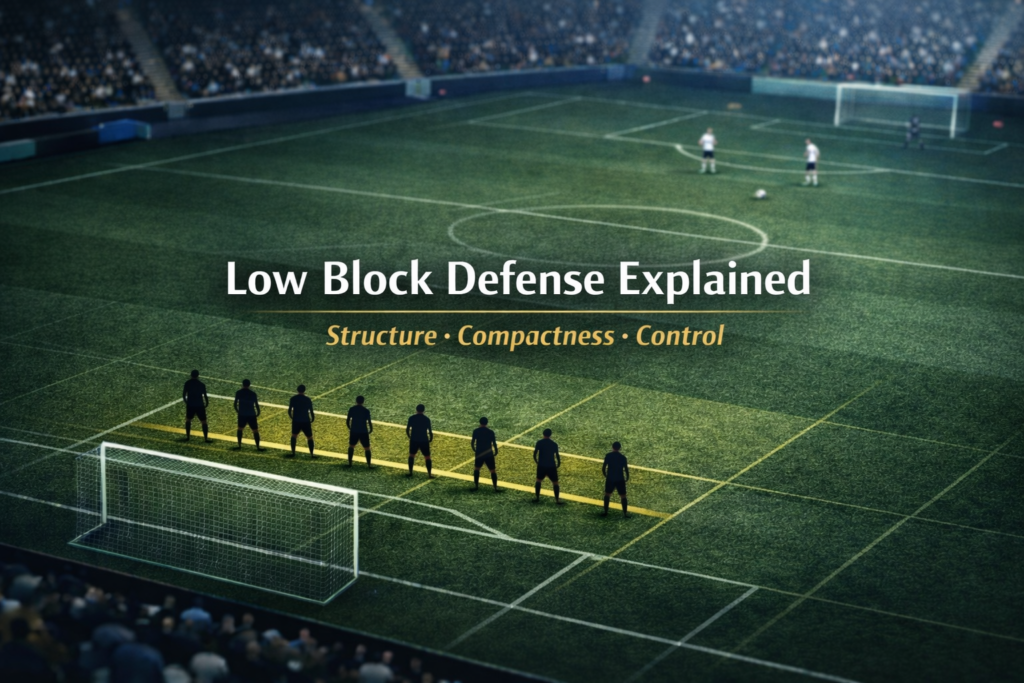
Low Block Defense Explained
Speak the language of the game
Get the free 47-term tactical glossary. Gegenpress, half-space, xT, low block, each defined in plain language and linked to a full breakdown. It is yours for an email.
Frequently Asked Questions (FAQs)
Is Rest Defense the same as parking the bus?
No. Parking the bus is a deep defensive block used when the opponent has the ball. Rest Defense is a structure used when your team has the ball to prevent counter-attacks.
Which Rest Defense structure is better for amateur teams?
The 2-3 structure is generally easier to teach amateur teams. It provides a clear central block and allows fullbacks to invert naturally without requiring the complex rotations of a 3-2 system
Can you play Rest Defense with a back four?
Yes, but one player usually joins the attack. Typically, one fullback overlaps (attacks), while the other fullback tucks in to form a back three with the center-backs. This creates a temporary 3-player Rest Defense line.