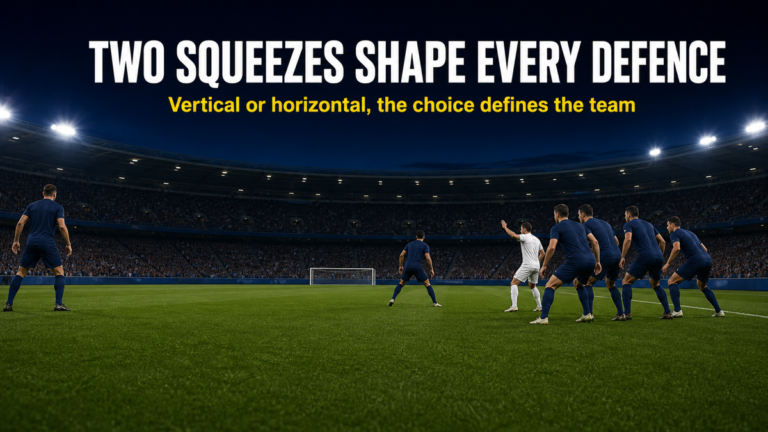

Last updated: September 19, 2026
Elite players only touch the ball for 3–4 minutes per 90-minute match. What separates champions from relegated sides is what they do in the other 86 minutes – and it starts with defending without the ball.
But at the elite level – the level where trophies are lifted and legends are made – football is actually a game of space, not just possession. The harsh reality is that in a 90-minute match, even the best players in the world, like Kevin De Bruyne or Lionel Messi, only have the ball at their feet for about three to four minutes.
So, the golden question is: What are they doing for the other 86 minutes?
To defend without the ball is not an act of passivity; it is an act of control. It is about manipulating your opponent into areas where they are weak, forcing errors through psychological pressure, and conserving energy for the transition. We have already explored the aggressive mechanics of the High Press vs Mid-Block and the resilient structure of the Low Block Defense Explained. Now, we must stitch these concepts together to understand the holistic philosophy of elite defensive movement.
In this deep dive, we will explore the nuances of shape, shadow play, and mental discipline that separate the champions from the relegated.
Key Takeaways
- Positioning over Possession: Elite defending is about occupying the right space to make the opponent’s pass impossible, rather than just tackling.
- The Chain Mechanism: When one defender moves, the entire unit must slide in unison to maintain compactness.
- Rest Defense: The best teams prepare to defend without the ball while they are still attacking.
- Triggers: Teams utilize specific cues, such as a bad touch or a backward pass, to initiate pressure.
- Mental Endurance: Defending is 90% concentration; a single momentary lapse can ruin 89 minutes of perfect work.
Table of Contents
The Philosophy of “Rest Defense”
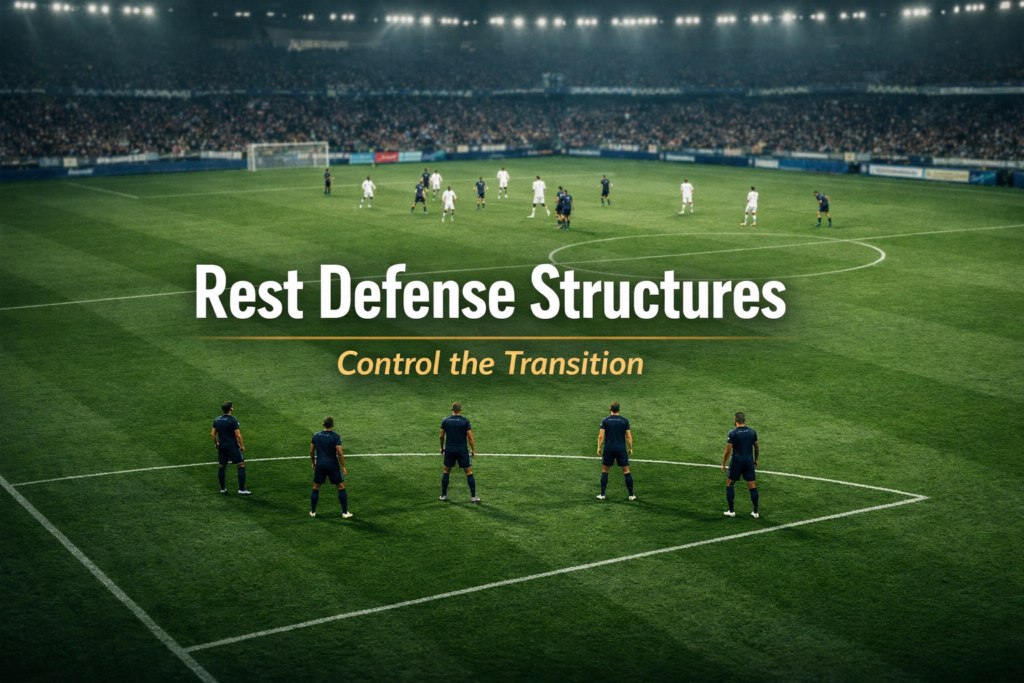
If you want to understand how to defend without the ball, you must first look at what a team does when they have the ball. This sounds contradictory, but it is the foundation of modern tactics, often referred to by the German term Restverteidigung (Rest Defense).
When a team like Manchester City is pinning an opponent in their own box, you will notice that their center-backs and perhaps one inverted fullback – a concept we detailed in Inverted Fullbacks Explained – are not watching the shot. They are positioning themselves in a rigid structure around the center circle.
They are preparing for the turnover before it happens.
To defend without the ball effectively, elite teams ensure that if a pass goes astray, they are instantly in a position to:
- Counter-press immediately: Suffocating the opponent before they can look up.
- Delay the counter-attack: Sometimes called a “tactical foul” or simply blocking the forward running lane.
If your Rest Defense is poor, you are gambling. If it is elite, you are controlling the game even when your striker misses a sitter.
Manipulating Space: The Art of Shadow Cover
In the old days, we taught “man-marking.” If the #10 went to the bathroom, the defensive midfielder followed him. Today, elite teams defend without the ball using “Cover Shadows” (or Deckungsschatten).
This is a geometric concept. A midfielder does not need to be physically touching an opponent to mark them. They simply need to stand in the direct line between the ball carrier and the intended receiver. By positioning themselves correctly, they cast a “shadow” over the opponent behind them.
Why is this superior?
- Efficiency: One player can screen a pass to a striker while simultaneously pressing the ball carrier.
- Trap Setting: You can leave an opponent slightly open to tempt a pass, then close the “shadow” as the ball leaves the passer’s foot.
When you watch Sergio Busquets or Rodri play, notice how rarely they sprint. They simply adjust their angle by two steps left or right. That subtle movement cuts off the passing lane, forcing the opponent to play a risky ball or pass backward. This is the epitome of how to defend without the ball intelligently.
Vertical and Horizontal Compactness
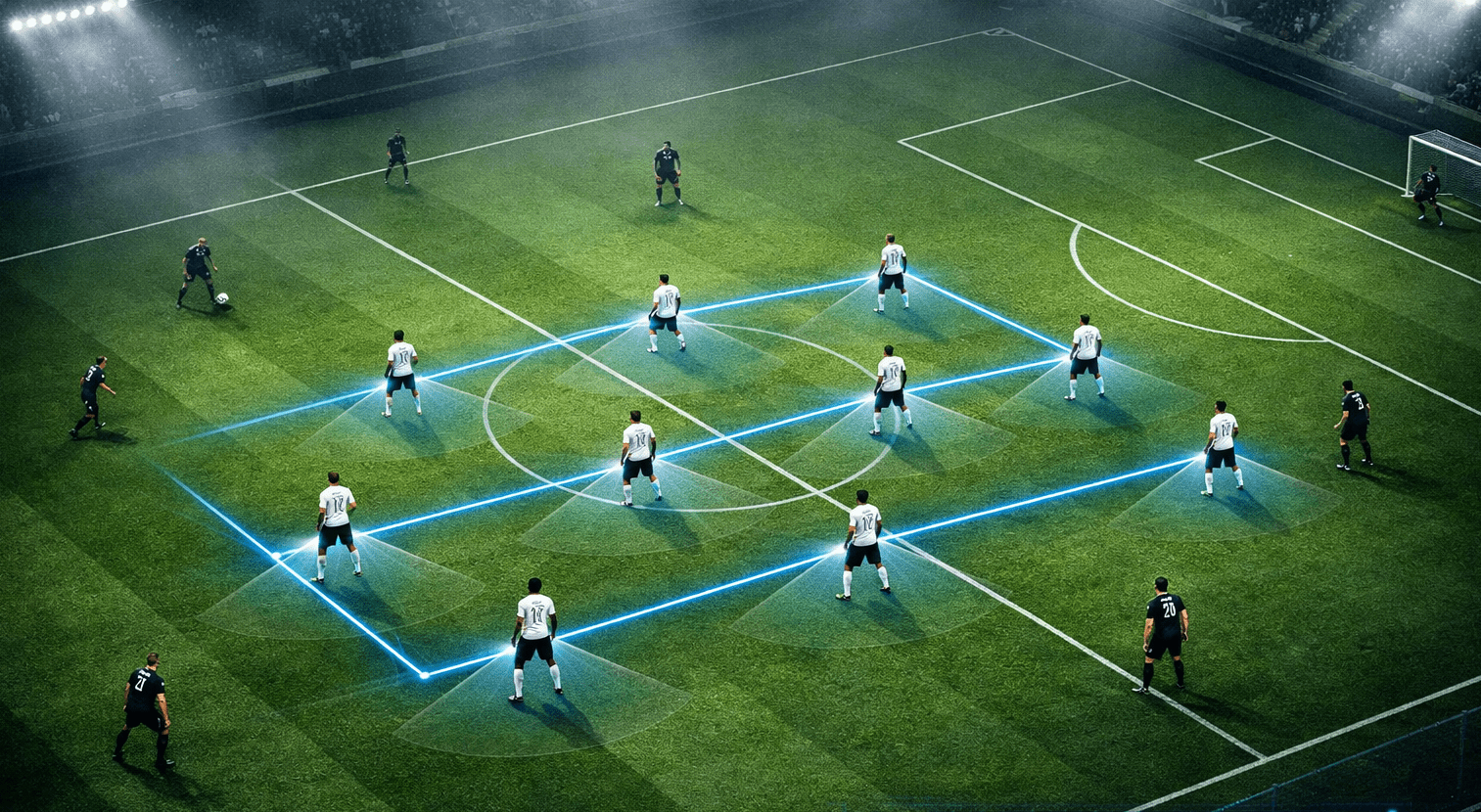
You will hear pundits scream about “staying compact,” but let’s break down what that technically means in a tactical blueprint.
Vertical Compactness
This refers to the distance between your deepest defender (usually a center-back) and your highest attacker. In a disciplined block, this distance should ideally be no more than 25 to 30 meters. By squeezing the pitch, you deny the opponent the ability to “play between the lines.” If this gap stretches, creative players like Kevin De Bruyne will destroy you.
Horizontal Compactness
This is the width of your team. When the ball is on the left touchline, your right winger should be tucked inside, almost in line with the far goal post. The objective is to make the pitch feel incredibly small for the team in possession.
When teams fail to defend without the ball, it is usually because this grid is broken. A defender steps up too late, or a winger stays too wide, creating a “pocket” of space. Elite teams move as if connected by an invisible rope.
The Defensive Slide and Shuttle
Building on compactness, the movement of the block is crucial. We call this “shuttling” or “sliding.”
Imagine a Foosball table. When you push the handle, all the players on that rod move together. A football team must act similarly.
- Ball moves Left: The Right Back tucks in to become a center-back; the Left Back engages the winger; the Midfield shifts left.
- Ball Switches: The team must sprint across to the other side while the ball is traveling in the air.
The time the ball is in the air during a switch of play is the only time the defense can relax slightly and reorganize. If the team is lazy in shifting, the opponent will find an overload on the far side. We discuss how attackers exploit this in Overloads & Isolations Explained, so as a defender, your job is to prevent that isolation from occurring.
How to Maintain Defensive Shape Without the Ball
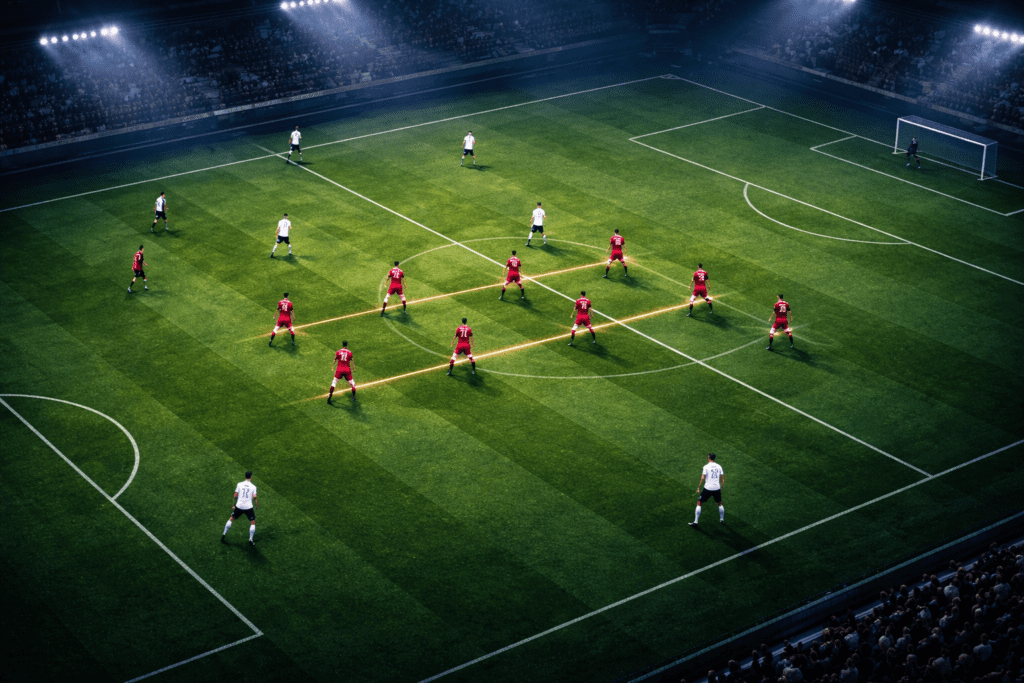
Defensive shape refers to the geometric structure – typically a 4-4-2 or 4-5-1 block – that a team holds when the opponent possesses the ball. Maintaining this shape requires constant communication, peripheral awareness, and disciplined spacing of 8–12 meters between each horizontal line. When one player breaks shape to press, the entire unit must compensate through coordinated sliding. Elite managers drill this through shadow play: the team shifts in unison against no opposition until the spacing becomes automatic muscle memory.
Pressing Triggers: When to Break Shape
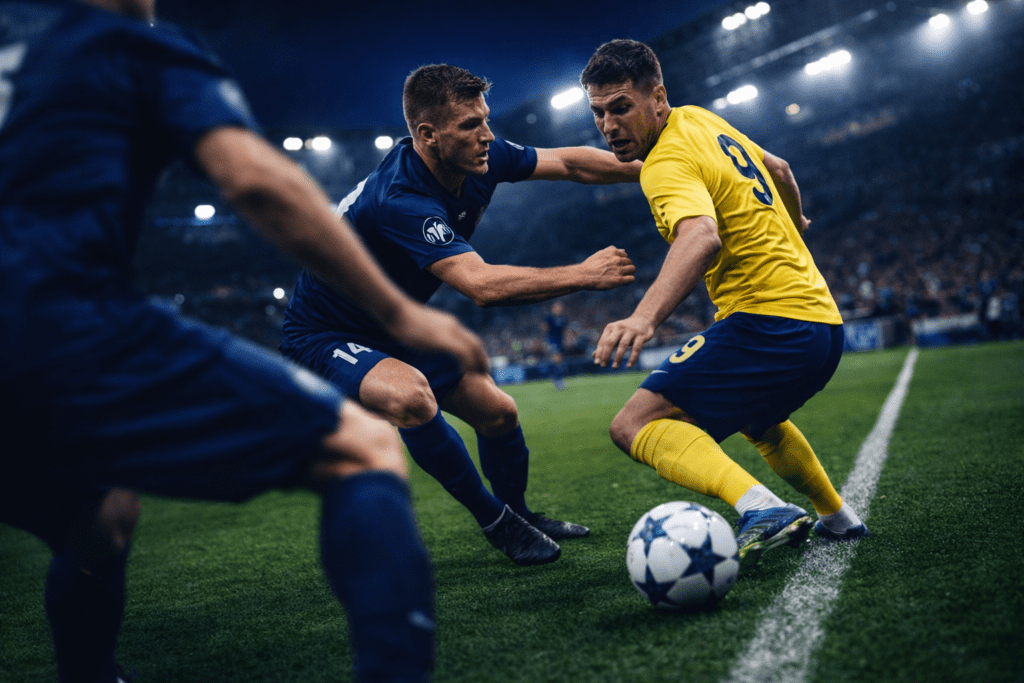
A team cannot just sit in a shape for 90 minutes; they will eventually concede. They must choose moments to attack the ball. These moments are called “Pressing Triggers.“
To defend without the ball proactively, players look for specific cues:
- The Touchline Trap: The sideline is the best defender in the world. It never misses a tackle. When the ball goes to a fullback on the line, the defending team locks on, cutting off all inland passing angles.
- Bad Body Shape: If an opponent receives the ball facing their own goal, they cannot see the pressure coming. This is a green light to press hard.
- The Bouncing Ball: A ball in the air is hard to control. Defenders should close distance while the ball is flighted.
- The Backward Pass: As discussed in Counter-Pressing Explained, a backward pass is a signal for the defensive line to push up and regain territory.
Comparative Analysis: Football Defensive Structures
Different managers utilize different structures to defend without the ball. Here is how the top elite approaches compare.
| Defensive Structure | Primary Focus | Key Mechanism | Best For |
| High Press (4-3-3) | Turnover Generation | Man-to-man matching in high areas | Athletic teams needing quick goals |
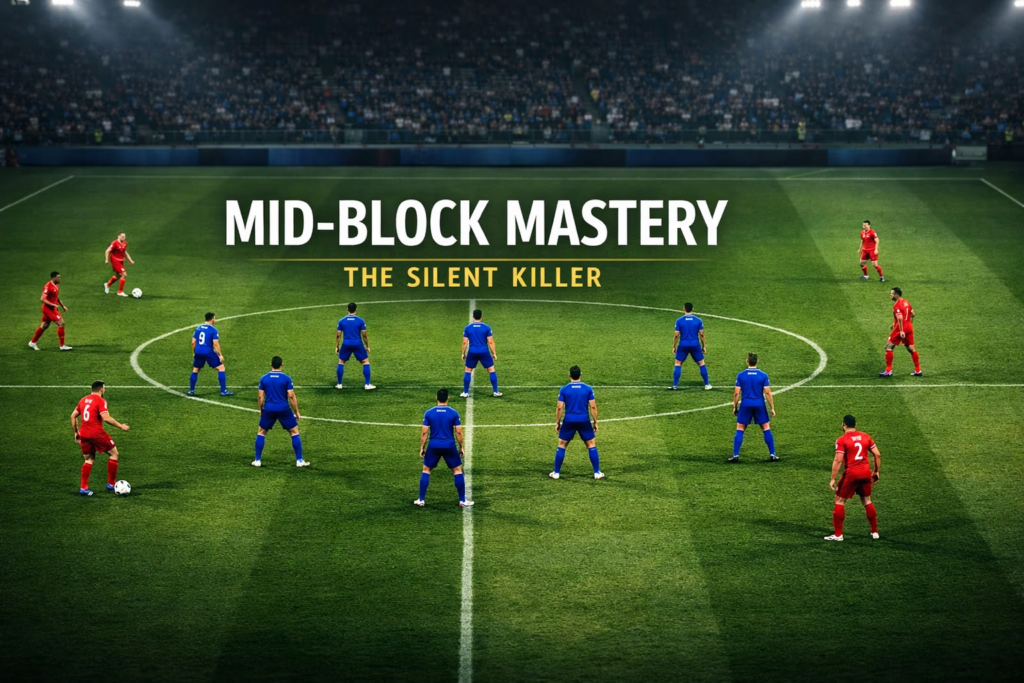
| Mid-Block (4-4-2) | Space Restriction | Shadow cover and sliding | Controlling tempo against strong teams |
| Low Block (5-3-2) | Area Protection | Denying space in behind | Underdogs or preserving leads |
| Box Midfield Press | Central Control | trapping opponents out wide | Teams facing elite passers |
Psychological Warfare: Patience as a Weapon
This is the aspect that stats like PPDA Explained often miss. The mental toll of defending.
To defend without the ball requires an immense amount of patience. Modern elite teams like Arsenal or Inter Milan are comfortable letting the opponent have the ball in “harmless” areas (usually their own defense). They do not bite. They do not lunge.
They wait.
This passivity is a trap. It frustrates the opponent. The attacking team starts to think, “Why aren’t they pressing us?” They get bored. They try a risky pass through the middle just to make something happen. That is exactly what the defense wants.
I always tell my players: “Let them have the ball, but do not let them have the space.” If you can frustrate an opponent into forcing a pass, you have won the psychological battle.
Real-World Case Study: Arsenal’s Defensive Structure (2023-24 Season)
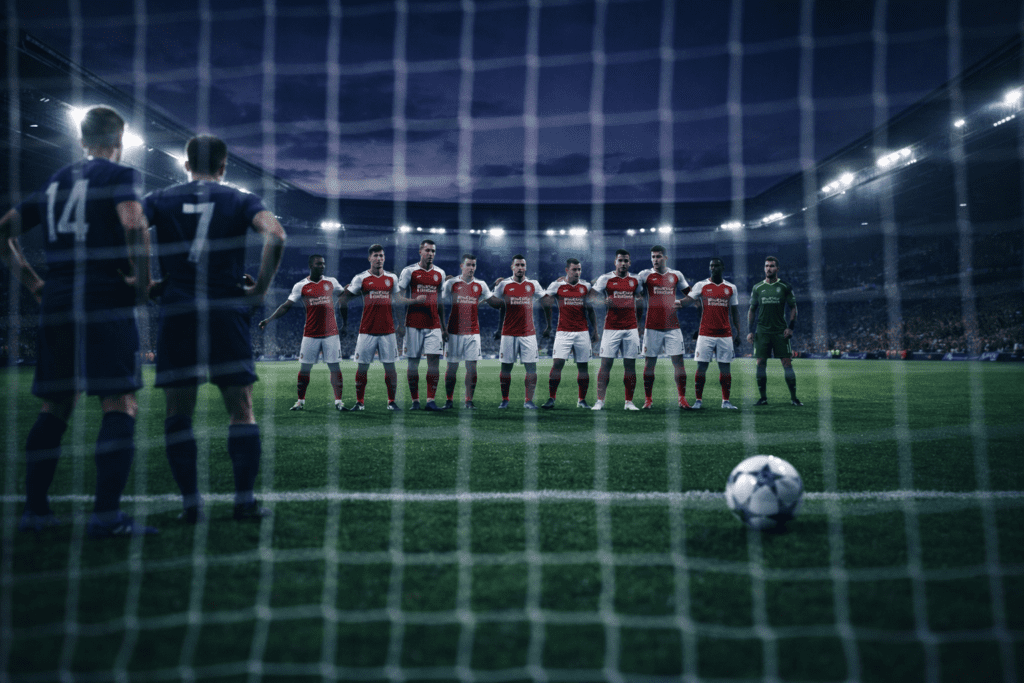
Under Mikel Arteta, Arsenal transformed into one of the best defensive units in Europe. Their ability to defend without the ball was built on a hybrid system.
Arsenal finished second in the 2023–24 Premier League season – but their defensive record was the most tactically sophisticated in the division.
- The Saliba-Gabriel Axis: Their center-backs were comfortable defending 1v1 with huge amounts of space behind them, allowing the rest of the team to push high.
- Odegaard’s Leading Press: The captain often initiated the press in a 4-4-2 shape, curving his run to cut off one side of the pitch.
- The Result: By cutting the pitch in half, Arsenal forced teams to play long balls, which their dominant center-backs would easily clean up.
This wasn’t just about tackles; it was about structure. They minimized their xG against (see What Is xG? ) not by goalkeeping heroics, but by preventing shots from ever happening.
The Bigger Picture
The glamour of football will always be the goals, the skills, and the celebrations. But for those of us who study the blueprint of the game, there is a distinct beauty in a perfectly organized 4-4-2 shifting in unison.
To defend without the ball is the ultimate sign of a disciplined team. It requires selflessness. It requires a striker to track back 40 yards. It requires a winger to tuck inside when they want to be hugging the touchline.
As we continue through the KharaSportsDaily Blueprint, remember that while your formation (like The Box Midfield (3-2-2-3) ) dictates how you play with the ball, your defensive structure dictates whether you survive long enough to use it.
What do you think?
Which part of defending without the ball do you find hardest to coach – maintaining shape during a switch of play, or keeping concentration when the opponent is just passing it around the back? Drop your take below.
Want to read any match like this?
The framework behind these breakdowns, in one place. The four phases, a 15-minute method for diagnosing both teams before the drinks break, a printable match-watching worksheet, and 51 terms defined. 40 pages.
Get the pack$9, instant downloadRelated Tactical Breakdowns
Defending without the ball only works when your team understands what happens the moment possession is won – this is how elite sides flip from defensive shape football into attack instantly.
Rest Defense Football Tactics Explained
Mid-Block Pressing Explained
Speak the language of the game
Get the free 47-term tactical glossary. Gegenpress, half-space, xT, low block, each defined in plain language and linked to a full breakdown. It is yours for an email.
Frequently Asked Questions (FAQs)
How do I teach youth players to how to defend without the ball?
Start with “handball” games. Remove the technical difficulty of dribbling. Have one team throw the ball to keep possession, and the other team must shift in a block to intercept. This teaches shape and shuffling without the distraction of tackling.
Is it better to defend wide or narrow?
Almost always narrow. The goal is in the middle of the pitch. You want to force opponents wide where their shooting angle is worse. Elite teams defend without the ball by protecting the “Golden Zone” (the width of the penalty box).
How does fitness impact the ability to defend without the ball?
It is crucial. While you aren’t sprinting constantly, the constant shuffling, checking shoulders, and explosive bursts to close down triggers deplete energy reserves quickly. A tired brain makes defensive errors
What happens if the press is broken?
This is where “Recovery Runs” come in. If the first line of defense is beaten, midfielders must sprint towards their own goal (not to the ball) to clog the central channel.
About the Author
Football Tactician & Analyst. breaking down elite systems for coaches and fans.