
Introduction: The Soul of the Number 9
In my experience of tracking the tactical shifts of European football—from the mud-soaked pitches of the English lower leagues to the pristine, manicured lawns of the Champions League final—I’ve seen the “Number 9” die and be reborn a dozen times. We are often told that football is a simple game, but the war for space in the final third is anything but simple. It is a chess match played at 20 miles per hour.
When we sit down to analyze False 9 vs Target Man, we aren’t just comparing two player profiles; we are comparing two distinct philosophies of warfare. One relies on the broadsword—blunt force, physical domination, and holding ground. The other relies on the dagger—stealth, misdirection, and striking from the shadows.
I remember watching the shift happen in real-time. I recall the era when the big man up top was a non-negotiable asset. If you didn’t have a 6-foot-2 battering ram, you weren’t serious about scoring goals. Then came the Pep Guardiola revolution, the Messi era, and suddenly, the striker wasn’t there anymore. The space was empty. The center-backs had nobody to mark. It was tactical anarchy.
Yet, despite the rise of the “ghost” striker, the traditional target man refused to go quietly into the night. This article is my love letter to that tactical tension. We are going to dissect the False 9 vs Target Man debate, not with spreadsheets, but with the eye of someone who has watched the game evolve from the stands and the dugout.
ead our analysis on The Evolution of the 4-3-3
Key Takeaways
- Opposing Philosophies: The False 9 vs Target Man debate is about Space vs. Contact. One creates space by leaving it; the other creates space by dominating it.
- Defensive Reaction: Target Men pin defenders back; False 9s drag defenders out.
- Wingers are Key: Target Men need crossers; False 9s need runners.
- Evolution: The modern elite striker (Kane, Benzema) often combines traits of both, making the strict distinction less clear at the highest level.
- Situational Use: The Target Man remains the ultimate “Plan B” for breaking down stubborn defenses or chasing late goals.
Enjoying the analysis?
Don’t Just Watch Football. Understand It.
Join KharaSportsDaily and receive occasional deep tactical insights most fans miss.
Occasional analysis. No match reports. No noise.
Table of Contents
Defining the Target Man: The Physical Anchor
To understand the False 9 vs Target Man dynamic, we must first pay respect to the elder statesman of the two: the Target Man.
In the modern game, “Target Man” is often used as a slur by tactical hipsters. They equate it with “hoof-ball” or a lack of technical ability. This is a gross misunderstanding of the role. A true Target Man is not just a tall player; they are the team’s oxygen outlet. When the midfield is suffocated by a high press, the Target Man provides the “out ball.”
The Wall
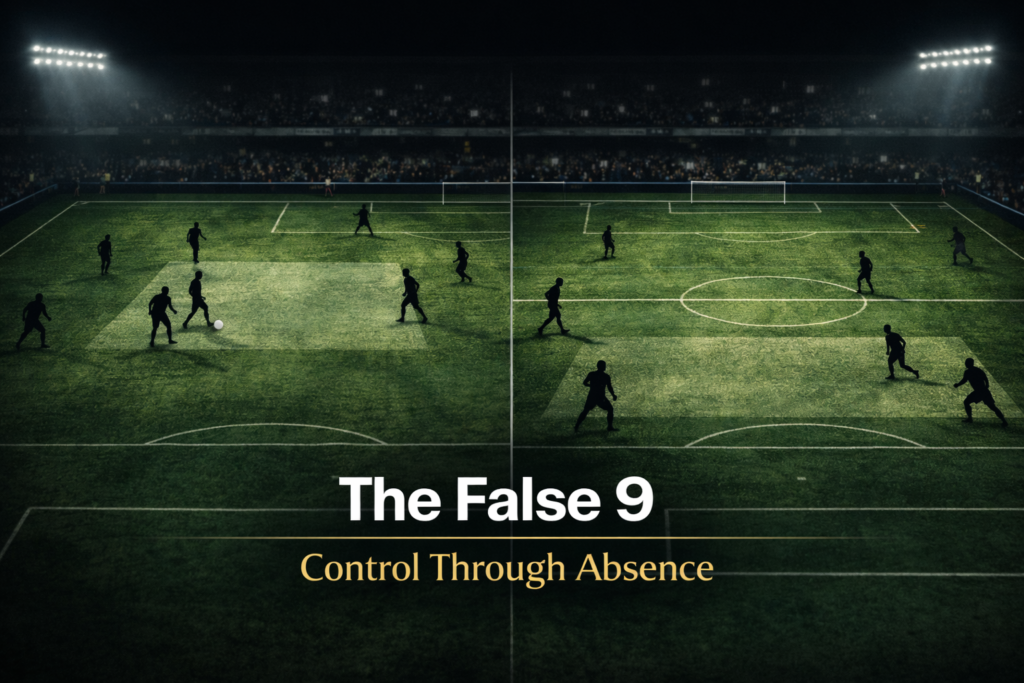
I often tell young analysts to watch Olivier Giroud. He is the archetype. He isn’t fast. He isn’t going to dribble past three players. But play the ball into his chest, and it sticks like glue. The Target Man acts as a wall against which the rest of the team can bounce passes. He pins the opposition center-backs back, forcing them into a physical wrestling match they cannot afford to lose.
This physical pinning is crucial. By occupying the two center-backs, the Target Man creates pockets of space behind him for wingers or attacking midfielders to run into. In a False 9 vs Target Man comparison, this is the primary differentiator: the Target Man craves contact. He wants the defender on his back. He wants to feel the pressure so he can roll his man or lay the ball off to an onrushing midfielder.
The Aerial Threat
We cannot ignore the vertical dimension. The Target Man forces the opposition to defend the entire box, specifically the air. If you are playing against a low block (a defense sitting deep), intricate passing often fails. Sometimes, you need the blunt instrument. You need a cross into the box and a header won through sheer willpower. This creates chaos, second balls, and ugly goals. And in my experience, ugly goals count just the same as the beautiful ones.
The False 9: Architecture of Deception
If the Target Man is the anvil, the False 9 is the smoke.
The concept of the False 9 isn’t new (the Austrians and Hungarians toyed with it in the 1930s and 50s), but its modern incarnation is the most disruptive tactical innovation of the last 15 years. The False 9 vs Target Man debate exists because the False 9 breaks the fundamental rule of being a striker: stay up top.
The Vacated Space
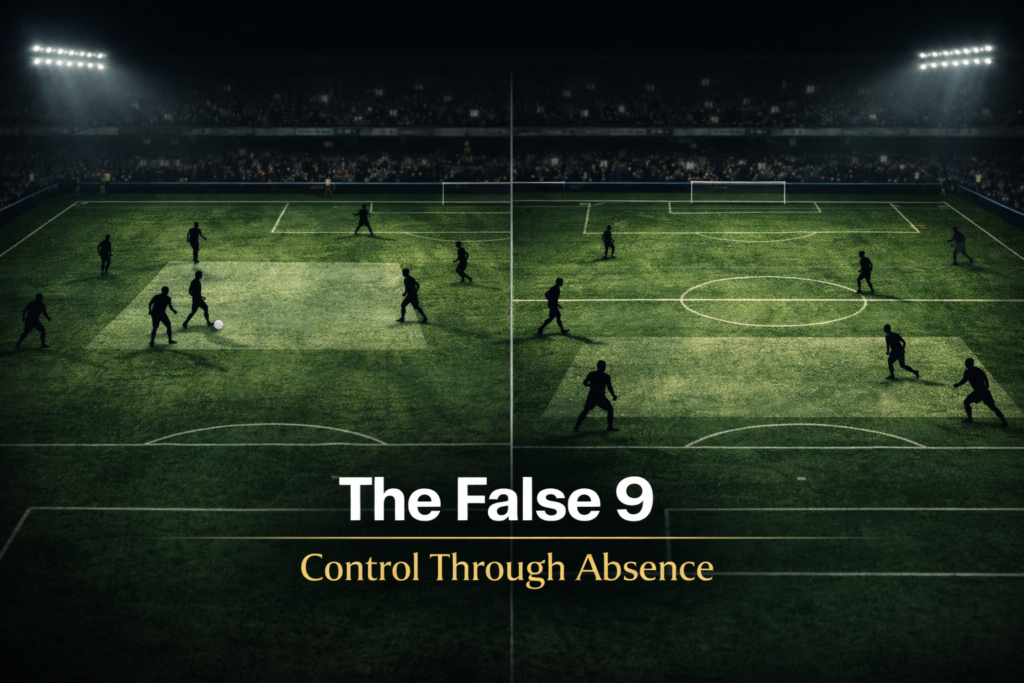
The False 9 starts in the striker position but drops deep into the midfield “hole” (the space between the opposition midfield and defense). This creates a nightmare scenario for the opposition center-backs.
I’ve watched world-class defenders like Sergio Ramos and Giorgio Chiellini look visibly confused when facing a False 9. They have a choice:
- Follow the striker: If the center-back follows the False 9 into midfield, he leaves a massive gap in the defense for wingers (like Salah or Mane) to sprint into.
- Stay put: If the center-back stays in his line, the False 9 turns and runs at the defense with momentum, creating a numerical overload in midfield (usually 4 vs 3).
The Midfield Overload
When we analyze False 9 vs Target Man, the False 9 wins on control. By dropping deep, they essentially become an extra midfielder. This allows the team to dominate possession. Think of Lionel Messi at Barcelona or Roberto Firmino at Liverpool. Firmino didn’t score 30 goals a season, but his movement unlocked everything for Salah and Mane. He was the system.
The False 9 requires a high football IQ. It is not about brute strength; it is about timing. It is about knowing when to drop and when to arrive in the box.
Must Read: Coache’s Voice False 9
Direct Comparison: Power vs. Space
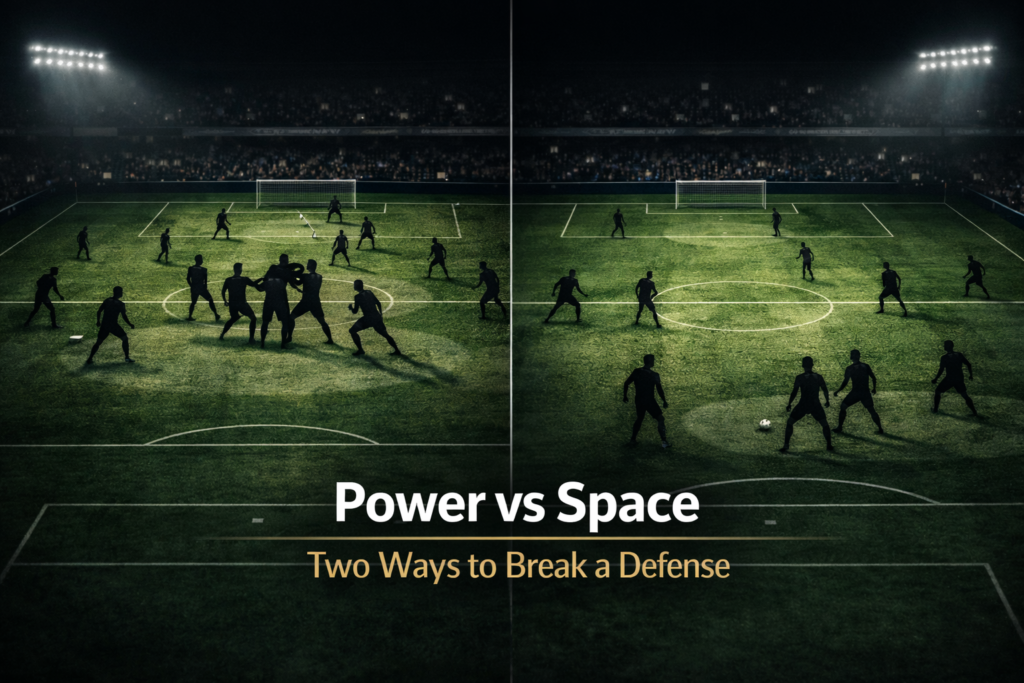
To make this False 9 vs Target Man discussion concrete, let’s look at the direct attributes. I’ve broken this down into a “Tale of the Tape” to highlight where the friction points lie.
| Feature | Target Man | False 9 |
| Primary Zone | The Penalty Box & Opposition Defensive Line | The “Hole” (Zone 14) & Half-Spaces |
| Physicality | High Strength, Height, Aerial Ability | Agility, Balance, Low Center of Gravity |
| Defender Interaction | Engages contact; pins defenders physically | Avoids contact; drags defenders out of position |
| Key Skillset | Heading, Shielding, Lay-offs, Finishing | Dribbling, Through-balls, Vision, Link-up |
| Tactical Goal | Create depth and win aerial duels | Create midfield overloads and exploit gaps |
| Best Wingers | Creators who cross the ball | Goal-scorers who run in behind |
| Archetypes | Olivier Giroud, Edin Dzeko, Didier Drogba | Lionel Messi, Roberto Firmino, Francesco Totti |
The starkest contrast in the False 9 vs Target Man battle is how they treat the opposition center-backs. The Target Man wants to be their nightmare; the False 9 wants to be a ghost they can’t touch.
The Tactical Evolution: Why Both Still Matter
You might think, based on the hype around modern tactics, that the False 9 has won the war. That the Target Man is a dinosaur. You would be wrong.
In the last three seasons, we have seen a resurgence of the “Number 9,” but with a twist. The False 9 vs Target Man debate has actually merged into a hybrid role.

The Modern Hybrid
Look at Erling Haaland or Harry Kane. Harry Kane, in particular, is the perfect synthesis. He has the body of a Target Man—he can win headers, shield the ball, and fight center-backs. But watch him play for England or Tottenham (formerly). He drops deep like a False 9, spraying passes out wide before arriving late in the box.
This evolution suggests that the False 9 vs Target Man binary is dissolving. The best modern strikers must do both. They must be strong enough to hold the ball (Target Man) but intelligent enough to vacate the space when the game is congested (False 9).
However, pure specialists still exist. When a team is chasing a game with 10 minutes left, they don’t bring on a False 9; they bring on a giant Target Man to cause havoc in the box. Conversely, when a team wants to control a game against a low block, the False 9 remains the superior tool to break the lock.
System Requirements: Building Around the Role
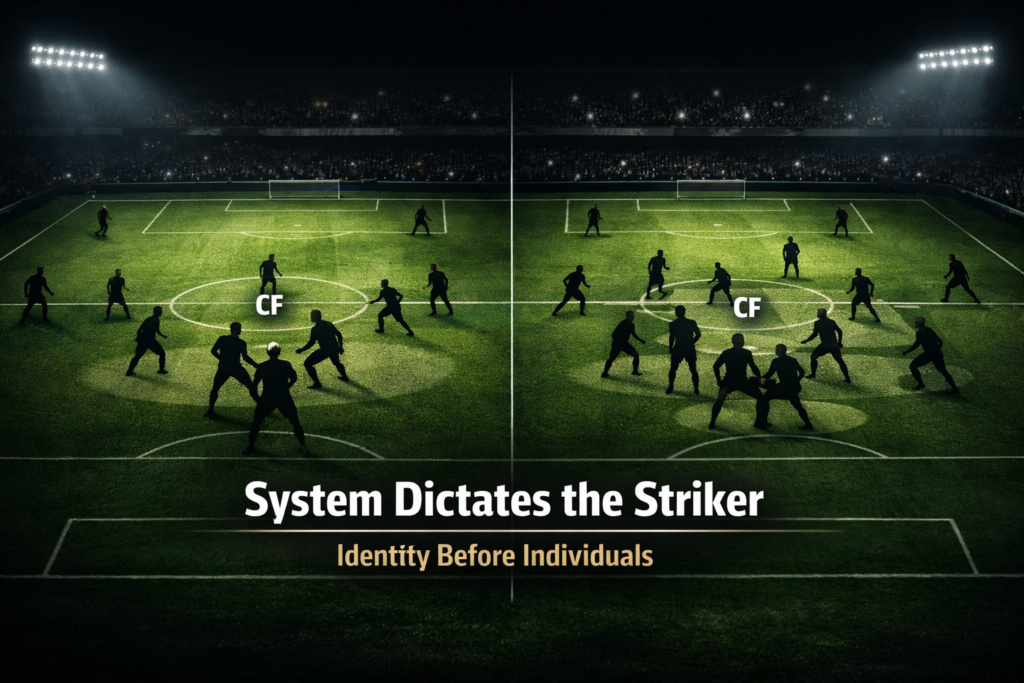
You cannot simply plug a player into a system and hope for the best. The False 9 vs Target Man decision dictates your entire team structure.
If You Choose a Target Man…
You need service. A Target Man is useless if he is isolated.
- Wingers: You need traditional wingers or full-backs who can cross the ball accurately.
- Midfield: You need runners who will go beyond the striker to pick up the knock-downs.
- Tempo: You can play more direct. Long balls are a valid strategy, not a sign of desperation.
If You Choose a False 9…
You need movement. A False 9 dropping deep is pointless if nobody runs into the space he creates.
- Wingers: You need “Inside Forwards” (Goal-scoring wingers). Think Son Heung-min or Mo Salah. They must be the primary goal threats.
- Midfield: You need technicians who can play quick, one-touch wall passes to exploit the overload.
- Tempo: Requires patience. You are looking for the perfect opening, not the quick cross.
The False 9 vs Target Man choice is essentially a choice of identity. Do you want to batter the door down, or do you want to pick the lock?
Final Thoughts
I have spent decades watching this beautiful game, and if there is one thing I have learned, it is that tactical trends are cyclical. The False 9 vs Target Man argument isn’t about one being “better” than the other. It is about the right tool for the right job.
There is a visceral joy in watching a Target Man bully a defender, chest the ball, and volley it home. It connects to the primal roots of the sport. Yet, there is an intellectual beauty in watching a False 9 manipulate an entire defense without touching the ball, creating passing lanes that didn’t exist seconds before.
As you build your tactical knowledge or your own team, don’t ask which is better. Ask yourself: Where do I want the space to be? Do you want it in front of the defense (False 9) or behind it (Target Man) and that is where this breakdown of False 9 vs Target Man will help you?
The answer to that question will decide who wears the Number 9 shirt for you.
Enjoyed this breakdown?
Don’t Just Watch Football. Understand It.
Join KharaSportsDaily and receive occasional deep tactical insights most fans miss.
Occasional analysis. No match reports. No noise.
Frequently Asked Questions (FAQs)
Is the Target Man role dead in modern football?
Absolutely not. While the pure “big man” is rarer at elite clubs, the role has evolved. Modern Target Men like Haaland or Osimhen combine physical dominance with speed. The tactical need for an aerial outlet and a physical presence to pin defenders will never disappear from the game.
Can a small player be a Target Man?
It is difficult, but possible. “Target Man” refers to the function (holding up the ball), not just height. A player with incredible balance and strength (like Carlos Tevez or Sergio Aguero) could act as a target by shielding the ball, though they lack the aerial threat of a traditional target man.
Why do teams struggle to defend against a False 9?
The False 9 causes “cognitive load” issues for defenders. Center-backs are trained to mark a player. When that player leaves their zone, the defender has to make a split-second decision to follow or stay. If the team isn’t perfectly coordinated, this hesitation creates gaps. It breaks the defensive structure.
Who was the best False 9 of all time?
Lionel Messi under Pep Guardiola is widely considered the peak implementation of the role. However, Francesco Totti at Roma is often credited with popularizing the modern interpretation, proving that a playmaker could function as the primary goal threat.
False 9 vs Target Man: Which is better for youth development?
For youth players, playing as a False 9 encourages technical development, vision, and spatial awareness. However, playing as a Target Man teaches resilience, physical shielding, and playing with your back to goal. A complete education should include exposure to both roles.
About the Author
Football Tactician & Analyst. breaking down elite systems for coaches and fans.