
⚽ Football Insights & Latest Updates
Football Insights & Latest Updates delivers in-depth coverage of the global football circuit, from major domestic leagues to high-stakes international competitions. At KharaSportsDaily, we focus on explaining the game beyond the scoreline — offering tactical insight, match analysis, and player performance evaluation.
“New to football tactics?”
→ Explore the Complete Football Tactics Guide
Whether it’s strategic adjustments during a title run, key battles in knockout matches, or emerging players influencing results, our football coverage emphasizes clarity and context. We analyze how teams adapt, where momentum shifts, and why certain decisions change the course of matches.
Our aim is to provide football fans with accurate, thoughtfully written content that enhances understanding of the modern game. From match previews to analytical features, this page is designed as a reliable destination for football coverage — informed, structured, and crafted for true enthusiasts.
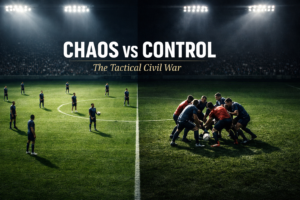
The Tactical Civil War: Relationism vs Positionism Analyzed
For fifteen years, we all spoke the same language. Juego de Posición. The pitch as a grid. Spacing as the weapon. Guardiola as the high priest, and the rest of football as eager deacons spreading the gospel.
It worked. It dominated. It became the only serious way to think about the game.
And then football, in its infinite stubbornness, started pushing back.
From the streets of South America and the pragmatic dugouts of Italy, a counter-philosophy has been gaining ground — one that treats the pitch not as a grid to be occupied, but as a canvas to be painted with movement. Relationism does not ask players to wait in their zones for the ball to arrive. It asks them to travel toward the ball, cluster around it, create overloads that no rigid structure can solve.
It looks like chaos. Against the right team, it plays like chess.
Guardiola’s City. Diniz’s Fluminense. Two philosophies. One pitch. The breakdown of what separates them – and what happens when coaches stop choosing between them – is now live.
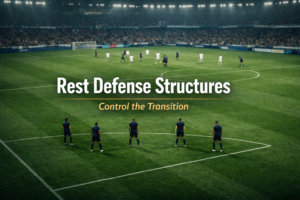
Elite Rest Defense Structures to Dominate Transitions
There is a question most coaches never ask. Not “how do we score?” Not even “how do we press?” But: what happens the moment we lose the ball?
Guardiola has an answer prepared before the game starts. It is built into every position, every rotation, every movement his players make while they are still in possession. The reason Manchester City can flood seven players forward without fear is not arrogance — it is architecture. While their attackers occupy the final third, a shadow structure exists behind the ball, invisible to the casual eye, designed to make counter-attacks impossible before they begin.
This is Rest Defense. Not a reaction. A prevention.
Most teams defend when they lose the ball. Elite teams are already defending while they still have it. The 3-2 structure, the inverted fullback as a tactical shield, the Rondo connection — these are not abstract concepts. They are the reason some teams concede three counter-attacks a season while others concede three a game.
The full breakdown is live. And once you see the geometry, you will never watch a team in possession the same way again.
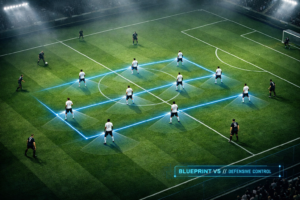
Masterclass Tactics on How Elite Teams Defend Without the Ball
The scoreline doesn’t tell the whole story. The shape does.
While the crowd screams attack, elite teams are calculating angles, compressing space, and setting psychological traps.
This isn’t reactive defending — it is defensive warfare.
This breakdown explores the 10 tactical principles that separate teams who chase the ball from those who control the game without ever touching it — from the geometry of Shadow Cover to the patience of Rest Defense and Arsenal’s defensive wall in 2023–24.
The best players in the world touch the ball for four minutes per match. What they do in the other 86 is what makes them elite.
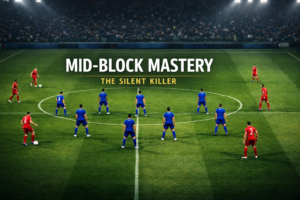
Tactical Secrets of Mid-Block Pressing That Win Games
We have been sold a lie about pressing.
Not about pressing itself — pressing works. Klopp proved it, Guardiola refined it, and a generation of coaches have built entire identities around the idea that the highest, most aggressive press is the purest expression of tactical intent. But somewhere along the way, the conversation became binary: press high, or sit deep and hope.
There is a third option. And the teams that have mastered it keep winning things that the high-pressing evangelists cannot explain.
Carlo Ancelotti’s Real Madrid. Deschamps’ France in 2018. Teams that look almost passive in possession phases, that concede territory willingly, that allow the opposition centre-backs to circulate the ball for 30 seconds without anyone closing them down. They are not defending. They are coiling.
The mid-block is not about sitting back. It is about controlling the space that actually matters — the zone between the lines, the central channels, the passing lanes that lead anywhere dangerous. Let them have the ball wide. Let them have it deep. But the moment they try to play through the center? The trap snaps shut.
Patience. Geometry. And the psychological discipline to do nothing until the exact right moment. This is the full breakdown of the most misunderstood defensive system in modern football.
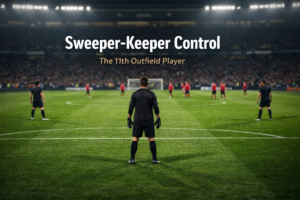
Elite Sweeper-Keeper Tactics That Dominate Modern Football
In the 1990s, the goalkeeper had one job. Stay between the posts. Do not wander. The moment you left your line, you were a liability.
That goalkeeper is extinct.
What Manuel Neuer started and Ederson perfected is not just a stylistic preference. It is a structural revolution. When a goalkeeper steps up to the edge of their area — or beyond it — they compress the space available to opposition forwards, allow the defensive line to push 10 yards higher, and create something no coach in the 1990s would have thought possible: a goalkeeper as the eleventh outfield player.
The mathematics of it are compelling. Opposition teams press 10 outfield players. They rarely assign a presser to the goalkeeper. Which means a sweeper-keeper is always the free man — the +1 that no high press is designed to account for. Ederson at his peak was not just a shot-stopper with good feet. He was the first pass of virtually every Man City attack, the player who broke the press before it could form.
But the margin for error is absolute zero. One misjudgment 40 yards from goal, and it ends in the net. This is the full breakdown of the role — the brilliance, the risk, and why modern football cannot function at elite level without it.

Deadly Ways Football Overloads and Isolations Destroy Defenses
If you are playing fair, you are doing it wrong.
That sounds cynical. In football, it is simply the truth. The entire architecture of modern attacking play is built around one goal: create a situation where your player faces a weaker opponent in a space they can exploit, and then make sure that situation happens over and over until the defense breaks.
The overload and the isolation are two sides of the same coin. You pull the blanket left — three attackers flooding one flank, dragging the opposition’s shape with them — and the right side opens up. Your best dribbler, alone, against one exhausted fullback. No help coming. The crowd already knows what is about to happen.
What makes this so difficult to defend is not the individual quality involved. It is the sequence. The overload does not just create a chance; it forces a defensive decision. And once you understand which decision the opposition is most likely to make, you already know where the space will appear.
Manchester City do not create overloads by accident. They build them pass by pass, movement by movement, until the defense has committed in exactly the wrong direction. This is the breakdown of how they do it — and how any team, at any level, can start applying the same principles.