


Last updated: September 19, 2026
In the 2002–03 Serie A season, Andrea Pirlo led the entire league in four statistical categories: passes played (2,589), ball possession time, successful balls, and successful passes. He averaged nearly 90 passes per game. AC Milan won the Champions League that year, and Pirlo wasn’t even the headline name – Shevchenko was. But remove Pirlo from that side and the whole machine seizes. That’s the paradox of the regista football: the player who touches the ball more than anyone is somehow the last one the crowd talks about.
In simple terms: A regista football is a deep-lying playmaker – a midfielder who sits just in front of the defensive line, receives the ball in tight spaces, and dictates the tempo and direction of an entire team’s build-up play.
Understanding regista football starts with one paradox: the player who touches the ball more than anyone else on the pitch is often the last name on the team sheet anyone discusses.
The role has roots in Italian football’s tactical culture, and the word itself – Italian for “director” – tells you everything about the function. This article breaks down exactly what a regista does, why the role has evolved dramatically over the last two decades, and where it can still be tactically exploited. For more on how possession and build-up shape modern systems, visit our Football Tactics hub.
This article breaks down exactly what regista football demands, why the role has evolved dramatically over two decades, and where it can still be tactically exploited.
Key Takeaways
- Pirlo Set the Template: Averaging nearly 90 passes per game at AC Milan in 2002–03, Pirlo’s sequence data showed his xG build-up contribution was more than double the average defensive midfielder of his era – according to Opta/Stats Perform analysis.
- The Role Has Evolved: The classic regista needed a “destroyer” partner (Gattuso at Milan, Khedira at Real Madrid) to compensate for defensive limitations. Rodri’s profile demands those qualities in a single player.
- Metrics That Matter: Progressive passes per 90, pass value (probability of scoring uplift), and press-resistance rate are the three numbers that separate a true regista from a possession-recycler.
- The Vulnerability Is Real: Teams who press aggressively around the regista’s reception zone – particularly in a 4-4-2 mid-block – can neutralise the role’s impact before it begins.
- Busquets Defined a Generation: Sergio Busquets, who retired in December 2025 after winning the MLS Cup with Inter Miami, proved that a regista could operate without Hollywood passes – his value was in what he prevented as much as what he created.
Table of Contents
What Is Regista Football?
The regista sits in the no.6 position – in front of the defence, below the midfield – but unlike a standard defensive midfielder, the remit is creative, not destructive. Think of the difference this way: Gennaro Gattuso protected Pirlo. Pirlo directed Gattuso. One broke the game up; the other built it. Both were necessary, but only one held the blueprint.
Tactically, the regista operates as the primary receiver from the centre-backs or goalkeeper, offering a reliable pass option under pressure before distributing forward. The distribution doesn’t have to be spectacular – the key is decisiveness. A regista who takes an extra touch in a congested central zone is a regista who has already lost his advantage.
What separates the role conceptually from a standard pivot or box-to-box midfielder is spatial intelligence. The regista doesn’t just find space – they manufacture it by pulling opposition midfielders toward them, creating pockets behind the defensive line for runners to exploit. As FBref data consistently shows, elite deep-lying playmakers register not just high progressive pass totals, but high pass value – meaning their passes materially increase the probability of a goal, not simply retain possession.
In regista football, decisiveness matters more than spectacle. A regista who takes an extra touch in a congested central zone has already lost his advantage.

The role suits players who process the game ahead of the moment – Pirlo was never the quickest, never the most combative. His mind moved at a different speed to his feet, and that’s precisely what the position requires.
How Pirlo’s AC Milan Defined the Role – and What Rodri Had to Add
Pirlo’s AC Milan role between 2001 and 2011 defined the modern regista template – a deep-lying playmaker freed from defensive duty, protected by destroyers, and tasked with directing every attack from the seam between defence and midfield. Carlo Ancelotti did not invent the role. At AC Milan, he industrialized it.
Pirlo’s repositioning from attacking midfielder to regista wasn’t a demotion – it was the unlocking of a talent that had been applied in the wrong room. With Gattuso and Ambrosini providing the defensive cover, Pirlo was free to sculpt. The results, per Stats Perform’s Opta analysis, were extraordinary: at his Milan peak, Pirlo started more than 8.9 sequences per 90 minutes – and the xG value of his contributions to team build-up reached 0.30 per 90, against an average of 0.13 for defensive and central midfielders of the same era. He was, by the numbers, more than twice as productive in possession as the typical no.6 around him. He was not the player who scored. He was the pass before the pass.
The table below contrasts the key metrics that define regista output across three different player profiles, using benchmark estimates aligned with top-league data:
| Metric | Pirlo (Milan peak, 2002–07) | Busquets (Barcelona peak, 2010–15) | Rodri (Man City, 2022–23) |
|---|---|---|---|
| Progressive Passes per 90 (2022-23) | Era-comparable data unavailable* | ~9.5 (est.) | ~16.0 (per ESPN Stats & Info – 521 in 32.5 PL 90s) |
| Long Ball Attempts per 90 | ~13 (Juventus: 13.23, 84% accuracy) | ~4–5 (shorter-range focus) | ~5–6 (est.) |
| Ball Recoveries per 90 (2022-23) | ~4 (protected by destroyer) | ~6.5 (high press-read) | ~7.2 (per ESPN Stats & Info – 235 in 32.5 PL 90s) |
| Pass Accuracy (peak season) | ~90% (2002–03 Serie A) | ~93% (Barcelona peak) | ~91.5% (2022-23 PL, per Coaches’ Voice) |
*Data sources: Pirlo 2002-07 Milan figures from Stats Perform’s published Opta analysis. Busquets Barcelona peak estimates from documented match-data records. Rodri 2022-23 figures from ESPN Stats & Information Group and Coaches’ Voice. *Era-comparable progressive pass data is not available for Pirlo’s Milan peak; Opta’s sequences framework instead measured his xG build-up contribution at 0.30 per 90, more than double the defensive-midfield average of his era.*
What this table shows is an evolution, not a replacement. Pirlo’s value was almost entirely in distribution and pass value – he needed protection. Busquets shifted the balance: lower long-ball volume, higher defensive contribution, but less direct creative impact. Rodri, at his peak before his September 2024 ACL injury, merged all three – the passing range, the press-resistance, the ball-recovery rate. He won the 2024 Ballon d’Or, the first ever awarded to a defensive midfielder, a landmark that reflects how far the analytical football world has come in valuing what happens before the shot.
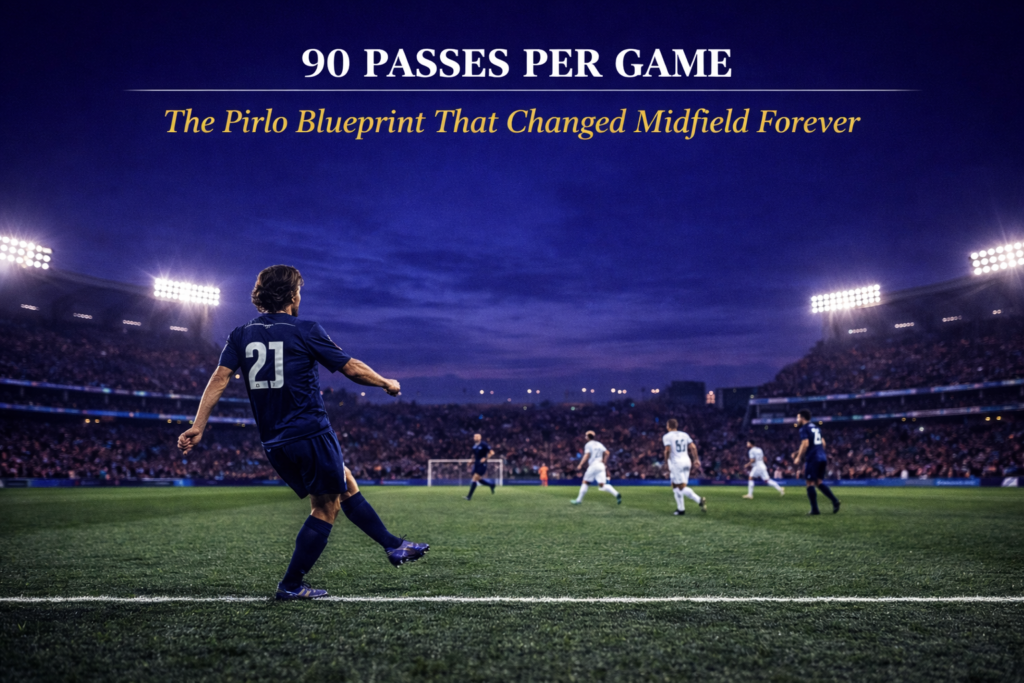
The Pirlo blueprint required a specific ecosystem – a team built around his limitations as much as his gifts. The modern regista, if they want to survive in elite football, has to carry more of the defensive load themselves.
“Pirlo led Serie A in 2002-03 in passes played, ball possession time, successful balls, and successful passes. He averaged nearly 90 passes per game. The team won the Champions League. Shevchenko got the headlines.”
Regista vs Defensive Midfielder: The Distinction That Matters
A regista is a defensive midfielder by position, but not by purpose. That single distinction explains why so many teams field a player in the no.6 shirt and call the role a regista when, by function, it is something else entirely.
The defensive midfielder’s brief is security: protect the back four, screen passes into the strikers, recycle possession when possession is contested. The regista’s brief is direction: dictate the tempo of the entire team’s attack, manufacture angles, and decide when build-up becomes attack. Both players occupy roughly the same vertical space on the pitch. They make the game look very different.
In regista football, the player who receives the ball under pressure is the same player who decides what happens next. There is no handoff to a creative no.10 above them. There is no pass back to a centre-back to start again. The decision begins and ends in the regista’s head. That is what separates the role from a standard pivot, and it is why so few players in modern football can sustainably play it. Pep Guardiola’s Manchester City teams have been built almost entirely around the assumption that Rodri can. Without him, as the 2024-25 season demonstrated after his September 2024 ACL injury, City’s possession structure visibly fractured.
For a deeper analytical breakdown of what defensive midfielders are actually measured on, see our PPDA Explained article.
The Metrics That Define a Regista in Modern Football
A regista is measured by what they prevent and what they progress, not by goals or assists. Three numbers separate a true regista from a possession-recycling no.6.
Progressive passes per 90. Per FBref’s definition, a progressive pass is a completed pass that moves the ball significantly closer to the opponent’s goal. Elite registas register between 9 and 13 progressive passes per 90 minutes in top-five league football. Anything below 8 suggests a player whose passing volume is high but whose passing direction is sideways or backwards.
Pass value (xG-added per pass). This is the metric Opta and StatsBomb both track to capture how much a single pass changes the probability of scoring. Pirlo’s pass value at his AC Milan peak was, per Stats Perform’s published Opta analysis, more than double the Serie A defensive midfield average of his era. A regista who produces low pass value is not actually directing the team. They are simply touching the ball.
Press-resistance rate. The percentage of receptions under direct opposition pressure where the player retains possession or completes a forward pass. Sergio Busquets, who retired in December 2025 after winning the MLS Cup with Inter Miami, made this metric famous before tracking data could quantify it. His value to Barcelona under Pep Guardiola and Xavi was almost entirely defined by what he did under pressure that ordinary midfielders could not.
Together, these three metrics describe regista football in numerical terms. A player who hits all three at elite levels is doing something only a small handful of midfielders in any given season can sustain.
“A regista is measured by what they prevent and what they progress. Goals and assists do not appear on either side of the equation.”
How the Regista Has Evolved: Pirlo to Busquets to Rodri
The regista has not disappeared from modern football. It has hardened. The role’s evolution from Andrea Pirlo at AC Milan, through Sergio Busquets at Barcelona, to Rodri at Manchester City, traces a single underlying truth: as football grew faster and more press-oriented, the regista was forced to absorb defensive responsibilities that previous generations outsourced.
Pirlo’s regista role at AC Milan was a luxury. He was protected by Gennaro Gattuso and Massimo Ambrosini, who covered the ground and won the duels Pirlo did not. His brief was almost purely creative. His progressive passing did the work; his teammates handled the rest. That model produced two Champions Leagues and a 2006 World Cup, but it required the entire team to be built around a non-runner.
Busquets shifted the balance. At Barcelona between 2008 and 2023, his value was less in Hollywood passes and more in tactical intelligence: anticipating opposition runs, cutting passing lanes before they opened, recycling possession in a way that protected the team without slowing it down. The Tiki-Taka era’s reliance on possession demanded a regista who could think defensively without being a destroyer.
Rodri represents the integration phase. At Manchester City under Pep Guardiola, Rodri carries Pirlo’s distribution, Busquets’ positional read, and a level of physical duelling and aerial dominance that neither predecessor offered. His 2024 Ballon d’Or was a recognition of how the regista’s job description had expanded. The role was once a luxury. It is now arguably the most demanding individual position in elite football.
The Pirlo-to-Rodri evolution is the strongest argument that regista football, far from being obsolete, is the role on which modern elite teams now most depend.
The Weakness: Where the Regista Gets Neutralised
The regista’s influence begins the moment they receive the ball. Which means the simplest counter is to ensure they never receive it cleanly.
Diego Simeone’s Atlético Madrid sides have practised this deliberately for over a decade. Atlético’s mid-block in a 4-4-2 shape sets two narrow central midfielders who shadow the opposition’s deepest midfielder rather than their assigned zones – the moment the ball moves to the centre-backs, one of those midfielders steps aggressively to cut off the pass into the regista’s feet. It’s not pressing in the Klopp sense; it’s interception designed to force the building team sideways into wider areas where Atlético’s defensive organisation holds firm.
José Mourinho, across his Inter, Chelsea, and Real Madrid tenures, used a similar mechanism – man-marking the regista with a box-to-box midfielder capable of pressing for extended periods. Against Pirlo’s Italy at Euro 2012, Spain’s solution was different: rather than press Pirlo, they flooded central zones to deny his passing lines, forcing him wide and reducing his vertical passing options. The result: Italy still reached the final, but Pirlo’s progressive pass count dropped significantly compared to the group stage.
The fundamental vulnerability is positional. A regista who can’t receive under pressure, or who operates for a team without sufficient press-resistance across the squad, becomes a liability rather than a luxury. Frenkie de Jong – a superb technical midfielder – has been criticised at times at Barcelona for exactly this reason: in a side that can’t consistently protect its deep-lying playmaker, the regista becomes the most dangerous man on the wrong team’s pitch.
Teams countering a regista successfully in 2025: Simeone’s Atlético (man-shadow in 4-4-2), Mauricio Pochettino (high-press trigger on the centre-back before the pass reaches the regista), and any team with a high PPDA (passes per defensive action) score that can sustain press intensity for 60+ minutes. For a deeper look at how PPDA quantifies pressing effectiveness, see our PPDA Explained article.
The Bigger Picture
Regista football did not disappear from the modern elite game. It got harder.
The regista didn’t disappear from modern football. It got harder. The role now demands what previously required two midfielders: the distribution of Pirlo and the defensive read of a genuine screen. Teams that have someone capable of both – Rodri when fit at Manchester City, Granit Xhaka who anchored Bayer Leverkusen’s 2023-24 unbeaten Bundesliga title and now captains Sunderland in the Premier League, and a small handful of others – are structurally better equipped to control games at the highest level. Most teams do not have that player, and most teams do not control games.
What the regista story actually tells us is that football’s most valuable commodity isn’t pace or power. It’s the ability to make the game predictable for your teammates and unpredictable for your opponents – simultaneously, from deep, under pressure. Pirlo did it with elegance. Busquets did it with intelligence. Rodri did it with force. The conductor’s baton looks different in every era. The orchestra still needs one.
What Do You Think?
Rodri returned from his ACL injury in 2025 and Manchester City’s season improved – but he hasn’t yet recaptured the dominance of his 2022–23 level, when City won the treble with Rodri anchoring a midfield that averaged over 60% possession in knockout football. Is the modern regista – with its demand to be both creator and destroyer – a role that is ultimately unsustainable across a full elite campaign? Or has Rodri simply proved that one player can do what previously required two? Drop your take below.
Want to read any match like this?
The framework behind these breakdowns, in one place. The four phases, a 15-minute method for diagnosing both teams before the drinks break, a printable match-watching worksheet, and 51 terms defined. 40 pages.
Get the pack$9, instant downloadRelated Tactical Breakdowns
PPDA Explained: The Metric That Measures Pressing Intensity
Why it connects: The regista is the primary target when opposition teams press high – understanding PPDA reveals exactly how aggressively a team pursues the regista’s reception zone, making these two articles analytically inseparable.
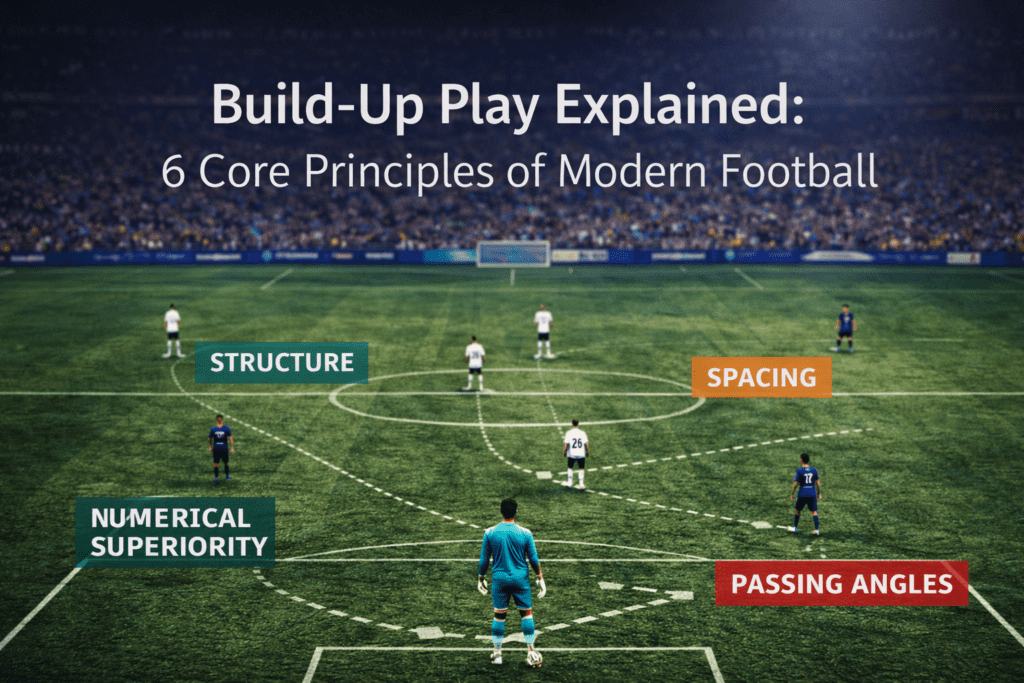
Build-Up Play Explained: How Elite Teams Progress from the Back
Why it connects: The regista is the central figure in build-up structures – this article maps the passing lanes and positional triggers that allow a deep-lying playmaker to function, completing the tactical picture started here.

The “Free 8” Role (The De Bruyne / Ødegaard Template)
Why it connects: Understanding what the regista enables from deep requires understanding what the no.8 ahead of them is free to do – the Ødegaard role is the direct beneficiary of a functioning regista’s progressive passing.
Speak the language of the game
Get the free 47-term tactical glossary. Gegenpress, half-space, xT, low block, each defined in plain language and linked to a full breakdown. It is yours for an email.
Frequently Asked Questions (FAQs)
What is the difference between a regista and a pivot?
A pivot is primarily a defensive player who protects the backline and circulates possession – the priority is security. A regista shares that positional base but is tasked with progressive creation: threading passes between lines, switching play with purpose, and generating xG value through distribution. Every regista plays as a pivot; not every pivot is a regista.
Which teams use a regista system in modern football?
Manchester City under Pep Guardiola have been the clearest modern example, with Rodri operating as the lone pivot and creative deep anchor simultaneously. Xabi Alonso’s Bayer Leverkusen used a modified version with Granit Xhaka anchoring their unbeaten 2023-24 Bundesliga title-winning side, before Xhaka moved to Sunderland in July 2025. Barcelona used a Busquets-inspired structure under Xavi until Sergio Busquets retired from professional football in December 2025. The role is present across elite football but demands specific personnel – teams without a true regista-profile midfielder often fragment in possession.
What metrics best measure a regista’s effectiveness?
Progressive passes per 90 (passes that advance the ball significantly toward the opponent’s goal), pass value (the expected goal probability added per pass), and press-resistance rate (how often the player retains possession under direct pressure). FBref and StatsBomb both provide progressive passing data as standard; pass value and press-resistance typically require more granular tracking data from providers like Opta.