


Last updated: September 18, 2026
Editor’s Note (updated July 2026): Fabregas remains Como head coach – he led Como to a top-four finish and a first-ever Champions League qualification, collected Italy’s Bearzot Award as Coach of the Year in April 2026, and publicly rejected links to bigger clubs. One squad change matters for this analysis: Real Madrid triggered their buy-back clause for Nico Paz in spring 2026, so the positional engine described below departs for the 2026-27 season. The mechanisms are Fabregas’s, not one player’s – watching who inherits the free-8 role is the next chapter.
Watch Como for ten minutes and you notice something that doesn’t quite fit. This is a club that was playing Serie B football 22 months ago, operating out of one of the smallest grounds in Italy’s top flight, against sides with wage bills that dwarf theirs by an order of magnitude. And yet they’re pressing Inter back into their own half, finding the spare man through relentless third-man combinations, and as of March 2026, sitting fifth in Serie A with four games remaining, on course for Europa League football in their first top-flight season in 21 years. Their first Serie A season in 21 years.
THE SYSTEM IN 30 SECONDS:
Formation: 4-2-3-1 base morphing into 4-2-1-3 in possession
Key principle: Third-man combinations to bypass the press
Playmaker: Nico Paz operating as free 8/10 hybrid
Weakness: High line vulnerable to wide press before build-up triangle forms
Serie A has seen promoted sides try to punch above their weight before. Most of them survive by sitting in a 4-4-2 block and making it boring. Fabregas is doing the opposite – and the speed at which he has installed a system with real coherence and attacking identity is the part that impresses most. This is not lucky football. This is a managed tactical structure with very specific mechanisms. Once you see them, you can’t unsee them.
What we’re doing in this piece is going a level deeper: how Fabregas has specifically applied those ideas, what makes the system so hard to defend, and where it comes apart when pressure arrives from the right angle.
This is where it starts to make sense – not in theory, but on the pitch.
Understanding how this fits within the broader football tactics framework gives you the full picture of how modern teams structure every phase of play.

Table of Contents
What Are Fabregas Como Tactics? (The Core System Defined)
Let’s start with the definition, because this matters before anything else.
Fabregas Como tactics are a possession-based, central-overload system built on three non-negotiable principles: relational positioning, the third-man principle, and immediate counter-pressing after ball loss. Understand those three things and you understand Como.
Relational positioning means no player’s job is defined by a fixed zone. Players move in relation to each other – when one player drops, another fills the space they vacated. When one moves wide, the nearest teammate tucks inside to preserve the central triangle. The shape breathes. It adapts. The idea is borrowed directly from the positional play schools of Pep Guardiola and Roberto De Zerbi, but the Cesc Fabregas tactics system has been adapted for a squad without Bernardo Silva or Alexis Mac Allister.
The third-man principle is simpler: you pass to a player who is immediately pressured, and that triggers a third player arriving into space that the press has just vacated. Player A to Player B to Player C – with C arriving into a gap that only opened because the opposition committed to pressing B. When it works, it looks effortless. It isn’t. It requires precise timing, spatial awareness, and hours on the training pitch drilling the sequences until they become instinct.
Counter-pressing – or gegenpressing, if you want the Klopp terminology – is the third pillar. The moment Como lose the ball, the nearest players jump to win it back within three to four seconds. This is not optional in Fabregas’s system. Every player, including the forwards, is expected to contribute. Against Lecce in December 2025, Como won the ball back inside their final third twice in the same sequence before eventually creating the Nico Paz goal through precisely this mechanism. The press created the possession. The possession created the goal.
That’s what we’re unpacking – fluid positions, combination play through the press, collective defensive urgency. Three things. But the way they connect is where it gets complicated.
The Philosophy: Why This Approach at This Club?
This is where most managers get it wrong. You take an identity that works at a top-six club and you try to replicate it with a squad built for survival. It usually ends in a relegation battle and a sacking by November.
The philosophy behind Fabregas Como tactics starts with a simple question: what happens when the system breaks down?
What makes Cesc Fabregas tactics smarter than most is this. He has taken the core principles of positional play and stripped them back to their structural essentials – and then he has built in fallbacks for every moment the system is under pressure.
If the short build-up isn’t available, the goalkeeper goes long to the striker and contests the second ball. If the press is beaten, the two holding midfielders hold shape rather than chase. If Nico Paz is being man-marked out of the game, the wingers tuck inside to create overloads in central channels and let the fullbacks go.
Think of it like this: possession coaches at the elite level have a system that works because they have elite players to execute it. Fabregas is building a system that works because of the structure itself, not because of the players in it. That’s a fundamentally different coaching problem – and the harder one to solve. This is the part I find most underappreciated about what he’s doing.
The 2-1 win over Roma on March 15, 2026 crystallised this. Roma went ahead from the penalty spot and looked comfortable defending in a mid-block. Fabregas made two attacking substitutions at half-time. Both paid off. Douvikas sprung the offside trap to equalise, and then Diego Carlos – a centre-back – sealed it from a corner after Nico Paz had already been substituted off. The system produced the result without its best player on the pitch. That’s the test of a real tactical structure, not a star player dependency.
Como’s Style of Play Under Fabregas: What Makes 2026 Different
The Como gameplay style in 2026 isn’t a continuation of their promotion season – it’s a deliberate evolution. Where last season’s system relied on transition speed and individual quality from Cutrone, the 2025-26 structure is about sustained territorial control. Three changes define the shift: a higher defensive line averaging 42 metres from goal, inverted wingers operating as half-space occupiers rather than touchline runners, and a double pivot that splits during build-up to create a back-three illusion. This isn’t style for style’s sake. It is calibrated to Como’s squad limitations – they can’t outspend, so they outposition.
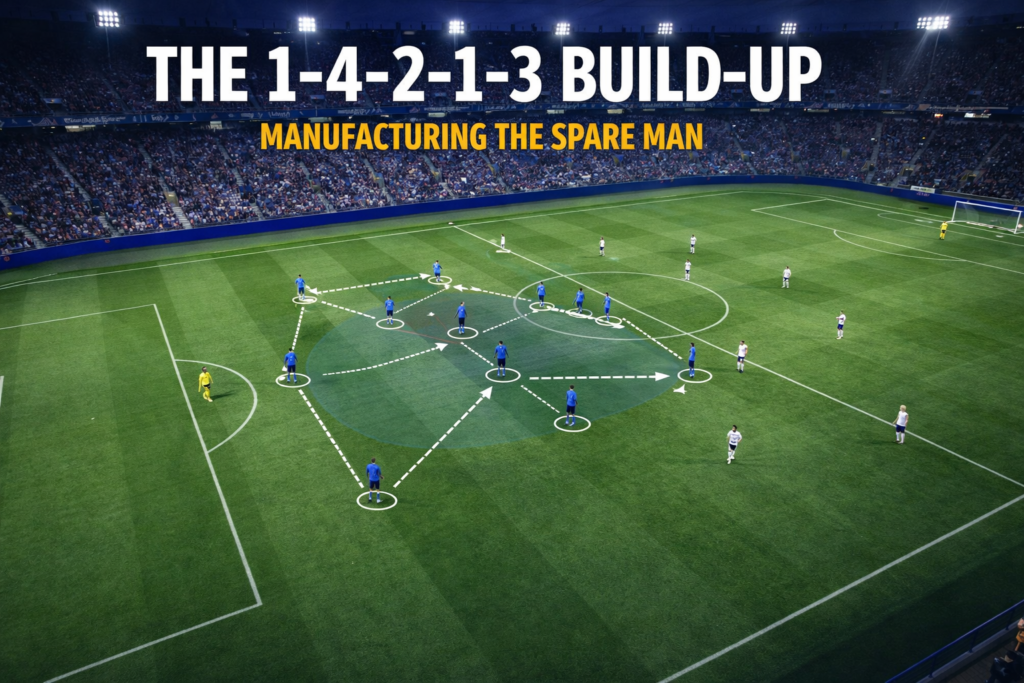
The Build-Up Structure: Manufacturing the Spare Man
Pause a Como goal kick. Look at the fullbacks. That’s where Cesc Fabregas tactics begin in practice.
When goalkeeper Jean Butez has the ball from a goal kick or deep restart, the two centre-backs split wide toward the touchlines. The double pivot – Perrone and Caqueret – drops slightly, offering passing options just ahead of the defensive line. The wingers invert, pulling infield. What this creates is a 1-4-2-1-3 shape in possession – seven players involved in the early build-up phase, enough to create a spare man against almost any press structure.
The fullback positioning is the specific detail that makes it work. When a centre-back has the ball, the ball-side fullback positions themselves fractionally outside and ahead of the opposition winger pressing them. There’s a passing lane. The centre-back hits it. The fullback takes one touch and drives forward past the press before it can reset. That single positional adjustment – being maybe five yards wider than the press expects – turns a potential loss of possession into a 20-metre advance up the pitch.
You saw this in near-perfect form against Lecce in December 2025. Como’s build-up bypassed Lecce’s press on the left side through the fullback rotation, the ball arrived at Cutrone who laid it immediately to Paz, and the goal came two passes later. The speed of the combination – each pass played before the press could re-engage – is what made it unstoppable. Lecce’s press wasn’t bad. Como were simply always one step ahead of where it was pointing.
If the opposition deny all short options by pressing extremely high, Como’s fallback is the direct route: Butez to the striker, hold up play, second-ball contest. It’s not pretty, but it’s deliberate. The system has a Plan B. It’s just that Plan B is always designed to reset to Plan A as quickly as possible.
The risk in this build-up model is real and it’s worth naming directly. When Como’s first passing option is cut off and the direct ball doesn’t stick, they can end up defending deep in a frantic 30-second transition with the midfield out of position. It’s happened. The reward – when the triangle forms and the spare man gets the ball – is a line-breaking combination that most Serie A defences simply can’t recover from in time. The ratio of reward to risk is what makes the system worth the gamble. But it is a gamble. Fabregas knows it.
Everything from here builds on this structure.
The Third-Man Principle in Practice
This is the mechanism that separates Fabregas Como tactics from ordinary possession football. Most teams that try to play out under pressure just recycle. Como use the press itself as the weapon.
Here’s the exact sequence. Paz drops between the lines to receive from Caqueret. The nearest opposition midfielder jumps immediately to press him. Paz doesn’t try to dribble through it. He plays it first time to Cutrone, who is slightly deeper and outside. Cutrone’s touch draws a second defender. But the moment those two defenders moved toward Paz and Cutrone, a gap opened on the far side of the pitch – and Strefezza is already running into it. Cutrone finds him. Strefezza is in on goal.

The opposition didn’t press badly. They pressed correctly. But the movement pattern made the press irrelevant, because the ball was always going to where the press wasn’t. That’s the third-man principle executed at high tempo – and it’s borderline impossible to defend without communicating constantly about who is tracking the late runner.
In the Roma match, the first equalising goal came from a version of this. A Valle through ball was the final trigger, but it was the sequences before it – combinations through the centre that forced Roma’s defensive shape to narrow – that opened the channel for Valle to exploit. You don’t get that pass unless the four or five passes before it have already done their work. Most analysts only look at the assist. Watch the two minutes before it.
In their first Serie A season, 2024/25, Como ranked fourth for through balls – evidence the third-man system was already functioning as the foundations were laid.
Nico Paz: The Positional Engine

You could write a separate breakdown on Nico Paz alone – but to understand Fabregas Como tactics properly, you have to understand his role first. For this article, we need to be precise about one specific thing: he is not a player who fits into Como’s system. He is the organisational logic of it.
Most sides operating positional play principles have a pre-defined structure that governs how the front players move. Fabregas’s Como doesn’t. The frontline is deliberately fluid, and Paz is the hinge on which all of it turns. Where he positions himself is the signal for everyone else. If Paz drops deeper, Cutrone makes the run beyond the defence. If Paz drifts wide right, the right winger tucks inside and the right fullback overlaps. His movement tells the team which attacking option they’re executing in that moment.
Putting this much responsibility on a 20-year-old sounds unstable. It isn’t – and the reason it isn’t is that Paz operates several seconds ahead of the ball. His scanning – the constant head movement to check positions before receiving – means he has already decided what comes next before the ball arrives at his feet. Watch it on video. He checks twice before the pass even leaves the previous player’s boot. Opposition midfielders have to track him across three different horizontal zones in a single phase of play. Most can’t.
Real Madrid’s buy-back clause is the most discussed aspect of his situation, and for good reason. As of March 2026, Inter Milan have identified Paz as their primary summer target – with Nico Williams as the alternative if they can’t get him. It’s unlikely to happen. Real Madrid are expected to exercise their buy-back option first. If he leaves, Fabregas loses not just a goalscorer – he loses the player whose positional intelligence structures the entire attacking system. Como’s 2-1 win over Roma came after Paz was substituted off in the 77th minute. That shows the depth of the system. It doesn’t change the fact that it functions at a significantly higher level when he’s on the pitch.
Paz finished the 2025-26 season with 12 Serie A goals and was named the league’s best midfielder – a remarkable return for a player operating as a free 8/10 hybrid rather than a traditional striker
Pressing and Defensive Shape
The narrative around Como focuses heavily on the possession play, which is fair. But the off-ball structure is where Fabregas’s coaching intelligence is most ruthlessly exposed – both for what it does well and what it leaves open.
Out of possession, Como shift into a 4-4-2. Paz moves higher to form a front two with the striker. The two central midfielders hold a compact line of four, deliberately narrow to deny access to any pivot trying to receive and turn centrally. The shape is designed to force the opposition wide before triggering the press.
The trigger is specific: when the ball goes to a wide defender under pressure from the Como winger, the nearest central midfielder steps aggressively to cover the central channel, Paz and the striker angle their positions to cut off the back pass to the goalkeeper, and the far-side winger begins a flat sprint across to compact the space further.
This is not just pressing – it’s a trap with a specific entry point. Teams that recognise the trigger and play through it quickly can hurt Como. Teams that don’t recognise it end up playing long balls from their fullback under pressure.
In their first Serie A season, Fadera, Strefezza and Paz ranked among Como’s top defensive duelists – attacking players doing defensive work, which tells you exactly how Fabregas has wired the system.. When wingers and a number ten are your most aggressive defensive contributors, that tells you something specific about how Fabregas has wired pressing responsibility into roles most managers treat as purely offensive. It also tells you why Como’s system is physically fragile over 90 minutes.
The press burns legs fast. Against Udinese in January, Como looked mechanically sharp for 60 minutes and then visibly lost the defensive trigger timing in the final half-hour – the midfield line dropped too deep, Paz stopped stepping up, and suddenly Udinese had space centrally that hadn’t existed all evening. Fabregas manages this through rotation. It’s not a perfect solution. It’s the only viable one.
Como by the Numbers: Data Visualisation
2025/26 Serie A Season – Selected Performance Metrics
| Metric | Como Rank (Serie A) | Context / Value | What It Signals |
| PPDA | 5th | Lower = more pressing activity | Active, man-oriented press structure |
| Through Balls | 4th | High-volume final-third sequences | Third-man combinations functioning |
| Progressive Passes | 5th | Consistent ball advancement | Build-up system bypassing pressure lines |
| Defensive Duel % (Attackers) | Top 3 (Fadera, Paz, Strefezza) | Attacking players pressing aggressively | Full-team press integration |
| Challenge Intensity | 3rd | Defensive actions per sequence | Collective pressing: win ball, not delay |
| March 2026 League Position | 4th | Champions League qualification spot | System producing elite-tier results |
The key thread through all of this: Como are not pressing to delay. They’re pressing to win. There’s a difference. A team pressing to delay accepts that the ball will move and looks to slow the attack. A team pressing to win commits to a specific moment and attacks it collectively. The PPDA and challenge intensity numbers together tell you that Como sit in the second category – which is why their press is fragile when beaten, and unstoppable when timed correctly.
The Weakness – And How to Counter It

No system this aggressive is without a specific exploitable gap. Como’s is real and it’s been identified.
The build-up structure depends on opposition pressing through central zones. The moment a team decides to press from wide angles – using their wingers to cut the fullback passing lanes before Como’s build-up triangle can form – the system loses its primary release mechanism. The double pivot becomes isolated. The centre-backs end up cycling the ball without advancing. And Paz drops deeper to help, which removes him from the positions where he does his damage.
That Lazio game is the one I keep coming back to when thinking about Como’s ceiling. Lazio’s wide forwards pressed the Como fullbacks early, before the centre-backs could trigger the fullback movement.
Como spent long stretches playing sideways, unable to find the angles that make their combination play work. Fabregas managed it by switching to the direct option more frequently in the second half – using Cutrone’s ability to hold up play as a reset – but it was a disrupted, uncomfortable 90 minutes. Not a disaster. Just a structural stress test, and Como didn’t fully pass it.
The second vulnerability is in the transition phase when the immediate counter-press fails. Como commit heavily to winning the ball back inside the first three or four seconds. If that initial press is beaten, the midfield is already committed forward. The corridor behind the double pivot and ahead of the back four becomes enormous – and teams with quick forwards who can exploit that space immediately after bypassing the press will find it. This is not a theoretical concern. It’s happened.
To counter Como effectively:
- press from wide angles on goal kicks to deny the build-up triangle;
- withdraw your press trigger on restarts to deny the spare man;
- sit in a disciplined 4-4-2 mid-block and invite them to play through the centre;
- and have a direct runner who can exploit the transition space centrally when you win possession.
Ironically, the teams that cause Como the most problems are teams that look structurally similar to how Como defend – compact, disciplined, and direct in transition. The style that Fabregas has built is most vulnerable to the style he himself deploys without the ball.
Key Takeaways
- Fabregas Como tactics are built on a 4-2-3-1 that morphs into a 1-4-2-1-3 in possession – creating a permanent spare man against most press shapes.
- The third-man principle is the central mechanism – every combination is designed to bypass pressing lines, not just recycle possession.
- Nico Paz is not just Como’s best player – his positioning signals dictate the movement of every other attacking player around him.
- Out of possession, Como sit in a 4-4-2 mid-block and force play wide before triggering a coordinated press trap.
- A 2-1 win over Roma in March 2026 put Como fourth in Serie A – Champions League football is no longer a fantasy.
- The system has one dangerous blind spot: press it from the flanks before the build-up triangle forms and Como can fragment badly.
This is what it all leads to.
Fabregas’s positional grammar comes out of the Guardiola school, and Pep Confidential documents that system being built week by week. It is on the tactical reading list.
Final Thoughts: How Far Can This Go?

Here’s the honest verdict: what Fabregas is building at Como is the most interesting managerial project in Serie A right now. Possibly in Europe.
I don’t say that because of the celebrity of his playing career or the glamour of the location. I say it because the tactical execution is unusually precise for a manager in only his second full season. The system has identity. The players understand their roles.
The structure produces results in high-pressure moments – a comeback win over Roma when the team is chasing Champions League qualification is a different kind of pressure to surviving relegation, and Como are handling it.
The ceiling depends on a handful of variables. Nico Paz and the Real Madrid clause is the central one – if he leaves in the summer, Fabregas faces not just replacing a talented player but rebuilding the positional logic at the heart of the entire attacking structure. That’s a near-impossible ask in a single transfer window.
The squad depth to sustain the pressing intensity across a European campaign is the second challenge. This system burns legs. A Thursday-Sunday schedule with a 14-man effective rotation is a different problem to a domestic-only season, and it’s one Como haven’t faced yet.
There’s also a subtler risk. Systems this mechanically precise require players who know the principles deeply. Rotate in someone who hasn’t internalised the third-man timing or the pressing trigger cues and the whole thing looks disjointed for 20 minutes. That matters in March. In a Europa League knockout in February, it could be fatal.
By March 2026, with Como sitting fourth in Serie A after beating Roma in a direct fight for a top-four place, the question had shifted. This was no longer a survival story. This is a team with a real idea, executing it under pressure, against sides with three times the resources. That’s rarer than it sounds.
If you’re not watching Como already, start. You’ll miss something.
What do you think?
Which current Serie A manager do you think is building the most tactically sophisticated system right now – and is Fabregas already ahead of managers with five times his experience and resources?
Want to read any match like this?
The framework behind these breakdowns, in one place. The four phases, a 15-minute method for diagnosing both teams before the drinks break, a printable match-watching worksheet, and 51 terms defined. 40 pages.
Get the pack$9, instant downloadRelated Tactical Breakdowns
Fabregas borrowed the core principles from Guardiola and De Zerbi – these breakdowns show the original systems his Como model is built on top of.
Xabi Alonso Tactics Explained

Counter-Pressing Explained

Speak the language of the game
Get the free 47-term tactical glossary. Gegenpress, half-space, xT, low block, each defined in plain language and linked to a full breakdown. It is yours for an email.
Frequently Asked Questions (FAQs)
What formation does Fabregas use at Como?
Fabregas nominally sets Como up in a 4-2-3-1, but this shape morphs significantly in different phases. In build-up possession, the team transitions into a 1-4-2-1-3, with wingers inverting and the double pivot dropping to create numerical superiority against the press. Out of possession, Como restructure into a 4-4-2 with the number ten joining the striker to form an active first pressing line.
How does Nico Paz fit into Fabregas Como tactics?
Paz is the positional anchor of Como’s entire attacking structure, not simply their best attacking player. His positioning dictates the movement of every other forward player – his drop or drift signals which attacking option the team is about to execute.
His scanning ability and spatial intelligence allow him to operate several seconds ahead of the ball, making him almost impossible to man-mark effectively across multiple zones in a single possession sequence.
Why are Como competing for Champions League qualification?
The combination of a coherent tactical identity, intelligent squad management, and Fabregas’s ability to install his system quickly has produced results well above expectations.
Como’s pressing structure, build-up sophistication, and collective defensive commitment are all functioning at a level that produces results against top-half Serie A sides – most recently the 2-1 win over Roma in March 2026 that kept them fourth in the table.