

Last updated: August 17, 2026
Mauricio Pochettino’s Tottenham scored 86 Premier League goals in 2016-17, the most in the club’s modern era. Dele Alli, listed in the team sheet as a central midfielder, contributed 18 of them. He did it almost without dribbling, ghosting from the second line into the penalty box after the ball had already moved past him, arriving uninvited to finish.
That is the Shadow Striker role at its purest. Where the classical Number 10 sat between the lines and made the final pass, this role takes the next step and becomes the receiver of the chance someone else manufactured. It is one of the cleaner answers to where the playmaker’s value went when modern football compressed the space between the lines.
In simple terms: The Shadow Striker is a forward who ghosts from a withdrawn second-line position into the penalty box to finish chances created by others.
This breakdown unpacks the Dele Alli template, where it overlaps with Thomas Müller’s Raumdeuter, and why the role is quietly becoming Premier League standard again under Pep Guardiola, Chelsea, and Bayer Leverkusen.
Key Takeaways
- Late beats early: A Shadow Striker scores by arriving in the box after the chance is built, not by sitting in it. Dele Alli’s 18 Premier League goals in 2016-17, the most by a midfielder that season, came almost entirely from delayed runs starting outside the area.
- It is a Number 10 in disguise: The role uses the classical playmaker’s withdrawn position as a launchpad into the box, finishing the chance the Number 10 would have created instead of playing the pass.
- Müller and Alli read different spaces: The Thomas Müller role finds gaps anywhere on the pitch as a Raumdeuter, while Alli’s profile reads space in one zone, the back of the penalty box.
- A target Number 9 is mandatory: Without a striker who pins centre-backs (Harry Kane, Robert Lewandowski), the late run has nothing to attack.
- It is returning to the Premier League: Phil Foden, Cole Palmer, and Florian Wirtz now operate in the same zones for the same reason Pochettino used Alli, the role weaponises a withdrawn forward in a system that has stopped trusting playmakers.
Table of Contents
What Is the Shadow Striker?
The Shadow Striker is a forward who plays just behind the main striker and scores by making late, delayed runs from a withdrawn second-line position into the penalty box. The role’s defining trait is patience, not pace. He stays out of the area during the build-up and breaks the line only when the ball reaches the wide channels and the centre-backs have already committed their attention elsewhere.
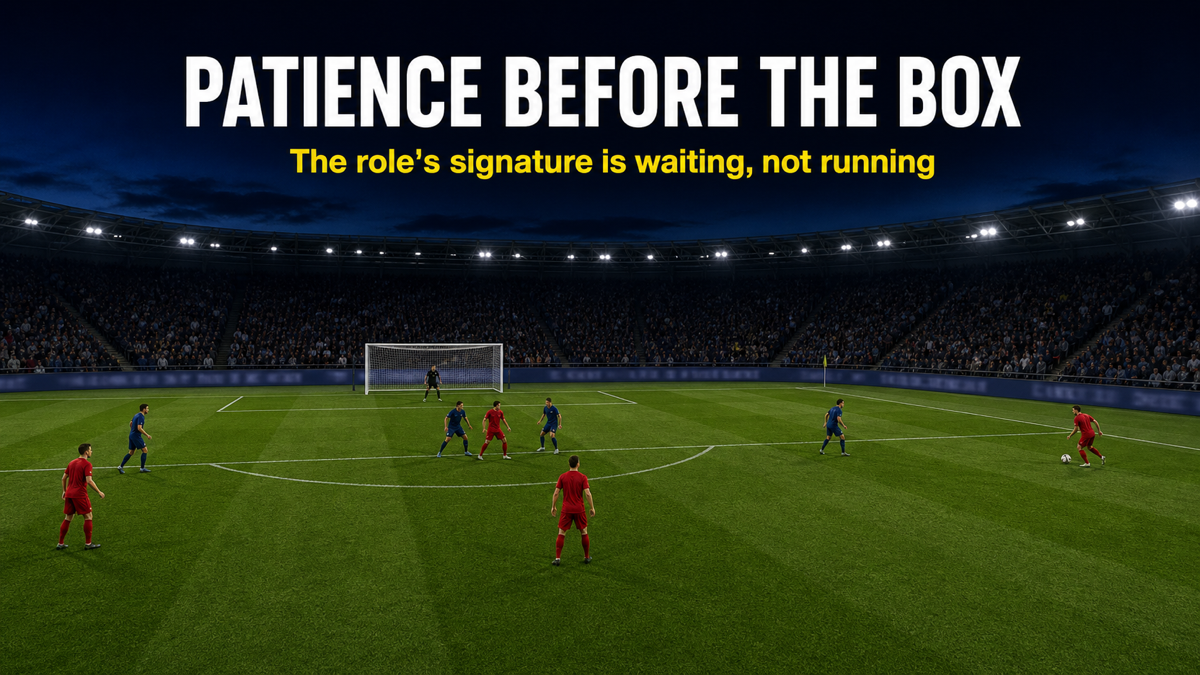
A traditional Number 10 wants the ball in his feet between the lines, and a target Number 9 wants it played to him inside the box. The Shadow Striker wants neither, he wants the chance to arrive uninvited at the back post or the penalty spot, with the ball already in motion and the defender’s eyes on someone else.
That is what makes the role distinct from both the Raumdeuter and the False 9. The Raumdeuter reads space everywhere on the pitch, the False 9 drops deep to manufacture it, and this role reads only the box.
Dele Alli at Tottenham: The Cleanest Premier League Template
Dele Alli’s 2016-17 Tottenham season is the cleanest Shadow Striker template the Premier League has produced, with 18 league goals scored almost entirely from late, off-ball runs originating outside the penalty box. The Dele Alli position was officially central midfield. The function was second forward.
Pochettino’s structure was specific. Spurs built through Eric Dier and Mousa Dembélé at the base, Christian Eriksen drifted off the right to create, and Harry Kane held the central channel to pin both centre-backs. Alli had one job once Spurs entered the final third: find the moment the centre-backs turned their attention to Eriksen or Kane, and break the line behind them.
The mechanism is visible in the goal totals. Across his first three Tottenham seasons, Alli scored 37 Premier League goals from a position that, by the team sheet, was central midfield. The table below shows the distribution against the role’s other prototype, Thomas Müller in his 2019-20 Bayern season under Hansi Flick.
| Player | Season | League Goal Contributions | Tactical Frame |
|---|---|---|---|
| Dele Alli | 2015-16 | 10 PL goals | Behind Harry Kane (Pochettino 4-2-3-1) |
| Dele Alli | 2016-17 | 18 PL goals | Behind Harry Kane (Pochettino 4-2-3-1) |
| Dele Alli | 2017-18 | 9 PL goals | Behind Harry Kane (Pochettino Diamond) |
| Thomas Müller | 2019-20 | 8 BL goals + 21 assists | Behind Robert Lewandowski (Flick 4-2-3-1) |
Data reflects goal-contribution metrics across each player’s peak Shadow Striker seasons. Individual team and season variance applies.

What the numbers do not capture is the consistency. Alli’s goals were not concentrated in two or three matches, they distributed across the season as a steady rhythm of late-arriving box runs, often from second-phase set-pieces or transition moments. That distribution is the operational signature of the role.
Thomas Müller: Where Raumdeuter and Shadow Striker Overlap
Thomas Müller is the player most often cited as the prototypical Raumdeuter, but his actual movement profile under Hansi Flick and Julian Nagelsmann sat at the exact intersection of two labels. The two terms describe the same player from different angles.
A pure Raumdeuter, as defined in the Raumdeuter explainer, reads space across the entire offensive third, drifting wide to half-space to deep central pockets and exploiting whichever gap opens. The box-arrival specialist, by contrast, plays one space, the back of the penalty box.
The Thomas Müller role does both at once. In Bayern’s 2019-20 treble season under Flick, he posted 21 assists and 8 goals in the Bundesliga, per Wikipedia, with the two outputs coming from two distinct movement types. The assists came from his Raumdeuter reads in half-space, while the goals came from late arrivals into the box behind Robert Lewandowski, who had pinned both centre-backs.
This is why Müller appears in tactical writing under both labels, and both are correct. The role is a Venn diagram and Müller sits in the overlap.
The Movement Pattern: Why Late Beats Early
Late midfield runs beat early ones because they exploit the centre-back’s attention rather than competing with it. The defender’s attention budget is finite. The role’s entire mechanism is built to attack the moment that budget is already spent.
The mechanic is simple to describe and brutal to defend. The runner stays outside the penalty box during the build-up, refusing to enter the area while defenders’ eyes are still on the ball. He breaks the line only when the ball moves wide, at the exact moment the centre-backs shift their focus to the wider threat.

An early-arriving forward is easy to mark, the defender sees him enter the box and stays with him. A late-arriving forward is invisible because the defender has already committed his attention elsewhere, and the run starts after the marking assignment has been completed.
Alli’s 2016-17 archive shows the same sequence repeating. Spurs work the ball to Eriksen or Kane in the right channel, the near-side centre-back drifts to cover Kane, and Alli enters from 25 yards out at the moment the cross is launched. The far-side centre-back is still tracking Kane, not him, and the goal is finished inside the six-yard box by a player nobody was assigned to mark.
The Set-Up: Why the Role Needs a Target Number 9
The Shadow Striker only functions if the team has a target-type Number 9 in front of him whose physical presence forces both centre-backs to commit, because without that occupation the late run has no defender to evade. The second striker role does not exist as a solo act.
Harry Kane is the textbook anchor. From 2015 to 2018, Kane averaged over 25 Premier League goals per season for Tottenham, but only a fraction of those were goals Alli could have scored in his place. Kane’s job, from Alli’s perspective, was to hold the central channel and demand attention from both centre-backs, creating the moment of indecision the late runner exploited.
Robert Lewandowski performed the same anchor role for Müller at Bayern Munich. In 2019-20, Lewandowski scored 34 Bundesliga goals while occupying the centre-back pairing match after match, and Müller’s 8 goals came from the space behind that occupation. The two roles are symbiotic.
This is why the role disappeared from England for several seasons after Alli left Tottenham. Premier League clubs experimented with the False 9 model and possession-based fronts that pulled the Number 9 deep, neither of which leaves the box space the late runner needs to attack.
The Modern Application: Foden, Palmer, and the Premier League Revival
The role is returning to the Premier League because modern defences no longer let classical playmakers operate between the lines. The same problem Pochettino solved with Alli is being solved again, and the same way.
Phil Foden has spent multiple seasons at Manchester City being used in Shadow Striker zones behind Erling Haaland. Haaland pins both centre-backs, Foden enters from withdrawn positions, and he finishes chances created in wider channels. He won the Premier League Player of the Season award in 2023-24 with a profile that matched Alli’s at Spurs more closely than any other Premier League player since.
Cole Palmer at Chelsea has run the role at higher volume than anyone since Alli, functioning as a withdrawn forward arriving in the box behind Nicolas Jackson across 2024-25 and drawing direct comparisons in tactical writing to Alli’s peak Spurs profile.
In the Bundesliga, Florian Wirtz fills the same job for Xabi Alonso’s Bayer Leverkusen, reading the space behind Patrik Schick and Victor Boniface and arriving late into the box from second-line positions, a fluent modern version of what Müller pioneered.
The Weakness: When the Shadow Striker Stops Arriving
The Shadow Striker collapses when the team loses the target Number 9 in front of him, because the role’s entire mechanism depends on the centre-back attention being committed elsewhere. The runner cannot manufacture the indecision. Somebody else has to.
Alli’s Tottenham example is the clearest case. When Kane was injured during stretches of 2017-18 and 2018-19, Alli’s goal output dropped sharply even as Spurs continued to generate chances elsewhere. Without Kane pinning the central channel, the centre-backs were free to track the late runner, and the entire mechanic went dormant.
The second weakness is the press-up. Top defensive teams have learned to step up on the late runner before he can begin his run, denying him the launch space. Antonio Conte’s Inter and Chelsea sides did this consistently against late-arriving attacking midfielders, forcing the player back into a passive position before the cross could be delivered.
The third weakness is fatigue. Late runs are physically expensive, requiring high acceleration from low starting positions over 70 to 90 matches a season. Alli’s late-career decline, documented in his Wikipedia biography, is widely linked to the cumulative load of the role.
Closing Analysis
The Shadow Striker is the role that absorbed the Number 10’s value without inheriting his limitations. The classical playmaker died because his space died, because between the lines was no longer territory a team could trust to win. The role survived that compression by keeping the playmaker’s geography and redirecting the intelligence into the box.
Whether the role is called Shadow Striker, Raumdeuter, second forward, or simply “a midfielder who scores,” the function is the same: it is the cleanest answer modern football has to the question of what to do with a creative attacking midfielder who is too good not to play. Dele Alli answered it first in the Premier League, and Foden, Palmer, and Wirtz are answering it again now.
What Do You Think?
Phil Foden played as a Shadow Striker for most of 2023-24 and won Premier League Player of the Season, while Cole Palmer plays the same role at Chelsea inside a less stable system. Which of the two has the more sustainable template, Foden’s positional discipline inside a Guardiola structure, or Palmer’s freedom inside a more chaotic one? Drop your take below.
Want to read any match like this?
The framework behind these breakdowns, in one place. The four phases, a 15-minute method for diagnosing both teams before the drinks break, a printable match-watching worksheet, and 51 terms defined. 40 pages.
Get the pack$9, instant downloadRelated Tactical Breakdowns
The Raumdeuter: Football’s Most Unmarkable Role Explained
Why it connects: The Raumdeuter is Müller’s other label, the same player profile described from a different tactical angle, and the natural next read for anyone who wants the role mapped beyond the late box-arrival pattern.

Why the Traditional #10 Disappeared – And What Replaced It
Why it connects: The Shadow Striker is one of the roles that absorbed the classical Number 10’s value when modern defences compressed the space between the lines, and this article is the prequel to where the playmaker went.

The Modern Maestro: Mastering The “Free 8” Role
Why it connects: The Free 8 sits one line deeper than the Shadow Striker, often paired with him in the same attacking midfield, and the comparison is the cleanest way to see how modern football has split the old Number 10 into two distinct jobs.
Speak the language of the game
Get the free 47-term tactical glossary. Gegenpress, half-space, xT, low block, each defined in plain language and linked to a full breakdown. It is yours for an email.
Frequently Asked Questions
What is a Shadow Striker in football?
A Shadow Striker is a forward who scores by making late, delayed runs from a withdrawn second-line position into the penalty box, behind the main striker. The role’s defining feature is timing: he stays out of the box during build-up and arrives only when defenders have committed elsewhere. Dele Alli at Tottenham and Thomas Müller at Bayern are the cleanest modern examples.
How is the Shadow Striker different from a Number 10?
The role is one line higher than the Number 10 and operates inside the penalty box rather than between the lines. The classical Number 10 stays in the half-space behind the striker to make the final pass, while the Shadow Striker uses that same withdrawn starting position as a launchpad for late runs into the box. He finishes the chance instead of creating it.
Why is Dele Alli considered the prototype Shadow Striker?
Dele Alli is the prototype because his 2015 to 2018 Tottenham seasons under Mauricio Pochettino showed the role in its purest Premier League form. Alli was listed as a central midfielder but functioned as a second forward, scoring 37 Premier League goals across three seasons almost entirely from late, off-ball runs into the box behind Harry Kane. The output is what makes him the prototype, the role had existed before him but nobody had run it at his volume.
Which current players play the Shadow Striker role?
Phil Foden at Manchester City, Cole Palmer at Chelsea, and Florian Wirtz at Bayer Leverkusen are the most prominent current examples in elite European football. Each operates in a different system: Foden inside Pep Guardiola’s positional structure, Palmer inside Chelsea’s more transitional shape, and Wirtz under Xabi Alonso’s possession-based Leverkusen build. The function is identical in each case, ghost in from withdrawn positions to finish chances behind a target Number 9.