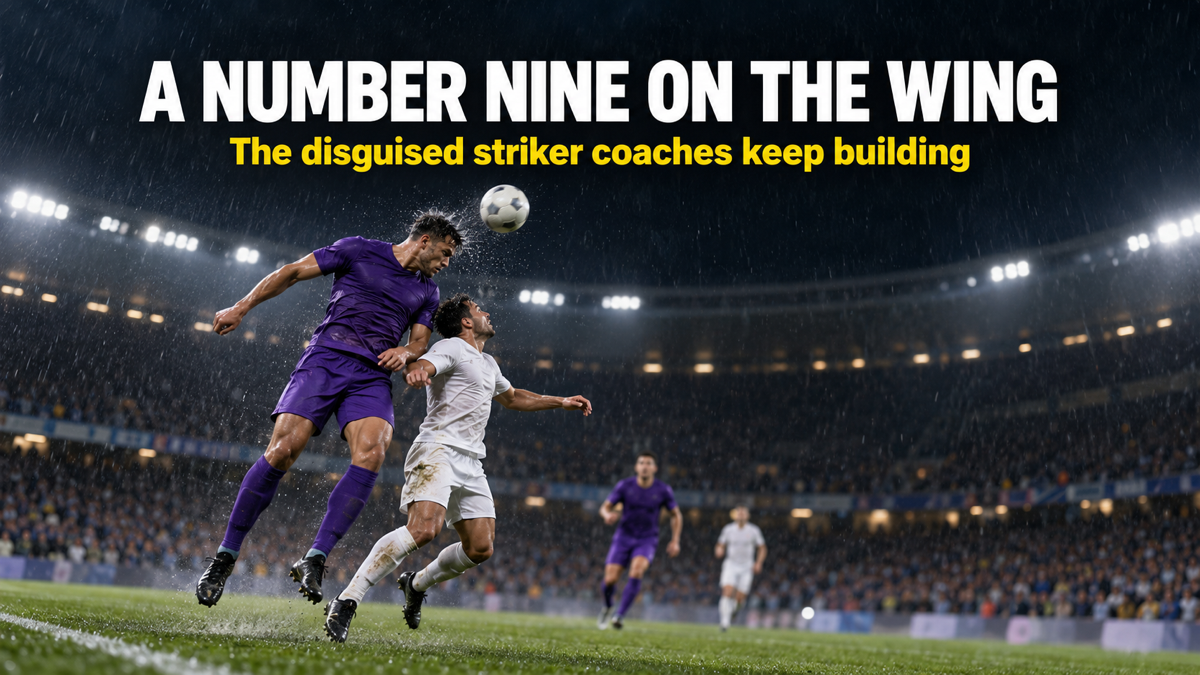

On a June night in Cardiff in 2017, Mario Mandžukić hung above the Real Madrid penalty area and scored an overhead kick that still runs on a loop every Champions League final week. The strange part was the postcode it came from. Mandžukić was not Juventus’ centre-forward that season, because Massimiliano Allegri had moved him to the left wing and rebuilt a battering-ram striker into football’s cleanest example of a target winger.
The job reads as a winger on the team sheet and behaves like a number nine who has wandered toward the touchline.
In simple terms: a target winger is a wide forward picked for aerial duels, hold-up play and pressing rather than dribbling or beating a full-back one on one.
This breakdown traces the idea from Allegri’s Juventus to Havertz at Arsenal, asks why coaches keep reaching for it, and names the one defensive read that switches it off. For the wider map of attacking roles, start with our football tactics hub.
Key Takeaways
- Two jobs, one position: A target winger stands on the flank but is measured by aerial duels won, hold-up play and pressing actions, not by dribbles completed.
- Allegri’s prototype: Massimiliano Allegri turned Mario Mandžukić into a wide target man at Juventus, and that role produced a bicycle kick in the 2017 Champions League final.
- The modern blur: Kai Havertz at Arsenal shows how elite coaches now fold a striker’s aerial and link traits into advanced, left-sided roles instead of a single fixed forward.
- Three problems, one pick: The role pins a full-back, guarantees an aerial outlet and frees the central striker to roam.
- The kill switch: Cut off the wide service and the player starves, because the role only works when the ball reaches his zone.
Table of Contents
What Is a Target Winger?
A target winger is a wide forward chosen to win aerial duels, shield the ball under pressure and trigger the press from a flank, rather than to beat defenders off the dribble. The team sheet says one thing. The actual brief is auxiliary centre-forward.
Picture a number nine slid ten yards toward the touchline. He still attacks crosses, still bullies centre-backs in the air, still holds the ball with his back to goal. He simply does it from a wider start position, which drags a full-back into duels that defender was never recruited to win.

The mismatch is the whole point. A pure dribbler asks a full-back to defend space and pace. The role instead asks him to defend contact, timing and aerial duels, and most full-backs are built for the first job, not the second.
This is a different animal from the central target man you meet in our breakdown of the false nine versus the target man. The functions rhyme, but the wide forward performs them from the touchline, where the help defence is thinner and the angles open up.
Mandžukić at Juventus: The Blueprint Allegri Drew
Massimiliano Allegri built the template in 2016, when he switched Juventus to a 4-2-3-1 and stationed Mario Mandžukić on the left. Mandžukić had been a recognised centre-forward for club and country. Allegri kept the striker instincts and changed only the address.
The payoff was immediate. Mandžukić offered the same aerial duels and hold-up play Juventus had relied on through the middle, only now from a flank that also asked him to track a full-back and press the first line. Per his career record at Juventus, he stayed in Turin from 2015 to 2019 and won four Serie A titles, with this wide role central to two of them.
The 2017 Champions League final crystallised it. Mandžukić scored that overhead kick from the left channel, not from a central striker’s slot, and in one knockout tie that season he won 10 aerial duels, per the match data. That is the signature of a target winger: a wide player whose box score reads like a number nine’s.
Allegri’s insight was that the wide target man is not a downgrade for a striker. It is a way to field two centre-forwards without playing two strikers, because one of them is disguised as a winger.
Havertz at Arsenal: The Idea, Quietly Modernised
Kai Havertz at Arsenal is the modern, blurred descendant of the role rather than a carbon copy. Mikel Arteta first used Havertz as a left-sided number eight, then increasingly as a forward, and his value never leaned on dribbling. It came from aerial duels, hold-up play and relentless pressing.
Havertz’s profile is the target winger idea ported into a fluid front line. When he drifts to the left of a front three or arrives late on the back post, Arsenal get the wide aerial outlet and physical screen Allegri once manufactured with Mandžukić. The position label changes, the job does not.
The numbers back the profile up. Havertz produced 13 goals and seven assists in his first Premier League season at Arsenal, per FBref, while ranking among the squad’s heaviest pressers and aerial competitors. At 186 centimetres, he gives Arsenal the option to go long to a flank and still win the first contact.
The lesson from Havertz at Arsenal is where the role is heading. Elite teams rarely pick a pure version now. They build the function into a versatile forward and switch it on by zone, which is harder for opponents to plan against than a fixed wide man.
3 Reasons Coaches Build a Target Winger
Coaches reach for a target winger because it solves three problems with one selection, not because it looks elegant. Each reason maps to a concrete defensive headache for the opponent.
First, it pins the full-back. A full-back facing this forward cannot push high to support his own attack, because leaving a 1.9 metre forward unmarked on the touchline invites a cross-and-header sequence every time possession turns over.
Second, it guarantees an aerial outlet. When a team is pinned in its own half, the wide outlet becomes a release valve: go long to the flank, win the duel, and the side climbs 40 yards without threading a pass through the press.
Third, it frees the central striker. With the wide man covering hold-up play and aerial duels, the number nine can drop, roam and create, which is exactly the freedom Cristiano Ronaldo enjoyed alongside Mandžukić at Juventus.
The table below shows how the profile diverges from a touchline dribbler.
| Function | Touchline Dribbler | Target Winger | Why It Matters |
|---|---|---|---|
| Aerial duels won per 90 | Low (1 to 2) | High (5 to 8) | Turns goal kicks and clearances into territory |
| Hold-up retention under pressure | Variable | High | Lets the team advance without a clean pass |
| Take-ons attempted per 90 | High (5 plus) | Low (1 to 3) | Trades dribbles for duels and link play |
| Pressing actions per 90 | Medium | High | Adds a fourth presser to the front line |
Data reflects illustrative benchmark ranges for the role profiles described, not a single player or season. Individual team and season variance applies.

Read together, the three reasons explain the role’s stubborn appeal. The pick is the rare one that improves a team with the ball, against the ball and in transition at the same time.
The Pressing Trap on the Flank
The defensive value is the most underrated part of the role, and it is why managers tolerate the lower dribble counts. A wide forward with a striker’s engine becomes the front line’s fourth presser, sealing the touchline so the opponent cannot escape down that side.
Mandžukić was the archetype here too, shuttling back to defend the left while still leading the press. Havertz brings the same trait to Arsenal, where pressing from the front is non-negotiable under Mikel Arteta. The role lets a side press with four without sacrificing an aerial presence in the box.
The two-way load is also the role’s entry fee. Only a specific player can win aerial duels, perform hold-up play and press for 90 minutes from wide, which is why a genuine example is rarer than the idea suggests.
The Weakness: When a Target Winger Becomes a Passenger
A target winger collapses the moment the opponent cuts off the wide service, because the role depends entirely on the ball arriving in his zone. Deny the channel and the most physical forward on the pitch can drift through 70 minutes untouched.

Coaches counter it in two ways. A back three, used by managers like Antonio Conte and Diego Simeone, doubles the wide channel so the forward meets a defender and a wing-back on every duel. Alternatively, a ball-dominant side simply keeps possession, since a wide forward with no ball to chase is a spectator.
The second vulnerability is pace in behind. The role is rarely a burner, so a full-back who steps up and attacks the space the forward vacates can turn it into a defensive liability. Unai Emery’s Aston Villa high line has punished slow wide forwards exactly this way.
The fix is balance, not abandonment. Teams that thrive with the role pair him with a genuine runner on the opposite flank, so the opponent cannot load every defender into one channel.
The Tactical Takeaway
The target winger is not a gimmick, and it is not new, but it is consistently underused. Allegri proved a striker’s habits travel to the touchline, and Havertz at Arsenal proves the function now lives inside versatile forwards rather than fixed wingers.
My view is that the role is undervalued because the box score lies. A wide forward who wins his duels, pins a full-back and presses for 90 minutes can shape a match while completing one dribble, and most recruitment models still pay for the dribble. The teams that read the role correctly get a second centre-forward for the price of a wide man, and that bargain is not going away.
What Do You Think?
Mandžukić made the role look like tactical genius, but he was a converted striker with rare aerial numbers. Is it a repeatable selection any coach can build, or does it only work when you already own a 1.9 metre forward who presses like a central midfielder? Tell me where you land in the comments.
Want to read any match like this?
The framework behind these breakdowns, in one place. The four phases, a 15-minute method for diagnosing both teams before the drinks break, a printable match-watching worksheet, and 51 terms defined. 40 pages.
Get the pack$9, instant downloadRelated Tactical Breakdowns

Why Football’s Elite Strikers Are Becoming Target Men Again
Why it connects: It covers the central version of the same physical idea, the classic number nine the role quietly imitates from wide.
The Wide Playmaker: Why Grealish’s Role Rewrote Modern Wing Play
Why it connects: It is the opposite wide-forward archetype, a ball-retaining dribbler rather than an aerial threat, which sharpens what makes this role distinct.

Why the Traditional #10 Disappeared – And What Replaced It
Why it connects: It tracks how scoring and creative load migrated as fixed roles dissolved, the same blurring that turned a striker into a target winger.
Speak the language of the game
Get the free 47-term tactical glossary. Gegenpress, half-space, xT, low block, each defined in plain language and linked to a full breakdown. It is yours for an email.
Frequently Asked Questions
What is a target winger in football?
A target winger is a wide forward selected for aerial duels, hold-up play and pressing instead of dribbling. He plays wide but functions as an auxiliary centre-forward, pinning the full-back and offering a long, direct outlet. Mario Mandžukić under Allegri is the clearest example of the type.
Why did Allegri move Mandžukić out wide?
Allegri wanted two centre-forwards without two strikers. Moving Mario Mandžukić to the left kept his aerial duels and hold-up play while freeing the central striker to roam. It also added a fourth presser and pinned the opposing full-back, solving three problems with one selection.
Is Kai Havertz a wide target man at Arsenal?
Not in the pure sense, but Havertz carries the same function at Arsenal. Mikel Arteta deploys his aerial presence, hold-up play and pressing from advanced and left-sided roles rather than as a fixed winger. He is the modern, blurred version of the idea rather than a traditional one.
How do you stop a target winger?
Cut off the wide service first. A target winger depends on the ball reaching his zone, so a back three that doubles the channel, or a possession-heavy side that denies him the ball, neutralises the role. Attacking the space behind a slow wide forward is the second proven counter.