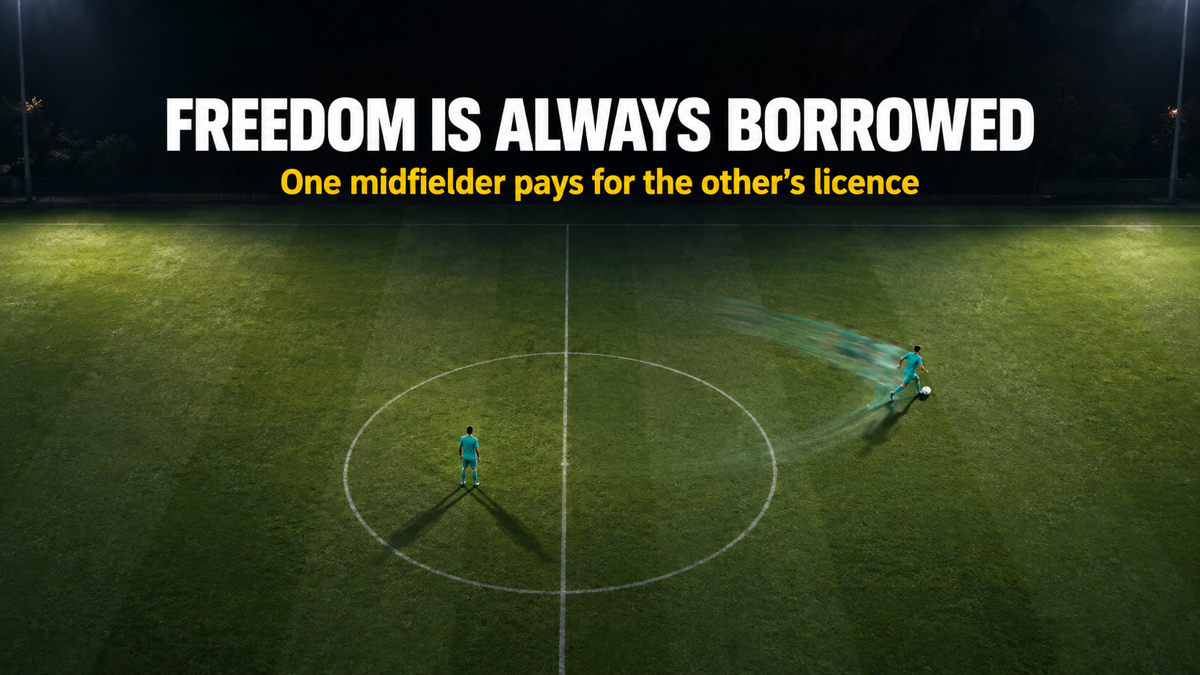

When Mikel Arteta sends Martín Zubimendi out at the Emirates, the instruction is not to create. It is to stay. That single command is what lets Martin Ødegaard drift, vanish between the lines, and operate as a roaming playmaker who answers to space instead of a fixed position.
This is the oldest bargain in midfield design, and it sits underneath almost every elite football tactics blueprint. One player’s freedom is always borrowed against another player’s discipline.
In simple terms: A roaming playmaker creates with positional freedom, while an anchor gives that freedom up to shield the defence and hold the shape.
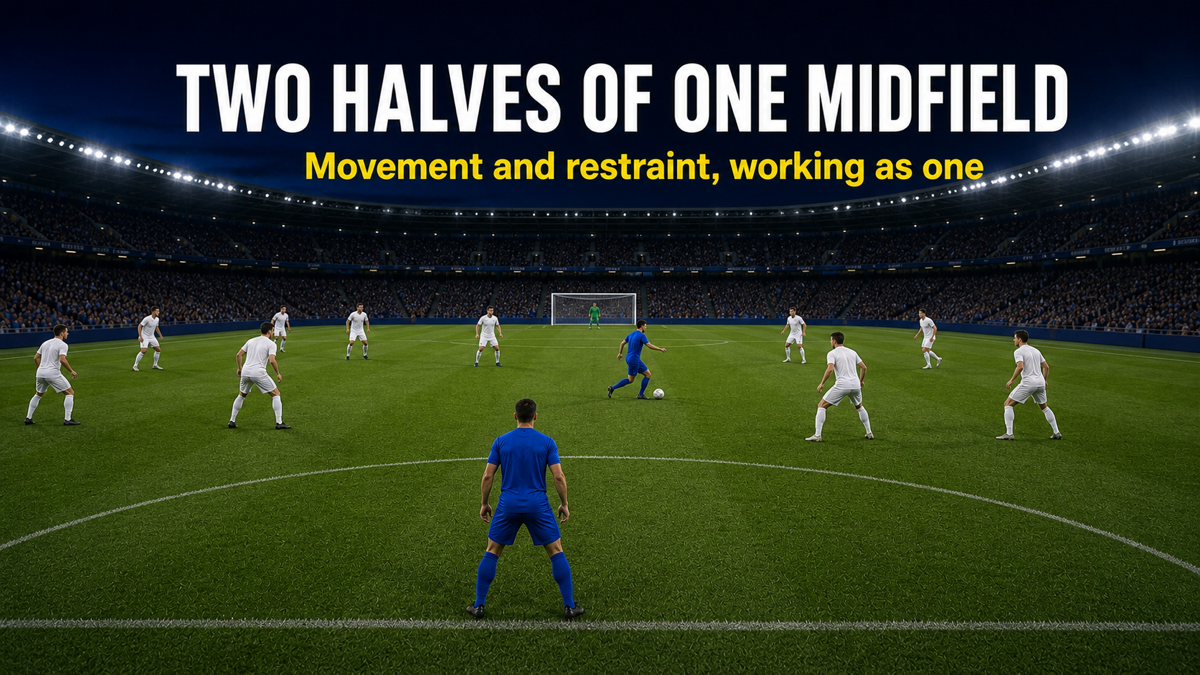
The two roles are not rivals on opposing teams. They are two halves of the same midfield, and the best coaches spend their careers balancing one against the other.
Key Takeaways
- Freedom is borrowed, not free: A roaming playmaker buys creative licence that an anchor pays for in defensive cover, so very few midfields can field two free creators at once.
- Arsenal built the clearest template: Martín Zubimendi holds as the single pivot specifically so Ødegaard and Declan Rice can push higher, a structure Opta credits for Arsenal’s sharper 2025-26 build-up.
- The anchor is a controller, not a destroyer: A modern anchor midfielder like Rodri completes over 90% of his passes for Manchester City, screening the back line and setting tempo rather than only winning tackles.
- Roaming carries a transition cost: When the roaming playmaker leaves his zone, the team is exposed on the counter unless the holding midfielder and full-backs pre-load the cover behind him.
- Balance beats stacking talent: Most title-winning teams pair one roaming playmaker with one holder, because two anchors smother creation and two roaming playmakers surrender control.
Table of Contents
What Is a Roaming Playmaker, and What Is an Anchor?
A roaming playmaker is a creative midfielder given licence to leave his nominal position and hunt space anywhere on the pitch, while an anchor is the holding midfielder who stays in front of the back line to protect it. One role is defined by movement, the other by restraint.
The anchor’s modern blueprint traces to Claude Makélélé, whose screening work at Real Madrid and Chelsea was so distinct that English football named the position after him, per the record of the Makélélé role. He rarely passed forward, almost never scored, and was completely indispensable.
The roaming playmaker grew from the opposite instinct. As rigid number 10 zones were pressed out of the game, the creative hub drifted deeper and wider, an evolution we trace in our breakdown of why the traditional number 10 disappeared.
Among modern midfield roles, these two sit at opposite poles. The roaming playmaker is granted maximum freedom; the anchor is handed maximum responsibility, and each only works because the other exists.
The Roaming Playmaker: Freedom Is the Whole Point
A roaming playmaker exists to break the opponent’s reference points by refusing to stand where the defence expects him. The freedom is not a luxury, it is the entire mechanism.
Ødegaard does this for Arsenal by floating between the right half-space and central pockets, dragging a marker out of shape before slipping the runner in behind. Kevin De Bruyne built a decade on the same idea before joining Napoli in 2025, and Florian Wirtz now gives Liverpool a younger engine for it.
The role’s deepest expression is the free number 8, the position we unpack in full in our guide to the Free 8 role. The job is not a location on a teamsheet, it is a licence to find wherever the game is most fragile.
The roaming playmaker is dangerous precisely because he is unpredictable. A defender can mark a position. He cannot mark a roaming playmaker who treats the whole pitch as his zone.
The Anchor: Someone Has to Hold the Floor
An anchor is the midfielder who stays so that everyone else can move, holding the central space in front of the defence at all times. His value is measured in the gaps that never open.
Rodri is the defining modern example, operating as Manchester City’s single pivot in roughly two-thirds of his 2025-26 minutes and completing over 90% of his passes while screening the back line. When he was absent through injury across 2024-25, City’s control visibly frayed.
Moisés Caicedo plays a more aggressive version at Chelsea, ranking among the Premier League’s busiest ball-winners with hundreds of recoveries across the 2025-26 season. The anchor is not always passive, but he is always responsible.
This is where the anchor is often confused with the deep-lying playmaker, or regista. The difference is intent: the regista sits deep to start attacks, while the anchor sits deep to stop them.
The Trade-Off: Why a Midfield Cannot Maximise Both
A midfield cannot maximise creativity and security at once because the same player cannot be in two places at the same time. Every system is a choice about whose absence the team can survive.
Each time the roaming playmaker vacates central midfield to influence the final third, he leaves a gap behind him. If the anchor steps up to join him, the team has no shield; if the anchor stays, the team has no second creator.
This is why most coaches choose a hierarchy instead of a balance. They decide which single player is allowed to be free, then build everything around protecting that decision.
The cost is real on both sides. A team that frees two midfielders concedes transitions, while a team that frees none becomes slow and easy to predict.
How Arsenal and Manchester City Settle It
Elite teams settle the trade-off by pairing exactly one roaming playmaker with one holder, then adding a third midfielder who can do either job. The table below shows how differently the two reference roles are used across a season.
| Role Metric (per 90) | Roaming Playmaker | Anchor Midfielder | Tactical Implication |
|---|---|---|---|
| Final-third touches | High (40-55) | Low (10-18) | The roaming playmaker lives where chances are made; the anchor rarely arrives there. |
| Tackles plus interceptions | Lower (2-3) | Higher (4-6) | The anchor carries the defensive load the roaming playmaker is excused from. |
| Average action height | High and shifting | Low and fixed | The anchor’s fixed depth is the insurance policy that protects the roaming playmaker. |
| Pass tendency | Forward and risky | Safe and stabilising first | Each role manages a different kind of risk for the team. |
Data reflects average per-90 benchmark ranges for elite Premier League midfielders in 2025-26, via FBref. Individual team and season variance applies.
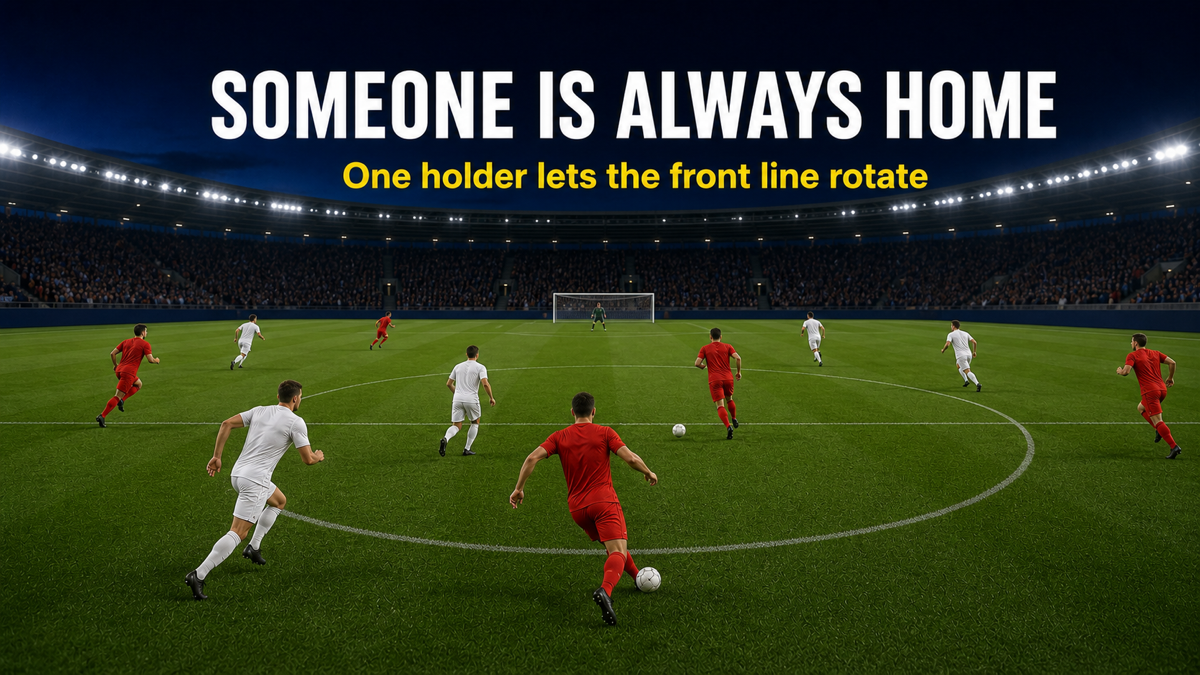
Arsenal show the template at its cleanest. Zubimendi anchors so Ødegaard and Rice can take turns advancing, a structure Opta’s analysts credit for freeing Arsenal’s creative midfielders without leaving the side exposed.
Manchester City run the same logic with Rodri as the constant reference point. His presence is what lets the full-backs invert and the front five rotate, because someone is always home.
The cleanest structural answer is the double pivot, where two holders share the anchor’s job so one can step out while the other stays. We cover that exact mechanism in our box midfield breakdown.
The Weakness: When the Balance Breaks
The system breaks when the opponent removes the anchor from the equation, because everything in front of him is built on his presence. Take away the pivot and the whole structure leans.

Pressing teams target the single pivot on purpose. Diego Simeone’s Atlético Madrid and other aggressive counter-pressing sides screen the anchor with a forward, forcing the centre-backs to play around him and cutting the roaming playmaker off from clean possession.
The second failure is overreach. When a team frees two midfielders at once, it invites exactly the transition it cannot cover, and one turnover becomes a clear run at the back four.
The roaming playmaker carries his own fragility. Assign a disciplined man-marker to shadow his every drift and a team can lose its only reliable source of creation, which is why leaning on one roaming playmaker is a risk in itself.
Final Thoughts
The roaming playmaker gets the highlight reel, but the anchor decides whether the highlight reel is even possible. That is the uncomfortable truth of modern midfields: the most valuable role is usually the one the broadcast cameras ignore.
Football’s drift toward positionless systems has not dissolved this trade-off, it has only disguised it. Even in the most fluid teams, someone is still quietly holding the floor while everyone else dances on it.
The best managers are not the ones who collect creators. They are the ones who decide, early and clearly, which player is allowed to be free, then pay the price to protect that freedom everywhere else.
Get that decision right and the midfield sings. Get it wrong and it is the first seam an elite opponent will pull apart.
What Do You Think?
Arsenal trust Zubimendi to anchor so Ødegaard can roam, but in a Champions League knockout where a single counter ends your season, would you still set your playmaker free, or chain him to the structure and trust the moment to someone else? Make your case below.
Want to read any match like this?
The framework behind these breakdowns, in one place. The four phases, a 15-minute method for diagnosing both teams before the drinks break, a printable match-watching worksheet, and 51 terms defined. 40 pages.
Get the pack$9, instant downloadRelated Tactical Breakdowns
Relationism in Football: The Complete Tactical Guide (2026)
Why it connects: The roaming-versus-anchored choice is the player-level version of the bigger relationism-versus-positionism divide that splits modern coaching.
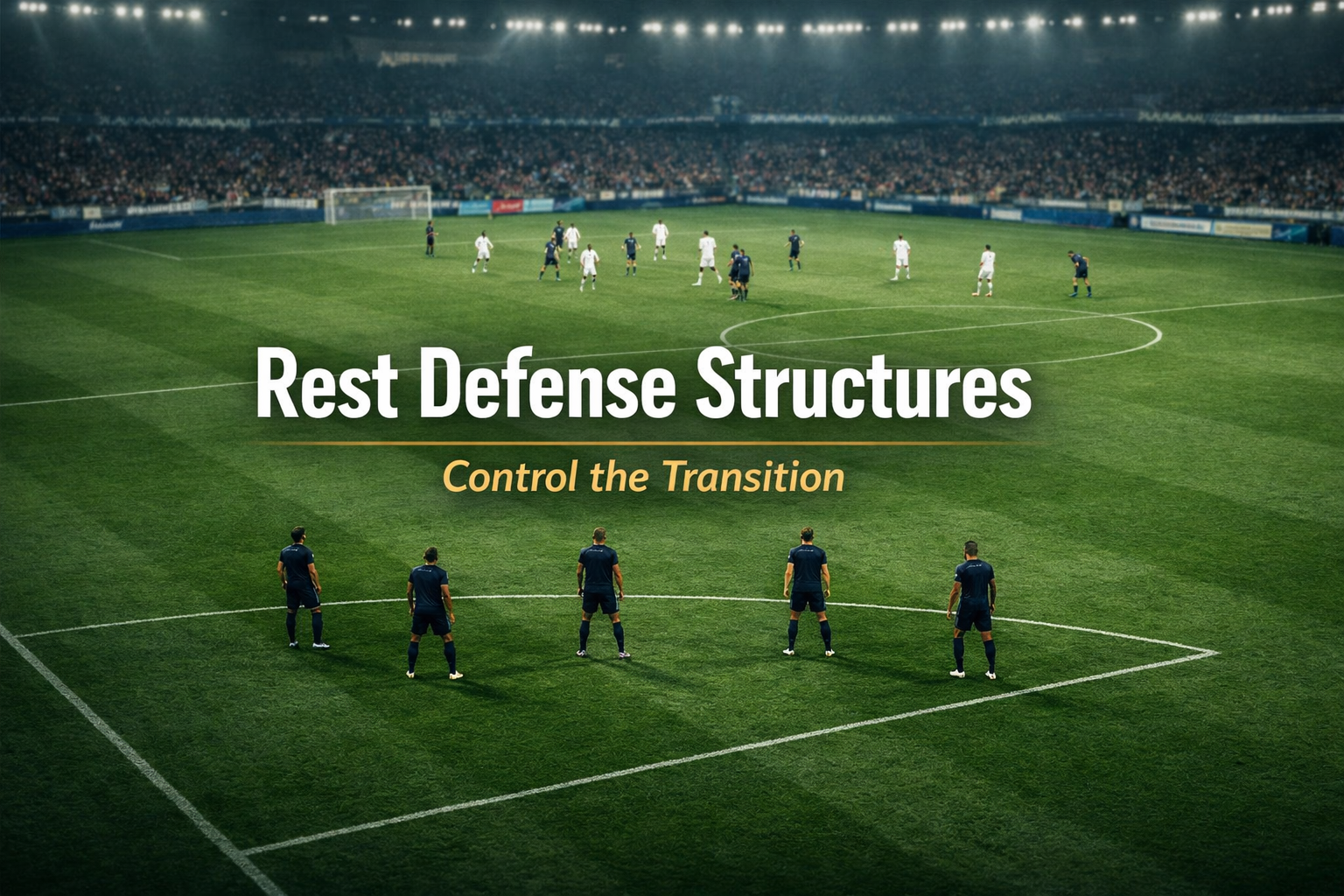
Rest Defense Explained: The 2-3 and 3-2 Structures That Kill Counter-Attacks
Why it connects: Rest defense is the structure that lets the anchor cover for a roaming playmaker without leaving the team open to the counter.
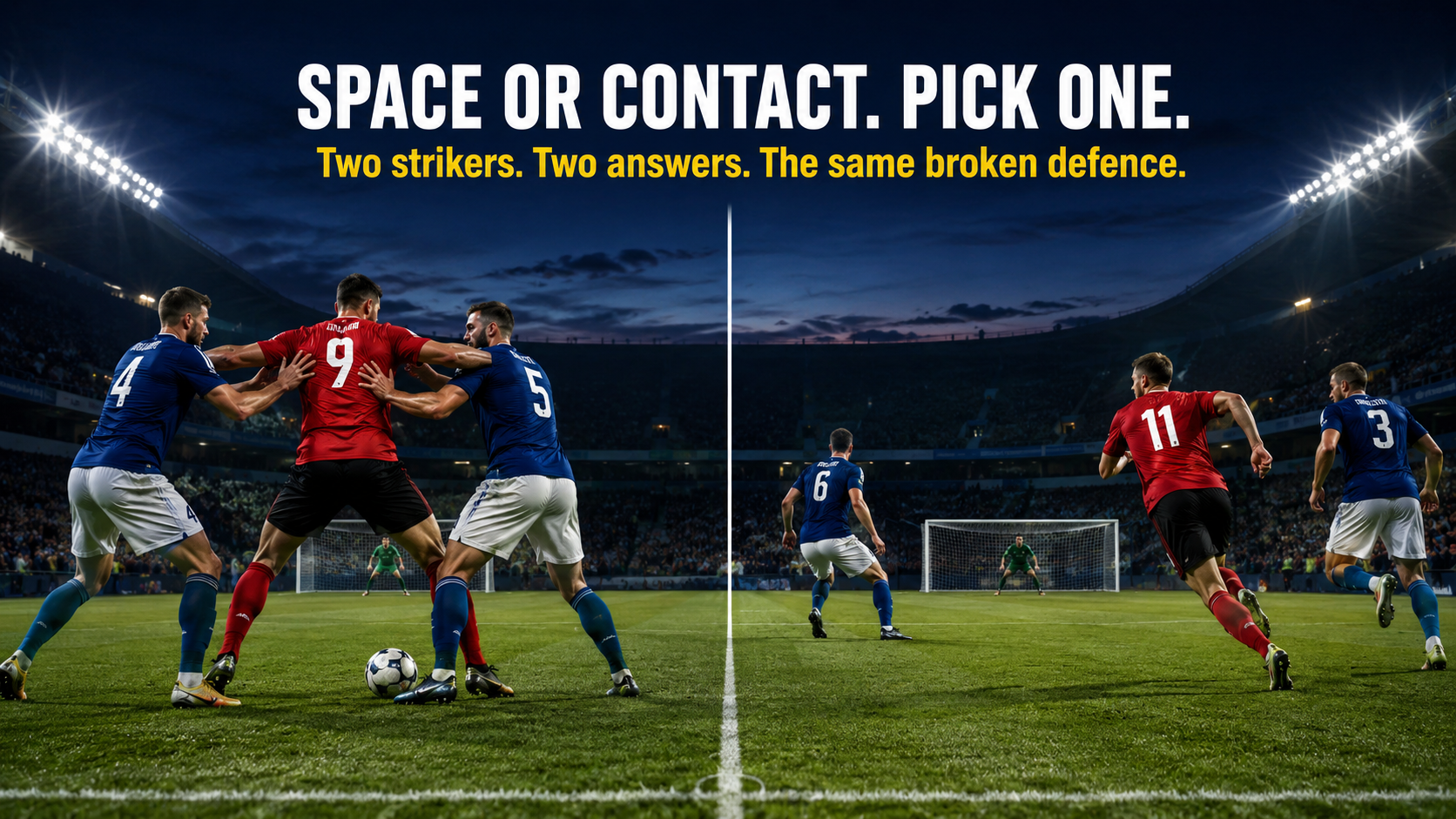
False 9 vs Target Man: How Two Strikers Break a Defence Differently
Why it connects: Like the roaming playmaker and the anchor, the false 9 and target man are two opposite answers to the same tactical question.
Speak the language of the game
Get the free 47-term tactical glossary. Gegenpress, half-space, xT, low block, each defined in plain language and linked to a full breakdown. It is yours for an email.
Frequently Asked Questions
What is the difference between a roaming playmaker and an anchor?
A roaming playmaker creates with freedom, while an anchor stays deep to defend the space he leaves behind. The playmaker drifts across the pitch to find pockets and break lines. The anchor holds one central zone, screening the back four and recycling possession so the team keeps its shape.
Why do teams need an anchor midfielder?
Teams need an anchor because attacking freedom always creates defensive gaps that someone must cover. When the full-backs push up and a roaming playmaker drifts forward, the anchor screens the space ahead of the centre-backs. Without that reference point, one lost ball becomes a direct run at goal.
Can a team play with two roaming playmakers?
A team can play with two roaming playmakers, but it usually pays for it in transition. Two roaming playmakers leave the midfield thin the moment possession is lost, exposing the defence to counters. Most elite sides keep at least one holding midfielder behind the creativity to manage that risk.
Is the anchor the same as a deep-lying playmaker?
No, the anchor and the deep-lying playmaker are not the same, even though they occupy similar space. An anchor sits deep mainly to defend and protect the back line. A deep-lying playmaker, or regista, sits deep to start attacks with progressive passing, prioritising creation over destruction.