
Last updated: November 13, 2026
October 19, 2013, the Emirates. Jack Wilshere scored against Norwich City at the end of a run of first-time exchanges with Santi Cazorla and Olivier Giroud, a sequence so fast the last defender never got his feet set. The goal was replayed for years as an aesthetic highlight, but it was really a demonstration of the oldest structural trick in football tactics: the wall pass, the give and go that turns a marked player into a free one.
The move needs two players, one quick exchange and roughly two seconds. Pressing has made defenders faster and blocks more compact, yet the combination keeps working at every level of the game, from academy sessions to Champions League semi-finals.
In simple terms: A wall pass is a two-player combination where the passer sprints past a defender and instantly receives the ball back.
This breakdown covers the 2v1 geometry that makes the move so durable, the league title it won in 1951, and the moment a simple exchange grows into a three-player pattern.
Key Takeaways
- Two attackers, one defender: The move manufactures a temporary 2v1, and no single defender can cover the ball and the run at the same time.
- The receiver decides everything: The wall’s first-time return, not the initial feed, determines whether the combination breaks the line or dies.
- Title-winning pedigree: Arthur Rowe’s push and run Tottenham rode relentless two-player exchanges to the 1950-51 First Division title, the style’s clearest historical proof.
- The gateway pattern: Add one more runner and the exchange becomes a third man combination, the move Xavi calls impossible to defend.
- Counter-press bait: A failed exchange leaves two attackers stranded ahead of the ball, exactly the turnover that gegenpressing teams feed on.
Table of Contents
What Is a Wall Pass?
A wall pass is a quick one-two in which a player feeds a teammate and sprints past the defender to collect an immediate first-time return. Coaches also call it the give and go, and older English manuals named the receiving player “the wall” because the ball rebounds off him at speed. It is the first passing combination taught in almost every academy syllabus.

Watch footage of Pep Guardiola’s Manchester City probing the edge of a deep block and the pattern appears constantly. A midfielder passes into the striker’s feet, darts beyond his own marker, and takes the return in stride behind the defensive line. The defender must choose between the ball and the runner, and either choice is wrong.
Three details separate the real thing from a hopeful exchange. The first pass must be firm and into feet, the run must attack the defender’s blind shoulder, and the return must arrive first time into space rather than to the spot the runner just left. Miss any one of the three and the move collapses into a turnover.
The 2v1 Equation: Why the One-Two Never Ages
The move survives every tactical era because it weaponises simple arithmetic: two attackers acting inside the same two seconds against one defender. A defender who jumps toward the ball releases the runner. A defender who tracks the run hands the receiver time to turn.
Compact defending was supposed to kill the pattern. Blocks got narrower, cover shadows got smarter, and recovery speed became a recruitment metric. The combination still works because the exchange finishes before covering defenders can process the first pass, let alone reach the return.
Timing matters more than raw speed in every exchange. The runner delays half a beat so the defender commits his weight toward the ball, then breaks. Release the return too early and the offside line swallows the run; too late and the defender recovers his ground.
Push and Run: The One-Two That Won a Title
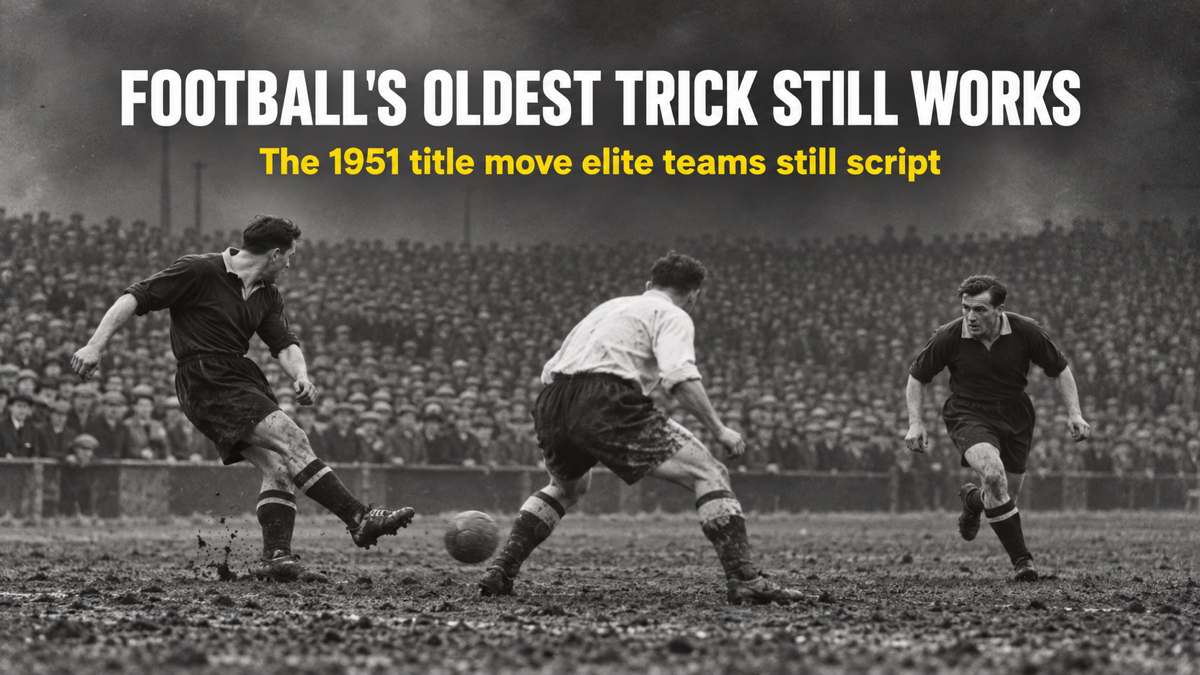
This simple exchange has already won an English league title, and it did it seventy-five years ago. Arthur Rowe built his Tottenham Hotspur side entirely around the combination, a style the press christened push and run because every player passed to a teammate and immediately moved for the return. Spurs took the Second Division in 1949-50 and the First Division title in 1950-51 in consecutive seasons.
Rowe’s motto was “make it simple, make it quick,” and the quick return pass was its purest expression. Defenders of the era marked man-to-man, so every exchange dismantled an individual duel rather than a zonal net.
The idea outlived its inventor’s era. Push and run is regularly cited as a forerunner of the possession styles that followed, and the two-man exchange it was built on remains the foundation of modern passing combinations.
The Wall’s Job: One Touch Decides Everything
The unglamorous half of every exchange is the wall, and the receiver’s first touch decides the combination’s fate. A proper return arrives first time, weighted into the runner’s stride, and played into the space behind the defender. A receiver who takes two touches kills the move, because the extra beat lets the defender release the ball and recover the runner.
Body shape does the work before the ball even arrives. Good walls receive side-on, hips open to the runner’s lane, using their frame to shield the exchange from the nearest defender. Strikers like Harry Kane have built careers partly on this skill, dropping a yard off the centre-back to set first-time returns that split the line.
Coaches drill the receiver’s touch more than the runner’s sprint for a reason. Any professional can run in behind; far fewer can weight a one-touch return under contact. When analysts praise a striker’s link play, a large share of what they are measuring is how well he plays the wall.
When Two Becomes Three: The Third Man Combination
Every third man combination is a wall pass wearing a better disguise. The sequence starts identically, a feed into feet and a first-time set, but the return releases a third player arriving from the blind side instead of the original passer. Xavi, who grew up with the idea at Barcelona, has called the third man impossible to defend, because defenders lock onto the two players exchanging the ball and never track the arrival.
The two-man version is the engine inside those longer patterns. Our breakdown of the third man run covers how elite teams script the arriving runner; the two-player exchange is what pins the defence in place so that run can land.
The table below maps the core combinations, what each one needs, and which defender it removes from the picture.
| Combination | Players involved | Typical touches | Defender it removes |
|---|---|---|---|
| Wall pass (1-2) | 2 | 3 | The runner’s direct marker |
| Up-back-through | 3 | 3-4 | The line-holder behind the set |
| Third man run | 3 | 3-4 | The blind-side cover defender |
| Overlap / underlap | 2 | Varies | The isolated wide defender |
Typical coaching patterns for each combination, not data from a single season.

The progression is worth stating plainly. Master the two-player exchange and the three-player patterns come almost free, because the hard skills, the set touch and the timed run, are identical in both.
The Weakness: When the One-Two Feeds the Counter-Press
The combination carries a structural cost: it commits two players beyond the ball with no guarantee the exchange comes off in a congested zone. An intercepted return does not just end the attack. It launches a counter with the passer and the receiver both removed from the defensive picture, the exact 5-second turnover window we broke down in counter-pressing.

Zonal cover is the second antidote. Man-marking defenders die to the move because they chase the runner; a drilled zonal unit simply hands the runner between defenders and holds the lane the return needs. Diego Simeone’s Atlético Madrid have spent a decade suffocating these central exchanges this way, funnelling the return ball into crowds where a second defender arrives before the runner’s touch.
The smartest low blocks do not even chase the interception. Defenders drop a protective yard so the return arrives in front of them, close the runner’s lane, and let the move complete harmlessly sideways. Beating one man means nothing when the man behind him was never moved.
Final Thoughts
The give and go endures because it attacks the one thing tactical evolution cannot patch: a single defender’s inability to be in two places at once. Systems change, and the 2v1 does not.
The verdict here is that the one-two is becoming more valuable, not less. Compact mid-blocks have strangled the dribble and crowded out the long through ball, which leaves the quick exchange as the cleanest remaining route through the middle of the pitch. Teams that rehearse the move as a scripted pattern, with named receivers and timed runs, are buying line-breaks that transfer fees cannot.
One question is worth carrying out of this piece. If a two-man exchange is this cheap and this reliable, why do so few sides below the elite actually script it?
What Do You Think?
Arthur Rowe’s push and run side won the 1950-51 title on relentless quick exchanges, and Guardiola’s teams leaned on the same 2v1 seventy-five years later. Is the move genuinely unkillable, or would a fully zonal, no-jump defensive line finally retire football’s oldest combination? Drop your take below.
Related Tactical Breakdowns

The Up-Back-Through Combination: How Elite Teams Score on the Break
Why it connects: The up-back-through is the three-player evolution of this move, using the same set-and-return mechanics to release a runner in behind.

Football Overloads and Isolations Explained: How Elite Teams Manipulate Space
Why it connects: This quick exchange is the fastest way to manufacture the 2v1 overload this breakdown maps across every zone of the pitch.

Underlap vs Overlap: How Elite Teams Break Low Blocks
Why it connects: Wide combinations and underlaps attack the same isolated fullback, and this piece shows when each release beats a low block.
Learn to read a match like an analyst
Get the free 33-page Starter Pack, How to Read a Football Match (the Four Phases, a 15-minute match read, a printable worksheet), plus the 70+ term tactical glossary. Both are yours for an email.
Frequently Asked Questions
What is a wall pass in football?
A wall pass is a two-player combination where one player feeds a teammate and immediately runs behind the defender to collect a first-time return. Coaches also call it the one-two or the give and go. The receiving player acts like a wall, rebounding the ball back into space.
Why is the one-two so hard to defend?
The one-two is hard to defend because it forces a single defender into two jobs at once. Stepping toward the ball releases the runner, while tracking the run gives the receiver time to turn. Covering defenders rarely arrive inside the two seconds the move needs to finish.
Is the one-two the same as a give and go?
Yes, the one-two and a give and go describe the identical combination. Both terms cover a feed into a teammate followed by an instant return played into the original passer’s run. British coaching tends to say wall pass or one-two, while give and go is the common North American label.
How does a one-two become a third man combination?
A one-two becomes a third man combination when the first-time return releases a different runner instead of the original passer. The first two players still provide the feed and the set. A third player then arrives from the blind side, unseen by defenders locked onto the ball.
Can a one-two break a low block?
Yes, the give and go is one of the few reliable routes through a compact low block. Deep defences remove the space in behind but leave defenders isolated in front of the ball, where a sharp exchange removes one instantly. The margin is small because cover sits close, so the timing must be exact.
Cite this article
Khara, J. (2026, November 10). The Wall Pass: Why Football’s Oldest Combination Still Splits Defences. KharaSportsDaily. https://kharasportsdaily.com/wall-pass-one-two/