
Last updated: September 19, 2026
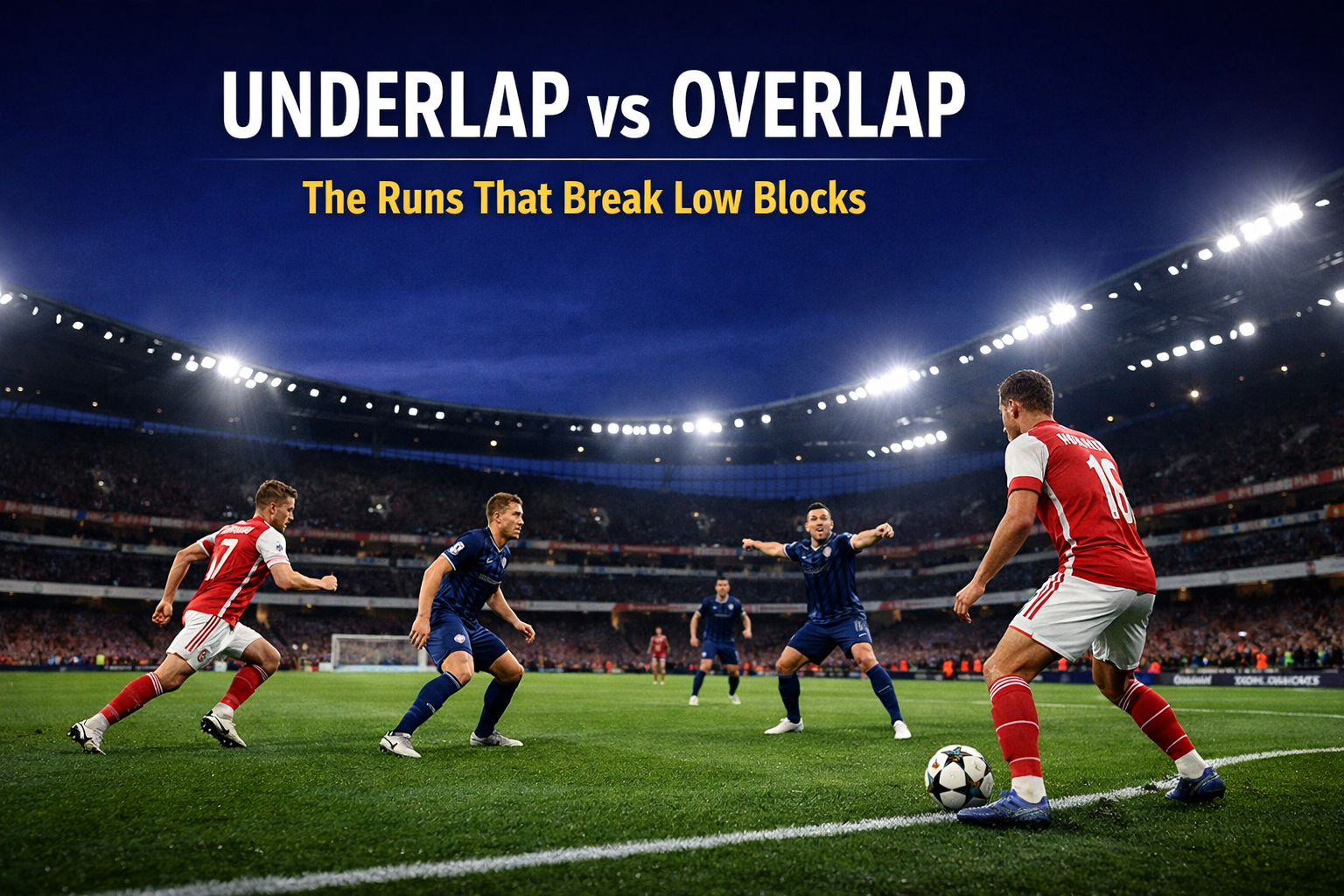
Watch any Arsenal match from the 2025-26 title season and you will see the same pattern on the right flank: Bukayo Saka receives the ball, and Jurriën Timber or Ben White comes sprinting around him on the outside. Classic overlap. Now watch the left flank. Piero Hincapié or Riccardo Calafiori does something different. He runs inside the winger, between the opposition centre-back and fullback, targeting the half-space. That is an underlap, and it is a completely different tactical problem for the defender.
Mikel Arteta is not mixing these up by accident. Sitting top of the Premier League after 11 games of the 2025/26 season with only five goals conceded, Arsenal are using both runs surgically, depending on which side of the pitch they are attacking and which defender they want to bend out of shape. The choice between tactical systems is never random at this level.
In simple terms: In Underlap vs Overlap comparison, an overlap is a run outside the ball-carrier toward the touchline; an underlap is a run inside the ball-carrier into the half-space.
This breakdown covers what each run actually does to a defensive line, which elite teams prefer which, and why the underlap has quietly become the more dangerous weapon in modern football.
Key Takeaways
- The core difference: An overlap runs outside the ball, targeting the touchline and crossing zones; an underlap runs inside the ball, targeting the half-space between centre-back and fullback.
- Different defenders under pressure: Overlaps force the opposition fullback into a 2v1 decision; underlaps drag the opposition central midfielder or centre-back out of position, which is a harder problem to solve.
- Modern bias toward the underlap: With inverted wingers now the norm, the half-space is where xG lives, and underlapping runs attack it directly.
- Elite examples in 2025/26: Arsenal overlap Saka on the right and underlap on the left; Manchester City use No. 8 underlaps as their primary chance-creation pattern.
- Context matters: Neither run is “better.” The right choice depends on the winger’s foot, the opposition structure, and where the gap in the back line is, not manager preference.
Table of Contents
What Is an Underlapping Run?
An underlapping run is a forward sprint made on the inside of the ball-carrier, usually into the channel between the opposition centre-back and fullback. An overlap does the opposite: the runner sweeps around the outside of the ball-carrier, hugging the touchline to stretch the defensive line horizontally.
The clearest modern template comes from Pep Guardiola’s Manchester City. When a City winger receives the ball wide, a No. 8, historically Kevin De Bruyne, now the pattern his successors inherit , makes an underlap through the half-space. The underlapping player often drags away a defensive midfielder, which opens the space inside. The winger can take the ball inside and shoot or find a pass to a free player in front of the backline. FBref The centre-back is now asked a brutal question: track the runner and leave Erling Haaland unmarked in the box, or hold position and let the underlapper receive a through ball with a shot on goal.
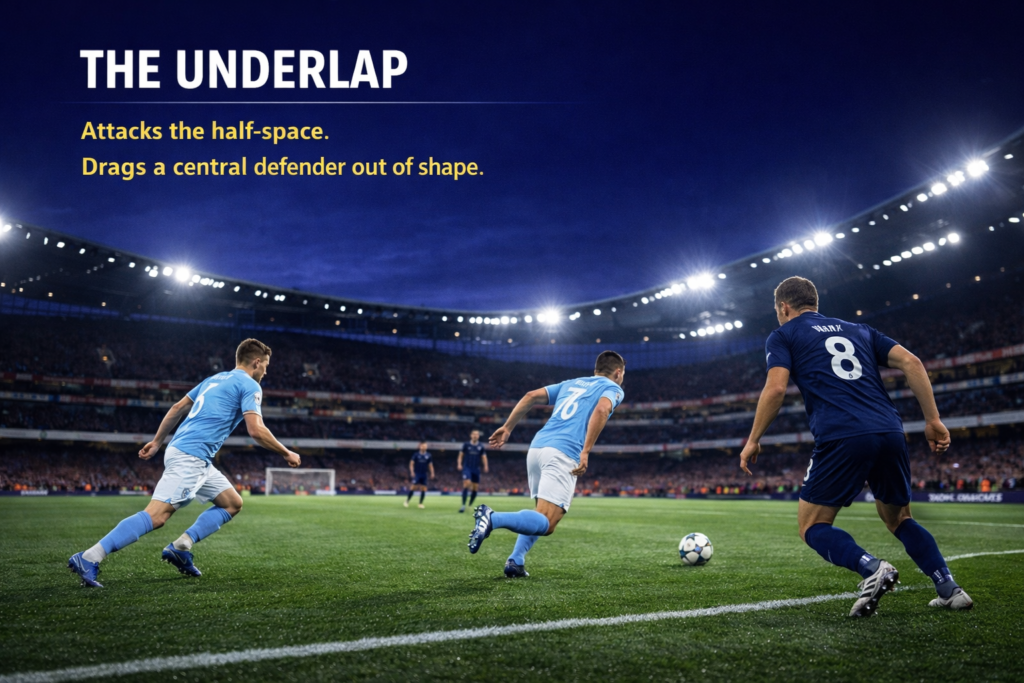
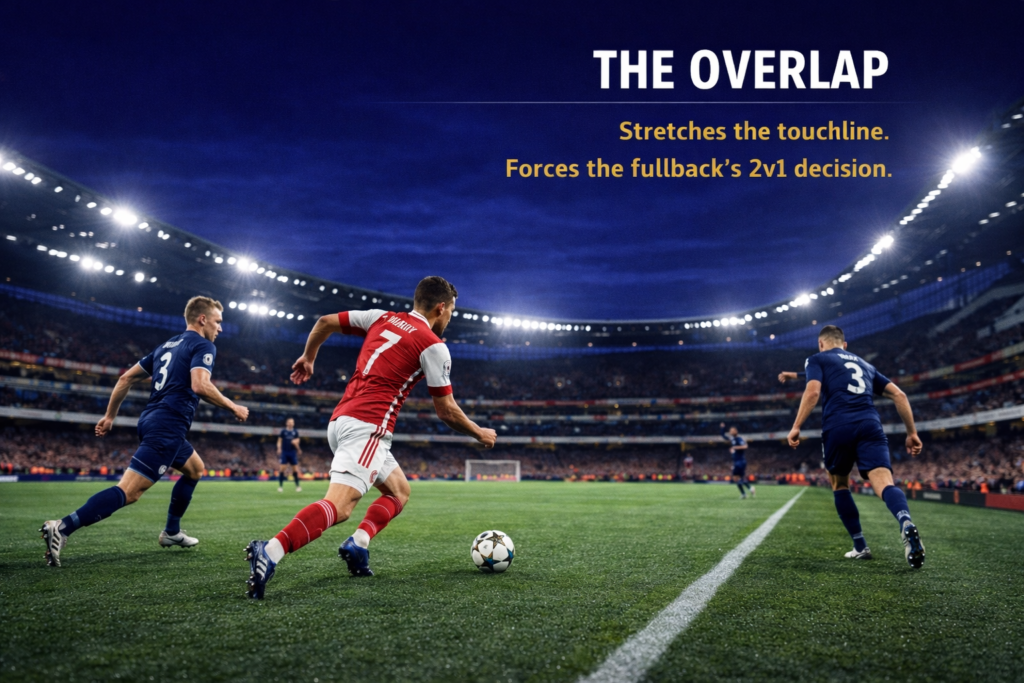
The overlap poses a simpler question. When the fullback bombs on, the opposition fullback must decide whether to follow the run and leave the inside-cutting winger 1v1 against the centre-back, or stay central and concede a crossing lane. Either choice creates a chance. But it is a wide-area question, not a central one, and that is why the underlap has become the more valuable weapon for teams trying to break low blocks.
The Geometry of the Half-Space
The half-space sits between the central channel and the wide channel, roughly between the touchline and the penalty area. It is the highest-xG attacking zone in the modern game.
Per FBref’s expected-goals model, shots from the half-space convert at significantly higher rates than shots from the wide channel, because the angle to goal is wider and the goalkeeper has less time to adjust. An underlap targets this zone by running between the opposition centre-back and fullback, arriving in the half-space exactly when the inverted winger needs the lay-off.
The overlap, by contrast, targets the wide channel. The angle is poor, the cross is the only realistic finish, and conversion rates collapse. This is why elite teams in 2025-26 lean increasingly on underlaps despite the higher technical demand.
Manchester City’s No. 8 Underlap Pattern
Pep Guardiola’s Manchester City built the modern underlap template. The pattern begins with the inverted winger receiving wide, drawing the opposing fullback toward the touchline. As the fullback commits, a No. 8 sprints from midfield into the half-space behind him.
Kevin De Bruyne played this role for nearly a decade. His successors, Phil Foden and Rico Lewis among them, run the same underlap geometry from slightly different starting positions. The constant is the timing: the No. 8 arrives in the half-space at the exact moment the winger needs a passing option diagonally inward, never sooner, never later.
City’s record from this pattern is the reference point every analyst measures against. Per FBref’s Manchester City team page, City generate the highest share of shots from half-space combinations of any Premier League side.
How Arteta’s Arsenal Uses Both Runs?
Arsenal in 2025/26 offer the cleanest example of modern overlap-underlap design because Arteta uses different runs on different flanks. Below is the general tendency pattern based on the team’s shape and personnel through the opening 11 league games, where Arsenal sat top with only five goals conceded.
| Flank | Runner | Run Type | Target Zone | Winger Behaviour |
|---|---|---|---|---|
| Right | Timber / White | Overlap | Outside Saka, toward byline | Saka cuts inside onto left foot |
| Left | Calafiori / Hincapié | Underlap | Half-space, inside the winger | Winger holds width, drives at fullback |
| Central support | Declan Rice | Late arriving underlap | Top of the box | Occupies defensive midfielder |
Data reflects the general tactical pattern observed in Arsenal’s 2025/26 Premier League shape. Individual match variance applies; personnel rotate based on opposition and availability.
The logic is foot-dependent. Saka is a right-footed winger on the right who lives to cut inside. An overlapping run from Timber gives him the 2v1 that either releases him to shoot with his stronger foot or drops the ball into the overlap for a cutback. This is the same principle that made Jordi Alba’s overlaps of Lionel Messi so lethal at Barcelona a decade ago. Different personnel, identical geometry.
The left is inverted. Arsenal’s left winger tends to hold width while the underlapping fullback attacks the pocket between the opposition right-back and right centre-back. That underlap is what the Coaches’ Voice analysis of Arsenal’s 25/26 structure called a 3-2 base, where the left-back tucks inside in build-up and then bursts forward late. It is the same principle Guardiola pioneered: use the fullback as a secondary midfielder in build-up, then as a vertical threat in the final third.
The tactical point is that Arsenal are not picking runs by player preference. They are picking them by which defensive question is harder to answer on that side of the pitch. If the opposition right-back is aggressive and steps out, the underlap punishes the space he leaves. If the opposition left-back is cautious and sits deep, the overlap stretches him horizontally until the gap appears.
When the Overlap Still Wins
The overlap remains the dominant choice in two specific situations. The first is when the opposition fullback is defending narrow, leaving the wide channel undefended. Forcing the play wide stretches the back four laterally and creates space for a cut-back.
The second is when the attacking team needs a cross. Plain crosses, half-volleys, and back-post headers all require the ball to arrive from a wide angle, which only the overlap delivers. Ange Postecoglou’s Tottenham in 2024-25 leaned on overlaps from Pedro Porro for this reason.
The decision is not philosophical. It is structural: if the inverted winger already occupies the half-space, an underlap is redundant and an overlap creates the only useful second runner.
The Inverted Fullback / Underlap Pairing
An underlap requires an inverted fullback or a midfielder willing to run from deep. The classic overlapping fullback, comfortable on the touchline, cannot perform the underlap profile reliably because the technical demand changes.
The inverted fullback runs forward through midfield zones, comfortable in tight central spaces, accelerating into the half-space rather than the wide channel. Riccardo Calafiori at Arsenal is the canonical 2025-26 example. Piero Hincapié plays the same role from a similar starting position.
Both spent their formative years comfortable on the ball in central zones, which is why both translate to the underlapping role naturally. For the foundational principle here, see our breakdown of inverted fullbacks. Teams without this personnel profile rarely execute the underlap consistently.
The Weakness: How Defences Counter Them
Both runs have clear counters, and the best defensive coaches in Europe are built around them.
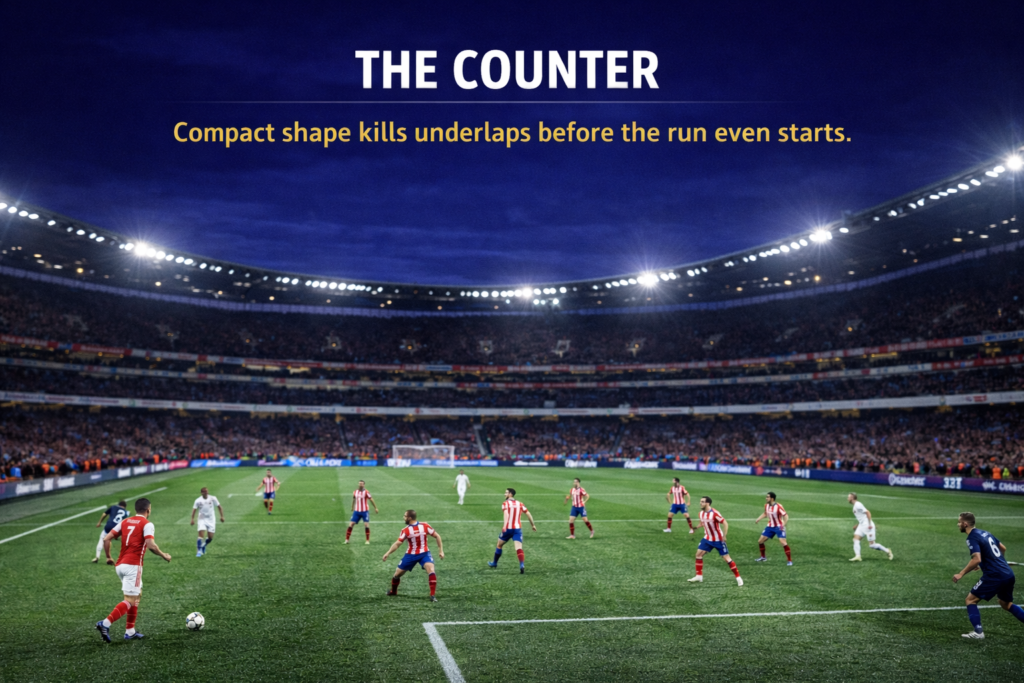
Diego Simeone’s Atlético Madrid are the textbook example. Their 4-4-2 mid-block does one thing ruthlessly: it forces play wide and stays compact centrally. Against an overlap, Atlético’s fullback trusts the winger tucked inside him to cover the half-space, so he can afford to follow the runner. Against an underlap, the centre-back never steps up because the defensive midfielder is already covering that channel. Atlético tend to rank among La Liga’s most disciplined teams at denying central penetration from wide combinations.
The other counter is structural: the back five. Unai Emery’s Aston Villa and Nuno’s Nottingham Forest have both used three centre-backs plus wing-backs specifically to solve the underlap problem. When a fullback underlaps, a back four has to shuffle. The centre-back steps out, the other centre-back shifts across, the far-side fullback tucks in. In a back five, the wide centre-back simply steps up and the shape holds. No domino effect.
The tactical foul is the third, cynical counter. When Guardiola’s City lose the ball and an opposition counter targets the space their inverted fullback vacated, a smart No. 6 kills the move with a bookable foul 40 yards from goal. This is why Arteta’s Arsenal were willing to take more tactical fouls across the 2025-26 title run. The underlap-heavy structure leaves spaces behind, and you cannot always recover them defensively.
The pattern is clear: underlaps and overlaps are not unstoppable. They are leverage plays. Elite defensive teams neutralise them by making the underlap’s central threat redundant (Simeone), rebuilding the shape to absorb both runs (Emery), or accepting the yellow card as the price of defensive integrity.
The Tactical Takeaway
The underlap vs overlap debate has a cleaner answer than most tactical discourse admits. The overlap is the older, wider, simpler run. A fullback bombing on to either cross or decoy. It still works, especially with inverted wingers who need a release valve. The underlap is the newer, sharper weapon. It attacks the half-space, which is where modern xG actually comes from, and it asks a harder question of the defence because it pulls a central player out of position rather than a wide one.
My verdict: the underlap is the more valuable of the two in 2025/26 because it solves the low-block problem that overlap-heavy teams keep running into. Arsenal understand this, which is why their left flank is underlap-coded and their right flank is overlap-coded. It is not dogma. It is asymmetric design. The teams that figure out which run to use on which side, against which opponent, are the ones breaking down the toughest defences. Which will Liverpool, Real Madrid and Bayern commit to in 2026-27?
What Do You Think?
Arsenal have conceded only five goals in 11 league games while running heavy underlap patterns on the left. But those patterns only work when the team dominates field position. Arsenal’s field tilt sits near the top of the Premier League. In Champions League knockout ties, where you spend long stretches defending rather than attacking, can an underlap-heavy team like Arsenal protect the space their fullbacks vacate? Or does that structure become a transition liability against elite opponents? Drop your take below.
Want to read any match like this?
The framework behind these breakdowns, in one place. The four phases, a 15-minute method for diagnosing both teams before the drinks break, a printable match-watching worksheet, and 51 terms defined. 40 pages.
Get the pack$9, instant downloadRelated Tactical Breakdowns
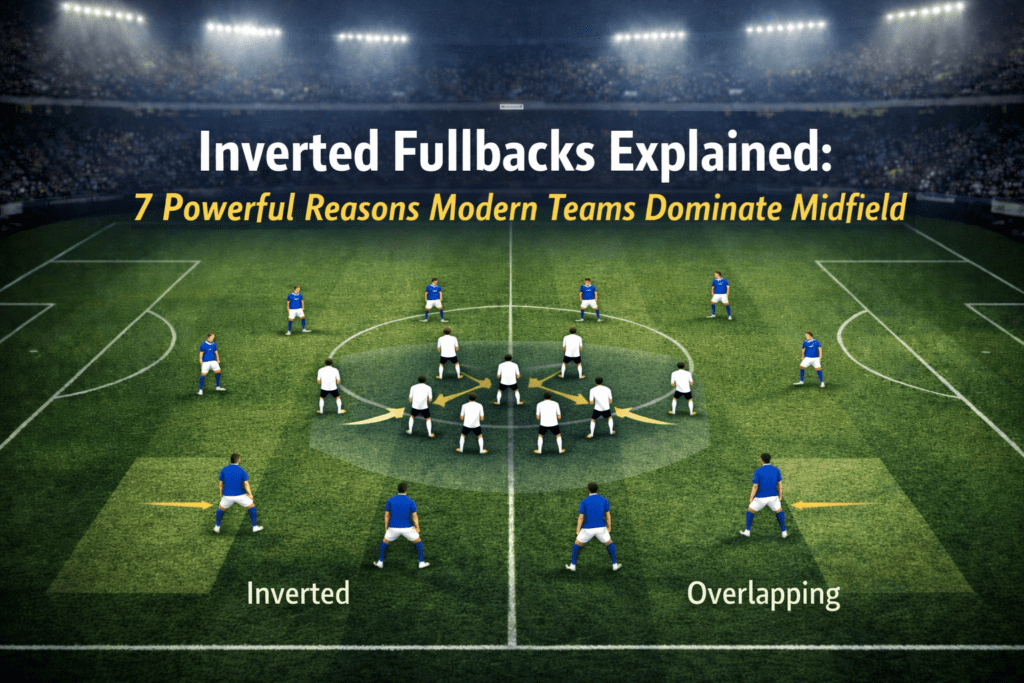
Why it connects: The underlap is impossible to execute without a modern fullback profile. This piece breaks down the role that makes Arsenal’s and City’s half-space runs possible.
Zone 14: The Most Dangerous Space on the Pitch
Why it connects: Underlapping runs target the half-space, which feeds directly into Zone 14. Understanding one requires understanding the other.
Pep Guardiola’s Final Third Mechanics
Why it connects: City’s underlap patterns are the clearest case study of how a top manager engineers half-space attacks, and why they break low blocks so consistently.
Speak the language of the game
Get the free 47-term tactical glossary. Gegenpress, half-space, xT, low block, each defined in plain language and linked to a full breakdown. It is yours for an email.
Frequently Asked Questions
What is the difference between an overlap and an underlap?
An overlap is a run made on the outside of the ball-carrier, typically by a fullback moving into the space along the touchline. An underlap is a run made on the inside of the ball-carrier, into the half-space between the opposition centre-back and fullback. Overlaps stretch defences horizontally; underlaps attack the central channel.
Why are underlapping runs more effective in modern football?
Most elite wingers now play inverted, right-footed on the left, left-footed on the right , which means they already occupy the half-space when they cut inside. An underlapping run targets the exact zone where xG is highest and forces a central defender to step out of position, which is a harder defensive problem than tracking a wide runner.
Which teams use underlaps and overlaps most effectively?
Manchester City under Pep Guardiola built their entire attacking structure around No. 8 underlaps through the half-space. Arsenal under Mikel Arteta use overlaps on the right flank behind Bukayo Saka and underlaps on the left flank from Calafiori or Hincapié. Both teams adjust the run type based on winger foot and opposition structure.
How can defenders stop an underlapping run?
Defenders stop an underlapping run by forcing the centre-back to track inside while the fullback holds the wide channel. The defensive midfielder must drop into the half-space the moment the inverted winger receives the ball, denying the seam the underlap targets. Teams that defend zonally with a disciplined No. 6 neutralise underlaps most consistently. Atlético Madrid’s compact 4-4-2 is the modern benchmark.
Can you read a match?
Six real in-game situations, one tactical read each. See how sharp your eye is, and get the full breakdown after every answer.
Take the test