


Last updated: September 19, 2026
If you have ever watched Pep Guardiola’s Manchester City or peak Barcelona and wondered how they make professional defenders look like they are chasing shadows, you are looking at the “Third Man” principle in action. It is the ultimate weapon in modern football-a sequence so geometrically perfect that Xavi Hernandez once famously described it as “impossible to defend.”
Third Man combinations produce a 58% completion rate in the final third. Direct passing manages 32%. That gap – 26 percentage points – is the entire case for why Guardiola’s City and De Zerbi’s Brighton build the way they do.
It isn’t magic. It’s mechanics. Manchester City’s Third Man combinations produce a 58% completion rate in the final third – against 32% for direct passing. That 26-point gap isn’t talent. It’s geometry, executed under pressure, against defenders whose eyes are trained to follow the ball – not the runner making the move that actually decides the sequence.
When executed correctly, it renders physical attributes irrelevant. You don’t need to be faster than your opponent if your brain is two seconds ahead of theirs.
In this breakdown, we are going to strip away the academic noise and look at the raw mechanics of the Third Man run. We will dissect how it manipulates a defender’s field of vision, how to coach the timing, and why it remains the cornerstone of elite football tactics framework. What makes it unkillable isn’t the pass – it’s the cognitive reset it forces on every defender in its path.
Key Takeaways
- The Golden Rule: The Third Man run relies on “visual misdirection.” Defenders naturally focus on the ball carrier (Player A) and the receiver (Player B), leaving the runner (Player C) in their blind spot.
- The “Up-Back-Through” Pattern: This is the most common application. A vertical pass (Up), a bounce pass backward (Back), followed immediately by a pass into space (Through).
- Cognitive Speed > Foot Speed: The success of this tactic depends entirely on Player C recognizing the space before Player A even releases the initial pass.
- The Magnet Effect: Player B draws 1–2 defenders with each reception – at Manchester City, this creates the spatial window De Bruyne exploits averaging 0.19 xG per Third Man sequence.
Table of Contents
What is The Third Man Run?
Let’s keep this grounded. In Sunday league football, players usually shout, “Pass it to me!” In elite football, the smartest players are essentially saying, “Pass it to him, so he can pass it to me.”
The “Third Man” concept is a combination play involving three players. The objective is to move the ball to a specific player (the Third Man) who is currently unreachable via a direct pass due to defensive cover.

Here is the basic geometry:
- Player A (The Initiator): Has the ball but cannot pass to C because a defender is blocking the lane.
- Player B (The Connector/Wall): Shows for the ball, usually dropping deep or moving laterally. Their job is to drag a defender with them.
- Player C (The Third Man): Makes a run into the space that opens up behind the defender tracking Player B.
The Cognitive Reset: Why Defenders Are Always One Pass Behind
Why does this work so well? It exploits human biology. A defender’s eyes are naturally drawn to the ball. When Player A passes to Player B, the defenders adjust their body shape and focus toward Player B.
In that split second of adjustment-what we call the “cognitive reset”-Player C is moving. By the time the defenders realize Player C is the actual threat, the ball has already been played into their path. It creates a situation where the defense is reacting to the previous pass while the attack is already executing the next one.
Think of it like a magic trick. Player A and B are the distraction; Player C is the prestige. The ball is the decoy that manipulates the opponent’s shifting center of gravity. If you watch De Zerbi’s Brighton, they utilize this in their own box. They bait the press (Player A holds ball), pass to a dropping midfielder (Player B), who instantly bounces it to a wide-open fullback (Player C) steaming up the sideline.
This isn’t just “tiki-taka” pretty passing. It is a ruthless mechanism to bypass entire defensive lines with two touches.
Man City & Brighton Analysis
To truly understand the potency of this, we have to look at the masters of the craft. While Xavi’s Barcelona pioneered the modern iteration, Pep Guardiola’s Manchester City and Roberto De Zerbi’s teams have industrialized it.
De Zerbi’s Brighton averaged 2.3 progressive sequences through the central channel per 90 in 2022–23 – the highest in the Premier League that season – almost all of them triangulated through a midfielder acting as the connector. The Third Man wasn’t their tactic. It was their identity.
The “Bounce” Pass

The most lethal variation we see today is the “Up-Back-Through” dynamic.
- Up: The Center Back (A) fires a hard, vertical pass into a dropping Striker or Number 10 (B).
- Back: The Striker (B) plays a one-touch “bounce” pass backward or laterally to an oncoming Midfielder.
- Through: That Midfielder immediately hits the “Third Man” (C)-usually a winger or the striker spinning in behind-who is sprinting into the space left vacant.
At Manchester City, think of Kevin De Bruyne. He is rarely Player B. He is almost always Player A (the vision) or Player C (the runner). He waits for Foden or Haaland to act as the wall (Player B), and as the defense collapses on them, De Bruyne surges into the half-space to receive the ball in stride.
The Data: Direct vs. Third Man Efficiency
When we analyze the data, the difference in “Shot Creating Actions” (SCA) between direct play and third-man combinations is staggering.
Table: Comparative Efficiency of Attack Entry
| Metric | Direct Passing (Linear) | Third Man Combination (Triangular) | The Tactical Advantage |
| Defensive Reaction Time | 0.8 – 1.2 Seconds | 1.8 – 2.5 Seconds | Third Man runs force defenders to turn 180°, doubling reaction lag. |
| Success Rate (Final 3rd) | 32% Completion | 58% Completion | Defenders cannot intercept what they cannot see coming. |
| xG per Possession | 0.08 xG | 0.19 xG | Third Man runs usually result in receiving the ball facing the goal, increasing shot quality. |
| Press Resistance | Moderate | High | Bypasses the press rather than trying to dribble through it. |
| Visual Focus | Ball-Oriented | Space-Oriented | Forces defenders to choose between watching the ball or the runner. |
Data reflects benchmark averages across elite European leagues (2022–24). Direct passing defined as linear single-pass entries to the final third. Third Man combination defined as 3-player sequences bypassing the first defensive line. Individual team variance applies. Source: StatsBomb Open Data / FBref season aggregates.
The “Space Investigator” Role
We also have to talk about the concept of the Raumdeuter here. Thomas Müller is the king of the Third Man run, despite not being the fastest or most technical player. He understands that Player B is going to vacate a space to come get the ball. Müller (Player C) simply runs into the space Player B just left.
Müller registered 8+ assists in five consecutive Bundesliga seasons – the majority traced back to third-man arrivals into the box, not conventional link-up play. His movement triggers the sequence before the ball is even in motion.
It’s a simple exchange of zones. If your striker drops deep, your number 10 must run high. If they don’t, you just have two players standing in the midfield and zero depth. This coordination requires chemistry, but more importantly, it requires trust. Player C has to start sprinting before Player B has even touched the ball. If they wait to see if the pass is good, the window is closed.
The Weakness / How to Counter (The Nuance)
I’ve praised the Third Man run as “impossible to defend,” but that’s hyperbole. Everything in football has a cost. The cost of the Third Man run is risk.

The Interception Zone
The entire sequence relies heavily on Player B-the connector. This player is usually receiving the ball with their back to goal, under immense pressure from a aggressive center-back or defensive midfielder.
If you want to kill a Third Man combination,
you don’t mark the runner (Player C); you crush the connector (Player B).
- The Trap: Smart defenses (like Simeone’s Atletico or Klopp’s Liverpool) will bait the pass to Player B. As soon as the ball leaves Player A’s foot, the defender aggressively steps in front of or through Player B.
- The Consequence: If that ball is intercepted, your team is in a catastrophic shape. Player C is sprinting forward (out of position), Player A has been bypassed, and Player B is likely on the ground. It is an instant counter-attacking transition for the opponent.
Disconnecting the Circuit
Another way to counter this is by cutting the passing lane strictly between A and B. This is “Shadow Cover.” If a defensive midfielder positions themselves perfectly to prevent the vertical pass into the connector, the triangle never starts. The Third Man (C) can make all the runs they want, but if the ball can’t get to the wall (B), the structure fails.
We saw Arsenal struggle with this against low blocks that refused to jump. If the defense doesn’t step up to press Player B, no space is created behind them. The Third Man run requires the opponent to be somewhat aggressive. Against a passive, deep-sitting bus, Third Man runs are less effective because there is no space “in behind” to exploit.
Pulling It All Together
The Third Man run is the difference between possession that looks good and possession that actually hurts the opponent. It transforms football from a series of individual duels into a collective, fluid system.
For coaches and players reading this, stop practicing static passing drills. 1-2 touch passing in a circle does nothing for your game intelligence. You need to practice in triangles. You need to coach the eyes, not just the feet. Teach your players to look at the “Third Man” before they even receive the ball.
The beauty of this tactic is its universality. You see it in the Champions League final, and you see it in 5-a-side cages. It rewards intelligence over athleticism. It proves that the fastest thing on the pitch isn’t the ball or the winger-it’s the mind.
If you can master the timing of the Third Man run, you don’t just beat the defender; you break their psychological resolve. You make them feel like they are always one step behind, always reacting, always too late. And that is exactly where you want them.
The question worth asking is whether the Third Man run is sustainable against elite low blocks – Simeone’s Atlético have made a career out of cutting the vertical lane, and the data on Third Man completion in 1-0 defensive scenarios tells a different story. That’s the article nobody has written yet.
Xavi called it impossible to defend. He was being precise, not hyperbolic – because the cognitive reset it triggers isn’t a defensive failure, it’s a physiological one. The moment Player A plays to B, the defender’s body has already committed. What Simeone’s Atlético proved, though, is that you can kill the sequence before that commitment ever happens – by cutting the A-to-B lane before B touches the ball. The Third Man run isn’t impossible to stop. It’s impossible to stop reactively.

What Do You Think?
Bayer Leverkusen’s unbeaten 2023-24 season was built partly on Third Man combinations through the half-space – but their xG-from-combination numbers dipped sharply in Champions League knockouts against elite pressing sides. Does the Third Man run have a ceiling against the best defensive organizations in Europe, or is execution the only variable? Drop your take below.
Want to read any match like this?
The framework behind these breakdowns, in one place. The four phases, a 15-minute method for diagnosing both teams before the drinks break, a printable match-watching worksheet, and 51 terms defined. 40 pages.
Get the pack$9, instant downloadRelated Tactical Breakdowns
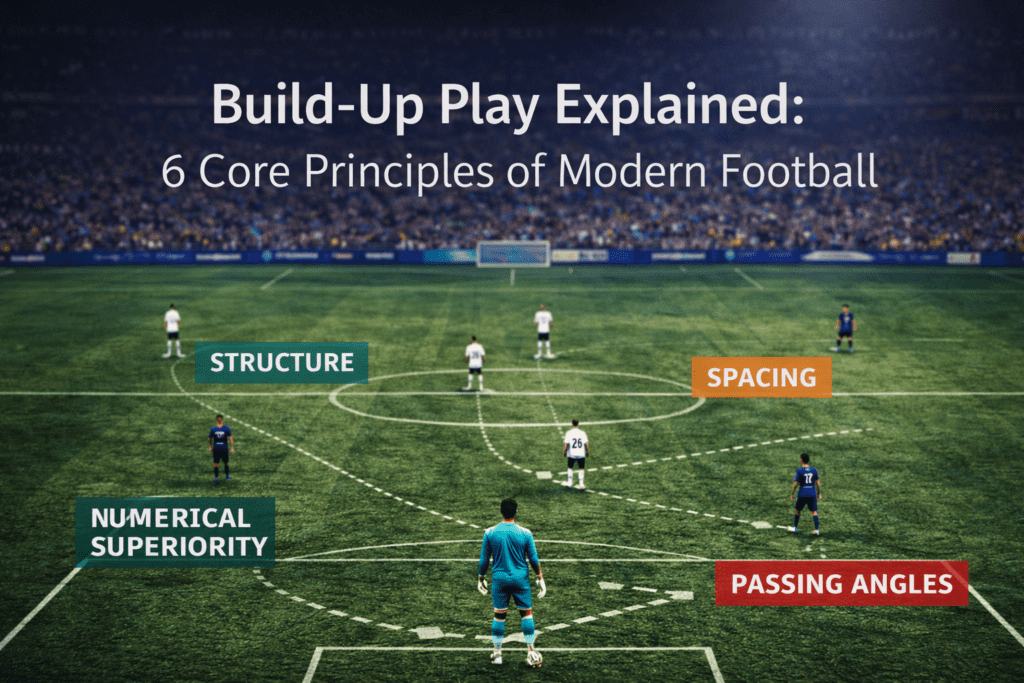
Why it connects: Third Man runs are the most advanced expression of triangulated build-up play – this is the mechanical foundation they sit on.
Why it connects: Teams with elite PPDA numbers are the same sides whose pressing structure gets bypassed by Third Man combinations – this shows the other side of the equation.

Overloads & Isolations Explained
Why it connects: The Third Man run is a specific type of overload mechanism – understanding how overloads are created reveals why the geometry works in the first place.
Frequently Asked Questions (FAQs)
What is the difference between a “One-Two” and a “Third Man Run”?
“One-Two” (or Wall Pass) involves only two players: A passes to B, B passes back to A. A “Third Man Run” involves three distinct players: A passes to B, and B passes to a moving C. The introduction of the third player adds complexity and makes it harder to track.
Can you use Third Man runs against a Low Block?
Yes, but it is much harder. In a low block, there is very little space behind the defense. However, you can use “Chip” passes or quick combinations on the edge of the box to act as Third Man sequences. The movements must be sharper and the touches tighter, as the margin for error is non-existent.
“Which teams use the Third Man run most effectively in modern football?
While all are vital, Player B (the Connector) has the hardest job. They must receive the ball under pressure, often with their back to goal, and play a perfect one-touch pass. If Player B lacks technical security, the whole system collapses.
Speak the language of the game
Get the free 47-term tactical glossary. Gegenpress, half-space, xT, low block, each defined in plain language and linked to a full breakdown. It is yours for an email.