Football Tactics Analysis
This is not a news site. No transfer rumours, no match reports, no injury updates. KharaSportsDaily covers one thing: how football is actually played. The pressing triggers. The spatial structures. The decisions coaches make before a ball is kicked.
Every article asks a single question – why did that happen? Not what happened. Why.
Start with the Football Tactics FrameworkMid-Block Pressing Explained: How Elite Teams Control Space Without the Ball

We have been sold a lie about pressing.
Not about pressing itself – pressing works. Klopp proved it, Guardiola refined it, and a generation of coaches have built entire identities around the idea that the highest, most aggressive press is the purest expression of tactical intent. But somewhere along the way, the conversation became binary: press high, or sit deep and hope.
There is a third option. And the teams that have mastered it keep winning things that the high-pressing evangelists cannot explain.
Carlo Ancelotti’s Real Madrid. Deschamps’ France in 2018. Teams that look almost passive in possession phases, that concede territory willingly, that allow the opposition centre-backs to circulate the ball for 30 seconds without anyone closing them down. They are not defending. They are coiling.
The mid-block is not about sitting back. It is about controlling the space that actually matters – the zone between the lines, the central channels, the passing lanes that lead anywhere dangerous. Let them have the ball wide. Let them have it deep. But the moment they try to play through the center? The trap snaps shut.
Patience. Geometry. And the psychological discipline to do nothing until the exact right moment. This is the full breakdown of the most misunderstood defensive system in modern football.
What Is a Sweeper-Keeper? The Complete Guide to Modern Goalkeeper Tactics
In the 1990s, the goalkeeper had one job. Stay between the posts. Do not wander. The moment you left your line, you were a liability.
That goalkeeper is extinct.
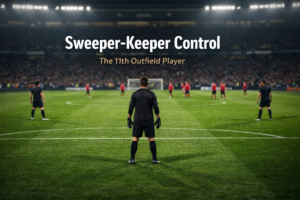
What Manuel Neuer started and Ederson perfected is not just a stylistic preference. It is a structural revolution. When a goalkeeper steps up to the edge of their area – or beyond it – they compress the space available to opposition forwards, allow the defensive line to push 10 yards higher, and create something no coach in the 1990s would have thought possible: a goalkeeper as the eleventh outfield player.
The mathematics of it are compelling. Opposition teams press 10 outfield players. They rarely assign a presser to the goalkeeper. Which means a sweeper-keeper is always the free man – the +1 that no high press is designed to account for. Ederson at his peak was not just a shot-stopper with good feet. He was the first pass of virtually every Man City attack, the player who broke the press before it could form.
But the margin for error is absolute zero. One misjudgment 40 yards from goal, and it ends in the net. This is the full breakdown of the role – the brilliance, the risk, and why modern football cannot function at elite level without it.
Football Overloads and Isolations Explained: How Elite Teams Manipulate Space
If you are playing fair, you are doing it wrong.
That sounds cynical. In football, it is simply the truth. The entire architecture of modern attacking play is built around one goal: create a situation where your player faces a weaker opponent in a space they can exploit, and then make sure that situation happens over and over until the defense breaks.
The overload and the isolation are two sides of the same coin. You pull the blanket left – three attackers flooding one flank, dragging the opposition’s shape with them – and the right side opens up. Your best dribbler, alone, against one exhausted fullback. No help coming. The crowd already knows what is about to happen.
What makes this so difficult to defend is not the individual quality involved. It is the sequence. The overload does not just create a chance; it forces a defensive decision. And once you understand which decision the opposition is most likely to make, you already know where the space will appear.
Manchester City do not create overloads by accident. They build them pass by pass, movement by movement, until the defense has committed in exactly the wrong direction. This is the breakdown of how they do it – and how any team, at any level, can start applying the same principles.
Box Midfield Tactics (3-2-2-3): How Elite Teams Dominate Possession
On paper, it looks like a telephone number. 3-2-2-3. A sequence that means almost nothing until you watch it move.
For decades, the midfield engine was built around a triangle – one holding midfielder anchoring two box-to-box players ahead. It was reliable. It was well-understood. It gave the opposition a clear structure to defend against.
Then Guardiola and Arteta started building squares instead.
The box midfield does not just add a player to the center. It rewires the entire geometry of possession. Two pivots deep, two attacking midfielders operating in the half-spaces behind the opposition’s line, and suddenly you have four elite technicians occupying the space that three midfielders cannot possibly cover. The fourth man is always free. Always.
What makes this structure almost impossible to defend is not pace or quality alone – it is the dilemma it forces on every opposition coach: send a fifth midfielder to track the free man and leave the wide areas exposed, or accept that one of your opponents will always have time on the ball in the most dangerous central zone on the pitch.
City have won trophies with it. Arsenal have rebuilt their identity around it. This is the full anatomy of the shape that has quietly become the most imitated structure in modern football.
False 9 vs Target Man: How Two Strikers Break a Defence Differently
The Number 9 has died more times than any other position in football. And every time, it comes back wearing a different shirt.
There is a version of the striker built like a siege weapon – broad, physical, immovable. He does not need to be the fastest player on the pitch. He just needs to be the hardest to shift. The Target Man does not glide past defenders. He pins them. He holds the line. He makes the ball stick in places where, by all logic, it should not. Olivier Giroud in a penalty box is not beautiful. It is effective in a way that cannot be replicated by anything smaller or more elegant.
And then there is the other version. The one who is not there. The striker who drops, drifts, and ghosts – leaving the two centre-backs staring at each other in the spaces they were supposed to fill. The False 9 does not score the way a Number 9 is supposed to score. He scores by making the position itself disappear, turning the entire opposition shape into a question with no answer.
Guardiola made one philosophy fashionable. History made the other indispensable. The question of which is better is the wrong question entirely – and this breakdown explains why the debate itself is the point.
Arne Slot Tactics: How Liverpool’s 4-2-3-1 System Works
Klopp built Liverpool on chaos. Slot dismantled it – and replaced it with something more dangerous. The double pivot, the La Pausa, the reborn Gravenberch. This is how the 4-2-3-1 actually works underneath the surface.