Football Analysis

Football Tactics Analysis

This is not a news site. No transfer rumours, no match reports, no injury updates. KharaSportsDaily covers one thing: how football is actually played. The pressing triggers. The spatial structures. The decisions coaches make before a ball is kicked.

Every article asks a single question – why did that happen? Not what happened. Why.

Start with the Football Tactics Framework

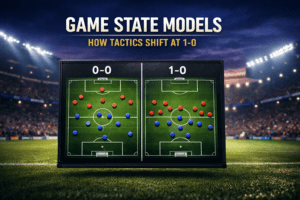
Football stadium image illustrating tactical contrast between 0-0 and 1-0 game state model.

Game State Models Explained: How Elite Teams Shift Tactics the Moment They Score

Most fans watching a team go 1-0 up think the same thing.
Why do they look so much worse now?
The pressing stops. The attackers drop. The ball starts going sideways. From the stands, it looks like nerves. Like the manager lost the plot. Like the team forgot how to play.
It isn’t any of those things.
The moment that first goal goes in, every tactical metric in the game shifts simultaneously. The defensive line drops 4-7 metres. PPDA climbs from 10.5 to 16.2. Possession percentage falls – deliberately. What looks like a team falling apart is actually a pre-programmed system activating.
The problem is most teams activate the wrong version of it.
There’s a specific moment – usually between the 60th and 75th minute – where a 1-0 lead becomes the most dangerous scoreline in football. Not for the team chasing. For the team protecting.
This week’s breakdown explains exactly why, what the best teams do differently, and the one psychological trap that turns a controlled lead into a crisis.

Football image showing a tactical foul stopping a counter-attack in midfield under stadium lights.

What Is a Tactical Foul in Football? The Complete Tactical Breakdown

Quick Answer: A tactical foul is a deliberate, low-risk infringement – typically in midfield – used to stop a counter-attack and allow the defending team to reset their shape. It trades a free kick for defensive stability. Think back to the Euro 2020 final, played in July 2021. Before the penalty shootout even began, Chiellini […]

Traditional number 10 surrounded by pressing defenders under stadium lights in modern football.

Why the Traditional #10 Disappeared – And What Replaced It

Juan Román Riquelme wouldn’t survive 20 minutes in Pep Guardiola’s Manchester City. Here’s why. The #10 used to be the most important player on the pitch. Everything went through them. They didn’t press or run – they waited, and decided the game. Today, that player doesn’t exist at the elite level. Not because the talent […]

goalkeeper making a fingertip save in a Champions League match illustrating Post-Shot xG (PSxG) shot-stopping performance.

Post-Shot xG (PSxG) Explained: The Complete Guide to Measuring Goalkeeper Performance

David de Gea. 2017/18. Manchester United finishing second in the Premier League with a midfield that had no business finishing second. The analysts ran the numbers afterwards and found something uncomfortable: De Gea’s Goals Prevented figure that season was +13.7. Thirteen goals. Statistically, mathematically, he dragged that squad to a place they hadn’t earned.
Nobody talked about it that way at the time. Because we were still judging goalkeepers by clean sheets.
Clean sheets are a team stat. Always have been. Judging a keeper by clean sheets is like judging a striker by how many corners his team wins – it’s a byproduct of the system, not the individual. The metric that actually isolates what a goalkeeper does, stripped of the defense behind them, stripped of the opposition’s finishing quality, is Post-Shot xG. And once you understand how it works, you’ll find it nearly impossible to watch a goalkeeper the same way again.
There’s also a blind spot in the model that most analysts gloss over – one that specifically flatters the wrong type of keeper and quietly penalizes the best ones.

Editorial football image showing a playmaker receiving the ball on the half-turn in Zone 14 as defenders hesitate just outside the penalty area.

Zone 14 in Football: What It Is, Why It Matters, and How Teams Exploit It

You have watched it a hundred times without realising what you were seeing.
A team dominates possession. They circulate the ball sideways, fullback to winger and back again, keeping it tidy, keeping it safe, controlling the game by every available metric. The stats say they are in control. Your eyes tell you they are going nowhere.
Then one pass goes vertical. Into the center. A player turns. The defensive line shifts in panic. And suddenly everything is different.
That pass did not go to a winger. It did not go wide. It went to the one patch of turf that defenders have nightmares about – a twelve-yard square, sitting directly outside the penalty area, dead center of the pitch.
Zone 14.
This is where Messi made a career. Where De Bruyne destroys low blocks. Where the difference between a team that looks dangerous with 40% possession and a team that looks sterile with 70% is decided. Not by talent, not by formation – by whether your best player can receive on the half-turn in this specific space and make the right decision in under a second.
The geometry of why this zone is so dangerous, how elite teams reach it, and – crucially – the only defensive structure that can neutralize it. All of it is in this breakdown.

A central defender pauses with the sole of his boot on the ball to bait an onrushing striker, illustrating the De Zerbi baiting press structure used to provoke pressure and break defensive lines.

De Zerbi Baiting Press Structure: The Artificial Transition System Explained

Lewis Dunk. Inside his own six-yard box. Ball under his studs. Motionless.
Liverpool’s forwards are pressing, screaming, closing – and Dunk is doing nothing. Just waiting. One second. Two seconds. And then, at the precise last moment, a pass pops into a dropping midfielder and Brighton are suddenly attacking a broken defensive line at pace.
This was not a mistake by Liverpool. It was the trap working exactly as designed.
Roberto De Zerbi built something at Brighton that most coaches are still struggling to comprehend: a system that does not survive the high press but actively invites it. Where every other team in England was obsessing over pressing harder and faster, De Zerbi asked a different question. What if the press is the problem – not the solution?
The answer became one of the most distinctive tactical systems in modern European football. The goalkeeper as the first line of attack, not the last line of defense. The centre-backs spreading wide to compress the pressing trigger. The forward already running into space before the ball has even moved. Three passes later, you are defending a two-on-one.
The teams that pressed Brighton hardest got punished most consistently. Arsenal fell for it. Liverpool fell for it. City fell for it.
Here is exactly how the trap works – and why it is now being studied in coaching rooms across Europe.