

Last updated: September 19, 2026
In the 76th minute of the 2022 Champions League final, Real Madrid weren’t defending desperately. They were executing. Their defensive line sat at 38 meters. Their PPDA had risen from 9.2 to 17.4 since Vinícius scored. They weren’t sitting back – they were running a Positive Game State Model.
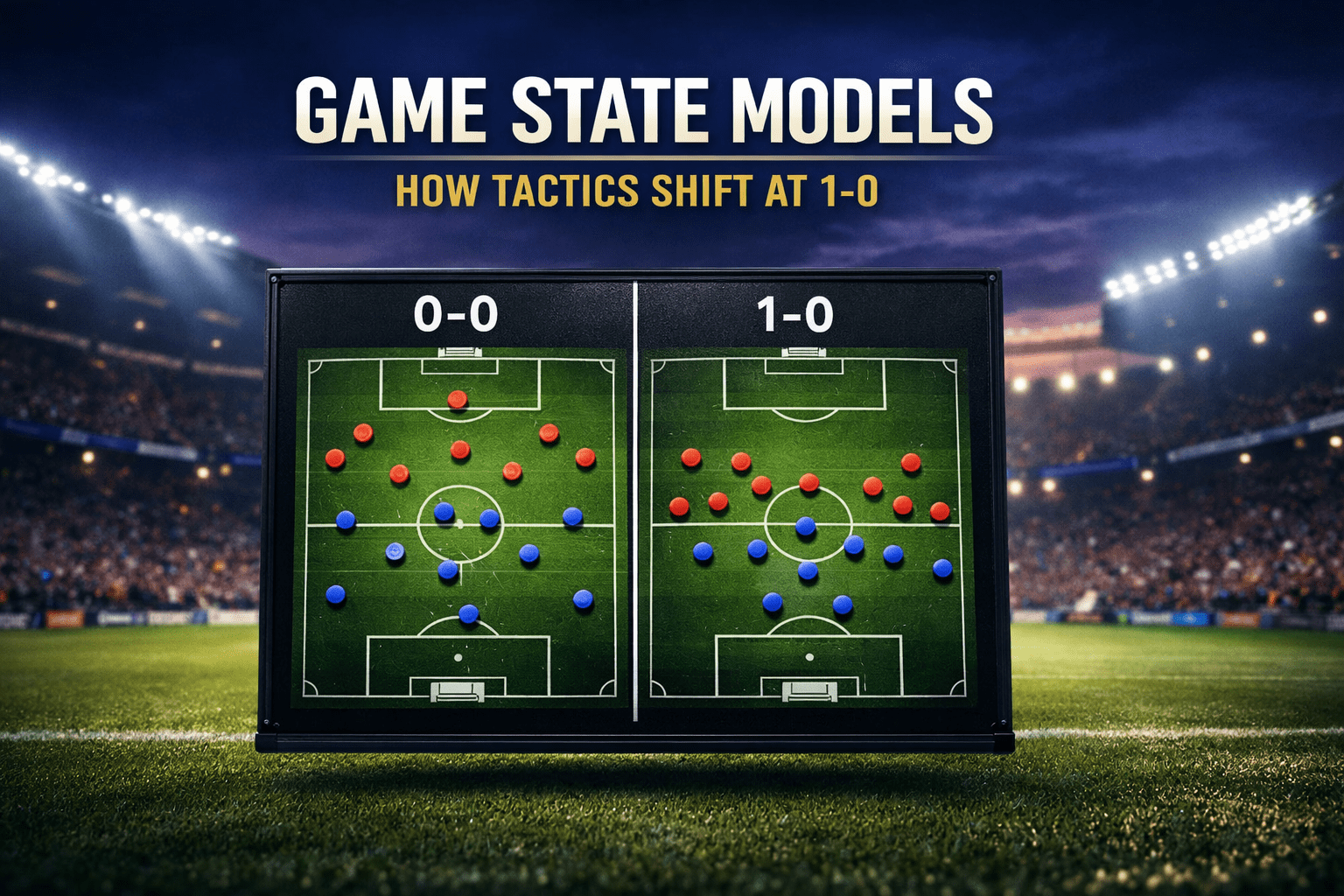
A Game State Model is the tactical identity a team adopts based on the scoreline. It is the single biggest variable in modern football analysis, and it explains why the same team can look completely different in consecutive matches.
In simple terms: the scoreline doesn’t just reflect the game – it dictates it.
In this breakdown, we cover how elite teams shift their defensive line, possession use, and pressing intensity the moment they go 1-0 up – and why ignoring Game State context makes almost every tactical statistic meaningless.
Key Takeaways
- Context is King: Statistics without “Game State” context are useless. A team winning 1-0 will naturally generate less xG and concede more possession than they did at 0-0.
- The “Turtle” Effect: Most teams naturally drop their defensive line by 5-10 meters after scoring, regardless of the manager’s philosophy.
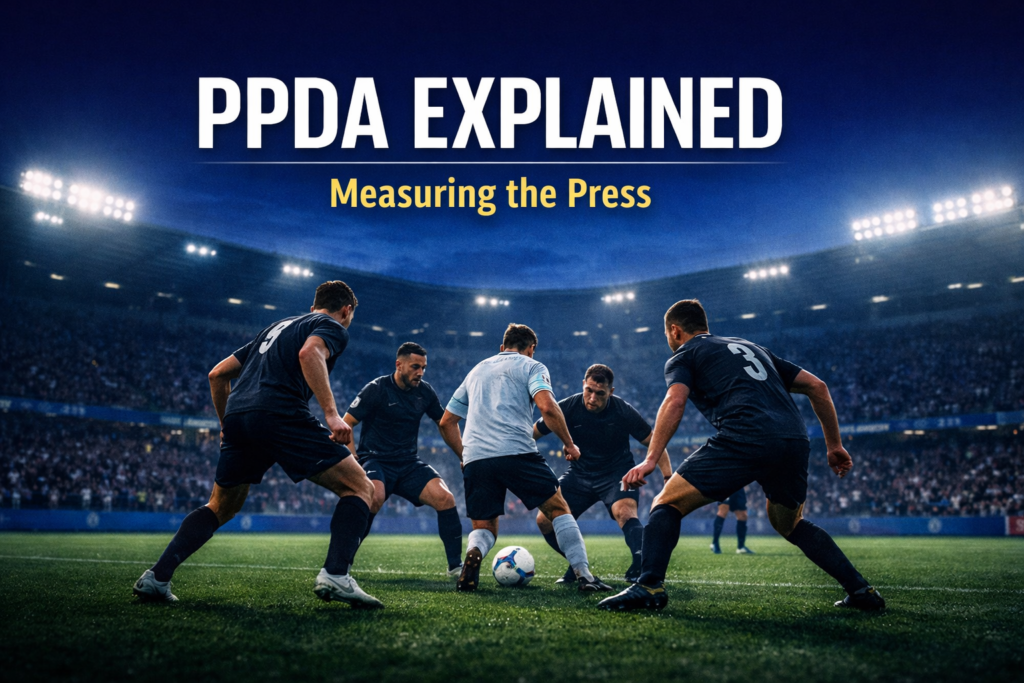
- Score Effects: Metrics like PPDA (Passes Per Defensive Action) drastically increase for winning teams (less pressing) and decrease for losing teams (desperate pressing).
- The 1-0 Trap: The most dangerous moment for a tactical system is the transition between “seeking a goal” and “protecting a lead.”
Table of Contents
What is a Game State Model?

At its core, a Game State Model is a framework that dictates how a team behaves relative to the scoreline and the time remaining. It is the acknowledgement that football is not played in a vacuum.
In the analytical world, we divide the match into three primary states:
- Even State: (Drawing, usually 0-0 or 1-1). Both teams are theoretically incentivized to attack.
- Positive Game State: (Winning by 1 or more goals). The incentive shifts from creation to retention or protection.
- Negative Game State: (Losing by 1 or more goals). The risk threshold must be abandoned to chase an equalizer.
Most public tactical analysis fails because it ignores this. You might look at a stat sheet and see that Arsenal had 35% possession against Liverpool and think, “Arsenal played poorly.” But if Arsenal went 1-0 up in the 10th minute and spent 80 minutes protecting that lead, that 35% possession isn’t a failure; it’s a successful execution of a Positive Game State model.
Think of it like a thermostat. At 0-0, the temperature is set to “Active.” The moment a goal is scored, the thermostat adjusts. For the losing team, the heat turns up (high pressing, high lines). For the winning team, the AC kicks in (cooling the game, slowing the tempo, dropping the block).
Analysis: The Three Tactical Shifts at 1-0
These tactical shifts 1-0 aren’t reactive – they’re pre-programmed.
When the deadlock is broken, we see three distinct tactical shifts occur. These aren’t accidents; they are coached mechanisms. Let’s break down how elite teams manipulate the game once they have the advantage.
1. The Engagement Line Drop (Defensive Control)
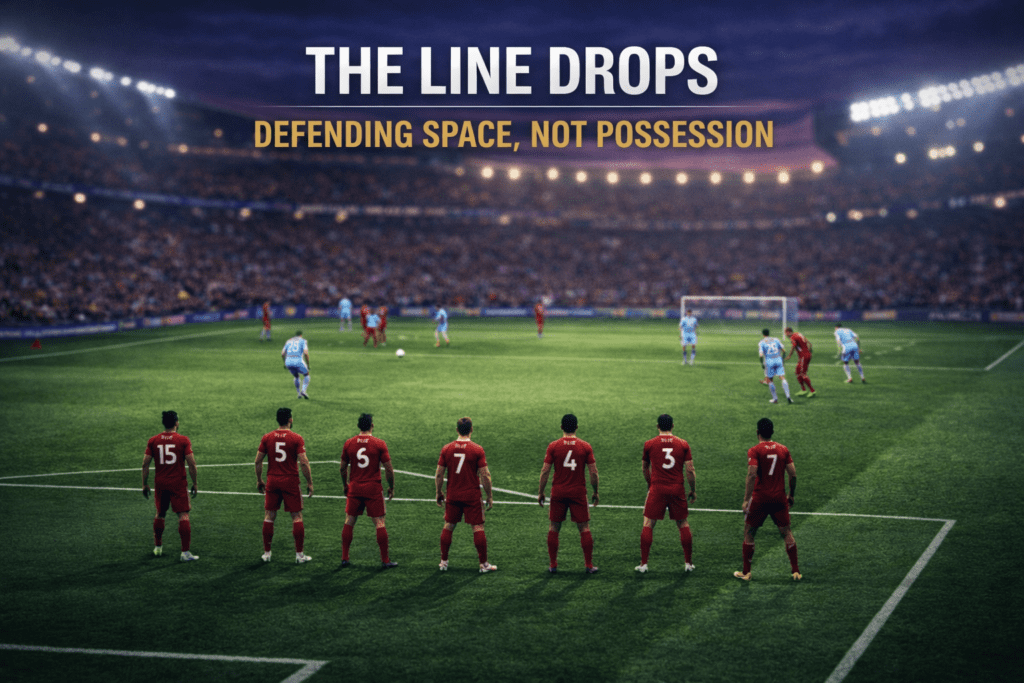
The most immediate change at 1-0 is the vertical shift of the defensive block. Data from the Premier League over the last five seasons suggests that, on average, a team’s defensive line drops roughly 4 to 7 meters deeper once they take the lead.
Why? It’s about space management. At 0-0, you need to win the ball high to create short transitions to goal. At 1-0, the opponent must come to you. By dropping the line, you deny the space behind your defense (preventing easy through balls) and force the opponent to play in front of you. This is the classic “low block” transition we see from managers like Jose Mourinho or Diego Simeone. They invite pressure, knowing that the opponent will leave gaps as they push forward.
2. The “Pause” on the Ball (Possession as Defense)

This is the Pep Guardiola and Mikel Arteta approach. Instead of dropping deep and defending the box, they use the ball to defend. At 1-0, you will notice Manchester City’s tempo drops noticeably. They stop looking for the “killer pass” every 30 seconds.
Instead, they circulate the ball in a U-shape around the opponent’s block. This is often criticized as “boring” by fans, but it is a lethal defensive tactic. If you have the ball, the opponent cannot score. By keeping the ball moving slowly, they force the losing team to chase shadows, physically exhausting them and mentally frustrating them until they make a mistake. This is known as La Pausa – the art of waiting.
3. The Counter-Attack Trigger (Transition Threat)

Once a team is winning, their xG (Expected Goals) strategy flips. They no longer rely on sustained pressure to create chances. Instead, they rely on high-quality transition moments.
Because the losing team pushes their fullbacks higher and commits more bodies to the attack (Negative Game State), they leave vast acres of space on the wings. The winning team shifts their attackers to sit on the shoulders of the last defender. We saw this perfectly with Leicester City in 2016 or Real Madrid in the Champions League. They don’t need 10 chances; they need one counter-attack into the space the desperate opponent left behind.
Data Visualization: The Impact of the First Goal
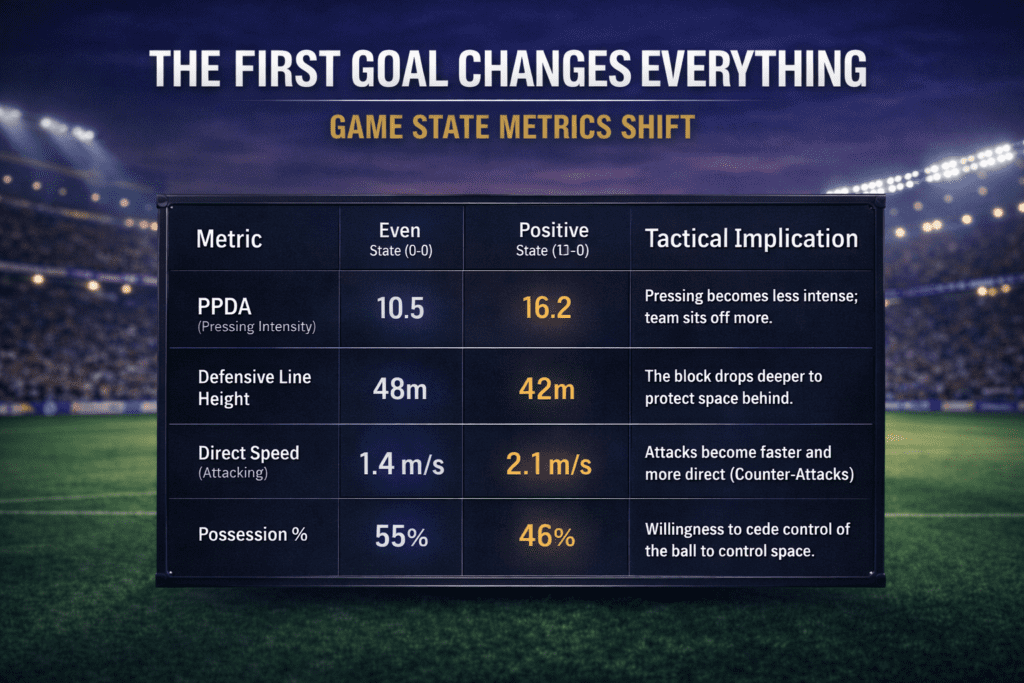
The following table illustrates the average shift in key metrics for a generic Top 4 Premier League team when moving from 0-0 to 1-0 up.
| Metric | Even State (0-0) | Positive State (1-0) | Tactical Implication |
| PPDA (Pressing Intensity) | 10.5 | 16.2 | Pressing becomes less intense; team sits off more. |
| Defensive Line Height | 48m | 42m | The block drops deeper to protect space behind. |
| Direct Speed (Attacking) | 1.4 m/s | 2.1 m/s | Attacks become faster and more direct (Counter-Attacks). |
| Possession % | 55% | 46% | Willingness to cede control of the ball to control space. |
Data reflects average metrics across Top 4 Premier League sides over the last 5 seasons. Individual team variance applies.
The Weakness: The “Passive” Trap
While adjusting to a 1-0 lead is smart, it is also dangerous. This is where the nuance of “Score Effects” can deceive a manager. The biggest weakness in shifting to a Positive Game State model is the psychological drift into passivity.
We often call this “parking the bus too early.” If a team scores in the 15th minute and immediately drops their defensive line to their own penalty box, they are inviting 75 minutes of sustained pressure. This is statistically unsustainable. The Expected Threat (xT) against them will accumulate to a point where conceding becomes statistically probable, not a matter of if – but when.
The “1-0 Trap” occurs when:
- Pressing Stops Completely: If the PPDA goes too high (above 20+), the opponent has too much time to pick a pass. Even a low block needs pressure on the ball carrier.
- No Outlet: The strikers drop so deep to help defend that when the team wins the ball, there is no one to pass to. The ball comes straight back, creating a cycle of endless defense.
- Mental Fatigue: Defending a lead requires immense concentration. One lapse in concentration in the 88th minute ruins 87 minutes of perfect work.
The best teams, like Bayer Leverkusen under Xabi Alonso or Klopp’s Liverpool, avoid this by maintaining a “Threat.” Even at 1-0, they keep their pressing triggers active. They might defend deeper, but when the trigger is pulled, they press with the same ferocity as if it were 0-0. They signal to the opponent: “We are winning, but we are still dangerous.”
The Final Word
Understanding Game State Models is the difference between watching the ball and watching the game. The scoreline is the conductor of the orchestra. It dictates the tempo, the aggression, and the risk.
When you see a team sit back after scoring, don’t assume they have lost their way or are playing badly. Ask yourself: Is this a tactical choice to exploit the opponent’s desperation?
The 1-0 lead is the most complex psychological state in football. It is a precarious balance between security and ambition. The managers who master this – who know exactly when to kill the game with possession and when to kill it with a counter-attack – are the ones who lift trophies. In the end, the only stat that truly remains fixed is the result.
What Do You Think?
Bayer Leverkusen under Xabi Alonso finished the 2023-24 Bundesliga season unbeaten – partly because they never fully shifted into passive Positive Game State mode, maintaining pressing triggers even at 1-0. But is that approach sustainable in a Champions League knockout context, where one counter-attack can end your season?
Drop your take in the comments.
Want to read any match like this?
The framework behind these breakdowns, in one place. The four phases, a 15-minute method for diagnosing both teams before the drinks break, a printable match-watching worksheet, and 51 terms defined. 40 pages.
Get the pack$9, instant downloadRelated Tactical Breakdowns
What Is PPDA in Football?
What Is Post-Shot xG?
5 Brutal xT Truths About Players

Frequently Asked Questions (FAQs)
Does “Game State” affect Expected Goals (xG)?
Absolutely. Teams in a “Negative Game State” (losing) usually accumulate more xG because they take more shots and attack more aggressively. Conversely, winning teams often have lower xG outputs because they prioritize defense. This is why looking at a final xG score of 2.1 vs 0.8 can be misleading if the 0.8 team was winning 1-0 for 80 minutes.
Which manager is the best at managing the 1-0 lead?
Historically, Jose Mourinho was the master of the 1-0, famously stating he loved winning by that margin because it meant total defensive control. In the modern era, Xabi Alonso’s Real Madrid have been exceptional at managing game states – allowing the team to absorb pressure without breaking, while Pep Guardiola prefers to “defend with the ball” to manage the clock.
What is “Score Effects” in analytics?
“Score Effects” is the statistical phenomenon where a team’s metrics (possession, shots, pass completion) are heavily influenced by the current scoreline. Analysts adjust data for score effects to see how a team performs on a level playing field, rather than when they are just protecting a lead or chasing a game. In score effects football analytics, adjusted metrics remove this bias entirely.
Speak the language of the game
Get the free 47-term tactical glossary. Gegenpress, half-space, xT, low block, each defined in plain language and linked to a full breakdown. It is yours for an email.