
Last updated: October 14, 2026
Minute 73 at the Metropolitano. Atletico trailing on aggregate. Pedri receives in the left half-space – and three seconds later, the move is dead. Pedri picks up the ball ten yards inside the left half-space, shapes to open his body, and before he can lift his head, Pablo Barrios has jumped out of midfield and Giménez has shifted three steps across the back line. No pass. No shot. A harmless recycle. Three weeks later, Atletico were in the semi-finals.
That sequence – repeated dozens of times per match – is the reason Simeone’s Atletico knocked Barcelona out of the Champions League for a third time Yahoo Sports. It is also the single most under-analysed phase in modern football. Because while every pundit talks about how Guardiola uses the half-space, almost nobody talks about the systems built to kill it.
In simple terms: Defending the half-space means denying opponents access to the two vertical channels between the central and wide lanes – the most dangerous zones on the pitch – through coordinated stepping, covering, and passing-lane coverage.
This piece breaks down why the half-space is the hardest zone to defend, .how elite blocks actually cover it, and where the system fails. Defending the half-space well is the single clearest tactical fingerprint a modern coach can leave on a team. For a wider context on low block tactics and compact defending, start with our defensive structures hub.
Key Takeaways
- Position beats reaction: Teams that defend the half-space well cover it by pre-positioning midfielders 3-5 yards inside their nominal slot – not by reacting once the ball arrives.
- The centre-back decision: The hardest defensive action in modern football is a centre-back stepping 8-12 yards into the half-space to meet a receiver, knowing the space behind him is now open.
- Compactness measured: Elite defensive sides typically operate with 28-32 metres between defensive and attacking lines, tight enough to shut half-space passing lanes entirely.
- The Atletico benchmark: Simeone’s 4-4-2 is the template for denying the half-space without a back five – the midfield eight shifts laterally as a unit, not individually.
- Where it breaks: Half-space defending collapses against third-man combinations and inverted fullbacks who receive between the lines before the block can reset.
- Defending the half-space is a midfielder’s job: The centre-back gets credit for stepping out, but the shadow-cover behind him is what makes the step survivable.
Table of Contents
What Is the Half-Space in Football?
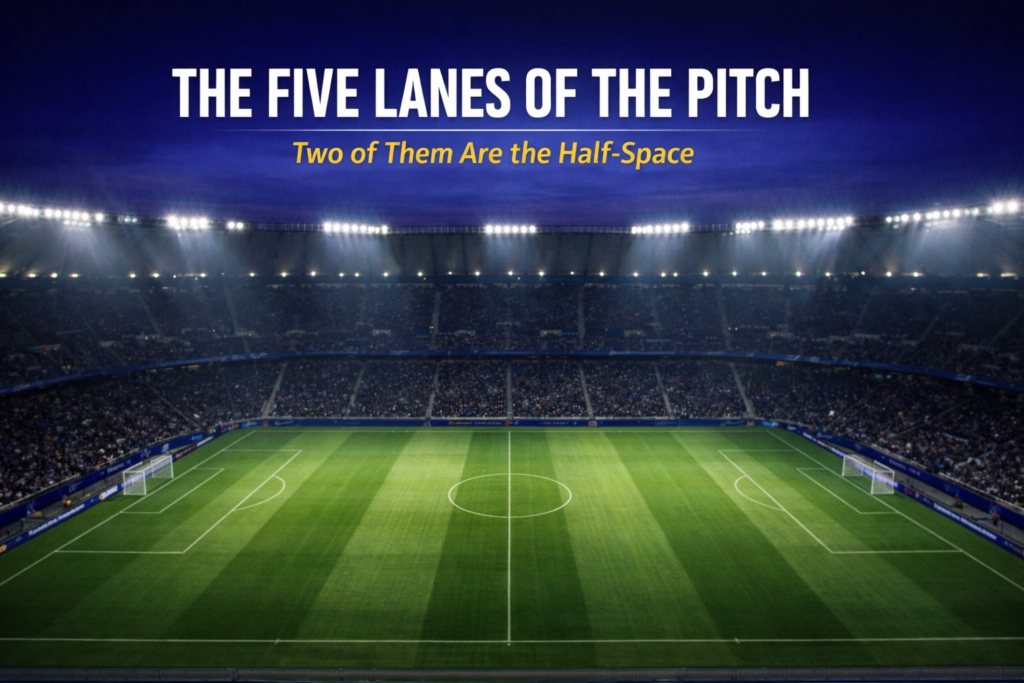
Divide the pitch into five vertical channels – left wing, left half-space, centre, right half-space, right wing – and the half-spaces are the two inner corridors that sit between the central lane and the touchline channels. They occupy a unique position on the field that offers a blend of centrality and width The Football Analyst, which is precisely what makes them so dangerous. A player receiving in the half-space has the passing angles of a central midfielder with the shooting angles of a winger cutting inside.
The defensive problem is geometric. The central lane is easy to defend because it is crowded – two centre-backs, two holding midfielders, one striker dropping. The wings are easy to defend because the touchline acts as a free defender. The half-space is neither. It is too wide for a centre-back to cover without breaking the back line, and too narrow for a fullback to cover without leaving the wing open.
This is why players in the half-space present an interesting dilemma for defenders Medium – mark them and the shape breaks, leave them and they receive in a high-quality chance creation zone. The half-space, in other words, is where elite attackers go to force defenders into a losing choice.
Why Defending the Half-Space Breaks Most Blocks
The half-space breaks defensive blocks because it sits in the seam between two defenders’ responsibilities. A centre-back is told to hold the central line. A fullback is told to hold the wing. Neither owns the half-space, and that ambiguity is what positional-play coaches like Pep Guardiola spent a decade engineering attacks around.
Per The Athletic’s tactical coverage, the half-space has become the single highest xT-generating zone in elite buildup since 2020. When a midfielder receives between the lines in the half-space, the defending side faces three losing options inside two seconds: jump the centre-back (line breaks), shift the holding midfielder (central lane opens), or do nothing (receiver turns and plays through). The block has already lost before the ball arrives.
This is why coaches like Diego Simeone build entire defensive systems around pre-positioning rather than reaction. Defending the half-space cannot be done after it has been entered. It can only be defended before.
How Active Blocks Defend the Half-Space: The Atletico Template
Defending the half-space is the load-bearing column of Diego Simeone’s entire system at Atletico Madrid. He has managed the club since December 2011, and in that time his 4-4-2 has become the league-level template for defending the half-space without a back five. The mechanics are simple to describe and brutally hard to execute.
When the opposition’s centre-back receives near the touchline, the entire midfield bank shifts four to five metres laterally as a single unit. A wide midfielder tucks inside to occupy the half-space passing lane. The fullback steps up two metres to cover the channel his teammate vacated. Four players cover three channels. The half-space is closed before the ball arrives.
What separates the Atletico template from ordinary deep blocks is the decision on stepping. When an opposition playmaker drops into the half-space to receive between the lines, a hybrid centre-back will step out up to 10 meters to meet him, trusting the cover behind him to shuffle across. The step is aggressive, early, and committed. The receiver gets pressed into a turn, forced to play backwards, or dispossessed. Atletico’s 2023-24 La Liga campaign produced one of the best defensive records in Europe’s big-five leagues off the back of this mechanism.
The full breakdown of how this 4-4-2 generates and survives those moments – including Simeone’s specific personnel choices and the in-possession trade-offs – sits inside our dedicated Diego Simeone’s 4-4-2: The Art of Suffering breakdown. This article stays focused on the half-space mechanism itself.

Per FBref’s open-source defensive data and tracking patterns published by The Analyst, compact blocks defending the half-space well show measurably different shape behaviour than passive ones. The table below illustrates the gap.
| Metric | Passive Block | Active Half-Space Defence | Tactical Implication |
|---|---|---|---|
| Avg. distance between defensive lines | 35-38 metres | 28-32 metres | Tighter vertical compactness shuts passing lanes between the lines |
| CB step-outs per match into half-space | 4-6 | 12-18 | Higher step-outs prevent receivers turning cleanly |
| Opponent touches in half-space per 90 | 45-55 | 22-30 | Active coverage cuts access by roughly 40% |
| PPDA (pressing intensity) when opponent enters half-space | 14-16 | 7-9 | Active blocks collapse on the receiver within 2 seconds |
Data reflects average patterns across top-flight European compact-block sides, derived from publicly available tracking and FBref defensive metrics. Individual team and season variance applies.
Defending the Half-Space Is a Midfielder’s Job
Defending the half-space is a midfielder’s discipline before it is a defender’s bravery. A centre-back stepping into the half-space only works if a midfielder shadow-covers behind him. According to StatsBomb’s open-data analysis, the defining metric for compact blocks is not where the ball is – it is where the nearest midfielder is positioned when the ball moves.
In an active block, the holding midfielders operate roughly two metres deeper than a conventional 4-4-2 midfield bank when the team is out of possession in its own half. That two-metre adjustment is the entire mechanism. When the centre-back steps up, the midfielder is already positioned to drop into the gap before the runner arrives. The cover is built into the starting position, not bolted on as a reaction.
Bayer Leverkusen’s 2023-24 unbeaten Bundesliga campaign under Xabi Alonso used the same principle in a different shape. Granit Xhaka, dropping deeper than the nominal pivot slot, gave the back four permission to step into the half-space because he was already covering the channel they would vacate. Per FBref, Leverkusen finished that season with the lowest Expected Goals Against per 90 in the Bundesliga – not because the defenders were elite, but because the shadow-covering was relentless.
The lesson is uncomfortable for any coach watching: defending the half-space is built before the ball moves, not solved after.
The Weakness: How Elite Teams Break Half-Space Defences
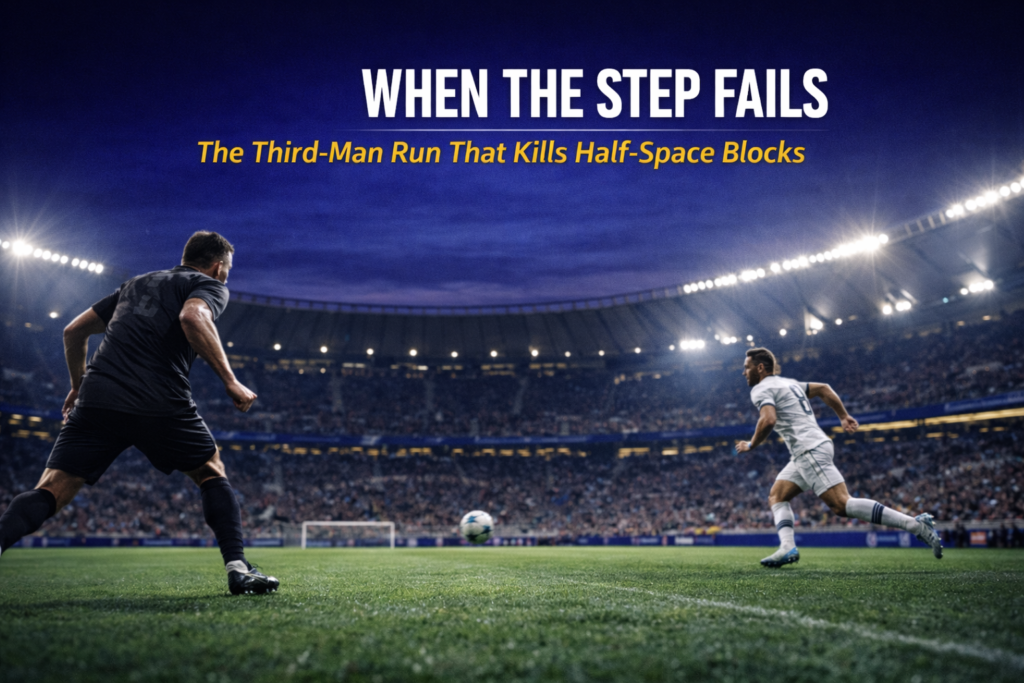
Defending the half-space has a defined failure mode, and the best attacking coaches know it. When a centre-back steps into the half-space, the back line has three remaining defenders covering a back-four’s worth of width. The space behind the stepping defender is the exploitable zone. Any attacker who makes a blind-side run behind him, while a third man plays the through ball, can carve the entire structure open.
Pep Guardiola’s Manchester City Football DNA uses this as a first-principle attacking pattern. City’s 2022-23 treble-winning side repeatedly used Kevin De Bruyne dropping into the half-space to pull a centre-back out, with Erling Haaland making the blind-side run behind. The third-man concept – receiver baits the step, second man plays the penetrating pass – makes half-space stepping a high-risk action against elite opposition.
The other killer is the inverted fullback. When a team like Hansi Flick’s Barcelona inverts its fullback into the half-space during build-up, the defending midfield is forced to choose: jump to the inverted fullback and open the wing, or stay narrow and let the fullback receive unopposed. Either choice loses. This is the same positional logic Guardiola refined during his time at Barcelona Total Football Analysis, and it is why teams without a disciplined ball-near midfielder struggle against positional-play sides.
Xabi Alonso’s 2023-24 Leverkusen, who went unbeaten in the Bundesliga, also exposed reactive half-space blocks by routing build-up through Granit Xhaka dropping between the centre-backs and Florian Wirtz receiving on the half-turn in the left half-space. The defending team was pulled apart before the ball ever entered the final third.
Closing Analysis
Defending the half-space is the most honest test of a tactical system. You cannot fake it with running, and you cannot disguise it with shape – either the coordination is there, or the receiver turns and the structure breaks. Simeone’s Atletico remains the clearest working example of half-space defence without a back five, but the margin for error has narrowed. Positional-play sides now treat the stepping centre-back as a trigger rather than a threat. The next tactical evolution will not be better stepping – it will be better shadow-covering from midfielders who can shut the half-space before the opposition ever gets a receiver into it.
Defending the half-space well is what separates structured teams from organized ones. Watch it. Everything else in modern defending flows from there.
What Do You Think?
Atletico defends the half-space by stepping out aggressively – a system that has produced four Champions League semi-finals under Simeone and cost them at least two ties where a late blind-side run punished a mistimed step. Is Simeone’s model still the best template for defending the half-space against elite opposition, or has Guardiola-era positional play made aggressive stepping a liability the modern game can no longer afford? Drop your take below.
Want to read any match like this?
The framework behind these breakdowns, in one place. The four phases, a 15-minute method for diagnosing both teams before the drinks break, a printable match-watching worksheet, and 51 terms defined. 40 pages.
Get the pack$9, instant downloadRelated Tactical Breakdowns
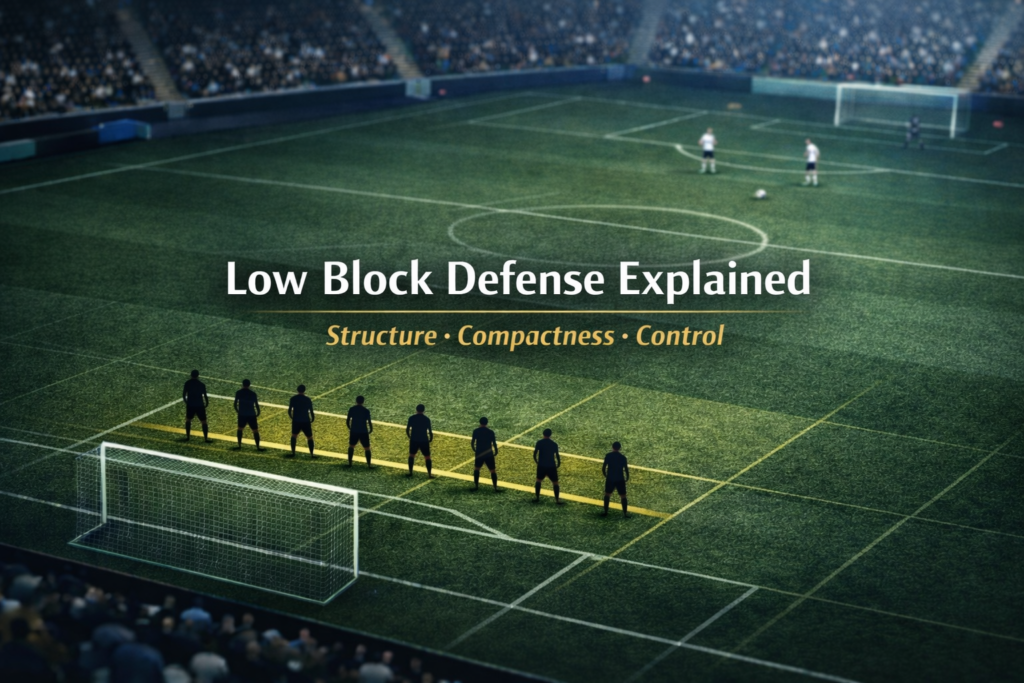
Why it connects: The half-space is the most vulnerable zone inside any low block – this piece covers the wider structural principles that make half-space defending possible.

Zone 14: The Most Dangerous Space on the Pitch
Why it connects: Zone 14 sits at the top of the central lane where the half-spaces converge – understanding one without the other leaves the picture incomplete.
Speak the language of the game
Get the free 47-term tactical glossary. Gegenpress, half-space, xT, low block, each defined in plain language and linked to a full breakdown. It is yours for an email.
Frequently Asked Questions (FAQs)
What is the half-space in football?
The half-space is the vertical channel between the central lane and the touchline on each side of the pitch. These two zones combine the passing angles of central midfield with the shooting angles of wide play, which is why modern coaches treat them as the highest-value attacking territory and the hardest defensive zone to cover cleanly.
How to defend the half-space effectively?
Teams defend the half-space through pre-positioned coverage rather than reactive marking. Elite blocks shift midfielders 3-5 yards inside their nominal slot, instruct centre-backs to step out early on dropping receivers, and maintain 28-32 metres between defensive and attacking lines. Reactive half-space defending almost always loses against positional-play opposition.
Which formations defend half-spaces best?
A back five or 5-4-1 structure provides the cleanest half-space coverage because wing-backs can tuck inside without breaking the back line. A disciplined 4-4-2 like Diego Simeone’s Atletico Madrid can also defend the zone, but it demands relentless lateral shifting from the midfield eight and committed shadow-covering from the holding midfielders behind any centre-back step-out.
Why is the half-space so dangerous for defenders?
The half-space is dangerous because it sits between two defenders’ responsibilities. A centre-back holds the central line, a fullback holds the wing, and the half-space belongs to neither. A receiver who turns cleanly in this zone has the central passing angles of a midfielder and the shooting angles of an inverted winger, forcing the defending team into a losing choice.