

The Xabi Alonso Leverkusen style is defined by a fluid 3-4-2-1 formation that relies on central overloads, short-passing “Relationism,” and aggressive counter-pressing.
In my experience of dissecting the ebb and flow of global footballing trends, I have witnessed many “flashes in the pan.” I’ve seen systems that were aesthetically beautiful but lacked a defensive spine, and I’ve seen pragmatic blocks that won trophies but bored the soul. Rare—exceedingly rare—is the occasion when a manager arrives and constructs a system that is both intellectually sublime and structurally invincible.
What Xabi Alonso has engineered at the BayArena is more than just a “tactical setup.” It is a manifestation of his own playing career—the patience of Juego de Posición fused with the vertical intensity of the German Bundesliga. When Alonso inherited Leverkusen, they were a collection of talented speedsters lacking a collective heartbeat. Today, they are a synchronized machine.
To understand how Xabi Alonso Leverkusen achieved a 51-match unbeaten run and a historic double, we must look beyond the 3-4-2-1 formation listed on the TV graphic. We must look into the “why” of the blueprint.
Alonso’s Leverkusen is not just exciting; it is a perfect example of a complete tactical system. From their build-up structure to their counter-pressing, they have mastered every phase of the game. To understand how these phases fit together in a cohesive system, read our complete guide on the[5 Pillars of Football Tactics Explained.
To Validate Alonso’s Coaching Ethos, refer this guide.
Key Takeaways: Xabi Alonso’s Tactical Blueprint
- The Box Midfield: Alonso uses a 3-4-2-1 that transforms into a 3-2-5, creating a central “box” of four midfielders to dominate possession.
- Short Passing (Relationism): Unlike traditional rigid positional play, players stay close together to combine with quick, short passes.
- The “Invincible” Press: Leverkusen uses aggressive counter-pressing traps to win the ball back instantly after losing it.
- Wing-Back Overloads: The wing-backs (like Grimaldo and Frimpong) act as attackers, providing the width while the #10s drift inside.
Enjoying the analysis?
Don’t Just Watch Football. Understand It.
Join KharaSportsDaily and receive occasional deep tactical insights most fans miss.
Occasional analysis. No match reports. No noise.
Table of Contents
The “Third Way”: Merging Possession with Verticality
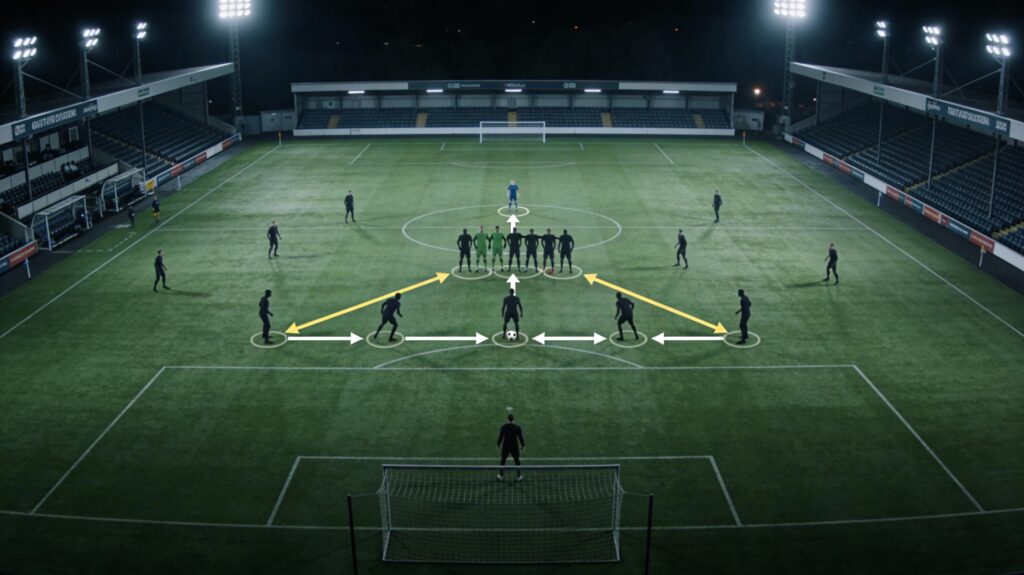
For years, the tactical world was split into two camps: the “Possession Purists” (the Guardiola disciples) and the “Transition Terrorists” (the Klopp/Rangnick school). Alonso has created the “Third Way.”
His Leverkusen doesn’t keep the ball for the sake of aesthetics. They use possession as a sedative. They pass horizontally and backward at a slow tempo, not because they are stuck, but because they are waiting for the opponent to flinch. The moment a defender steps out of line or loses focus, the team shifts instantly into “Vertical Mode.” It is a system that uses the ball to manipulate the opponent’s nervous system.
Provoking the Press: The “Short-Short-Long” Trap

Most coaches spend their training sessions teaching players how to avoid the press. Alonso teaches his players how to invite it.
Leverkusen’s build-up is a calculated bait-and-switch. The three center-backs spread so wide they are almost touching the chalk, while the double-pivot (Xhaka and Palacios) drops deep. This creates a “Hexagon” around the opponent’s first line of pressure. By circulating the ball slowly in these dangerous areas, they force the opponent to commit more players forward. The moment the opponent’s midfield steps up to engage, a vertical line-breaking pass is fired into the “Shadow Zones” occupied by Florian Wirtz. They don’t beat the press; they use the press as a vacuum to pull the opponent out of position.
The “Box Midfield” Geometry (3-2-2-3)

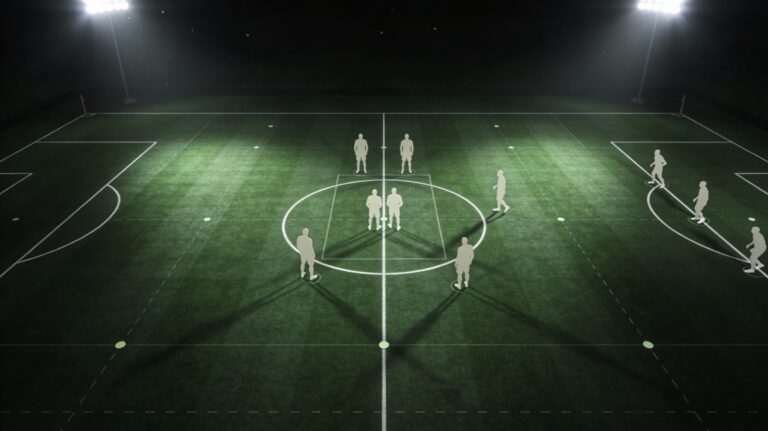
While the team sheet says 3-4-2-1, the reality in possession is a 3-2-2-3. The two holding midfielders and the two attacking “Number 10s” form a perfect central square.
This “Box” is the heart of the machine. By placing four elite technicians in the central corridor, Alonso creates a permanent numerical overload. If an opponent plays a standard 4-4-2 or 4-3-3, they are physically incapable of marking all four corners of the box without leaving the flanks entirely exposed. It is a geometric “Checkmate” that ensures Leverkusen always has a free man in the most dangerous part of the pitch.
To validate the Box Midfield, this guide will help.
The Xhaka Factor: The On-Pitch General
A strategist is only as good as his lieutenant on the grass. In Granit Xhaka, Alonso found a mirror of his own playing self. Xhaka’s role is defined by “Rest-Defense Positioning.” While the wing-backs fly forward, Xhaka remains the “Pivot.” He rarely makes the final pass, but he is the one who chooses when the final pass is allowed to happen. He dictates the “Metronomic Tempo.” If the attack breaks down, Xhaka is already positioned in the channel to snuff out the counter-attack before it starts. He is the safety valve that allows the creative players the luxury of taking risks.
Asymmetric Wing-Back Warfare
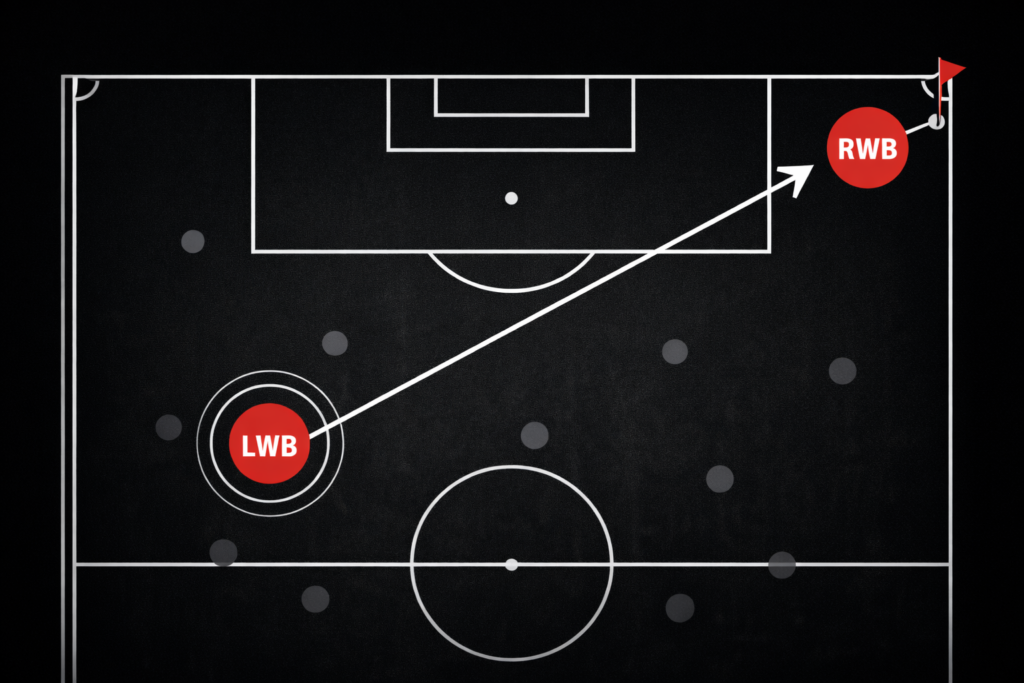
Leverkusen’s wing-backs, Jeremie Frimpong and Alex Grimaldo, are the most productive pairing in the modern era, but they achieve this through entirely different profiles.
- Jeremie Frimpong (The Touchline Rocket): Frimpong provides the “Maximum Width.” He stays high and wide, acting as a traditional winger. His presence pins the opponent’s left-back deep, creating massive gaps in the interior.
- Alex Grimaldo (The Inverted Architect): Grimaldo often drifts inside, effectively becoming a third central midfielder. This creates a 5-on-3 overload in the middle. When the opponent shifts to stop Grimaldo, the ball is switched to the isolated Frimpong.
This asymmetry is a nightmare for opposition managers. If you defend the width, you lose the center. If you congest the center, Frimpong kills you in a 1v1.
Florian Wirtz: The “Half-Space” Ghost
Florian Wirtz is the crown jewel. In a strategist’s vocabulary, Wirtz is a “Space Hunter.” He doesn’t stay in a fixed position; he hunts for the “Half-Spaces”—the vertical channels between the opponent’s full-back and center-back.
Because of the “Box Midfield” mentioned earlier, defenders are often preoccupied with the holding midfielders, allowing Wirtz to receive the ball on the half-turn. Once he turns, the defense is essentially broken. His ability to “ghost” into these pockets of space is what makes Leverkusen’s attacks feel unpredictable.
Defensive Compactness: The 5-2-3 Block
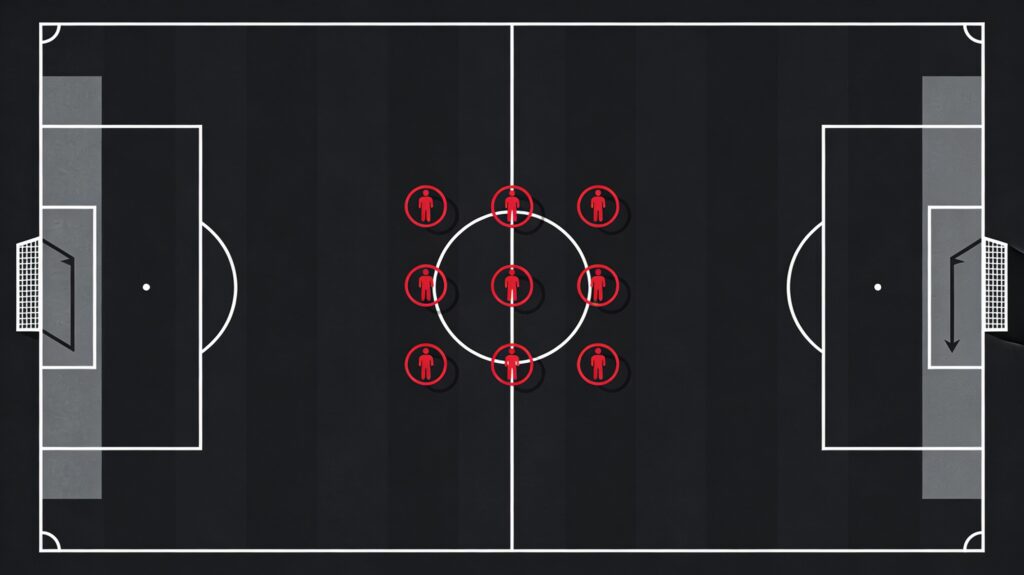
Leverkusen’s defense is about “Position-Oriented Pressing.” They do not engage in the “mad dog” pressing seen in early Klopp teams. Instead, they use a compact 5-2-3 shape that prioritizes central density.
The front three (the striker and the two 10s) form a narrow screen to block passes into the middle. They want to force the opponent to play the ball to the sidelines—the “Dead Zones.” Once the ball moves wide, the Leverkusen wing-back “jumps” to press, and the entire team shifts like a synchronized wave. It is a defense designed to be “boring” until the moment a turnover is forced, at which point the transition is lightning-fast.
“La Pausa”: The Power of the Pause
One of the most human elements of Alonso’s tactics is the concept of La Pausa. This is the deliberate slowing down of the game. Sometimes, a Leverkusen player will simply stop with the ball under his foot.
To a novice, it looks like a lack of urgency. To a strategist, it is a weapon. By stopping, the player forces the opponent to make a choice. As soon as the defender flinches or takes a step toward the ball, the rhythm changes instantly. It is the tactical equivalent of a pitcher in baseball changing his delivery speed to keep the hitter off balance.
Exploiting “Rest-Defense” Vulnerabilities
Alonso knows that most teams in the Bundesliga are built to counter-attack. Leverkusen minimizes this risk by maintaining a “3+2” structure at the base of their attacks. Even when they are deep in the opponent’s half, the three center-backs and two holding midfielders form a protective shell. This is why they conceded so few goals on the break—they are defending even while they are attacking.
Cognitive Exhaustion: The Psychology of the 90th Minute
The most impressive “stat” of the Alonso era is the number of goals scored after the 85th minute. Critics call it “Leverkusen Luck”; as a strategist, I call it Cognitive Exhaustion.
Alonso’s system forces the opponent to make thousands of micro-decisions. Should I track Wirtz? Should I jump to Frimpong? Should I stay with Xhaka? By the 80th minute, the opponent’s brain is physically and mentally tired. Their concentration slips for just one second, and in a system as precise as Leverkusen’s, one second is all it takes for the house of cards to fall.
Tactical Comparison: Standard 3-4-2-1 vs. Alonso Hybrid
| Feature | Standard 3-4-2-1 | Alonso’s Leverkusen Hybrid |
| Wing-Backs | Symmetric width on both sides. | Asymmetric: One “Winger,” one “Inverted Pivot.” |
| Midfield Build-up | Two flat pivots. | Fluid “Box Midfield” (2-2 structure). |
| Tempo | Usually consistent verticality. | “Slow-Slow-FAST” (Using La Pausa). |
| Defensive Shape | Usually a flat 5-4-1. | Flexible 5-2-3 with a narrow front three. |
| Playmaking | Rely on traditional wingers/10s. | Playmaking begins with ball-playing CBs. |
Final Thoughts
Xabi Alonso has proven that you don’t need a decades-long coaching resume to build a masterpiece; you need a clear vision and the courage to demand technical perfection. For any student of the game, Leverkusen isn’t just a team to watch—it is a textbook to be studied. They remind us that football is a game of geometry, and he who controls the shapes, controls the result.
Enjoyed this breakdown?
Don’t Just Watch Football. Understand It.
Join KharaSportsDaily and receive occasional deep tactical insights most fans miss.
Occasional analysis. No match reports. No noise.
Frequently Asked Questions (FAQs)
Why don’t more teams copy the 3-2-2-3 “Box Midfield”?
Because it requires extraordinary technical discipline. If you lose the ball in the center of that “box,” you are incredibly vulnerable to a direct counter-attack. You need a “Metronome” like Xhaka who rarely misplaces a pass to make this work.
Is the system vulnerable to any specific tactic?
Yes. Extremely high-intensity, man-to-man pressing (like Atalanta in the 2024 Europa League Final) can disrupt the rhythm of the “Box Midfield.” If you deny Leverkusen the “Pause,” you deny them their ability to manipulate the game.
Does Victor Boniface/Patrik Schick have a traditional “Striker” role?
Not entirely. The striker in this system is often used as a “Wall.” They receive the ball with their back to goal, hold it up for one second to allow the “10s” to run past them, and then lay it off. They are facilitators as much as finishers.
About The Author
Football Tactician & Analyst. breaking down elite systems for coaches and fans.
[…] we analyzed Xabi Alonso’s Leverkusen Blueprint, we saw how tactical structures are designed specifically to maximize high-xG cut-backs while […]
[…] If you want to see how a low PPDA translates to attacking success, read our case study on Xabi Alonso’s Leverkusen Blueprint. […]