
Last updated: September 18, 2026
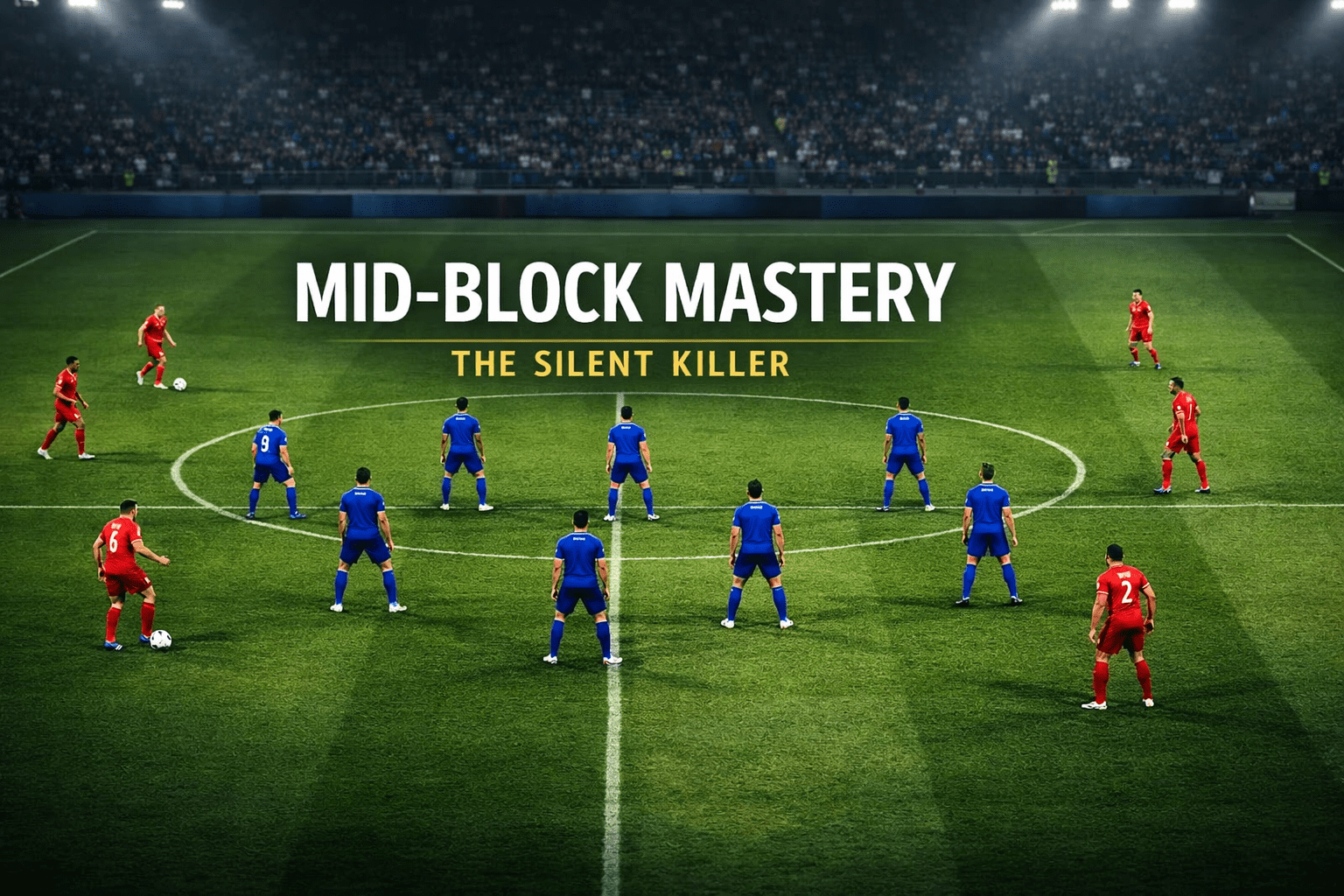
What is mid-block pressing? It is a defensive structure where a team stays compact in the middle third, protects central space, and applies pressure only when specific triggers appear. It balances control and risk by denying progression rather than aggressively chasing the ball.
We live in an era obsessed with “Heavy Metal” football. If you aren’t pressing the goalkeeper’s studs into the goal line, are you even trying? That’s the narrative fed to us by the high-pressing revolution of the last decade. But I’m here to tell you that the obsession with the high press is often a trap. The most sophisticated, controlled, and dangerous teams in the world don’t always chase the ball 80 yards from their own goal. They wait. They coil. They utilize Mid-Block Pressing.
Think of Carlo Ancelotti’s Real Madrid in the Champions League, or Didier Deschamps’ 2018 World Cup-winning France. They didn’t win by running more; they won by controlling the space that matters most. Drawing from Real Madrid’s 2021–22 Champions League campaign,
The mid-block pressing is the tactical “Goldilocks” zone – not as risky as the high press, not as passive as the low block. It is a calculated weapon of containment and ambush. In this breakdown, we are going to dissect exactly how to coach, execute, and dominate using the mid-block.
What is mid-block pressing? It is a defensive structure where a team stays compact in the middle third, protects central space, and applies pressure only when specific triggers appear. It balances control and risk by denying progression rather than aggressively chasing the ball.
Table of Contents
Defining the Mid-Block Pressing Landscape
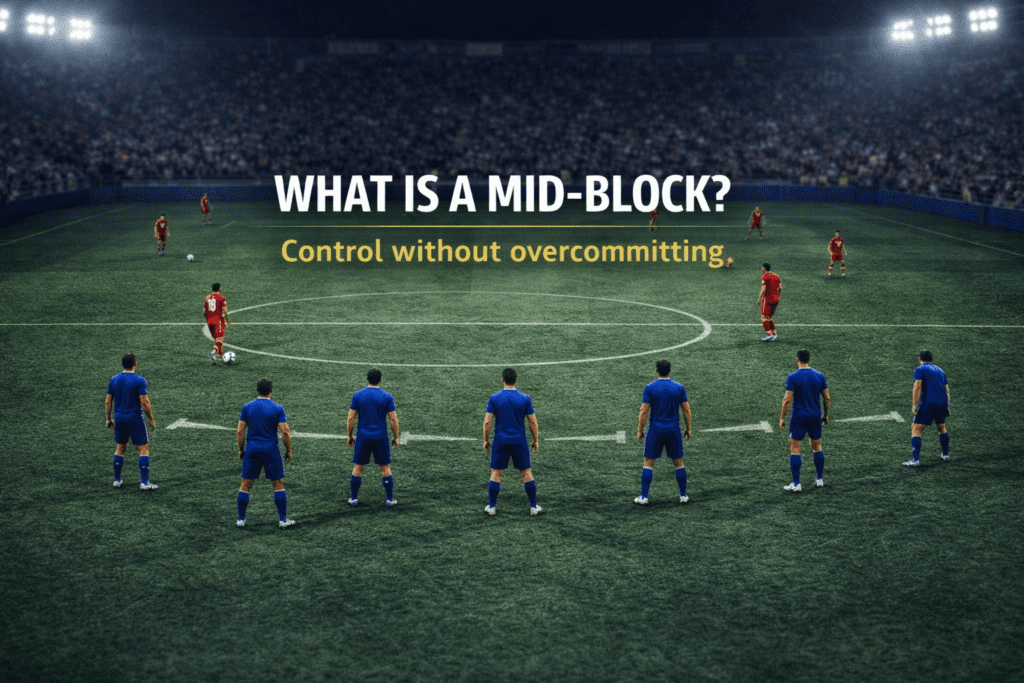
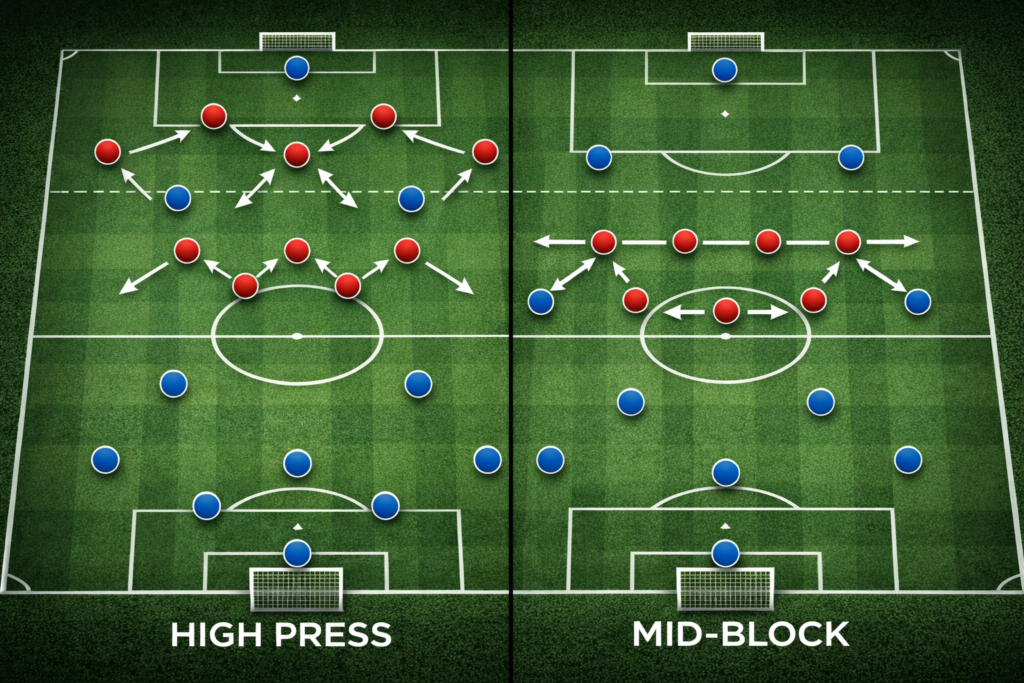
In this mid-block pressing explained guide, the focus is not on chasing the ball – but controlling space and forcing predictable decisions. The high press operates in the attacking third (Zone 3). The low block bunkers down in the defensive third (Zone 1). The mid-block lives, unsurprisingly, in the middle third – Zone 2.
But it’s not just about geography; it’s about intent.
When I coach a mid-block, I tell my players: “We’re not trying to win the ball instantly. We’re trying to make them play exactly where we want.”
In a high press, the objective is immediate disruption. In a mid-block pressing, the objective is manipulation. You allow the opponent’s center-backs to have the ball. You might even let them pass it sideways a dozen times. You are essentially saying, “Go ahead, keep the ball in harmless areas. But the moment you try to step into our house, we slam the door.”
This patience requires immense psychological discipline. I’ve seen talented squads fail at this because their strikers get impatient and jump the gun, breaking the structure. A successful mid-block requires the collective mind of a hive – moving as one unit, sliding left and right, waiting for the trigger.
If you’ve ever wondered what a mid-block looks like in football – this is the system elite teams use to control games without overcommitting.
If you’re new to pressing systems, start with the full comparison →
→ High Press vs Mid-Block Explained
What Is Mid-Block Pressing in Football? (Definition and Zones)
A mid-block in football refers to a team’s defensive positioning within the middle third of the pitch – typically between the halfway line and the edge of their own penalty area. Unlike a high block (pressing in Zone 3) or a low block (defending deep in Zone 1), the mid-block occupies Zone 2. Teams using a midblock concede territorial possession to opponents but prioritize compactness, protecting the central corridor, and triggering coordinated pressing moments when the ball enters predefined danger areas.
Mid-Block Structure & Compactness
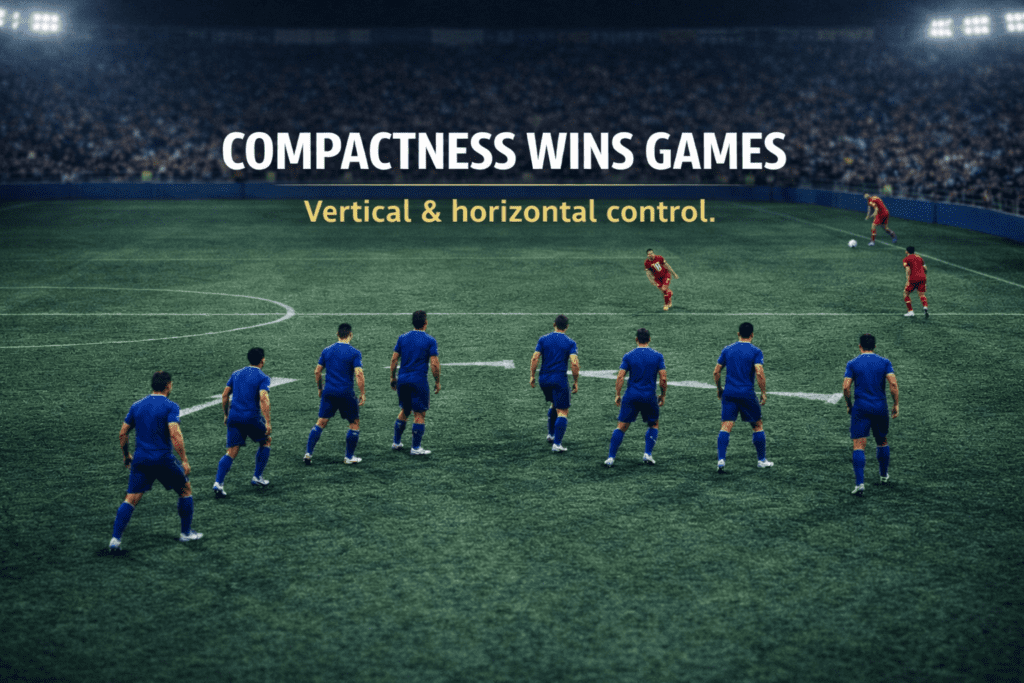
If you take nothing else from this article, remember this: Compactness is non-negotiable.
A mid-block without compactness is just a group of players standing in the middle of the field getting bypassed. We need to look at compactness in two dimensions:
Vertical Compactness
This is the distance between your highest player (usually the striker) and your deepest player (the center-backs). In an elite mid-block, this distance should be roughly 25 to 30 meters. This compresses the playing area. If the opponent tries to play between the lines (that dangerous Zone 14), they find no space because your midfield line is sitting practically on the toes of your defensive line.
Horizontal Compactness
This is the width of your team. When the ball is in the center, your wingers should be tucked in, no wider than the width of the penalty box. We force the opponent to play wide. Why? Because the touchline is the best defender in the world. It never misses a tackle, and it never gets tired.
Visual Asset 2: Diagram Prompt Prompt: High-fidelity tactical diagram showing a football pitch. A red team is set up in a 4-4-2 mid-block pressing. Shaded zones indicate the “compact block” in the center circle area. Arrows show the red team sliding laterally to force the blue team toward the touchlines. Minimalist, clean design suitable for tactical analysis. Overlay Text:
- Headline: COMPACTNESS IS KING
- Subtext: VERTICAL VS HORIZONTAL File Name:
kharasportsdaily_mid-block-pressing_diagram_01.pngAlt Text: Tactical diagram illustrating the vertical and horizontal compactness required for a successful mid-block pressing structure.
When the ball moves to the opponent’s left back, your entire block must slide across like a foosball team. If one player is lazy and doesn’t slide, a gap opens in the “half-space,” and elite teams like Manchester City or Arsenal will punish you instantly.
Mid-Block Pressing Triggers and Traps
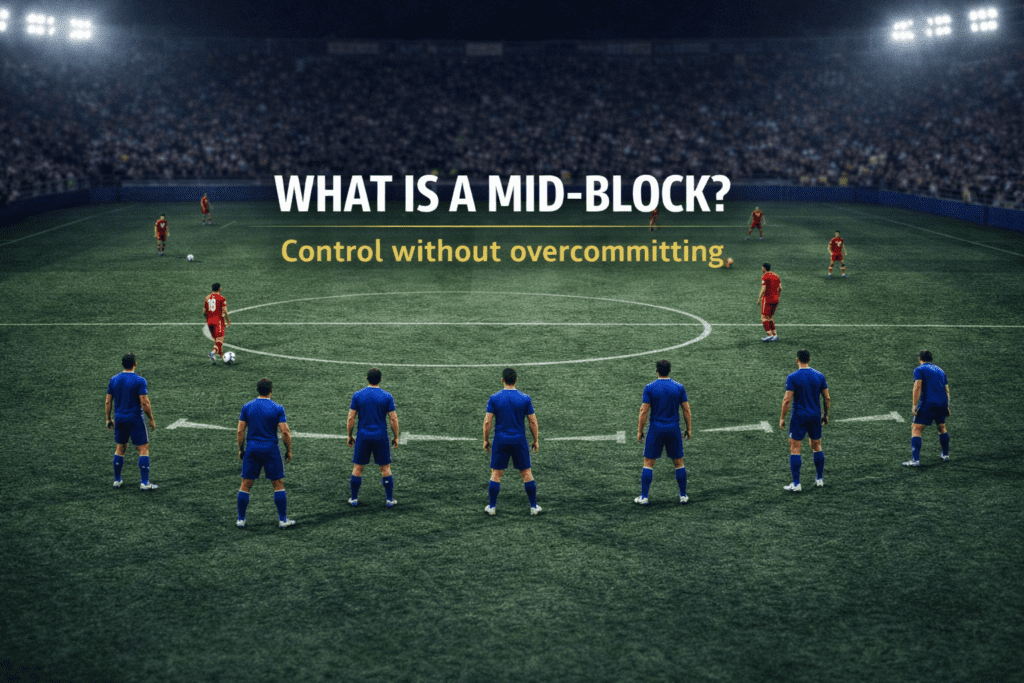
A passive mid-block eventually gets broken down. An active mid-block sets traps. You need defined “triggers” – specific events that tell your team, “Now we hunt.”
Common Pressing Triggers:
- A poor touch: If an opponent creates a heavy touch, the nearest man engages aggressively.
- A backward pass: This is a cue for the entire defensive line to step up and compress the space further.
- A pass into the “Trap Zone”: This is the most advanced tactic.
Setting the Wide Trap

We often set up what I call a “U-shape” trap. We leave the opposition full-back open. It looks like a mistake, but it’s bait. As soon as the center-back passes to that open full-back, our winger sprints to press them, cutting off the return pass to the center-back. Simultaneously, our central midfielder shifts across to cover the line, and our full-back steps up.
Suddenly, the opponent’s full-back is in “The Cage.” They can’t go back, they can’t go forward, and they can’t go inside. Their only option is a high-risk long ball down the line, which our defenders should easily clean up.
Data Analysis: Pressing Types Compared
To truly appreciate the utility of the Mid-Block, we need to compare it against its siblings: the High Press and the Low Block. We can evaluate them based on risk, physical demand, and spatial control.
| Feature | High Press | Mid-Block | Low Block |
| Engagement Line | Opponent’s Penalty Box | Halfway Line / Center Circle | Own Defensive Third |
| Physical Demand | Extremely High (Sprinting) | Moderate (Shifting/Sliding) | Low (Static/Absorbing) |
| Defensive Line | High (Leaving space behind) | Medium (Balanced) | Deep (No space behind) |
| Primary Risk | getting bypassed = 1v1 on goal | Gaps between lines | Conceding shots from distance |
| Best For… | Chasing a game / Dominant teams | Control & Counter-Attack | Protecting a lead / Underdogs |
As you can see, the Mid-Block Pressing offers the most balanced risk-to-reward ratio. It is sustainable for 90 minutes, whereas a high press often leads to burnout by the 70th minute.
Real-World Case Studies: The Elite Standard
Let’s look at two masters of this craft.
Didier Deschamps’ France (2018)
People forget that France had the most attacking talent in the world (Mbappé, Griezmann, Pogba), yet they played a rigid mid-block. Deschamps knew that if he drew opponents out to the halfway line, he created 50 meters of green grass behind them for Kylian Mbappé to run into. Their mid-block wasn’t defensive; it was the launchpad for their offense. They utilized Rest Defense principles to ensure they were ready to transition the moment they won the ball.
Erik ten Hag’s Ajax (2019)
While known for possession, that famous Ajax team used a mid-block pressing to disrupt rhythms. They focused heavily on cutting off the “6” (the opponent’s defensive midfielder). By placing their #10 (Donny van de Beek) on the opponent’s pivot, they severed the connection between defense and attack, forcing opponents to hit hopeful long balls which De Ligt would head away all day.
Unai Emery’s Aston Villa (2024–25)
Emery’s Villa have been one of the most disciplined mid-block sides in the Premier League during the 2024–25 campaign. Operating primarily in a 4-4-2 shape, Villa invite pressure from the opposition’s fullbacks before triggering coordinated press moments through the central corridor – the same “trap zone” principle Deschamps used in 2018, applied in a modern league context.
The Role of the Pivot (The Anchor)

The success of your mid-block often hinges on your defensive midfielders (the Double Pivot or Single Pivot). In a 4-4-2 mid-block, the two central midfielders are the engine room. They must constantly communicate.
If one steps out to press an opponent carrying the ball, the other must drop slightly to cover the space behind. We call this the “pistons” movement. If both step up, a simple pass breaks your entire line. If both drop, you give the opponent too much time to pick a pass.
This requires “scanning” – a concept we see constantly with elite midfielders. They aren’t just watching the ball; they are checking their shoulders to ensure the vertical distance to the strikers and the center-backs is maintained.
Key Takeaways
- Control Without Exposure: The mid-block pressing protects the space behind the defense while preventing the opponent from playing through the center.
- Energy Conservation: Unlike a high press, a mid-block allows players to conserve physical energy for explosive counter-attacks. I have written a full breakdown in my previous High Press vs Mid-Block article how these tactics differ.
- The Trap is Key: You aren’t just defending; you are funneling the opponent into specific “kill zones” to win the ball back.
- Vertical Compactness: The distance between your strikers and your center-backs must never exceed 25-30 meters.
Final Thoughts
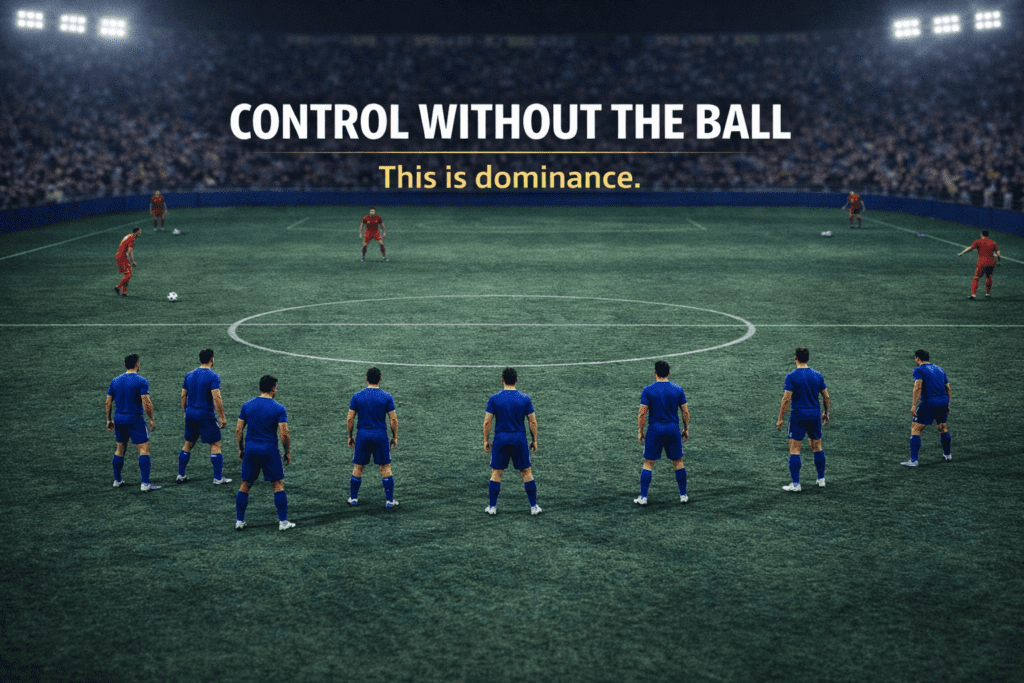
The Mid-Block is the tactical equalizer. It allows a team with less technical quality to frustrate and defeat a superior opponent by controlling the geometry of the pitch. It requires humility – you have to accept that you won’t have the ball for spells of the game. But if you execute the slide, maintain the compactness, and trigger the trap correctly, you aren’t just defending. You are controlling the game without the ball.
For further reading on how this integrates with defensive transitions, check out our guide on Rest Defense or see how this structure frustrates Zone 14 entries.
This is why mid-block pressing remains one of the most effective defensive systems in modern football.
Want to read any match like this?
The framework behind these breakdowns, in one place. The four phases, a 15-minute method for diagnosing both teams before the drinks break, a printable match-watching worksheet, and 51 terms defined. 40 pages.
Get the pack$9, instant downloadRelated Tactical Breakdowns
The mid-block only holds when your team transitions without losing shape – this is how elite sides protect structure the moment they win or lose the ball.
High Press Vs Mid-Block
Rest Defense Explained
De Zerbi’s Tactics Explained
Speak the language of the game
Get the free 47-term tactical glossary. Gegenpress, half-space, xT, low block, each defined in plain language and linked to a full breakdown. It is yours for an email.
Frequently Asked Questions (FAQs)
Is a Mid-Block the same as “Parking the Bus”?
Absolutely not. “Parking the Bus” refers to a low block where the intent is solely survival. A mid-block is proactive. It aggressively closes space in the middle third to win the ball and counter-attack. It is a trap, not a bunker.
Which formation is best for a Mid-Block?
The 4-4-2 is the gold standard for mid-blocks (used by Simeone’s Atletico and Ancelotti’s Madrid) because it covers width and depth evenly. However, a 4-1-4-1 is also excellent if you need extra protection between the lines against a team with a strong #10.
How do you train the Mid-Block?
You must use shadow play. Set up your team against zero opponents and have them shift in unison as the coach moves the ball. Once the spacing is automatic, introduce opponents in small-sided games where points are only awarded for winning the ball in the middle zone.