
Last updated: August 17, 2026
In the 2021-22 Champions League knockout rounds, Real Madrid had 45.7% possession against Paris Saint-Germain, 43.8% against Chelsea, and 40.8% against Manchester City, per Coaches’ Voice. They lost the expected goals battle in four of seven knockout matches that season. They still won the trophy. Two years later the pattern repeated: four of six knockout xG battles lost, another European Cup secured at Wembley, with Carlo Ancelotti now the most successful coach in the competition’s history.
The puzzle this raises is the foundation of the Ancelotti anti-system, the idea that has come to define an entire alternative to positional football. In an era where Pep Guardiola, Mikel Arteta, Xabi Alonso and Vincent Kompany are coached around a single philosophy, Ancelotti is the manager who appears to have no system at all. He famously could not tell reporters whether his 2022 final XI played a 4-3-3 or a 4-4-2.
In simple terms: The Ancelotti anti-system is a meta-tactic that prioritises player autonomy and situational adaptation over a fixed positional structure.
This article breaks down what the Ancelotti anti-system actually is, how it works in possession, how it punishes positional sides in transition, and why no other elite club has been able to copy it.
Key Takeaways
- The Ancelotti anti-system is a meta-tactic, not an absence of one: the deliberate refusal to lock players into pre-set positional patterns is itself the strategy, flexibility codified at the highest level.
- Player autonomy replaces manager instruction: Real Madrid’s 2021-24 era trusted Luka Modrić, Toni Kroos and Karim Benzema to make in-game decisions positional coaches would normally script themselves.
- The Ancelotti anti-system thrives on the xG-loss paradox: per The Analyst, Real Madrid have lost the xG battle in 26 Champions League knockout games since 2010-11 and still posted an 11-6-9 record across those contests.
- It is the purest relational counter to positional play: where Pep Guardiola’s Manchester City controls space first, the Ancelotti anti-system controls time first.
- Its weakness is structural, not stylistic: against equally elite positional sides without a senior leadership spine, the Ancelotti anti-system can be out-organised in possession phases.
Table of Contents
What Is the Ancelotti Anti-System?
The Ancelotti anti-system is a meta-tactic that treats flexibility itself as the tactical idea. Where Pep Guardiola’s Manchester City designs positional patterns that players execute, Carlo Ancelotti‘s Real Madrid was designed around player relationships that the players themselves managed in real time.
Think of it this way. Guardiola’s system is a sonnet: strict rules, fourteen lines, defined rhyme scheme, infinite expression within the constraint. Ancelotti’s system is jazz; the musicians know the chord changes, but the order, the length of each solo and the dynamics all get made on the night by the players holding the instruments.
This is what tactical writers call relational football, and Ancelotti is its highest-profile practitioner in the European game. He has eliminated Pep Guardiola from the Champions League over two legs twice in five seasons, the only coach to do so.
The Origin: Roberto Baggio and the Lesson at Parma
Ancelotti was not always a relational coach. He began his career as a disciple of Arrigo Sacchi and the 4-4-2 dogma. The pivot moment came at Parma in the early 1990s, when he turned down the chance to sign Roberto Baggio because Baggio could not be slotted into the system Ancelotti was committed to.
The lesson he took from that decision shaped every subsequent appointment. At AC Milan, the team was built around Andrea Pirlo’s deep playmaking and Kaká’s freedom between the lines. At Chelsea, Frank Lampard and Didier Drogba were given a directness the system was redesigned to amplify.
At Real Madrid, the late careers of Luka Modrić, Toni Kroos and Karim Benzema were extended by a coach who refused to constrain them. The system bent to the players, not the other way round.
How the Ancelotti Anti-System Works In Possession
Possession inside the Ancelotti anti-system is built around what tactical theorists call relationism: small groups of players solving local problems together rather than executing a pre-scripted positional grid.
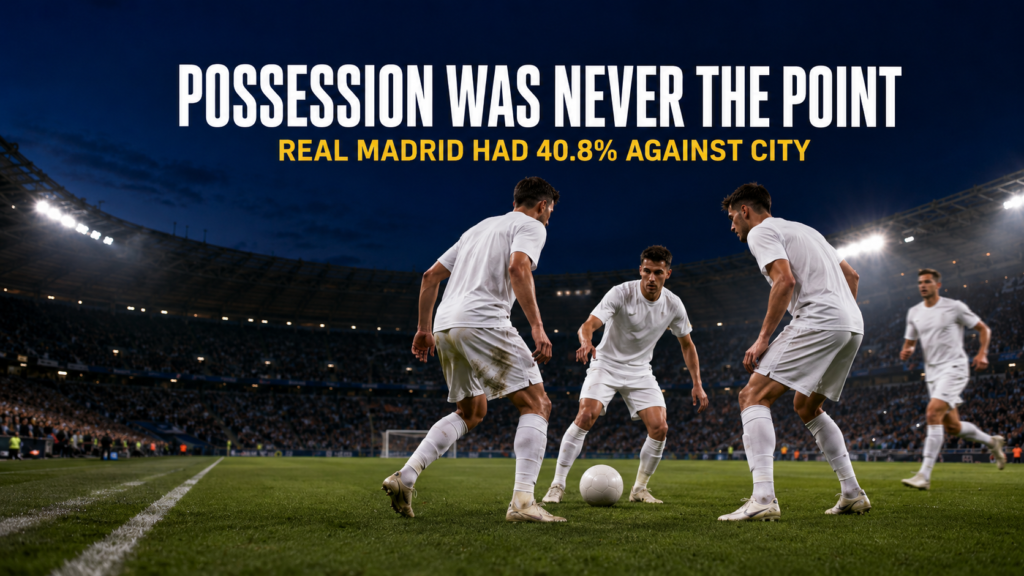
Real Madrid would frequently overload the left side around Vinícius Júnior. Karim Benzema would drop into midfield to receive, pulling a centre-back with him. Luka Modrić would drift wide while Toni Kroos held the deep left half-space.
The shapes that emerged were not pre-coached patterns. They were the by-product of four senior players reading the same picture and arranging themselves accordingly. Where Manchester City would arrive in a 3-2-5 every possession, Real Madrid would arrive in whatever shape the immediate problem required.
This is also why Ancelotti’s teams rarely dominate possession statistics. The numbers from the 2021-22 Champions League knockouts (45.7% against PSG, 43.8% against Chelsea, 40.8% against City) are not failures, they are features. The anti-system accepts that the opposition will sometimes have the ball, because the value extraction comes elsewhere.
The Midfield Triangle: Modrić, Kroos, Casemiro
The functional spine of the anti-system at Real Madrid was a midfield three that operated almost without a coach’s intervention: Luka Modrić, Toni Kroos and Casemiro. Together they made more than 300 starts across two managerial cycles, per Wikipedia squad records.
| Phase | Modrić’s Role | Kroos’s Role | Casemiro’s Role |
|---|---|---|---|
| Build-up | Half-space carrier | Deep distributor (left) | Shield behind the line |
| Progression | Third-man combinations | Diagonal switches | Holding pivot |
| Defensive transition | Press initiator | Cover for fullback | First defender to ball |
Data reflects observed positional roles across the 2021-22 and 2023-24 Champions League knockout rounds. Individual match variance applies.
The triangle was the autonomy engine. Each player understood the other two well enough that Ancelotti did not need to choreograph the build-up phase the way Guardiola does at City. The decision-making was distributed, not centralised.
When Casemiro left for Manchester United in 2022 and Kroos retired in 2024, the system creaked in the way structural engineers always predicted it would. Player-led football lives or dies by the quality of the players doing the leading.
The Transition Game: Where the Ancelotti Anti-System Punishes Positional Sides
The transition game is where the Ancelotti anti-system’s xG-loss paradox starts to make sense. Per The Analyst, since the start of the 2010-11 season Real Madrid have lost 26 Champions League knockout games on expected goals yet posted an 11-6-9 record in those contests.
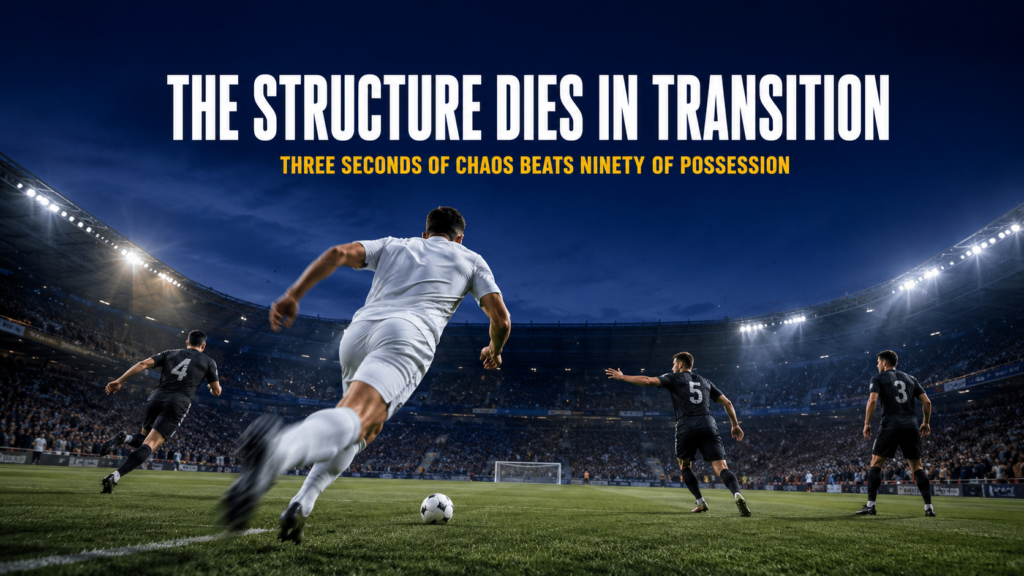
Losing the xG battle is meant to indicate inferior chance quality. Real Madrid keeps winning anyway, because they generate goals from moments positional models do not weight properly.
The mechanism is transition. Positional sides like Manchester City compress space when they have the ball, which means they are also at their most vulnerable the instant they lose it. Ancelotti’s teams sit in mid-blocks waiting for that moment, then break with Vinícius Júnior, Rodrygo Goes and Federico Valverde in three-second sequences that bypass the structure the opposition just built.
The 2022 semi-final at the Bernabéu against Manchester City, two Rodrygo goals in 90 seconds to overturn a tie that was already lost, is the canonical example. What looks like an inferior xG profile is actually a different one: fewer shots, but from moments where the opposition’s defensive structure does not exist yet.
The Bellingham Reinvention: A System Built Around Talent
The 2023-24 season was the cleanest proof that the Ancelotti anti-system is a real philosophy rather than a happy accident. Karim Benzema left for Saudi Arabia. The natural number nine was gone, and a positional manager would have signed a direct replacement.
Ancelotti did not. The traditional 4-3-3 was reshaped into a 4-3-1-2, with Vinícius Júnior pushed into a central forward role and Jude Bellingham deployed as a free number ten.
Bellingham scored 23 La Liga goals from that role in his debut season, per La Liga records. The system did not absorb Bellingham, the system was rebuilt to release him. This is what “no system” actually means: the team architecture is downstream of the squad’s most talented player, not upstream.
Game-State Data: How Real Madrid Manipulates Score Pressure
Real Madrid in 2023-24 generated more chances per minute when leading than when trailing, per Opta data, the opposite of nearly every elite team in Europe. This is the layer of the Ancelotti anti-system that often gets missed.
Most teams attack hardest when they need a goal. Real Madrid attacks hardest once they already have one, because a leading game state opens the larger spaces the opposition then has to chase into.
The anti-system is built to weaponise game state the way positional sides weaponise possession. The score is the structural input; everything else flows from it.
The Weakness: Where the Ancelotti Anti-System Breaks
The Ancelotti anti-system has two clear failure modes. The first is when the senior decision-making spine ages out faster than it can be replaced. The 2024-25 Real Madrid season, with Casemiro gone, Kroos retired and Modrić at 39, produced visibly more chaotic possession phases and less reliable defensive shape than the 2021-22 vintage.
The autonomy engine requires leaders capable of running it. Without those leaders, the freedom that defines the Ancelotti anti-system collapses into disorganisation.
The second weakness is structural. Against equally elite positional sides who do not concede transitions easily and who do not need a senior spine of their own to stay organised, peak Manchester City and peak Bayer Leverkusen under Xabi Alonso, the Ancelotti anti-system can be out-passed in extended possession phases.
Real Madrid’s xG-loss record in knockout football is not a tactical badge; it is a real cost the team absorbs on the assumption that one or two transition moments will rescue them. Sometimes those moments do not come.
This is also why Pep Guardiola, Mikel Arteta and Xabi Alonso continue to invest in positional structures rather than copying Ancelotti. Player-led football is the hardest model to replicate because the inputs, veteran leaders, generational individual talent, and a club willing to absorb xG-loss noise, are not buyable in the same way pressing schemes are.
What This Means on the Pitch
The temptation is to say Ancelotti got lucky. Five Champions League titles, the most in the competition’s history, is a very long luck. The honest reading is that positional play and the Ancelotti anti-system are not opposite ends of a spectrum where one is right.
They are two genuine answers to the same question, and the football world’s instinct to flatten the debate into one correct philosophy says more about analysts than about the game itself.
Ancelotti is now the head coach of Brazil, named manager of their 2026 World Cup squad on May 18. The same questions will follow him: can the anti-system survive without Modrić and Kroos, and can it work in international football where preparation time is a fraction of what it is at a club? The answer to both is probably yes, because the philosophy was never about those specific players, it was about trusting whichever players you have.
What Do You Think?
Ancelotti has eliminated Pep Guardiola from the Champions League over two legs twice in the last five seasons. If the positional model is genuinely superior, that result is impossible. So if the Ancelotti anti-system is the better answer, why isn’t every elite club copying it? Drop your take below.
Want to read any match like this?
The framework behind these breakdowns, in one place. The four phases, a 15-minute method for diagnosing both teams before the drinks break, a printable match-watching worksheet, and 51 terms defined. 40 pages.
Get the pack$9, instant downloadRelated Tactical Breakdowns
Liverpool 2.0: Inside Klopp’s Tactical Rewire Of A Fading Empire
Why it connects: Klopp built the opposite of an anti-system, a coached, intense, choreographed pressing structure that sharpens what makes Ancelotti’s autonomy model so distinct.
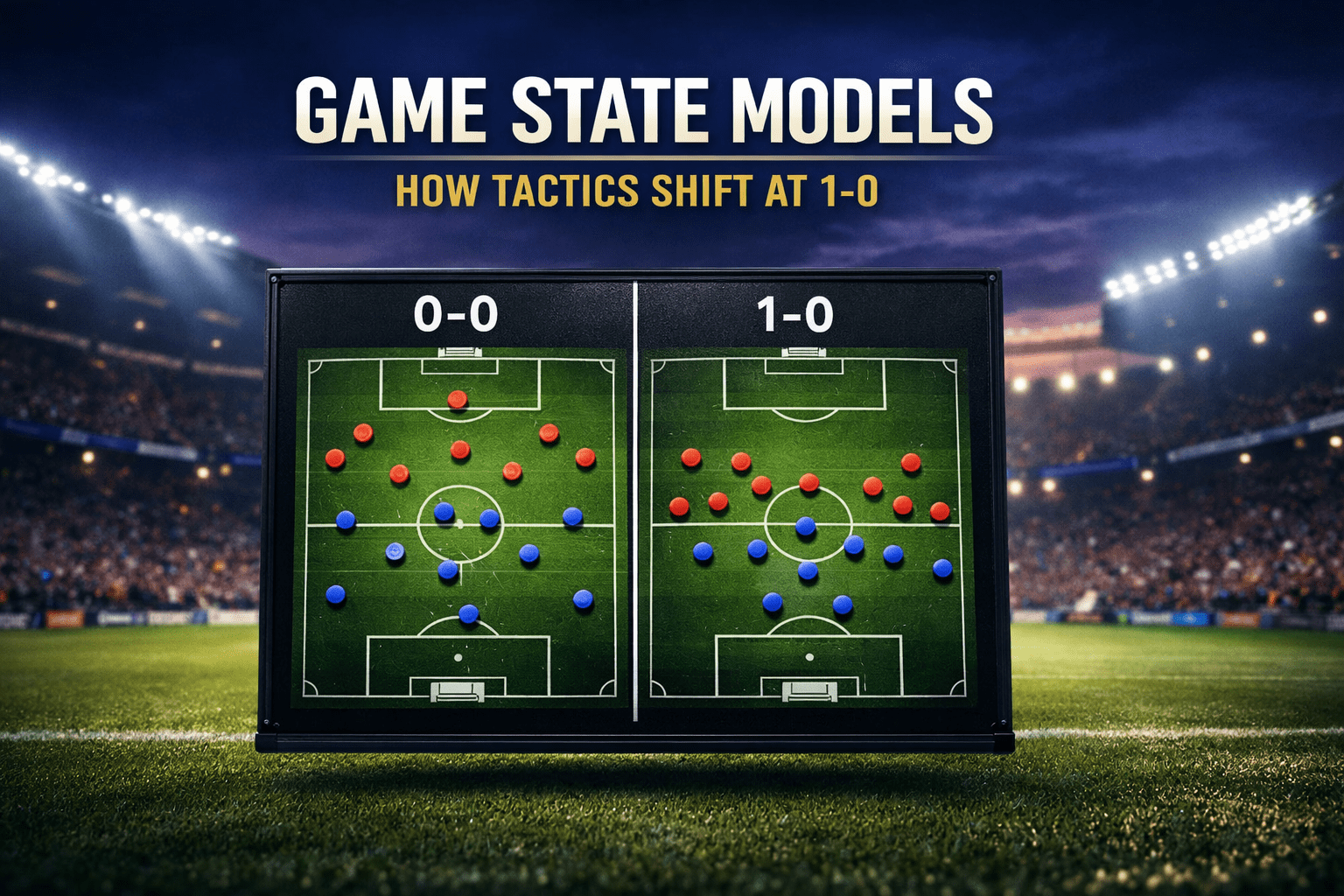
Game State Models Explained: How Elite Teams Shift Tactics the Moment They Score
Why it connects: Real Madrid’s “attacks harder while leading” pattern is the cleanest case study of how elite teams weaponise scoreline pressure, the data backbone of the anti-system.
Simeone’s 4-4-2 at Atletico Madrid: How Suffering Became a System
Why it connects: Simeone is the other great anti-Guardiola, but his model is total structural discipline rather than total autonomy, the same enemy approached from the opposite side.
Speak the language of the game
Get the free 47-term tactical glossary. Gegenpress, half-space, xT, low block, each defined in plain language and linked to a full breakdown. It is yours for an email.
Frequently Asked Questions
What is Carlo Ancelotti’s tactical philosophy?
Ancelotti’s tactical philosophy is situational flexibility: a deliberate refusal to commit to one fixed system in favour of adapting structure to the players available and the opponent being faced. He builds the team around individual talent rather than forcing talent into a prescribed pattern. This is sometimes called relational football, and it is the most successful counter-philosophy to positional play in the modern game.
Does Ancelotti use a fixed system or formation?
Ancelotti does not use a fixed system. He has won Champions League titles using 4-4-2 at AC Milan, 4-3-3 at 2014 Real Madrid, and a 4-3-1-2 diamond during 2023-24. He once told reporters he could not remember whether his 2022 final XI played a 4-3-3 or a 4-4-2, because the formation is downstream of the players, not the other way round.
Why is Ancelotti so successful in the Champions League?
Ancelotti has won five Champions League titles, the most of any manager in the competition’s history per UEFA: 2003 and 2007 with AC Milan, then 2014, 2022 and 2024 with Real Madrid. His success comes from a player-led model that excels in knockout football, where one or two transition moments can decide a tie. Senior leaders make better in-game decisions than any touchline can broadcast in real time.
How does Ancelotti differ from Pep Guardiola tactically?
Guardiola designs positional patterns that players execute; Ancelotti designs player relationships that players themselves manage in real time. Guardiola seeks to control space first and time second; Ancelotti seeks to control time first and space second. Both models have won European Cups, and they are different answers to what football fundamentally is.