

Last updated: September 19, 2026
The Simeone’s 4-4-2 has not lost a defensive identity battle in 13 years. In the 94th minute of the 2014 Champions League final, Sergio Ramos cancelled Diego Godin’s opener with a header that stole the trophy from Atletico Madrid. But the system itself had already won the argument – Simeone’s side had suffocated Real Madrid for 90 minutes inside a compact, disciplined block that defined an era.
Diego Simeone built something European football had no name for at the time – a methodology so structurally complete that his players believed suffering was the fastest route to winning. From January 2012 to today, no team across Europe’s big five leagues has conceded fewer goals per game than Atletico Madrid under the Simeone 4-4-2. That number sits at 0.72.
In simple terms: The Simeone 4-4-2 is a compact two-bank defensive system built to invite pressure, control central space, and convert defensive wins into direct counter-attacks.
This breakdown explains how the Simeone 4-4-2 actually functions, the data behind its dominance, and where elite teams have found the cracks. Read more on our Football Tactics Hub.
Key Takeaways
- Historically elite defensive output: Across Europe’s big five leagues since 2012, no team has conceded fewer goals per game than Atletico Madrid under the Simeone 4-4-2 system, with the rate sitting at 0.72 (per Opta Analyst).
- The compactness principle: The Simeone 4-4-2 collapses to approximately 25 metres vertically between its two banks of four, making the central corridor near-impenetrable and forcing opponents wide.
- Funnel pressing, not high pressing: Unlike Klopp’s Liverpool, the Simeone 4-4-2 invites opponents into wide channels and triggers swarming ball-wins at the touchline, not the halfway line.
- The 2020-21 proof point: Atletico Madrid defensive tactics under the Simeone 4-4-2 conceded just 25 goals in 38 La Liga games while winning the title – the fewest in any of Simeone’s championship campaigns.
- The structural weakness: Patient back-three buildup systems create 3v2 overloads against the Simeone 4-4-2 front line, the most reliable known method to dismantle the block.
Table of Contents
What Is the Simeone 4-4-2?
The Simeone 4-4-2 is a compact, two-bank defensive system that uses spatial control rather than pressing intensity to dominate opposition possession. Out of possession, Atletico Madrid set up in two rigid horizontal lines: a midfield bank of wide midfielder, central midfielder, central midfielder, wide midfielder, with a back four directly underneath. Two strikers sit above, positioned not to create chances but to block the central passing lanes between opposition centre-backs.
The structural principle is compactness. The two lines in the Simeone 4-4-2 rarely sit more than 25 metres apart vertically, making central penetration nearly impossible. Atletico does not chase the ball – it controls the geometry of the pitch and forces the opponent into predictable channels.
This is the foundation of Cholismo – Simeone’s tactical philosophy named after his nickname “Cholo.” The Simeone’s 4-4-2 treats defensive solidity not as a starting point but as an entire identity.
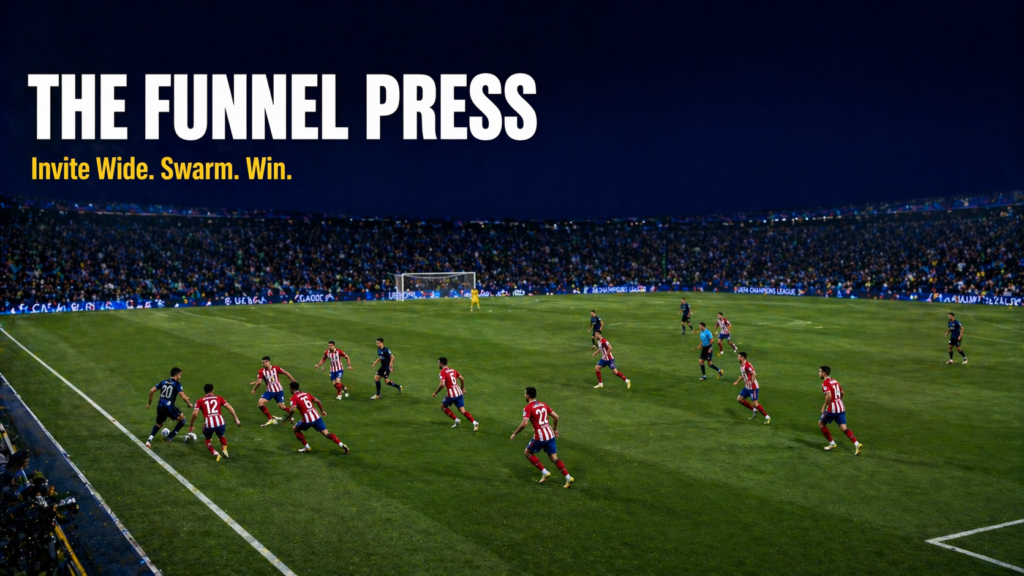
In match terms: when a winger or full-back receives possession wide, Atletico’s midfield collapses toward the ball. The winger drops, the wide midfielder closes, the near centre-back holds the line. The moment the ball is won – and it is won with force, not merely intercepted – the spring is released. Central attackers burst forward into the space left by the opposing team’s advanced shape.
This is not reactive defending. It is proactive defending with a structured, predetermined endpoint.
The Two Banks of Four: Compactness as a Weapon
Compactness is the engine room of the Simeone 4-4-2. The two horizontal lines of four players each operate as a single coordinated unit, shifting laterally and vertically together rather than as eight independent decision-makers.
When the ball moves laterally across the pitch, the entire Simeone 4-4-2 block shifts as one. The far-side wide midfielder tucks inside to become a third central midfielder, the back four slides toward the ball-side, and the strikers shadow the opposition’s deepest playmaker. There are never gaps between the lines for opposition number tens to receive.
This is what separates the Simeone 4-4-2 from a generic low block. A standard low block sits deep and absorbs pressure. The Simeone 4-4-2 absorbs pressure with a purpose – every defensive moment is structured to produce a high-probability ball-win in a specific zone of the pitch. Atletico Madrid defensive tactics under Cholismo are not reactive; they are pre-engineered.
The two banks of four defending model also has historical depth. Sir Alex Ferguson’s Manchester United used a similar shape in counter-attacking knockout matches. Sean Dyche’s Burnley produced consistent Premier League survival with the same structural template. What separates the Simeone 4-4-2 is the relentless application across 90 minutes and 38 league games – not a tactical option, but a baseline identity.
Funnel Pressing: How Atletico Force the Ball Wide
Funnel pressing is the offensive trigger inside the Simeone 4-4-2 defensive system. Rather than pressing high to win the ball in advanced areas – the Klopp model – Atletico Madrid press selectively, only when opponents enter pre-designated wide zones.
The mechanism works in three stages. First, the central corridor is sealed: two strikers cover the centre-back passing lanes, two central midfielders block any vertical pass into the opposition number ten. Second, the opposition is funneled wide: with the centre closed, the ball almost inevitably travels to a full-back or wide midfielder near the touchline. Third, the swarm arrives: as the ball enters the wide channel, Atletico’s near-side wide midfielder, central midfielder, and full-back collapse onto the ball-carrier simultaneously.
This low block counter-attacking system produces a higher ball-recovery rate in dangerous zones than traditional gegenpressing models because the ball-win location is predetermined. Atletico’s defenders know in advance where they will recover possession – and they know exactly where to release the counter the moment they do.
The Simeone 4-4-2 funnel press also explains Atletico’s deliberately low PPDA numbers. They do not press often, but when they do, the press is high-conversion. This is the tactical opposite of Klopp’s Liverpool or De Bruyne-era Manchester City, where pressing intensity is sustained across the entire pitch.
How Atletico Madrid Execute the System
The 2013-14 La Liga season is the most cited case study for Simeone’s 4-4-2, and the data supports every claim made about it. Atletico conceded just 26 goals across 38 league games while simultaneously reaching the Champions League final, where they conceded six goals across 12 European matches – and never more than one in a single game across the knockout rounds.
The 2020-21 title win took the system one step further. With Luis Suarez arriving from Barcelona as the focal point alongside Joao Felix, Atletico adapted the offensive application of the 4-4-2 without touching its defensive core. That season they conceded just 25 goals across 38 La Liga matches – the fewest in any of Simeone’s title campaigns – while their 1.9 goals scored per game was the highest ratio Atletico had produced since the 2013-14 title, according to analysis from The Mastermind Site. Jan Oblak, who kept 10 clean sheets in 17 combined La Liga and Champions League appearances, won his fifth Zamora Trophy for the lowest goals-conceded ratio among Spanish top-flight goalkeepers.
The table below illustrates the shift in Atletico’s key metrics between balanced and dominant defensive contexts across two title-winning seasons:
| Metric | 2013-14 (La Liga) | 2020-21 (La Liga) | Tactical Implication |
|---|---|---|---|
| Goals Conceded | 26 (38 games) | 25 (38 games) | Structural consistency across 7-year gap |
| Goals Scored | 77 | 67 | Offence built on controlled transitions |
| Clean Sheets | 20 | ~14 (est.) | Elite defensive organisation at both ends |
| Average Possession | ~43% | ~48% | Low possession, controlled territory |
| La Liga Position | 1st (90 pts) | 1st (86 pts) | Title delivered via defensive superiority |
Data reflects La Liga season totals. Possession estimates drawn from contemporary match reports. Individual season variance applies.

The players who made this system function were not merely technically excellent – they were psychologically specific. Simeone’s concept of “fibra” – a Spanish term for the mental and physical grit required to sustain defensive suffering – defined his recruitment across a decade. Diego Godin, Gabi, Koke, and Marcos Llorente were not the most gifted players on paper. They were the most reliable in the system. The commitment to collective shape over individual brilliance is what separated the 4-4-2 under Simeone from every other team that tried to replicate it.
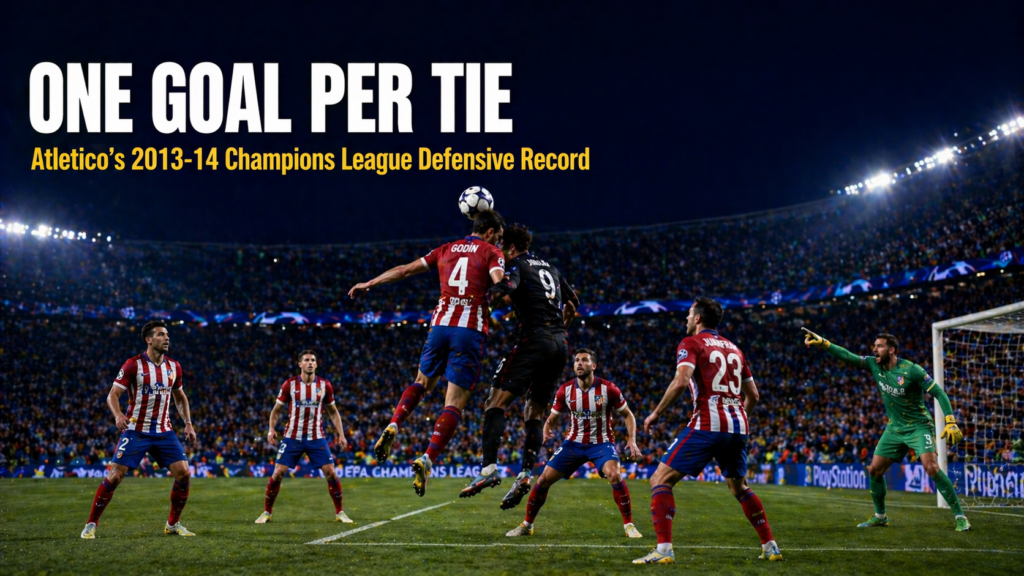
In Champions League knockout matches against Barcelona, Chelsea, and Liverpool across 2013-14 and into subsequent seasons, Atletico conceded a combined total of six goals across six two-legged ties – averaging exactly one goal per tie. The system did not merely defend – it defined the upper limits of how well a structured defensive shape could perform against elite attacking football.
The Weakness: How to Break the Block
No system is airtight. The structural vulnerability in Simeone’s 4-4-2 is well-documented and has been exploited by specific managers with the patience and personnel to do it.
The fundamental problem is numerical: two strikers pressing against a back four cannot account for a back three. When a team builds from the back with three centre-backs, they create a natural 3v2 overload against Atletico’s forward press. The central centre-back carries the ball forward, the striker from Atletico presses one side, and the wide centre-back becomes free to receive. Once that third centre-back receives in space, the traditional Atletico funnel collapses – the wide midfielder must step out, the central midfielder must shift, and gaps appear between the lines.
Pep Guardiola’s Manchester City and Jurgen Klopp’s Liverpool both identified this mechanism and built attacking structures to exploit it. Liverpool’s 2019-20 Champions League group stage encounters with Atletico saw Atletico ultimately eliminate the European champions via the second leg at Anfield – but the first-leg data revealed how Atletico’s compactness also restricts the speed of their own offensive transitions against high-defensive-line opposition. They won, but Klopp’s side forced Virgil van Dijk into long balls precisely because the Atletico shape controlled the central lanes so aggressively that Liverpool’s build-up was disrupted before Atletico even had to defend.
The other weakness is altitude and fatigue. Simeone’s system demands extraordinary physical commitment across 90 minutes. In Champions League knockout matches over two legs, and particularly in congested fixture schedules, the defensive intensity can drop in the second half of away legs. Atletico’s 2021-22 season saw them concede 26 goals in just 21 La Liga games – their worst defensive return at that stage under Simeone – as a combination of injuries, fatigue, and the structural exposure of individual concentration lapses unravelled the collective organisation.
The teams that consistently cause Atletico the most difficulty are those with wide overloads through back-three systems, patient buildup that refuses to be funneled, and the physical capacity to sustain pressure for 70 or more minutes. Guardiola’s side, Klopp’s Liverpool, and elements of Carlo Ancelotti’s Real Madrid have all shown the model for doing it.
The Tactical Takeaway
Simeone’s 4-4-2 is not a relic of a defensively cautious era. It is a structural argument that has held up across 13 years and two La Liga titles against opponents with three, four, and five times Atletico’s resources. The system did not survive because of nostalgia for the flat back four – it survived because it was built around a truth that modern football often ignores: controlling space is more reliably efficient than controlling possession.
What Simeone understood – and what the data continues to confirm – is that the team with the ball is not necessarily the team in control of the match. Atletico’s defensive record across Europe’s big five leagues since 2012 is not an accident of personnel. It is the product of a philosophy that treats defensive compactness not as a limitation, but as a tactical weapon.
The question for Simeone’s current iteration – with a younger, more technically ambitious squad built around Alvarez, Giuliano Simeone, and the still-present Griezmann – is whether the system can evolve without losing the core identity that made it elite. So far, the evidence suggests the system bends without breaking. That may be its most impressive quality of all.
What Do You Think?
Atletico Madrid won La Liga in 2013-14 with 90 points and 77 goals – their most expansive season under Simeone. They won it again in 2020-21 with just 67 goals, relying almost entirely on defensive solidity. Which version is the more sustainable model at Champions League level, and could Simeone’s current squad – built around Julian Alvarez and Alexander Sorloth rather than Diego Costa – ever replicate the defensive purity of those Godin-era sides? Drop your take below.
Want to read any match like this?
The framework behind these breakdowns, in one place. The four phases, a 15-minute method for diagnosing both teams before the drinks break, a printable match-watching worksheet, and 51 terms defined. 40 pages.
Get the pack$9, instant downloadRelated Tactical Breakdowns
PPDA Explained: The Metric That Measures Pressing
Why it connects: PPDA quantifies how aggressively teams press – and Atletico’s deliberately low PPDA compared to teams like Liverpool illustrates exactly why Simeone’s funnel press is a structural choice, not a tactical failure.
Game State Models: How Tactics Change at 1-0
Why it connects: Simeone’s 4-4-2 is among the most extreme examples of game state manipulation in European football – the system is designed around the question of what happens after the lead is established, not how it is achieved.
Tactical Fouls and “The Dark Arts”
Why it connects: Atletico’s system relies not only on structural organisation but on targeted fouling to disrupt transitions – understanding the tactical foul explains a dimension of Cholismo that pure formation analysis misses.
Speak the language of the game
Get the free 47-term tactical glossary. Gegenpress, half-space, xT, low block, each defined in plain language and linked to a full breakdown. It is yours for an email.
Frequently Asked Questions (FAQs)
What makes Simeone’s 4-4-2 different from a standard low block?
Most low blocks are passive – they simply sit deep and absorb pressure. Simeone’s version is active: it invites opponents into specific zones, particularly wide areas, and uses triggered pressing swarms at those zones to win the ball before launching direct counter-attacks. The compactness is the invitation, not the end goal.
Which players are best suited to Simeone’s 4-4-2 system?
Simeone prioritises what he calls “fibra” – mental and physical resilience – over technical elegance. Players who thrive are high-work-rate central midfielders capable of covering both sides of the ball quickly, physically dominant centre-backs who can sustain aerial duels across 90 minutes, and forwards who can hold a defensive line while remaining lethal on the counter-attack. Diego Godin, Gabi, and Koke are the archetypes.
How do teams break down the Simeone 4-4-2?
The most reliable method is a back-three buildup system, which creates a 3v2 numerical overload against Atletico’s two strikers. This frees a wide centre-back to receive in space, which collapses the funnel structure and forces Atletico’s midfield to step out of shape. From there, wide overloads and patient combination play in the half-spaces can destabilise the defensive block.