

Last updated: October 7, 2026
When PSV knocked out AC Milan in the 2005 Champions League semi-finals, Park Ji-sung barely touched the ball. He didn’t need to. His job was Pirlo – every touch, every turn, every drift into space – suffocated at source. Milan couldn’t move the game through their most creative player, and PSV’s man-marking assignment was the reason.
The debate over zonal marking vs man-to-man defending has never really been settled – it surfaces every time a team concedes from a corner, and it runs far deeper than set pieces. In the twenty years since that semi-final, the question has fundamentally shifted: it’s no longer about which philosophy is “correct.” It’s about when each fails, and what the hybrid reality of elite defending actually looks like in 2025.
In simple terms: zonal marking defends space, man-to-man defends people, and elite defending is knowing when to switch between them.
And the timing couldn’t be sharper. On May 5th, Mikel Arteta’s Arsenal face Diego Simeone’s Atlético Madrid in the Champions League semi-final second leg at the Emirates – a match that will pit Arsenal’s zonal pressing discipline against Simeone’s man-oriented midfield triggers in the highest-stakes environment in club football.
This article breaks down the core differences between both systems, how Pep Guardiola and Diego Simeone apply them at opposite ends of the tactical spectrum, and why the false choice between them is the most persistent myth in football tactics.
Key Takeaways
- The Core Trade-off: In the zonal marking vs man-to-man defending debate, neither system is categorically superior – context, squad, and game phase determine which wins.
- Modern Dominance of Zonal: In the 2004 Champions League knockout stages, 15 of 16 teams used zonal marking as their primary system in open play, per UEFA records.
- Set-Piece Exception: At the 2022 World Cup, only 28% of teams used a purely man-to-man setup at corners, per FIFA’s Technical Study Group analysis. The majority deployed a hybrid, with UEFA-confederation teams favoring zonal setups at a 62% rate.
- Simeone’s Hybrid: Atlético Madrid’s system is zonal at the back line but applies tight man-marking in central midfield zones – a layered approach designed to funnel play wide and deny central progression.
- The Energy Equation: Man-to-man marking is physically unsustainable at elite level over 90 minutes; Leeds United in 2021-22 were the only Premier League side deploying it consistently in open play, and their defensive record reflected the cost.
The 5 Core Differences at a Glance
These five dimensions capture the practical gap between zonal marking vs man-to-man defending at elite level:
| # | Dimension | Zonal Marking | Man-to-Man Defending |
|---|---|---|---|
| 1 | Defensive reference point | The space / zone | The individual player |
| 2 | Primary risk when system breaks | Gap between zones – neither defender commits | Marker loses opponent – no coverage layer behind |
| 3 | Energy demand over 90 minutes | Lower – players hold position | Higher – markers chase movement |
| 4 | Set-piece application (2025-26) | Hybrid dominant at elite level | Still used for tracking aerial threats |
| 5 | Modern usage in open play | Virtually all elite clubs | Specialist/situational use only |
Table of Contents
What Is Zonal Marking vs Man-to-Man Defending?
The clearest way to understand zonal marking is this – it’s a security system, not a manhunt. If someone walks into their section, that guard deals with them. When the person moves to the next section, they become someone else’s responsibility. No one chases anyone across the entire building – the coverage is structural.
Man-to-man marking is the opposite: each guard is assigned a specific individual from the moment they arrive. Wherever that person goes, the guard follows. If they walk into someone else’s section, the original guard goes with them – pulling coverage from their assigned area.
In football, zonal marking means a back four shifts laterally and vertically as a coordinated unit, defending passing lanes and horizontal channels. Man-to-man assigns a specific defender to a specific attacker, regardless of where that player drifts on the pitch. Arrigo Sacchi’s legendary Milan teams of the late 1980s codified the zonal approach – his players were trained to reference four key points simultaneously: the ball, opposition positions, teammate positions, and open space. That multi-reference awareness is the intellectual foundation of every zonal system in modern football.

Both systems reflect a fundamentally different defensive philosophy. Understanding zonal marking vs man-to-man defending isn’t just academic – it determines how a team organises every phase of out-of-possession play, from a high press trigger to a compact low block. In open play, the vast majority of elite clubs now use zonal principles. At set pieces, the debate remains genuinely alive – and it’s where the real tactical argument lives.
Understanding zonal marking vs man-to-man defending isn’t just academic – it determines how a team organises every phase of out-of-possession play.
How Guardiola and Simeone Apply Both Systems {#application}
Pep Guardiola’s Manchester City and Diego Simeone’s Atlético Madrid represent the two poles of the zonal marking vs man-to-man defending spectrum in elite football today. Guardiola’s back four slides as a single zonal unit; Simeone’s midfielders send a man when specific triggers fire inside a zonal frame.
Guardiola’s City defends zonally almost everywhere. When they drop into their defensive shape, the back four slides as a single unit – narrowing channels, covering passing lanes, refusing to chase individual runners into zones where other defenders can pick them up. City’s defenders trust positional coverage over individual pursuit. The result: a back line that rarely gets isolated in one-versus-one situations, because the shape itself closes the angles before the attacker gets there.
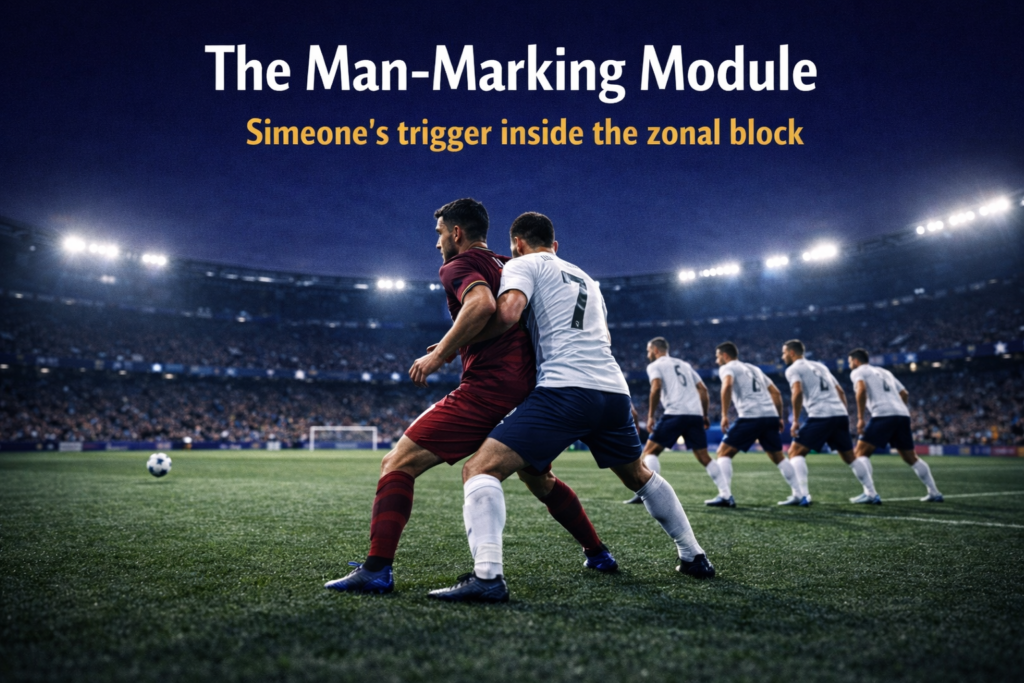
Simeone deploys something more layered. The back line at Atlético operates zonally – compact, organised, hard to bypass centrally. But his central midfielders apply tight man-oriented pressure on opponents in their zone, and specific attackers are given licence to press man-to-man against the opposition’s build-up. The result is a system that functions zonally at its base but uses man-marking principles as a pressing trigger in the middle third. It’s not a pure hybrid so much as a zonal frame with man-marking modules inside it.
The data below reflects how these principles translate into defensive outcomes across the 2024-25 La Liga season at the point of analysis:
| Metric | Man City (PL) | Atlético Madrid (La Liga) | Aston Villa (PL) | Top-6 Benchmark |
|---|---|---|---|---|
| Goals Conceded Per Game | 1.16 | 0.87 | 0.95 | 1.0 |
| xGA Per 90 (per FBref) | 1.18 | 0.88 | 1.02 | 1.05 |
| Defensive Duels Won % | 62% | 71% | 67% | 64% |
Data reflects average metrics across the 2024-25 season. Individual match and squad variance applies. The data captures the measurable difference between zonal marking vs man-to-man defending philosophies across a full season.
Atlético’s xG against figure stands out. Simeone’s system doesn’t just prevent goals – it suppresses quality chances at source, which is the mark of a genuinely coherent defensive structure football rather than individual heroics. City’s numbers reflect a transitional defensive period, but the zonal principles remain intact: even in a difficult season, their shape doesn’t collapse, it just generates more recovery situations.
Set pieces tell a specific story. At the 2022 World Cup, teams from UEFA’s confederation favoured zonal setups at corners at a 62% rate – significantly higher than any other confederation. The data suggests that at elite level, zonal marking at set pieces has become the institutionally preferred approach, despite the popular perception that it’s risky.
The Set-Piece Battleground: Where the Debate Still Lives
Set pieces are the one context where the zonal marking vs man-to-man defending debate remains genuinely unresolved at elite level. In open play, zonal dominance is near-total. At corners, the argument is live and the stakes are immediate.
The split is measurable. At the 2022 World Cup, per FIFA’s Technical Study Group, teams from UEFA’s confederation favoured zonal setups at corners at a 62% rate – significantly higher than any other confederation. But that preference hasn’t produced consensus. Teams using hybrid set-piece structures – zonal defenders on the six-yard line, man-markers assigned to the opposition’s best aerial threats – have increasingly outperformed both pure approaches.
The logic is structural. Zonal defenders at corners stand still while attackers arrive with momentum – that’s the fundamental disadvantage. Man-markers at corners get blocked, screened, and deceived by rehearsed movement patterns – that’s their fundamental disadvantage. The hybrid neutralises both: zonal coverage near the goal, man-marking on the runners who generate the most danger.
Mikel Arteta’s Arsenal have become the Premier League’s most dangerous attacking set-piece team in 2025-26. Watch their corners – the near-post runs aren’t random. They’re designed to land exactly between zonal assignments, where hesitation lives. A runner arrives at the seam between two defenders at the precise moment the ball does. Neither defender has clear ownership. That half-second of doubt is all Arteta needs.
The Hybrid Reality: How Emery and Arteta Blend Both
Pure zonal and pure man-to-man are coaching shorthand, not match reality. Every elite defensive system in 2025-26 operates as a hybrid – the question is where each manager draws the line between zonal base and man-marking module.
Unai Emery’s Aston Villa are the clearest current example. Villa’s default defensive shape is zonal – compact, laterally disciplined, hard to play through centrally. But when specific high-value attackers receive the ball in transition zones, Villa’s midfielders switch to tight man-oriented pressure. The system defends space until it identifies a threat worth tracking individually – then it sends a man. The handoff between modes is what Emery drills; the zonal base is just the starting position.
Arteta’s Arsenal operate a similar logic in reverse. Arsenal’s defensive block is zonal and deep when protecting a lead – the back four slides, the midfield screens passing lanes, nobody chases. But when Arsenal press high, specific pressing triggers activate man-oriented pressure on the opposition’s build-up players. The system is zonal at rest, man-marking in pursuit.
The convergence tells you everything about where zonal marking vs man-to-man defending actually sits in 2025-26 – not as a binary, but as a spectrum every elite team operates on. The tactical spectrum between Guardiola (full zonal) and Simeone (zonal with man-marking modules) is narrower than the traditional framing suggests. The real gap is execution quality – how cleanly a team transitions between modes without losing compactness. That transition is invisible on a broadcast angle, but it’s where matches are won and lost.
Where Each System Breaks Down – and Who Exploits It
Zonal marking breaks when attackers time runs into the seam between two defenders’ zones; man-to-man breaks when a marker loses their opponent and no coverage layer exists behind them. Neither system in the zonal marking vs man-to-man defending debate is structurally sound without specific conditions. Understanding where each fails is where the real tactical education starts.
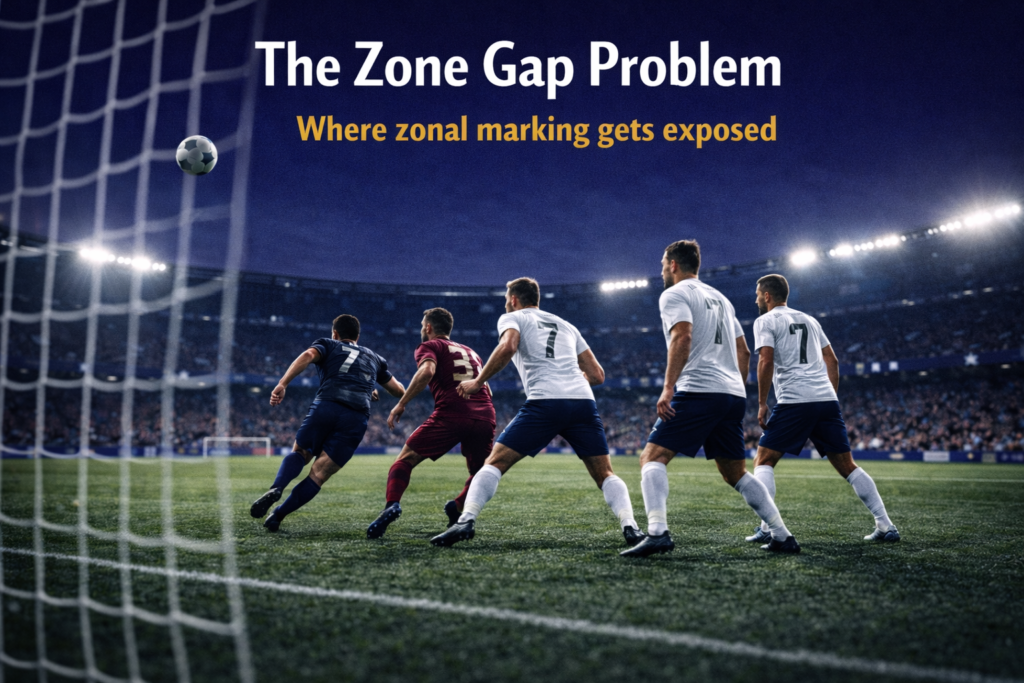
Zonal marking’s fundamental weakness is the gap between zones. When an attacker times a run into the seam between two defensive zones, neither defender has clear ownership of the ball – and that hesitation is the half-second that elite attackers exploit. Arrigo Sacchi’s system required compulsive communication between defenders to prevent zone boundaries from becoming dead ground. When teams deploy zonal marking with poor communication – or switch to it without drilling the triggers – it produces exactly the kind of confusion that leads to unmarked headers at corners.
Managers who consistently exploit zonal marking tend to be those whose attacking systems create movement across multiple zones simultaneously. Watch Arsenal’s set-pieces from the 2025-26 title season – the near-post runs aren’t random. They’re designed to land exactly between zonal assignments, where hesitation lives. A runner arrives at the seam between two defenders at the precise moment the ball does. Neither defender has clear ownership. That half-second of doubt is all Arteta needs. His corner routines are essentially a live experiment in finding the dead ground inside zonal structures – and they’ve made Arsenal the Premier League’s most dangerous attacking set-piece team.
The set-piece battleground is where zonal marking vs man-to-man defending produces its most visible failures – and its most instructive lessons.
Man-to-man marking football tactics weakness is purely physical and positional. The moment a marker loses their opponent – even briefly – the defensive structure has a hole in it. And unlike a zonal system, there’s no coverage layer below. Marcelo Bielsa’s Leeds United were the only Premier League side regularly deploying man-to-man in open play during 2021-22 – and the physical cost was measurable across the second half of their seasons, when energy reserves dropped and markers began losing duels. The system demands elite fitness from every outfield player, every match.
The modern answer to both weaknesses is the hybrid – zonal base with selective man-marking triggers. Unai Emery’s Aston Villa have demonstrated this effectively in 2024-25, using zonal structure as their default and assigning specific man-marking duties against high-value attackers in transition zones. The principle: defend the space, but mark the threat.
The Bigger Picture
The framing of zonal marking vs man-to-man defending as a binary choice has always been slightly dishonest. Pure man-to-man marking in open play is essentially extinct at elite level, which means the real zonal marking vs man-to-man defending question has shifted from “which?” to “when?”- not because it can’t work, but because it cannot be sustained across 90 minutes, 38 games, and a Champions League run with a squad of 25. The energy mathematics don’t hold.
What actually separates elite defensive teams is not which system they’ve chosen, but how coherently they switch between zonal and man-marking principles across different game phases. Simeone’s Atlético Madrid are not a man-marking team. They’re a zonal team that uses man-marking as a tactical module when specific triggers appear. That distinction matters enormously to how you read their defensive numbers.
The most instructive case in current football isn’t who plays pure zonal or pure man-to-man – it’s who has drilled the handoff between both systems without losing compactness in the transition. That’s the defensive art most coverage misses entirely.
What Do You Think?
Atlético Madrid’s 0.88 xGA per game in 2024-25, per FBref, stands out. Manchester City’s 1.18 xGA per game across the 2024-25 Premier League season (per FBref’s defensive metrics) reflect. If Simeone’s system suppresses chance quality better than Guardiola’s – is that tactical structure, or just control through suffering? And which one actually holds up across a full season, a Champions League knockout, an injury to your best centre-back?
The Champions League semi-final between Arsenal and Atlético Madrid is the live test case. If Simeone’s man-marking modules shut down Arsenal’s build-up at the Metropolitano, does that settle the argument? Or does Arteta’s zonal structure at the Emirates prove the point the other way?
Drop your take below.
Want to read any match like this?
The framework behind these breakdowns, in one place. The four phases, a 15-minute method for diagnosing both teams before the drinks break, a printable match-watching worksheet, and 51 terms defined. 40 pages.
Get the pack$9, instant downloadRelated Tactical Breakdowns

Why it connects: Counter-pressing is the out-of-possession complement to the defensive marking debate – understanding how teams win the ball back immediately after losing it directly shapes which marking system they use as their base.
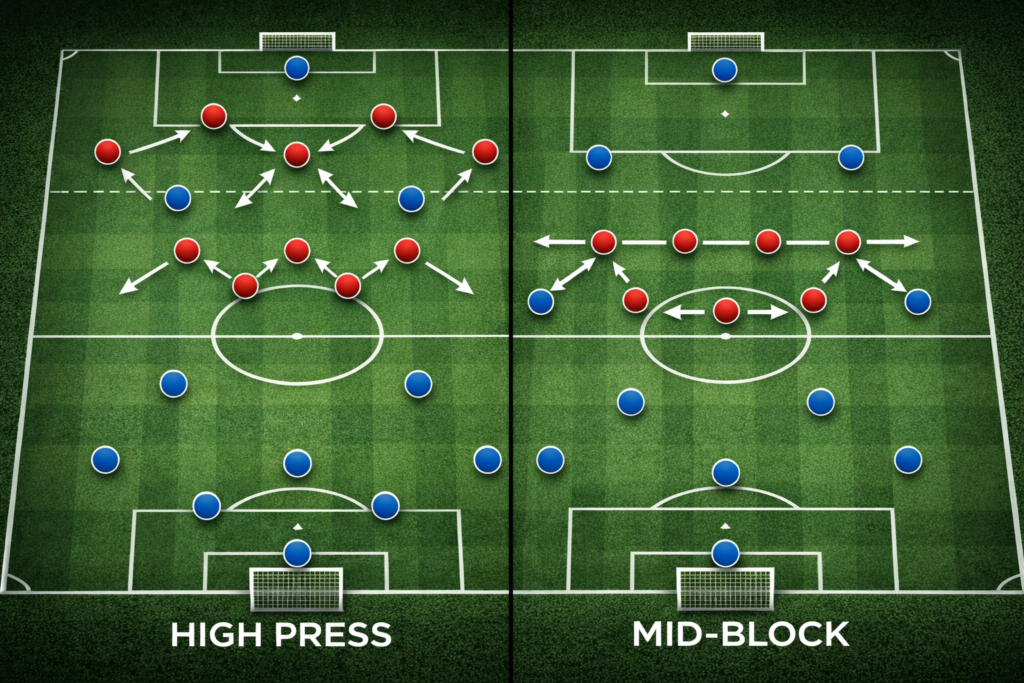
Why it connects: The choice between pressing high and holding a mid-block is inseparable from marking system design – a high press requires man-oriented triggers, while a mid-block depends on the zonal compactness analysed in this article.

How Elite Teams Defend Without the Ball
Why it connects: The structural principles behind out-of-possession organization – compactness, zonal discipline, defensive triggers – are the foundation that both marking systems in this article depend on.
Speak the language of the game
Get the free 47-term tactical glossary. Gegenpress, half-space, xT, low block, each defined in plain language and linked to a full breakdown. It is yours for an email.
Frequently Asked Questions (FAQs)
What is the difference between zonal marking vs man-to-man defending in football?”
Zonal marking assigns each defender a specific area of the pitch to protect, with responsibility shifting to whoever enters that zone. Man-to-man marking assigns each defender a specific opponent to follow. Zonal keeps the defensive shape intact; man-to-man prioritises individual accountability over collective structure.
Which is better: zonal marking or man-to-man marking?
Context determines which system wins, not either system’s inherent design. Zonal marking is more energy-efficient and maintains defensive structure against possession-heavy teams. Man-to-man is more effective for isolating a specific creative threat, particularly in cup matches or when suppressing a high-impact playmaker. Most elite teams now use a hybrid of both, switching between them across different game phases.
Do modern elite teams use zonal or man-to-man marking?
Virtually all elite clubs use zonal marking as their primary system in open play. At set pieces, hybrid systems dominate – combining zonal defenders near the goal line with man-markers assigned to the opposition’s most dangerous aerial threats. Leeds United in 2021-22 were the only Premier League side consistently deploying man-to-man in open play, demonstrating how rare pure man-marking has become at the top level.
How do teams use zonal marking vs man-to-man defending at corners?
Most elite teams use a hybrid system at corners. Zonal defenders occupy the six-yard box in assigned zones, focusing on the ball’s trajectory rather than tracking individual runners. Man-markers are assigned to the opposition’s most dangerous aerial threats. This combination neutralises the weaknesses of both pure approaches – zonal defenders don’t get beaten by momentum, and man-markers handle the specific threats that zonal coverage can miss.