
Last updated: October 27, 2026
For an hour against Manchester City on 11 October, Liverpool’s press looked like the reason Andoni Iraola was hired. Then Ryan Gravenberch was sent off for a second booking, and Enzo Maresca’s City scored three times against ten men.
That hour is the clearest sample yet of Iraola Liverpool tactics: a 4-2-3-1 in which every presser is assigned a man, and the chain depends on nobody going missing. It breaks with Arne Slot’s patient possession game and reopens the oldest argument in modern football tactics: control the ball, or control the opponent.
In simple terms: Iraola Liverpool tactics mean a man-marking high press inside a 4-2-3-1, followed by fast, straight attacks toward the number nine.
Six league games in, Liverpool tactics under Iraola already rank among the Premier League’s most aggressive, yet the side sat ninth after the City defeat. The shape, the marking scheme and the legs explain both facts.
Key Takeaways
- The press is sharper: After five league games of Liverpool tactics under Iraola, opponents managed only 9.1 passes in their own three-fifths of the pitch before a Liverpool challenge, third-lowest in the division, per Opta data published by Liverpool FC.
- The ball travels straighter: Passes per sequence fell from 4.2 in 2025-26 to 3.9 over those five games.
- Every presser has a man: Against City, Florian Wirtz stepped up to form a 4-4-2 and Virgil van Dijk followed City’s No 10, per Coaches’ Voice.
- One absence breaks the chain: City scored three times after Gravenberch’s 62nd-minute red card, and Liverpool finished on 0.86 expected goals, per Opta.
- Workload is the test: Iraola’s Rayo Vallecano and Bournemouth sides never played more than 45 games in a season, while Liverpool are guaranteed at least 48 in 2026-27, per The Analyst.
What Are Iraola Liverpool Tactics in 2026/27?
Iraola Liverpool tactics are a pressing-first game model: win the ball high, then reach the striker in as few passes as possible. At AFC Bournemouth, The Analyst measured Andoni Iraola’s side as the Premier League’s fastest-attacking team, moving upfield at 1.95 metres per second.
Iraola explained the priority in a 2024 Sky Sports interview quoted by The Analyst: “The first thing we try to do when we recover the ball is play to the number nine.” Bournemouth averaged 2.98 passes per sequence under him, fewer than every ever-present Premier League side except Everton.
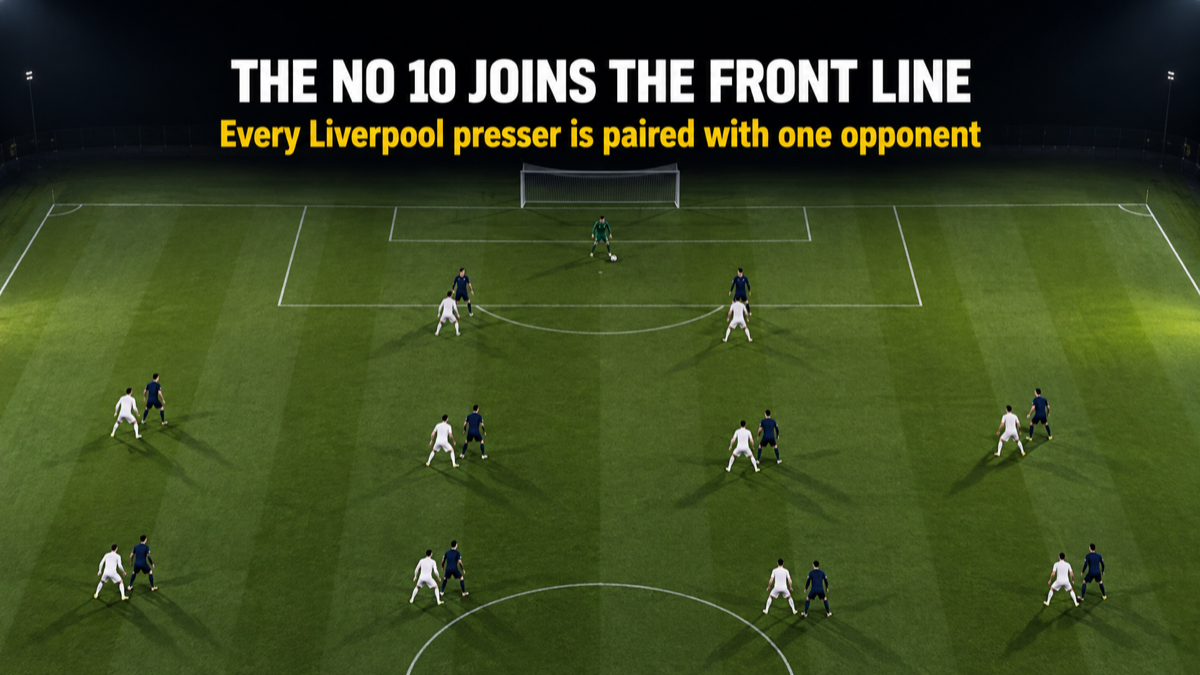
The pressing half of these Liverpool tactics has a clear lineage. The Premier League’s analysis traces it to Marcelo Bielsa, Iraola’s coach at Athletic Club, and to Jürgen Klopp’s gegenpressing, with the trick being to stay compact even when the press is high.
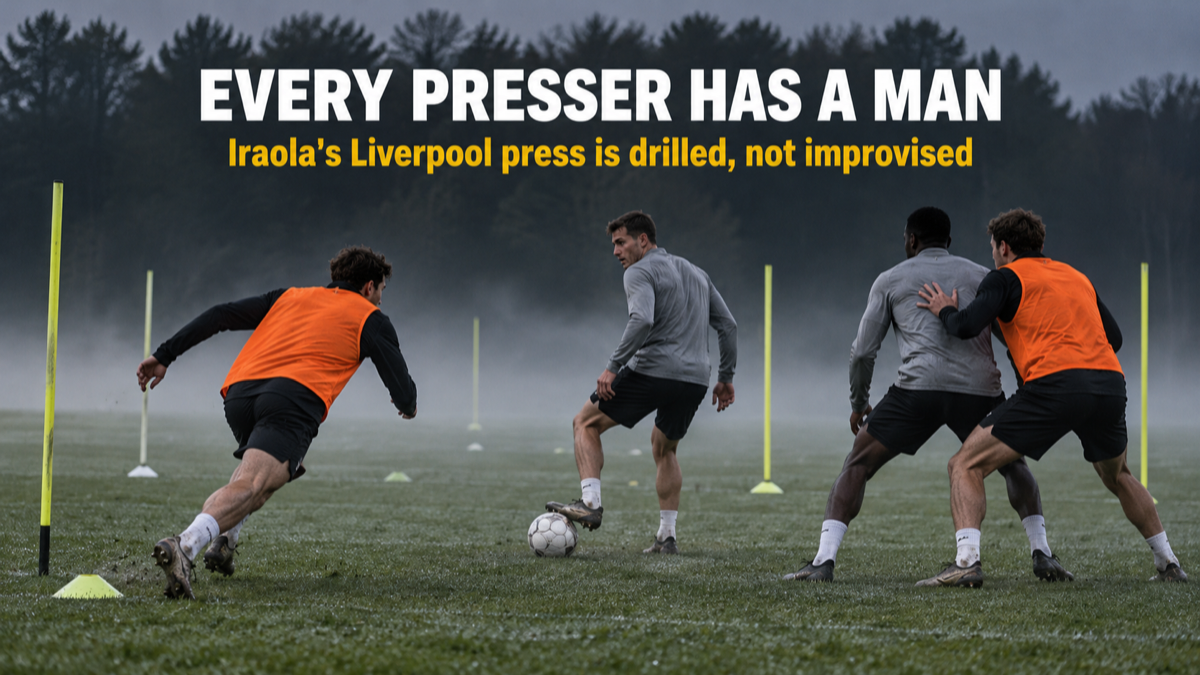
That compactness separates Liverpool tactics under Iraola from a generic high press. The new Liverpool tactics are not about chasing the ball in numbers; they are about each player knowing which opponent is his the moment the trigger arrives.
The Four Shifts in Liverpool Tactics After Slot
The biggest change from Slot to Iraola is that Liverpool tactics now prize the speed of an attack over the length of a possession. Slot’s 4-2-3-1 at Liverpool let the ball circulate until a gap appeared, and only Manchester City averaged more possession than Liverpool in 2025-26, a season that ended fifth.
The table sets Iraola’s Bournemouth against Klopp’s and Slot’s Liverpool, using per-90 averages from the Premier League’s June 2026 analysis. Read it as four shifts in Liverpool tactics: less possession, shorter sequences, more tackles and more high regains than Slot managed.
| Metric (Premier League, per 90) | Klopp’s Liverpool | Slot’s Liverpool | Iraola’s Bournemouth | Shift in Liverpool tactics |
|---|---|---|---|---|
| Possession | 61.7% | 58.6% | 47.5% | Less of the ball |
| Passes per sequence | 4.2 | 4.2 | 3.0 | Shorter, straighter attacks |
| Tackles | 16.6 | 14.9 | 17.9 | More duels from man-marking |
| High turnovers | 9.6 | 7.8 | 8.6 | More high regains than under Slot |
| PPDA | 10.2 | 10.9 | 10.6 | Pressing intensity close to Klopp’s |
Per 90 figures from the Premier League’s June 2026 analysis (Opta data): Klopp and Slot at Liverpool, Iraola at Bournemouth.

Early 2026/27 data points the same way: Liverpool tactics produced 3.9 passes per sequence after five league games, down from 4.2 in 2025-26, per Opta data published by Liverpool FC.
The Liverpool Formation: A 4-2-3-1 That Presses as a 4-4-2
Liverpool tactics under Iraola start from a 4-2-3-1 with the ball that becomes a 4-4-2 without it, as Florian Wirtz steps up from No 10 beside the striker. Wirtz has filled that role since pre-season, just behind Alexander Isak.
Against Bournemouth on 20 September, the back four was Ronald Araújo, Jérémy Jacquet, Van Dijk and Milos Kerkez, with Alexis Mac Allister and Dominik Szoboszlai as the double pivot and Cody Gakpo, Wirtz and Bradley Barcola behind Isak. The 1-0 winner was Liverpool tactics in miniature: Gakpo crossed from the right, Wirtz helped it on, and Isak finished.
The full-backs follow a rule Coaches’ Voice recorded at Rayo Vallecano, now written into Liverpool tactics: when one attacks, the other holds. Kerkez, who played under Iraola at Bournemouth, is licensed to push on, so the right-back choice between Araújo and Jeremie Frimpong is about cover as much as threat.
Inside the Pressing System: Every Liverpool Player Has a Man
The pressing system behind Liverpool tactics under Iraola is player-oriented: each presser is assigned an opponent rather than a zone. Coaches’ Voice’s analysis of the City game showed Lewis Koumas leading the press, Barcola and Víctor Muñoz tracking the full-backs, and Wirtz screening a centre-back from a half-and-half position.
Behind them, Gravenberch pushed onto Enzo Fernández, Mac Allister marked Rayan Cherki, and Van Dijk followed City’s No 10 high up the pitch. That last job shows how far Liverpool tactics now trust centre-backs to defend forward.
The numbers back the intent of the new Liverpool tactics. After five league games Liverpool led the division for high pressures in the opponent’s half, per the club’s Opta review, using the same family of pressing triggers Iraola coached at Bournemouth.
Direct Football: Why the First Pass Looks for the Number Nine
Direct football is the second half of Iraola Liverpool tactics: once the ball is won, the first look is forward to the striker. After five league games, direct speed had risen to 1.87 metres per second from 1.84, and Liverpool’s 15.38 metres of progress per sequence ranked second only to Manchester United, per the same Opta review.
Isak is the target of Liverpool tactics in transition. Before the City game he had four Premier League goals from 3.5 expected goals, and all three of Gakpo’s league assists had gone to him, per The Analyst.
The fit is no accident: during Iraola’s Bournemouth years, Liverpool took more fast-break shots than any Premier League side, 155 to Bournemouth’s 128, per The Analyst, so these Liverpool tactics build on an attacking transition habit the squad already had. Without the injured Isak against City, the press still worked but the outlet did not, and only 0.38 of Liverpool’s expected goals came from open play.
Wirtz, Gravenberch and Jacquet: The Roles Behind Liverpool Tactics
Three players carry the heaviest load in Liverpool tactics under Iraola: the No 10 who presses like a striker, the midfielder who carries the ball out, and the centre-back who passes forward. Wirtz ranked second in the league for distance covered at high speed early in the season, per Sky Sports.
Gravenberch is the escape valve in these Liverpool tactics. Coaches’ Voice described him as Liverpool’s main ball carrier against City, receiving on the half-turn when the press needed relief, which is why his red card broke the structure.
Jacquet, signed from Rennes, had the division’s third-best aerial duel success rate at 76.9 percent after five league games, per Liverpool FC’s Opta review. The defence behind these Liverpool tactics kept three straight clean sheets against Ipswich Town, Fulham and Bournemouth.
Can Liverpool Tactics Survive Three Games a Week?
Liverpool tactics under Iraola were designed at a Bournemouth side that rarely played midweek, and that is the project’s biggest structural doubt. The Analyst’s season preview noted that Iraola’s teams at Rayo Vallecano and Bournemouth never played more than 45 games in a season, while Liverpool are guaranteed at least 48 in 2026-27.
The first warning came at home to Fulham, three days after beating Atlético Madrid in the Champions League. Liverpool drew 0-0, and Iraola admitted: “I think today, especially first half, we were arriving late to the presses.”
Rotation is how Iraola plans to keep Liverpool tactics sustainable. At LASK on 14 October he named Liverpool’s third-youngest Champions League XI, and the 6-3 win brought 19 first-half shots, the most by an away side in a Champions League first half on record, but also 2.02 expected goals conceded, per The Analyst.
The Weakness: When One Man Is Missing, the Marking Chain Breaks
The weakness in Liverpool tactics under Iraola is that player-oriented pressing has no spare man, so one absence turns every duel into a mismatch. Gravenberch’s dismissal against City proved it: Mac Allister had to cover more ground, and Muñoz had to choose between tucking in and helping Araújo against Jérémy Doku.
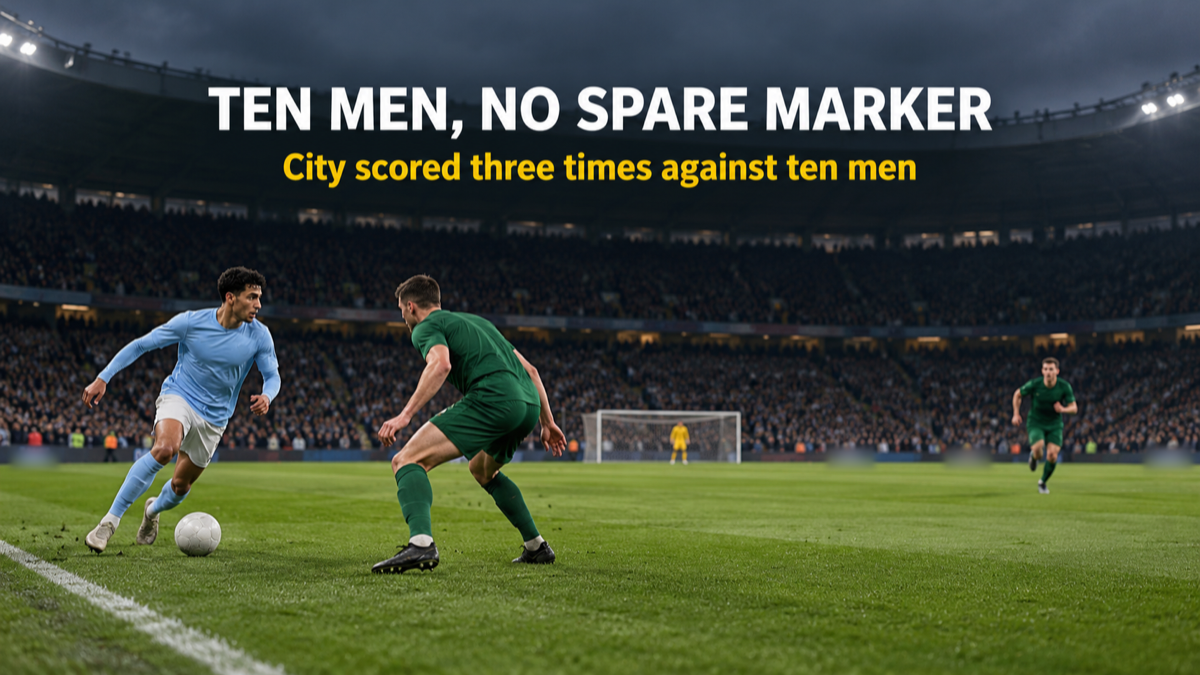
Iraola switched to a 4-4-1, replacing Wirtz with Trey Nyoni, and Liverpool dropped deeper. Enzo Maresca’s City had the patience to exploit Liverpool tactics at their thinnest: full-backs Nico O’Reilly and Matheus Nunes tucked inside to form a 2-2-1-5, and the third goal ended a 41-pass move that pulled Liverpool’s block out of shape, per Coaches’ Voice.
A milder version appears when the legs go. Sky Sports described a split team at times, attackers pressing while the defence retreated, and noted that Fulham goalkeeper Bernd Leno found easy passes out at Anfield.
That gap behind the press is where rest defence must hold, and it is where calm, press-resistant opponents will aim next. Against them, Liverpool tactics need a second answer: a mid-block Iraola can drop into without surrendering the ball for good.
Final Thoughts
Iraola’s Liverpool tactics are the right correction for a midfield The Analyst judged “far too easy to play through” in 2025-26, and the pressing numbers after five games show the players have bought in. The problem is not the idea; it is the margin.
Liverpool tactics built on a man-for-man press need fit, connected players and at least one midfielder who can carry the ball out when the jump fails. Liverpool have that player in Gravenberch and few like-for-like options behind him, and a 48-game minimum will test the gap long before May.
The verdict: Liverpool tactics under Iraola will look brilliant in games Liverpool start fresh and fragile in the ones they finish short. The January window should buy a second ball-carrying midfielder, not another forward, so is ninth after six games a fitness lag or the true price of the system?
What Do You Think?
Liverpool tactics under Iraola allowed opponents just 9.1 passes before a challenge after five league games, yet the side had not won a league game at Anfield by mid-October. Is that a fitness problem Iraola fixes by December, or proof that man-for-man pressing is the wrong tool for a team expected to dominate the ball? Drop your take below.
Related Tactical Breakdowns

Bielsa Man Marking: How One Idea Turns Eleven Players Into Hunters
Why it connects: Iraola's player-oriented press descends from Marcelo Bielsa, his coach at Athletic Club, and the man-for-man hunting this piece explains.
Liverpool 2.0: Inside Klopp’s Tactical Rewire Of A Fading Empire
Why it connects: Klopp's 2023-24 rewire built the possession structure Slot inherited, and Liverpool tactics under Iraola now trade it for speed.
De Zerbi Baiting Press Structure: The Artificial Transition System Explained
Why it connects: De Zerbi's baiting build-up is the counter-model designed to drag man-markers like Liverpool's out of position.
Learn to read a match like an analyst
Get the free 33-page Starter Pack, How to Read a Football Match (the Four Phases, a 15-minute match read, a printable worksheet), plus the 70+ term tactical glossary. Both are yours for an email.
Frequently Asked Questions
What formation does Andoni Iraola use at Liverpool?
Andoni Iraola uses a 4-2-3-1 at Liverpool that becomes a 4-4-2 without the ball. Florian Wirtz plays as the No 10 and steps up beside the striker to press, while two midfielders such as Alexis Mac Allister and Ryan Gravenberch form the double pivot. In Liverpool tactics under Iraola, the full-backs take turns to attack, so one always holds.
How are Liverpool tactics under Iraola different from Slot’s?
Liverpool tactics under Iraola are faster and more direct than Slot’s possession game. After five league games, passes per sequence had fallen from 4.2 to 3.9 and direct speed had risen to 1.87 metres per second, per Opta. The press is also player-oriented, so each Liverpool player has a specific opponent.
Is Iraola’s pressing system man-to-man?
Yes, Iraola’s pressing system is largely player-oriented rather than zonal. Against Manchester City, each Liverpool player was assigned an opponent, from Wirtz on a centre-back to Van Dijk following the No 10. These Liverpool tactics win the ball high but leave no spare man when a player is missing.
When did Andoni Iraola become Liverpool manager?
Andoni Iraola became Liverpool head coach on 4 June 2026, replacing Arne Slot after a fifth-place finish in 2025-26. He arrived from AFC Bournemouth, whom he led to sixth place and the club’s first European qualification. His first Premier League game in charge was a 2-2 draw at Newcastle United.