

Shot-Creating Actions: Why the Pass Before the Assist Finally Counts
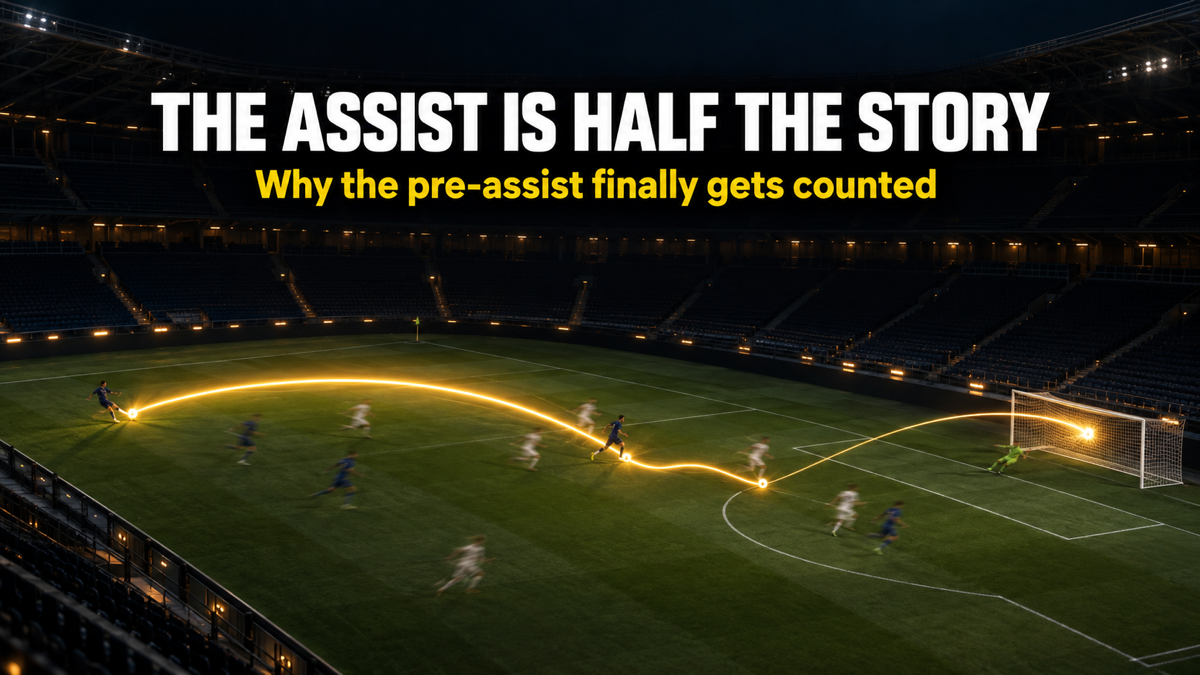
Watch the goal back. The assist lands on the player who squared the ball into an empty net, and the box score files it away. Rewind two seconds though, and a winger has driven at the full-back, dragged a second defender across, and clipped a pass into the channel that bent the entire back line out of shape. That player gets nothing on the scoresheet. The pass that actually broke the defence is invisible. Shot-Creating Actions were built to make that pass count, and they sit at the heart of how analysts now read modern football tactics.
The metric matters because creation is rarely a single act. The assist is the last brushstroke, not the painting, and for decades the data ignored everything that came before it.
In simple terms: Shot-Creating Actions count the two offensive moves leading directly to a shot, crediting the build-up, not only the final pass.
This breakdown explains how the metric is counted, the six actions it tracks, what a good number looks like, and the blind spot every analyst has to manage when they use it.
Key Takeaways
- Two actions, not one: Shot-Creating Actions credit the final two offensive moves before a shot, so the pre-assist, the pass before the assist, finally appears in the data.
- Six routes to a shot: A live pass, a dead-ball pass, a take-on, a drawn foul, a previous shot, or a defensive action can all be counted as creating actions.
- GCA is the sibling: Goal-Creating Actions apply the same two-action logic but only to moves that end in a goal, as FBref defined them.
- Read it per 90: SCA per 90 separates genuine creative hubs from players who simply rack up volume in high-possession sides.
- Volume is the trap: Each action is counted equally, so SCA rewards quantity of chances, not the quality of them.
Table of Contents
What Are Shot-Creating Actions?
Shot-Creating Actions are the two offensive actions a team makes immediately before a shot, with each action credited to the player who performed it. The metric, popularised by FBref using StatsBomb and later Opta data until that feed was withdrawn in January 2026, widens the lens beyond the assist to capture the move that set up the setter. One shot can therefore hand creative credit to two different players at once.
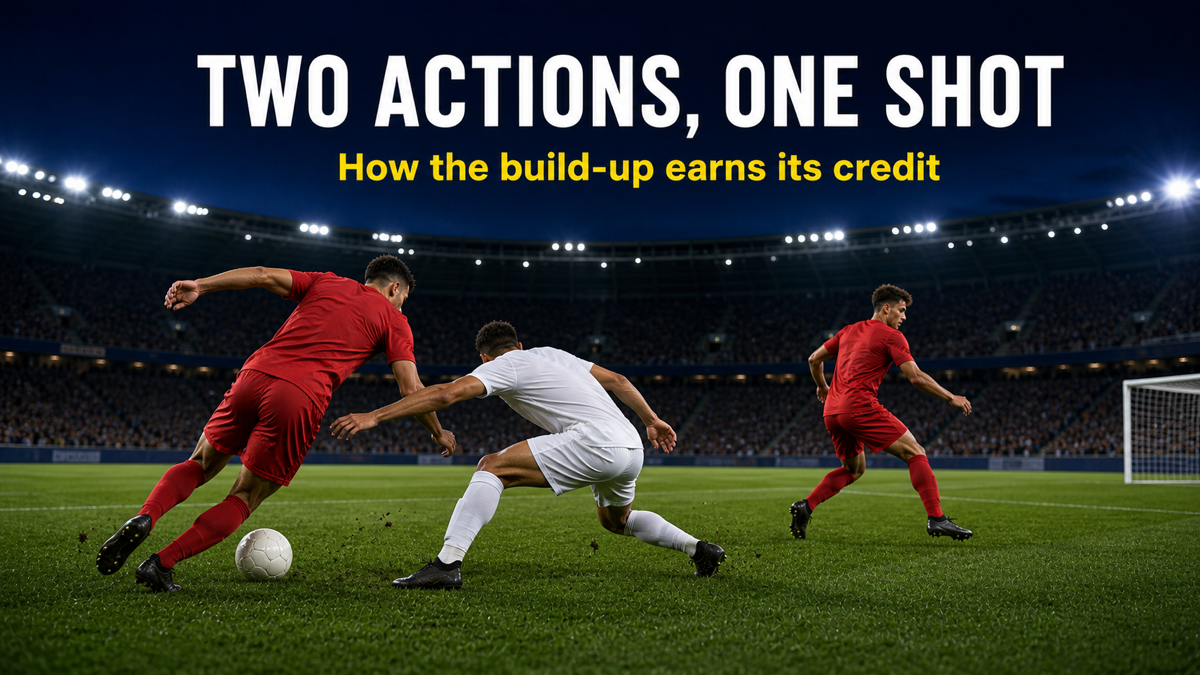
Picture a deep playmaker in the mould of Kevin De Bruyne during his Manchester City years. He receives on the half-turn, drives ten yards, then threads a pass to a forward who lays it off for the finish. The forward earns the assist, while De Bruyne earns a shot-creating action for the pass before it, the pre-assist that broke the press.
Older box scores erased that contribution entirely. Shot-Creating Actions restore it by treating chance creation as a chain of actions rather than a single decisive ball. That is why the metric has become a standard column on every serious profile, and why shot creation in football is now measured in twos, not ones.
The Two-Action Rule That Defines SCA
The rule is strict: only the two actions immediately before the shot are counted, and nothing earlier. A move can travel through eight passes, but Shot-Creating Actions only reward the final two contributors in the sequence. Everything upstream is left to possession-chain metrics instead.
That two-action window is the whole design. It keeps the metric focused on the sharp end of an attack, where the decisive moments live, rather than diluting credit across an entire build-up. A centre-back who starts the move with a clearance is not creating the shot; the winger and the passer at the end of it are.
The trade-off is deliberate. By capping credit at two actions, SCA stays readable and comparable across players, but it quietly ignores the deep progressors who do their work three or four actions before the shot. Those players need a different tool, which is exactly where chain-based numbers take over.
The Six Ways to Build a Shot
Six distinct action types can register as Shot-Creating Actions, and FBref used to break every player’s total into these buckets:
- Live pass (PassLive): An open-play pass that leads to a shot. This is the most common creating action and the one closest to a traditional key pass.
- Dead-ball pass (PassDead): A pass from a free-kick, corner, or throw-in that produces a shot. Set-piece specialists live here.
- Take-on (Drib): A successful dribble past an opponent that leads directly to a shot.
- Shot (Sh): A previous shot, usually a rebound, that immediately creates another shot.
- Foul drawn (Fld): Winning a foul that leads to a shot, often a free-kick in a dangerous area.
- Defensive action (Def): A tackle or interception that wins the ball and launches an attack ending in a shot.
The spread between these buckets tells its own story. A wide playmaker piles up live-pass and take-on numbers, while a pressing forward generates defensive-action SCAs by winning the ball high. Reading the mix, not just the total, is where the real analysis starts.
Reading SCA per 90: What the Numbers Say
A good SCA per 90 sits above roughly 4.0 for an attacking midfielder, with the elite creative hubs pushing past 6.0. Rate matters more than raw totals, because a player in a dominant side will accumulate creating actions simply from volume of possession. Normalising to 90 minutes is what makes the comparison fair.
The benchmark bands below orient those numbers by role. They are rough guides rather than published league averages, so treat them as a map, not a verdict.
| Player Profile | Benchmark SCA per 90 | What the Number Signals |
|---|---|---|
| Elite creative hub (No. 10 or deep playmaker) | 5.5 to 7.5+ | A constant presence in the moves that end in shots |
| Creative winger or wide playmaker | 4.0 to 6.0 | High volume from carries, cut-backs, and drawn fouls |
| Progressive central midfielder | 2.5 to 4.0 | Creates through the pre-assist, rarely the final ball |
| Modern full-back | 1.5 to 3.0 | Wide deliveries and overlapping runs feed the count |
| Pressing forward | 1.0 to 2.5 | Defensive-action SCAs from winning the ball high |
These bands are approximate guides, not published league averages.

These chance creation metrics also expose the players a manager cannot replace cheaply. When a hub posting 6.0 SCA per 90 is injured, the team does not just lose assists, it loses the moves that manufactured the assists in the first place. That is the hidden cost the scoresheet never shows.
SCA vs Assists: What the Box Score Hides
Assists capture the final pass and nothing else, which is precisely the gap Shot-Creating Actions were designed to close. A StatsBomb study on what really matters in chance creation showed years ago that raw assist counts are noisy, swinging wildly with finishing luck. SCA strips out some of that noise by rewarding the contribution, regardless of whether a teammate converts.
Bruno Fernandes created 136 chances in the 2025-26 Premier League season, the most in the division per Opta, as catalogued in The Analyst’s season data. Assists alone would have hidden how relentless that creative output actually was. This is the same reframing that expected assists separates from raw key passes, and SCA pushes it one action deeper into the move.
The practical upshot is simple. Two players can finish a season with five assists each, yet one might post double the shot-creating actions of the other. The higher-SCA player is creating far more, and is being failed by his finishers, not by his own contribution.
The Weakness: SCA Counts Volume, Not Value
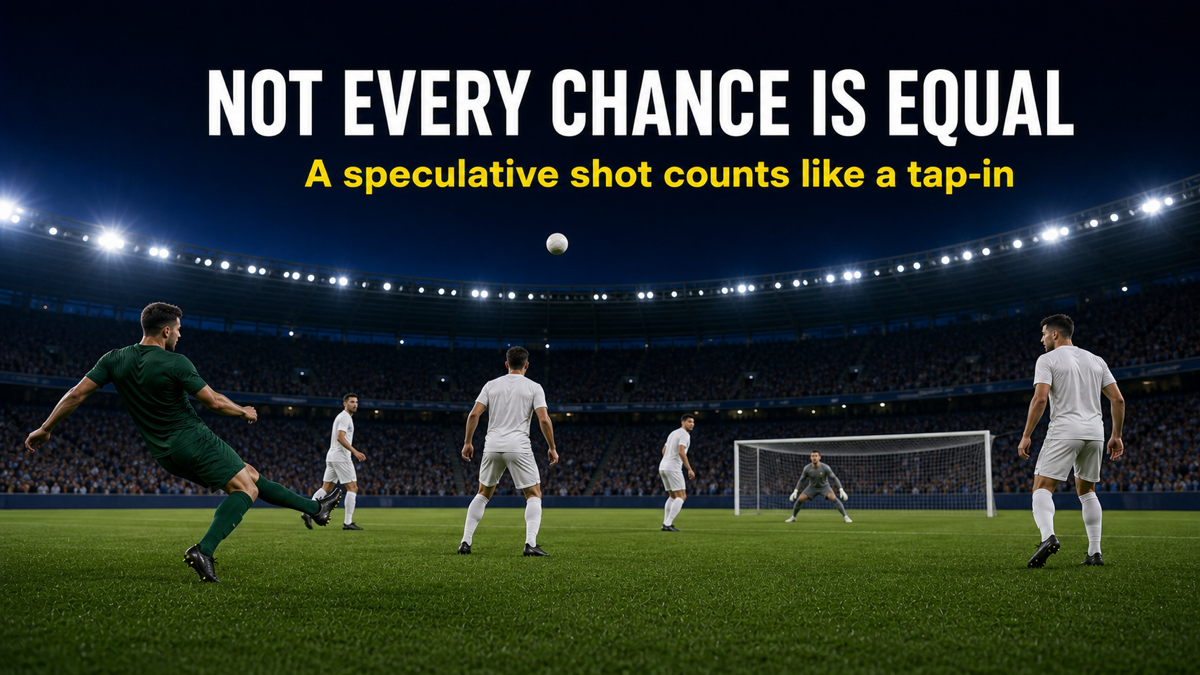
The flaw is that every shot-creating action counts the same, no matter how good the chance is. A hopeful pass that leads to a speculative shot from 30 yards scores identically to a cut-back that sets up a tap-in. SCA measures how often a player creates, never how dangerous what they create actually is.
Dead-ball specialists distort the picture too. A corner taker can inflate his total with PassDead deliveries that produce low-value headers, reading as a creative star when he is really a delivery merchant. Smart analysts counter this by pairing SCA with shot quality, weighting each creating action by the expected threat it actually generated or by the underlying xG of the shot it produced.
The metric also says nothing about the deep build-up. A regista who controls tempo three actions before every shot is invisible to SCA, because the two-action window cuts him out. Used alone, the number flatters the final third and ignores the players who make the final third possible.
The Bigger Picture
Shot-Creating Actions are one of the clearest ways to see the creator behind the creator. The metric drags the pre-assist out of the shadows and rewards the actions that assists and goals quietly ignore, which is a genuine step forward for how creativity is measured. It sits alongside possession-chain metrics such as xGChain, which credit everyone involved in a move.
The discipline is in how you read it. Treat SCA as a volume map of who is involved at the sharp end, then cross-check it against shot quality before you crown anyone, because a player with elite shot-creating actions and weak expected threat is busy, not necessarily brilliant. So the next time a goal goes in, ask who made the two plays before it, and whether the data is finally giving them their due.
What Do You Think?
Bruno Fernandes led the 2025-26 Premier League for chances created, but a chunk of any creator’s SCA total comes from dead-ball deliveries. Should set-piece deliveries be stripped out to reveal the true open-play creators, or is a corner that creates a shot just as valuable as a pass that does? Drop your take below.
Want to read any match like this?
The framework behind these breakdowns, in one place. The four phases, a 15-minute method for diagnosing both teams before the drinks break, a printable match-watching worksheet, and 51 terms defined. 33 pages, free.
Get it freeFree PDF, sent to your inboxRelated Tactical Breakdowns
Expected Assists (xA) vs Key Passes: 7 Truths That Reframe Football Creativity
Why it connects: xA puts a probability on the final pass, while SCA widens the credit to the action before it, making the two metrics natural reading partners.

xGChain and xGBuildup: The Possession-Chain Metrics That Finally Credit the Build-Up
Why it connects: where SCA stops at two actions, possession-chain metrics credit the deep progressors that the two-action window deliberately ignores.

On-Ball Value (OBV): The Metric Rewriting How Football Judges Midfielders
Why it connects: OBV values every action by how much it changes scoring probability, the quality layer that raw shot-creating actions leave out.
Learn to read a match like an analyst
Get the free 33-page Starter Pack, How to Read a Football Match (the Four Phases, a 15-minute match read, a printable worksheet), plus the 70+ term tactical glossary. Both are yours for an email.
Frequently Asked Questions
What are shot-creating actions in football?
Shot-Creating Actions are the two offensive actions immediately before a shot, each credited to the player who performed it. The metric, popularised by FBref using StatsBomb and later Opta data, captures both the assist and the pre-assist. It widens creative credit beyond the final pass to the move that set it up.
How are shot-creating actions different from assists?
Shot-creating actions reward the two moves before a shot, while an assist only counts the single final pass that leads to a goal. SCA also credits chances that are not converted, so it strips out finishing luck. That makes it a fuller picture of who is genuinely creating.
What is a good SCA per 90 number?
A good SCA per 90 is roughly 4.0 or higher for an attacking midfielder, with elite creators clearing 6.0. Reading the rate rather than the season total controls for how much possession a player’s team enjoys. Always compare players within similar roles for a fair read.
Are shot-creating actions and goal-creating actions the same?
No, goal-creating actions use the identical two-action logic but only count moves that end in a goal. SCA tracks the two actions before any shot, so its numbers are far larger across a season. Analysts read both together to see who creates shots and who creates goals.
Where can I find shot-creating actions data?
Shot-creating actions were published free on FBref for years, split into the six action types, including live passes, dribbles, and set-piece deliveries. That ended in January 2026, when FBref’s data provider withdrew its advanced data and the site deleted those tables.