

Last updated: October 27, 2026
Pep Guardiola spent most of 2024-25 at Manchester City reshaping a possession side that had lost Rodri’s ball circulation to a September 2024 knee injury. Jürgen Klopp, by contrast, built his teams around what happens in the seconds after the ball changes hands.
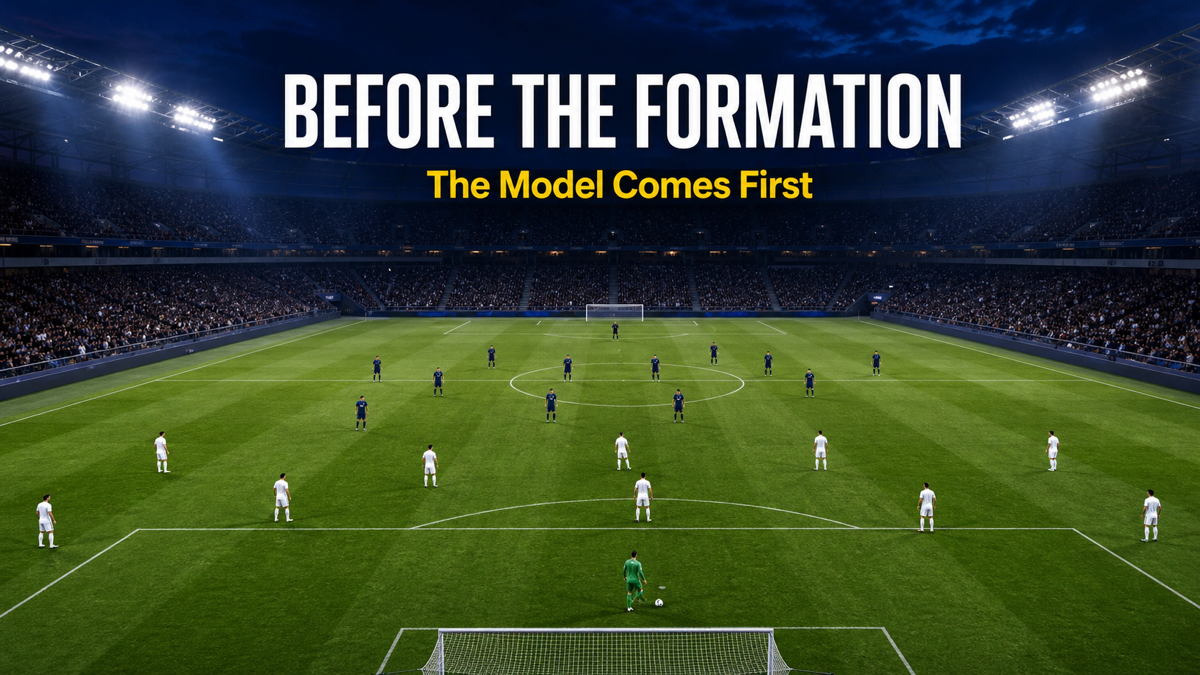
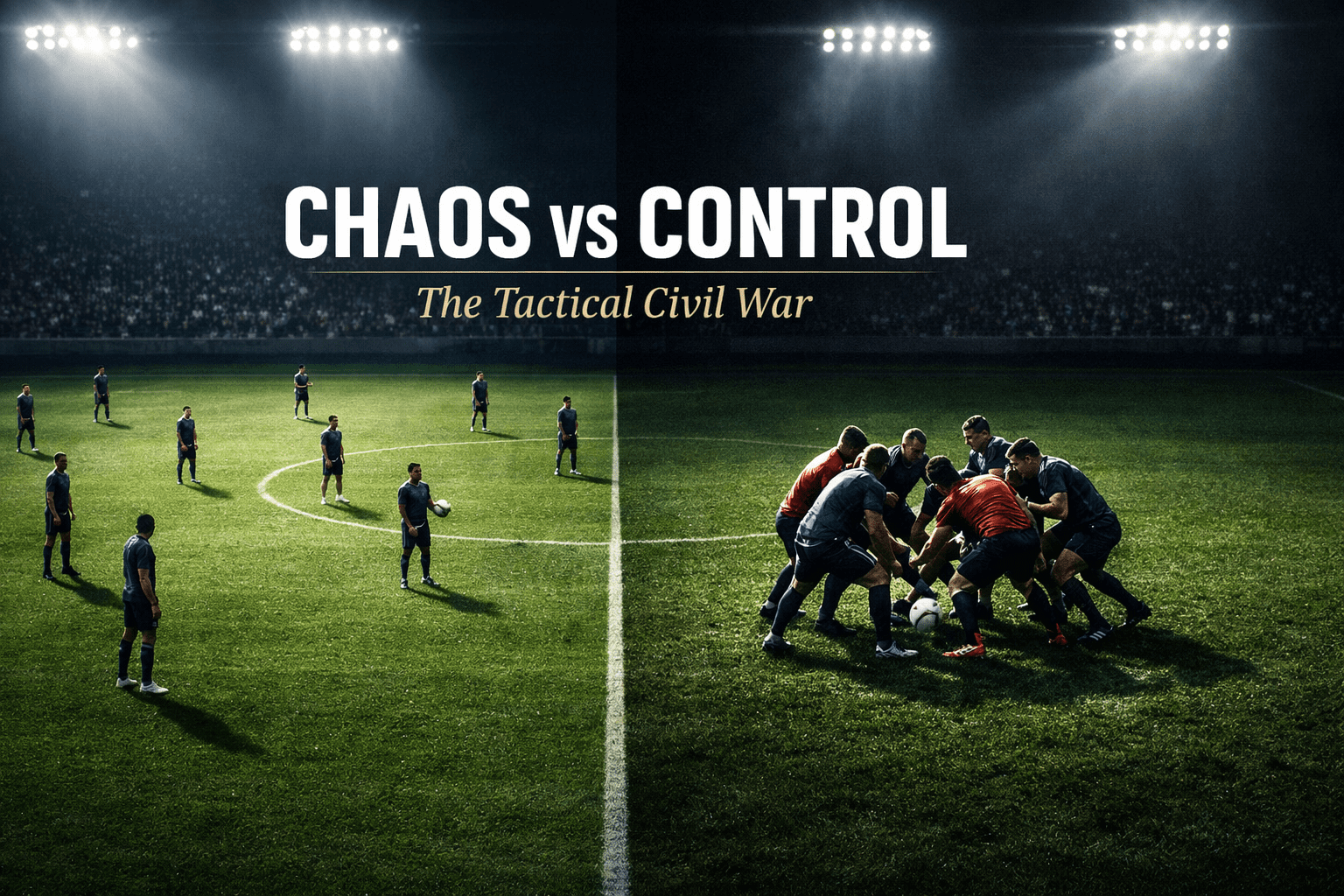
Two of the era’s defining managers, both ruthlessly disciplined coaches, both wedded to entirely different ideas of what a football team is supposed to do on the pitch. That choice has a name in modern coaching language. Game models are the tactical identity below every formation, every press, every set-piece routine, and our Football Tactics hub frames the broader cluster this article belongs to.
In simple terms: A game model is a team’s tactical identity, built around either moments of transition or sustained possession of the ball.
The two dominant game models are broken down side by side below, named at the manager level, weighted against real possession and direct-attack data.
Key Takeaways
- Identity precedes formation: Game models are chosen before any formation diagram, and the choice between transition-first and possession-first defines everything below it.
- Klopp’s answer is the counter-press: his Liverpool tried to win the ball back immediately after losing it and break vertically before the opponent could reset.
- Pep’s answer is the ball: his Manchester City averaged 65.2% possession across the 2022-23 Premier League treble season, per Opta.
- The hybrids exist but are rare: Arne Slot’s Liverpool and Xabi Alonso’s Real Madrid sat on the seam, paying a tactical cost for the flexibility.
- The counter is always the other model: Possession sides struggle against organised transition; transition sides struggle against deep blocks that refuse the trigger.
Table of Contents
What Is a Game Model in Football?
A game model is a club-level framework that specifies what the team is trying to do across all four phases of play. The phrase comes from European coaching education, where it sits above the formation and matchday tactics as the most stable layer of a team’s identity.
The framework answers four questions before any session is planned. In possession, where does the team want to break the line, through the centre, the half-spaces, or wide? In transition to attack, how many seconds before the ball needs to be played forward?
In defence, where does the press start, and what is the trigger? In transition to defend, who counter-presses and who drops? The answers form a club’s tactical fingerprint, and they remain stable even when the manager rotates personnel or formation.
José Mourinho’s Inter, Pep Guardiola’s Barcelona, and Jürgen Klopp’s Liverpool all played a 4-3-3 at points, with completely different game models underneath. The formation is the shape; the model is the soul. Coaches who do not articulate one end up coaching the formation, which is why their teams stall the moment the formation is countered.
The Transition-First Game Model: Klopp, Tuchel, and the 5-Second Rule
The transition-first model treats moments of turnover as the most valuable phase of play, and structures everything else around producing or surviving them. The club’s identity is defined by what it does in the first 5 to 8 seconds after the ball changes hands, in either direction.
Jürgen Klopp’s Liverpool is the cleanest example of the era. Klopp’s counter-press demanded the ball back almost immediately after it was lost, followed by a vertical attack into the recovered space. The theory built on long roots; the original German gegenpressing coaching tradition Klopp inherited frames the press as the playmaker, an idea we unpack in our counter-pressing breakdown.
Thomas Tuchel’s Chelsea side that won the 2021 Champions League ran a sister version of the model with deeper starting points. Tuchel, England manager since October 2024, has carried the same identity into international football, picking squads weighted toward two-way midfielders and counter-attackers rather than possession-careful technicians.
The signature of the transition-first model is the cost it pays in possession share. Klopp’s Liverpool were not a low-possession side, averaging 61.3% in his final Premier League season, but the team accepted spells without the ball if those spells produced clean turnover moments.
The Possession-First Game Model: Guardiola, De Zerbi, Xavi
The possession-first model treats sustained control of the ball as the primary defensive mechanism, and accepts every other trade-off in service of holding that control. The thinking is simple: if the opposition does not have the ball, the opposition cannot score.
Pep Guardiola’s Manchester City has run the cleanest version of the model in the modern era. City averaged 65.2% possession across the 2022-23 Premier League treble season, per Opta. The model demands a goalkeeper who can play, a back four who can pass under press, and a holding midfielder whose touch map looks like an air-traffic dashboard.
Roberto De Zerbi at Brighton, then Marseille, and since March 2026 Tottenham, pushed the same approach in a different register. De Zerbi’s teams routinely invited the press by stopping the ball with a defender’s foot in the centre of the pitch, baiting the trigger to break the second line of pressure. Our De Zerbi baiting press structure breakdown details the exact mechanism.
Xavi Hernández’s Barcelona of 2022-23 built a softer-edged version of the same identity, with rondo-trained midfielders and a 4-3-3 that defaulted to the half-spaces. It is not a single shape; it is a commitment to the ball.
The cost is exposure on the transitions a possession side rarely has. When the ball is lost in advanced areas with full-backs high, the counter-attack runs into a back-three that was never built to defend at speed.
How the Two Game Models Choose Different Players
A club’s game model determines which players it signs, not the other way around. The recruitment team is briefed on the model before they are briefed on the position, which is why two clubs with the same listed need produce completely different shortlists.
Transition-first clubs prioritise vertical carriers, ball-winners, and counter-runners. Liverpool’s recruitment under Michael Edwards and Julian Ward was famously data-led, and the profiles it targeted fitted that transition-first identity.
Possession-first clubs invert the priority. Manchester City’s recruitment under Txiki Begiristain has historically weighed pass completion under pressure, body orientation, and one-touch combination data above raw athletic output. Rodrigo Hernández, signed from Atlético Madrid in 2019, was the archetype of that profile; his replacement search after the September 2024 ACL injury exposed how narrow the model’s tolerance is for non-Rodri profiles.
The same dynamic holds at the manager level. When Arne Slot took over at Liverpool in 2024, Anfield’s recruitment did not pivot to a Pep-style profile; Slot inherited the existing transition-first profile rather than imposing a new game model from day one. A change of game model is a multi-window project, not a single-summer pivot.
The Identity Fingerprint in the Data
Game models are visible in the numbers before they are visible on the pitch. Three metrics expose a team’s identity more reliably than any tactical board: average possession share, PPDA, and direct-attack share of total attacks.
The table below sketches how the three profiles typically differ. The ranges are illustrative, not measured data.
| Metric | Transition-first side (illustrative) | Possession-first side (illustrative) | Hybrid side (illustrative) |
|---|---|---|---|
| Average possession % | 52–58% | 62–68% | 56–62% |
| PPDA (lower = higher press) | 7.5–9.5 | 10–12.5 | 9–11 |
| Direct-attack share | 22–28% | 11–15% | 17–21% |
The ranges are illustrative, not measured data.
The clearest signal is direct-attack share: how many of a team’s attacks go quickly and vertically from deep. Transition-first sides tend to post far more of these than possession-first sides, which makes it the statistic that exposes a team’s identity at a glance.

Hybrids sit in the middle of every column for a reason. Mikel Arteta’s Arsenal and Unai Emery’s Aston Villa both choose to retain a transition-first toolkit while still spending long spells of their matches with the ball, and they pay the cost in tactical complexity: every outfield player has to know two systems.
The Hybrid Game Models: Slot, Xabi Alonso, Arteta
A small number of elite coaches refuse the binary and run hybrid game models that switch register inside the same match. The flexibility is real, but it pays a tactical cost that often gets underplayed in coverage.
Arne Slot’s Liverpool, in his first 18 months, layered a Dutch possession frame on top of Klopp’s transition skeleton. Per the Premier League’s analysis, his side averaged 57.4% possession in 2024-25, down from 61.3% in Klopp’s final season, and became more selective about moving the ball forward.
Xabi Alonso’s Real Madrid, from June 2025 until his exit in January 2026, carried his Leverkusen blueprint into a club whose recruitment was built for a different one. The team visibly struggled when matches demanded pure possession patience against deep blocks.
Mikel Arteta’s Arsenal has lived in the same hybrid territory since 2023. The cost shows up in squad management. Hybrid models need at least two players per outfield position who can run both registers, which is part of why Arsenal’s wage bill has risen.
The Weakness: When Each Game Model Breaks
Every game model has a structural counter, and the counter is almost always the other model run by an opponent who understands it well enough to weaponise it.
Possession-first models break against organised transition sides who refuse to chase the ball. Diego Simeone’s Atlético Madrid has built well over a decade of European results on this principle.
A possession side that meets an Atlético-style block with no transition outlet runs into walls for 60 minutes and then loses to a 30-second counter.
Transition-first models break against deep blocks that refuse the press trigger. When the opposition goalkeeper kicks long or holds the ball for as long as the eight-second limit allows, the press has nothing to trigger off, and the transition-first side is left chasing without recovery zones. Sean Dyche’s Burnley sides did this for years in the Premier League, and in January 2021 they ended Liverpool’s 68-match unbeaten home league run with a 1-0 win at Anfield.
The deeper lesson is that no game model is a complete answer on its own. Hybrid coaches like Arteta and Slot are not over-engineering; they are insuring against the structural counter the binary leaves exposed.
Final Thoughts
The game model debate looks like a tactical disagreement; it is actually a recruitment, contract, and coaching-hours decision dressed up as a philosophy. Clubs that pick a transition-first model save on midfield wage budget and spend on physical recovery infrastructure. Clubs that pick possession-first spend on technical security in defence and accept the counter-attack risk that follows.
Slot’s Liverpool and Xabi Alonso’s Real Madrid were the two clubs at the top of Europe attempting genuine hybrid game models, and both paid the cost in tactical complexity – and both projects lost their architect in 2026, with Alonso leaving Madrid in January and Slot leaving Liverpool in May. If a successor keeps either blueprint alive across three full seasons, the binary that has defined the last twenty years of elite football will start to look like a transitional phase rather than the steady state.
For now, every coach still picks a side. Most just pretend the choice was made for them.
What Do You Think?
Both hybrid projects lost their architects in 2026 – Alonso left Madrid in January, Slot left Liverpool in May. If their successors keep the profiles alive, does the transition-vs-possession binary survive the late 2020s, or does it collapse into a single elite hybrid game model? Drop your take below.
Want to read any match like this?
The framework behind these breakdowns, in one place. The four phases, a 15-minute method for diagnosing both teams before the drinks break, a printable match-watching worksheet, and 51 terms defined. 33 pages, free.
Get it freeFree PDF, sent to your inboxRelated Tactical Breakdowns
Relationism in Football: The Complete Tactical Guide (2026)
Why it connects: Game models sit one layer above the relational/positional divide; this article maps the deeper identity decision underneath the on-pitch organisation.
The 3-Second Rule: Why Attacking Transitions Win Elite Football Matches
Why it connects: The 3-Second Rule is the mechanic the transition-first game model is built around, named at the second-level granularity.

The Future of Football: Why “Positionless” Is the New Tactical Language
Why it connects: Positionless football is the next layer above the binary, asking whether the game model still requires fixed positions to execute.
Learn to read a match like an analyst
Get the free 33-page Starter Pack, How to Read a Football Match (the Four Phases, a 15-minute match read, a printable worksheet), plus the 70+ term tactical glossary. Both are yours for an email.
Frequently Asked Questions
What is a game model in football?
A game model is a club-level framework defining what a team does across all four phases of play. It sits above the formation and matchday tactics as the most stable layer of a club’s tactical identity, telling players what kind of football the club expects regardless of opponent. Coaches educated in European programmes name their model before they name their starting eleven.
Is possession football better than transition football?
Neither is structurally better; each is a different trade-off. Possession-first models reduce defensive exposure by holding the ball but pay the cost on the transition they rarely have. Transition-first models score more from direct attacks per Opta but accept long spells without the ball. The Champions League winner has come from both camps in the past decade.
How does Klopp’s game model differ from Guardiola’s?
Klopp built a transition-first game model around immediate ball recovery and vertical breaks. Guardiola built a possession-first game model around sustained control, with Manchester City averaging 65.2% possession across the 2022-23 Premier League season, per Opta. The recruitment, training, and contract structures follow from the model, not the other way around.
Can a team play both transition and possession football?
A team can run a hybrid game model, but only with a deeper squad. Arne Slot’s Liverpool, Xabi Alonso’s Real Madrid, and Mikel Arteta’s Arsenal all attempted this register-switching at the elite level. The cost shows up in coaching hours, contract budgets, and the need for two players per outfield position who can execute both systems.