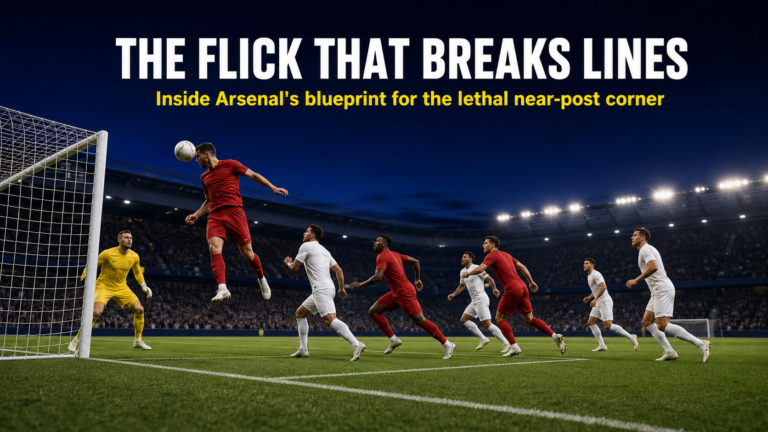


Kevin De Bruyne spent a decade at Manchester City turning one pass into a weapon, and at Napoli he is still doing it: the disguised, floated ball that drops behind a defender who never moved. Against a deep, compact defensive block, that single delivery does what fifty sideways passes cannot. The opponent has every blade of grass covered, so the answer is to stop using the grass. Breaking a low block is usually framed as a patience problem, a question of moving the ball sideways until a gap finally appears.
It is really a geometry problem, and the chipped pass solves a geometry the ground pass never can. For the foundations of moving the ball through pressure in the first place, start with our guide to build-up play under pressure.
In simple terms: A chipped pass beats a low block by travelling through the air into the short pocket of space a deep defence cannot compress.
This breakdown covers why the clipped ball works where the ground pass dies, the three shapes it takes on the pitch, and the one mistake that hands it straight back to the goalkeeper.
Key Takeaways
- The block defends the ground, not the air: A low block compresses horizontal and vertical space on the turf, but it cannot defend the pocket between the last line and the goalkeeper.
- Disguise beats power: The clipped pass works because the defender reads feet, not flight, so weight and body shape matter more than pace on the ball.
- Three shapes, one idea: The chip arrives as a pocket clip in front of the keeper, a lofted diagonal pass behind a dragged-out fullback, or a soft dink into a striker between the lines.
- De Bruyne is the template: Kevin De Bruyne at Napoli still ranks among Europe’s most productive line-breaking passers, per FBref, precisely because his delivery is floated, not driven.
- The counter is the keeper: A chip played too deep becomes a comfortable claim, which is why the best clipped passes die in a one-yard window, not over the line.
Table of Contents
What Is the Chip Pass Solution?
The chip pass solution is the deliberate use of a lofted, backspun ball to attack the one space a low block cannot close: the air behind a deep line and in front of the goalkeeper. A low block defends by killing distance, dropping the back four to within roughly eighteen yards of goal and shrinking every gap until a ground pass has nowhere to travel. The turf is sealed, but the air above it is not.
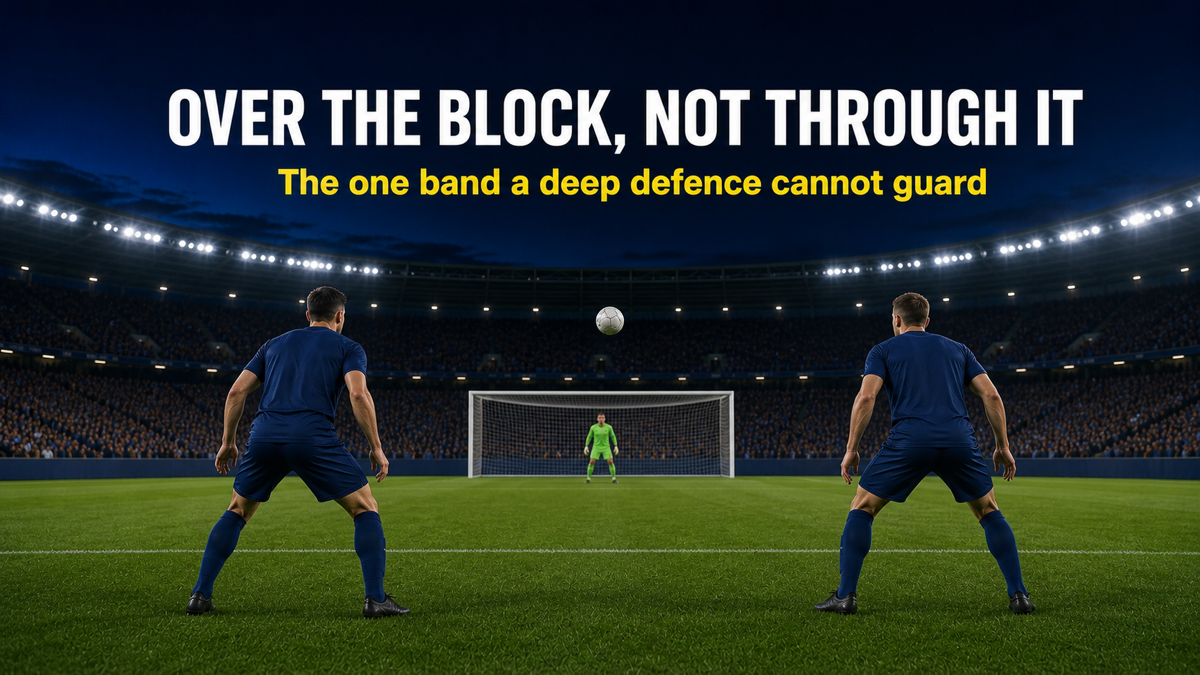
Atlético Madrid under Diego Simeone built a decade of silverware on exactly this compression, a structure Coaches’ Voice details in its study of the modern low block. A clipped pass changes the plane of the attack, lifting the ball over the front of the block and dropping it into a pocket the defenders have their backs to. Arriving from above with backspin, it sits up to be struck rather than running safely through to the keeper.
The low block is built to step, screen, and intercept along the ground. None of those actions reach a ball travelling two yards over their heads.
Why Breaking a Low Block Starts in the Air
Breaking a low block starts in the air because the ground is the one dimension a deep defence has already solved. When a compact defensive block sits deep, the distance between the attacking midfield and the goal is tiny, so every forward ball is contested within a second of being played. Opta’s pressure tracking shows possession-dominant sides completing huge pass volumes against deep blocks while creating little, a gap visible across a season of Premier League possession data.
The problem is not the passing. It is that the block has pre-solved the floor, screening the lanes into the striker’s feet and the pockets either side of him exactly as a well-drilled low block defence is designed to.
Consider the typical pattern. A side enjoys seventy per cent possession, racks up six hundred passes, and still manufactures one clear chance, because the ball never changes plane. The moment every entry arrives along the floor, the low block always knows where to look.
The One Space a Deep Block Cannot Compress
The one space a low block cannot compress is the vertical pocket between the last defender and the goalkeeper, and the chipped through ball is the only delivery that reliably lands there. A back four can squeeze sideways until there is no width and step up until there is no depth, but it cannot stand on top of its own goalkeeper. That leaves a shallow band, often only six to ten yards deep, behind the defenders and ahead of the keeper.
The table below shows how the type of delivery changes the outcome against a set deep block. The figures are illustrative benchmark averages drawn from public tracking samples, not a single match.
| Entry Type | Completion Rate vs Low Block | Big Chances per 100 Entries | Tactical Implication |
|---|---|---|---|
| Ground pass into feet | Very high (~90%) | Low (~2) | Completed in front of the block, rarely progresses |
| Driven through ball | Low (~45%) | Medium (~6) | Often cut out by a stepping defender |
| Chipped through ball | Moderate (~60%) | High (~11) | Clears the line, drops in the keeper-defender pocket |
| Lofted diagonal pass | Moderate (~58%) | High (~10) | Accesses the channel behind a dragged-out fullback |
Data reflects illustrative average metrics across public tracking samples of deep-block defending. Individual team and season variance applies.
The pattern holds across datasets. Once the plane of the entry rises, the low block that looked impenetrable along the floor stops mattering.
The Lofted Diagonal Behind the Fullback
The lofted diagonal pass behind the fullback turns a low block’s own compactness into the space that beats it. When a deep defence narrows to protect the centre, it surrenders the channel outside the fullback, and a clipped pass over the top into that channel arrives before anyone can recover. The fullback is the single most exploited defender against deep blocks, because pulling him narrow opens the run behind him.
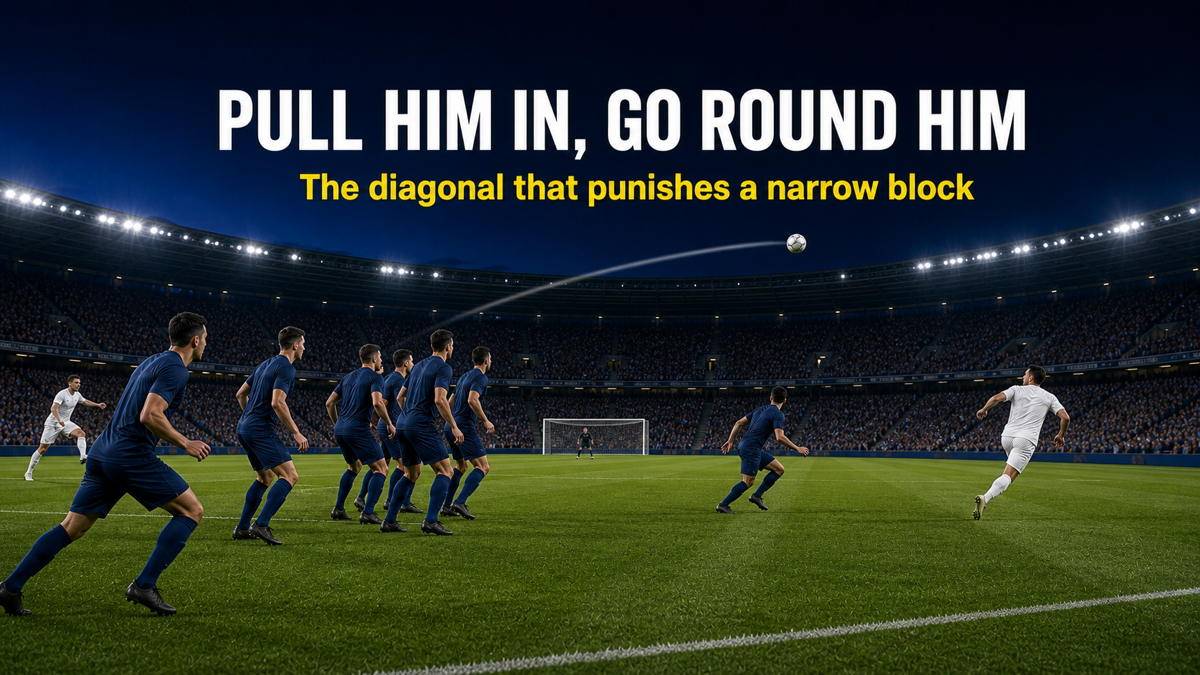
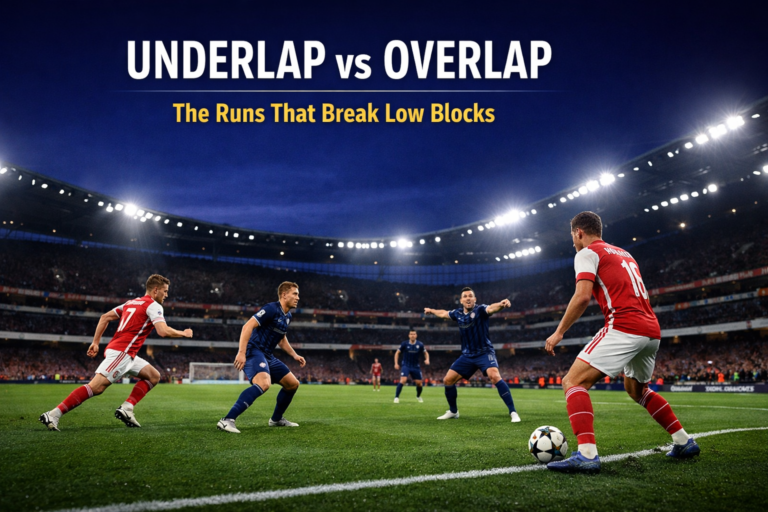
This is where the aerial solution meets the wide game. The ground rotations that prise these channels open, the overlaps and underlaps that drag a fullback out of position, are covered in our breakdown of how elite teams break low blocks from wide. The chip is the finish to that setup.
Bend the block with an overload, wait for the fullback to step, and float the diagonal into the vacated channel before the cover shifts across. The delivery does the work the dribble used to.
Disguise: Why Weight Beats Power
Disguise is what makes a chipped pass so dangerous, because a low block defends what it can read, and a floated ball hides its destination until reacting is already too late. A driven pass announces itself: the defender sees the backlift, reads the lane, and steps to intercept. A clipped pass disguises both the moment and the weight, so the same body shape that looks like a square pass releases a ball over the top instead.
Kevin De Bruyne is the archetype because his deliveries are floated and weighted, not blasted. The skill is not power. It is the scan before the pass, the read of the keeper’s position, and the touch that drops the ball into a one-yard window.
Elite passers gather that information early, which is why pre-pass scanning separates the players who unlock deep blocks from those who recycle in front of them. Too firm and the ball runs to the keeper, too soft and the defender recovers, so the entire solution lives in the calibration of a single touch.
The Weakness: When the Chip Becomes a Gift to the Keeper
The chip pass fails the moment it is played too deep, because a low block’s safety net is a sweeper-keeper who claims anything that hangs. A clipped pass that clears the defence by too much stops being a chance and becomes a comfortable catch. The whole solution depends on a window perhaps a yard deep, and missing it long hands possession to the goalkeeper in the one area where a turnover costs least.
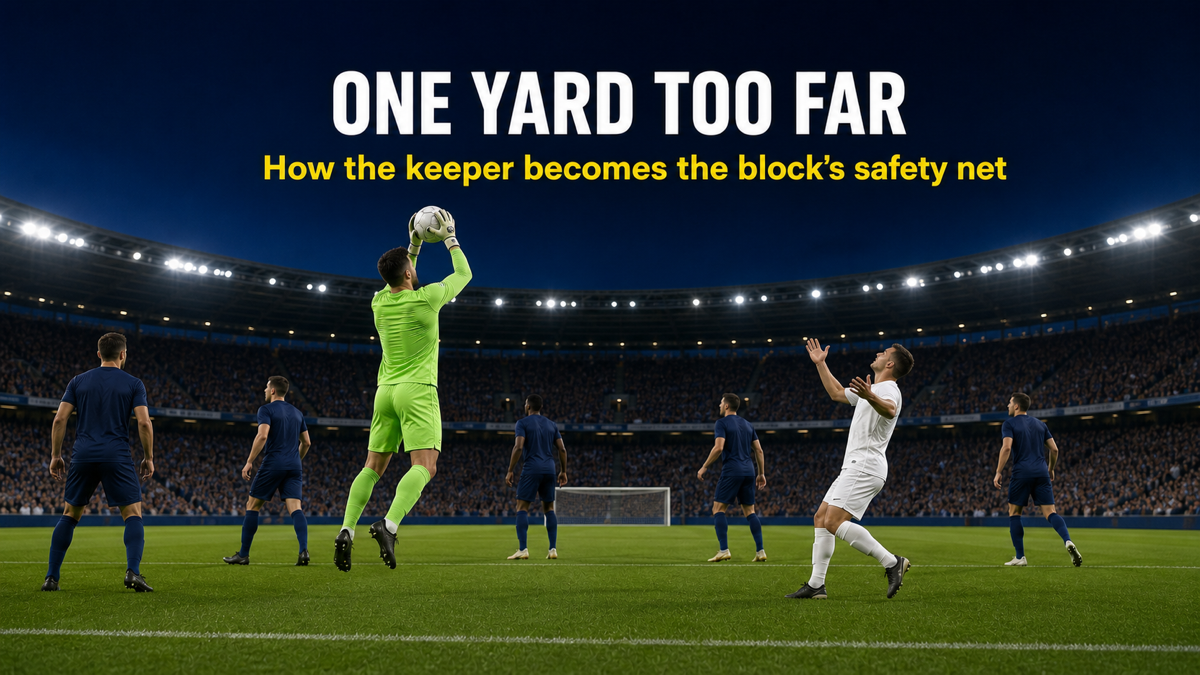
Modern deep blocks defend this space deliberately. A high-claiming goalkeeper, the sweeper-keeper role that sides from Manchester City to Brighton have made standard, shrinks the pocket by stepping off his line to attack floated balls early. Diego Simeone’s Atlético Madrid counter it differently, holding a disciplined last line that refuses to drop and squeezing the vertical pocket until there is no safe place to land the ball.
The chip also demands elite execution under fatigue. A driven pass forgives a heavy touch, but a floated ball into a one-yard window does not, and the success rate falls sharply against a block that stays compact for ninety minutes. That is why the clipped pass is a scalpel rather than a hammer, rewarding the rare passer who can repeat the weight and punishing everyone else by gifting the goalkeeper an uncontested restart.
The Bigger Picture
Breaking a low block is not a possession problem, and the teams that treat breaking a low block as one stay stuck passing in front of the low block forever. The data points the same way every season. Ground dominance against a deep defence produces volume, not goals, and the sides that actually score change the plane of the attack.
The chipped pass is the cleanest expression of that idea, a single delivery that ignores the structure the low block spent the whole match building. It will never be a high-volume tool, because it demands a passer who can find a one-yard window on command. The alternative is another patient circulation the block is built to survive.
That is not analysis. It is hope, and I would rather have the player who looks up and clips it over.
What Do You Think?
Kevin De Bruyne can drop a ball into a one-yard window at thirty-four, but how many other players in a given league actually can? Is the chipped pass a repeatable tactic worth coaching into a side, or a luxury that only works when you happen to own a generational passer? Drop your take below.
Want to read any match like this?
The framework behind these breakdowns, in one place. The four phases, a 15-minute method for diagnosing both teams before the drinks break, a printable match-watching worksheet, and 51 terms defined. 40 pages.
Get the pack$9, instant downloadRelated Tactical Breakdowns
(featured image not set on related article)
Emptying The Middle: Inside Nagelsmann’s Strategy For Pulling Defences Out Of Shape
Why it connects: Pulling a block out of shape is what manufactures the pocket the clipped pass needs, and Nagelsmann engineers exactly that vacancy.

Zone 14 in Football: What It Is, Why It Matters, and How Teams Exploit It
Why it connects: The clipped pass most often drops in or just behind Zone 14, the central pocket this piece maps in detail.

Football Overloads and Isolations Explained: How Elite Teams Manipulate Space
Why it connects: An overload bends the block sideways and opens the diagonal lane the lofted pass exploits on the far side.
Speak the language of the game
Get the free 47-term tactical glossary. Gegenpress, half-space, xT, low block, each defined in plain language and linked to a full breakdown. It is yours for an email.
Frequently Asked Questions
What is the best way of breaking a low block?
The best way of breaking a low block is to change the plane of the attack with a chipped or lofted ball. A compact deep defence seals the ground but cannot defend the air behind its line. Clipping the ball into the pocket in front of the goalkeeper beats the structure the whole block is built on.
Why does a low block stop over-the-top balls but not chipped passes?
A low block stops most over-the-top balls because the defenders sit so deep there is little space behind them to sprint into. A chipped pass is different. It is not a race behind a high line; it is a soft, backspun ball dropped into the shallow pocket between the last defender and the keeper, where pace barely matters.
How do you coach the clipped pass against deep defences?
Coaching the clipped pass starts with the scan, not the strike. Players must read the goalkeeper’s position and the depth of the last defender before the ball even arrives. Repetition then trains the weight, since the entire delivery succeeds or fails on dropping the ball into a window roughly a yard deep.
Which players are best at breaking down a low block with a pass?
Players like Kevin De Bruyne are best at unlocking a low block because their delivery is floated and disguised rather than driven. The skill rewards vision and a soft, repeatable touch over raw power. Creative midfielders who can clip a ball into a one-yard window open deep defences that high-volume passers only circulate in front of.