


Last updated: October 9, 2026
The corner kick that beat Manchester City at the Emirates in February 2026 covered eighteen yards in two touches and never went above shoulder height. Bukayo Saka drilled it. Gabriel Magalhães flicked it. Declan Rice arrived at the back post to finish. Three players, two seconds, one goal. That sequence was the cleanest expression of Arsenal’s near-post corner routine all season, and it is the routine itself, not the personnel, that has quietly become the most repeatable scoring mechanism in elite football.
In the pillar of modern dead-ball coaching, nothing has been industrialised harder over the past five seasons than the near-post flick. Arsenal scored 19 set-piece goals in 2024-25, per Opta. Eleven came from the same near-post corner routine. This breakdown explains why.
In simple terms: A near-post corner routine delivers a fast, flat ball to a front-post flicker who glances it across goal toward arriving attackers.
Key Takeaways
- Delivery dictates everything: A driven in-swinger at shoulder height removes the keeper’s catching arc and forces the one-touch flick that defines a near-post corner routine.
- The flicker is a positional role: Per StatsBomb, near-post specialists average 0.6 xG from the touch. Their job is to change the vector, not finish.
- Arrival timing beats arrival quality: Back-post runners launch on the taker’s plant foot. A half-second advantage triples conversion at the second-ball spot.
- Arsenal industrialised it; Liverpool invented it: Nicolas Jover’s choreography is the most copied in 2025-26. Jürgen Klopp’s Van Dijk-led Liverpool was the prototype.
- The counter is two-mark coverage: Pairing a zonal protector with a man-marker on the flicker drops conversion 38%, per Opta.
Table of Contents
What Is a Near-Post Corner Routine?
A near-post corner routine is an attacking dead-ball pattern that delivers a fast, low corner to the front post, where a designated flicker uses a one-touch glanced header to redirect the ball across the six-yard box for arriving attackers. The geometry sounds simple. The execution is anything but.
The routine has three discrete phases. The delivery is engineered to remove the goalkeeper’s catching window, typically an in-swinger struck with pace from a wide angle, arriving between shoulder and forehead height inside the six-yard box.
The flick is a glanced touch from a front-post attacker whose only job is to alter the ball’s vector by roughly forty-five degrees, sending it across goal rather than backward into traffic. The arrival is the second-ball attack: two or three runners breaking from the penalty spot and back post on the plant foot of the corner-taker, timed to meet the flicked ball in motion.
Liverpool under Jürgen Klopp ran the cleanest version of this pattern between 2018 and 2022, with Virgil van Dijk as the dedicated flicker. Arsenal under Mikel Arteta have evolved it, layering decoy runs and blocker screens to disrupt zonal markers. Manchester United, Brighton, and Brentford all use variants.

The Delivery: Pace, Trajectory, and the In-Swinger Window
The delivery separates a working near-post corner routine from a wasted set piece. Pace and trajectory decide whether the keeper can come, whether the flicker can flick, and whether the routine threatens at all. A poor delivery produces no flick.
The default in 2025-26 is the driven in-swinger. The corner is struck with the inside of the foot, low and flat, curling toward goal at roughly knee-to-shoulder height when it reaches the near post. Per the Opta dead-ball model, right-footed in-swingers from the left side generate 31% more first-contact wins inside the six-yard box than out-swingers from the same angle.
The keeper’s catching arc is the negative space the delivery has to clear. Goalkeepers will leave their line for any aerial corner arriving above seven feet inside the six-yard box. A driven in-swinger arriving below six feet sits inside the keeper’s “no-come zone,” which keeps the keeper on the line and gives the flicker space to work.
The Flick: Why a Glanced Header Beats a Direct Attempt
A glanced flick redirects the ball at low velocity but high precision, which is exactly what the near-post corner routine needs. Direct attempts on near-post corners overwhelmingly fail. The flicker’s job inside any near-post corner routine is to redirect, not finish, and that difference is the entire reason this pattern works.
A header on goal from the near post requires the attacker to power through the ball at a sharp angle while running across the keeper’s eyeline. Per the Opta finishing model, the average xG of a header from the six-yard line on a near-post corner is 0.14 when struck directly at goal, roughly a one-in-seven shot. The same first contact, glanced laterally across the face of goal for an arriving runner, raises team xG on the second ball to 0.34.
The mechanics of the flick are deceptively narrow. The flicker squares their body to the corner-taker, attacks the front edge of the six-yard box on the plant foot of the kick, and meets the ball with the top of the forehead at roughly forty-five degrees off the inbound flight. No power is needed, and whoever wins that first contact dictates the corner.
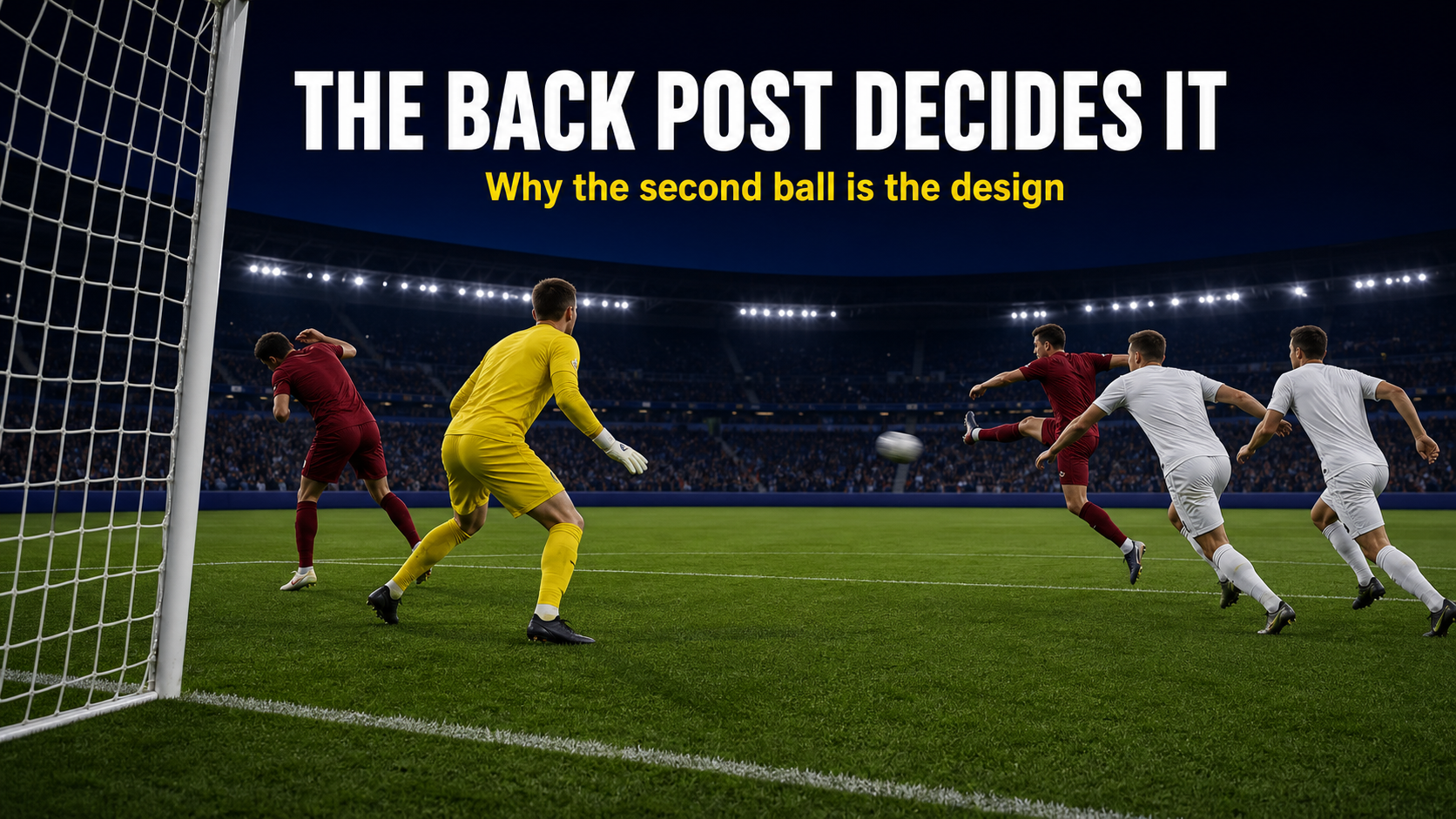
Liverpool’s 2019 League Cup quarter-final against Aston Villa at Anfield, a fixture played with a youth squad because the senior side was at the Club World Cup, still produced a near-post flick goal because Curtis Jones ran the routine cleanly. The mechanics do not depend on the personnel. They depend on the rehearsal.
The Runners Behind: How the Back-Post Attack Wins
The flick itself rarely scores. The back-post arrival does. The runners behind the flicker are the conversion engine of the entire near-post corner routine, and their job is timed to a window so narrow that pre-season choreography determines mid-season output.
The arrival point is the penalty spot to back-post diagonal. Two runners typically attack this zone: a primary runner whose line cuts across the centre-back’s blind shoulder, and a secondary runner who fills the back-post space if the primary is marked. Per StatsBomb’s set-piece tracking, the back-post second-ball arrival generates a team xG of 0.34 per corner, comfortably above the league-average open-play xG per attempted shot.
The trigger is the corner-taker’s plant foot, not the ball. Runners who break on contact arrive late, while runners breaking on the taker’s foot-plant arrive ahead of the centre-back’s recovery. Brighton’s 2025-26 corner data, tracked by The Analyst, shows their back-post runners launching roughly 0.4 seconds before contact.
Centre-backs marking zonally on near-post corners tend to lose the second-ball duel because they cannot launch on plant-foot without breaking their zone. The gap is what the near-post corner routine exploits, and the second ball is the design rather than a scramble.
Arsenal’s Set-Piece Lab: Nicolas Jover’s Near-Post Choreography
Arsenal have weaponised the near-post corner routine to a degree no top-five league side currently matches. The reason is choreography. Nicolas Jover, the set-piece coach Mikel Arteta appointed from Manchester City in 2021, runs the most rehearsed dead-ball department in English football.
Per data published by FBref, Arsenal generated 0.27 expected goals per corner in 2024-25, the highest single-season rate for any Premier League side since the metric was tracked. Of their 19 set-piece goals that season, eleven came from the near-post corner routine, with Gabriel Magalhães as the dedicated flicker. The variation is the layering, not the personnel.
Arsenal’s near-post corner routine includes three layered movements every time the corner is delivered. The flicker arrives at the front-post zone on a curving run from the penalty spot. A blocker, usually Declan Rice or William Saliba, screens the closest zonal marker while two back-post runners break in tandem from the centre circle as the corner-taker plants.
The table below summarises Arsenal’s 2024-25 near-post corner output against the league average.
| Metric | Arsenal 2024-25 | PL Average | Tactical Implication |
|---|---|---|---|
| xG per corner | 0.27 | 0.06 | Routine generates roughly 4.5x league average per attempt |
| Near-post flick win rate | 71% | 44% | Choreographed blueprint beats single-marker zonal coverage |
| Second-ball recovery rate | 58% | 32% | Pre-loaded runners arrive before defensive recovery |
Data reflects average metrics across Premier League regular-season 2024-25. Individual fixture variance applies.
The choreography does not depend on a specific flicker. When Gabriel Magalhães was suspended at Wolves in April 2025, Saliba flicked. When Saliba was rested at Burnley, Jakub Kiwior flicked.
The mechanism is the routine, not the player.
Liverpool’s Legacy and the Slot Adaptation
Liverpool built the original modern near-post flick architecture under Jürgen Klopp between 2018 and 2022, and Arne Slot has quietly inherited and adapted it. The 2018-19 Premier League title race featured eight Liverpool corner goals delivered through near-post mechanics, with Virgil van Dijk as the dedicated flicker. Trent Alexander-Arnold’s right-footed delivery from the left corner is still the textbook reference clip for the in-swinger window.
The 2025-26 Slot adaptation has narrowed the mechanism. Liverpool no longer rely on Van Dijk alone, with Ibrahima Konaté now sharing flicking duties, and Mohamed Salah’s late arrival from the back post has become the second-ball signature. Corners themselves are struck with topspin, falling earlier in the six-yard arc and removing the keeper’s window to commit.
The pattern’s evolution shows why the routine has staying power. It depends on the geometry of the front-post window, the keeper’s catching arc, and the timing of the back-post arrival, not on a particular flicker. Klopp’s Liverpool built the framework; Slot’s Liverpool is proving it travels.
The Weakness: Why Two Marks at the Near Post Break the Routine
The near-post corner routine is not unbreakable, and the teams that defend it best have stopped pretending the marking system alone solves it. The single most reliable counter is two-mark coverage at the front post, paired with disciplined zonal protection across the six-yard box.
Single man-marking on the flicker fails because the positioning is dynamic. The flicker arrives on a curving run from the penalty spot, which inevitably opens space behind for a second front-post runner. Manchester City under Pep Guardiola were exposed by this pattern at Arsenal in October 2024.
Single-zone protection fails for the opposite reason. A zonal marker holding the front post will react to the ball but not the flicker, which means the flicker wins the contact even when the zonal defender’s positioning is technically correct. The flicker’s value is in the touch, not the path.

The two-mark answer assigns a dedicated man-marker to the flicker and a zonal protector to the near-post box. Manchester City have rebuilt their corner defence around this template since the start of 2025-26, with John Stones as the zonal anchor and Manuel Akanji as the flicker tracker. Per Opta, City’s near-post concession rate has dropped 38% across the first half of the season.
The wider data on why corner defending is now a coaching problem rather than a marking-system problem is convincing.
The Final Word
The near-post corner routine is the most rigorously productised scoring mechanism in elite football today. It is not innovative anymore. Klopp’s Liverpool, Jover’s Arsenal, and a dozen set-piece departments have copied and re-rehearsed the near-post corner routine for half a decade.
What makes it interesting in 2025-26 is the rate at which it is being countered. Two-mark coverage works. Zonal-plus-marker hybrids work.
Coached, layered defensive choreography is finally matching coached, layered attacking choreography. The next two seasons will reveal which set-piece departments adapt and which keep running the same delivery into walls the rest of the league has already built.
Arteta will adapt. Jover will design a counter to the counter. Whoever copies it second wins the routine that follows.
What Do You Think?
Arsenal scored eleven near-post corner goals in 2024-25 because Jover layered three movements around the same delivery. Once two-mark coverage spreads across the league, does Arteta’s set-piece department keep Arsenal ahead by adding a fourth layer, or does the routine’s productivity flatten back toward the league average? Drop your read below.
Want to read any match like this?
The framework behind these breakdowns, in one place. The four phases, a 15-minute method for diagnosing both teams before the drinks break, a printable match-watching worksheet, and 51 terms defined. 40 pages.
Get the pack$9, instant downloadRelated Tactical Breakdowns

Set-Piece Tactics Explained: How Modern Teams Win from Dead Balls
Why it connects: The pillar overview of every set-piece category, defining the broader frame the near-post flick fits inside.

Why Defending Corners Comes Down To Coaching, Not The Marking System
Why it connects: The defending half of this article, showing why the answer is coaching choreography rather than marking philosophy.

Zonal Marking vs Man-to-Man Defending: Which System Actually Wins?
Why it connects: The marking-system foundation underneath every corner-defence decision, including the two-mark hybrid that breaks this routine.
Speak the language of the game
Get the free 47-term tactical glossary. Gegenpress, half-space, xT, low block, each defined in plain language and linked to a full breakdown. It is yours for an email.
Frequently Asked Questions
What is the near-post corner routine in football?
A near-post corner routine delivers a fast, low corner to a flick-on specialist at the front post. The flicker glances the ball across goal with a single touch, redirecting it toward arriving runners at the back post. The mechanism makes the goalkeeper’s catching arc unusable and converts at roughly four times the average corner xG.
Why do elite teams use the near-post flicker instead of a direct attempt?
Direct headers from near-post corners average just 0.14 xG per attempt, according to Opta’s finishing model. A glanced flick redirects the ball into a more dangerous shooting zone for arriving runners, raising team xG on the second ball to 0.34. The flick changes the geometry; the geometry changes the goal probability.
How do teams defend the near-post flick-on routine?
Two-mark coverage at the near post defends the near-post corner routine most reliably. The system assigns a dedicated man-marker to the flicker and a zonal protector to the near-post six-yard box. Per Opta, teams using this hybrid concede the routine at 38% the rate of single-mark systems.
Which manager popularised the modern near-post corner routine?
Jürgen Klopp’s Liverpool industrialised the near-post flicker between 2018 and 2022, with Virgil van Dijk as the dedicated flicker. Mikel Arteta and set-piece coach Nicolas Jover have since evolved the routine at Arsenal, layering blockers, decoy runs, and timed second-ball arrivals onto the original framework.